A sale and purchase agreement (SPA) in Dubai is the contract between you and the developer for an off-plan home. It sets the unit, the price, the payment plan, the expected completion date and what happens if either side does not perform. It only takes legal effect for the sale once it is registered on the Dubai Land Department's interim register, Oqood, and several of its clauses are overridden by Dubai law: the default and termination procedure in Law No. 13 of 2008 as amended in 2020, the area rule in Article 12 of that law, the escrow rules in Law No. 8 of 2007 and the service charge and defects rules in Law No. 6 of 2019.
Key takeaways
- The SPA is drafted by the developer, but a developer must file a standard sale contract with the Dubai Land Department before it may sell off-plan. Ask for the full SPA and its schedules before you pay anything beyond a booking amount.
- An off-plan sale is void unless it is entered on the interim register (Oqood) under Article 3 of Law No. 13 of 2008. Check that your registration shows the same unit, area and price as the SPA.
- Your payments go to the project's escrow account, held in the project's name. Check that the account in the SPA matches the one shown for the project in the Dubai REST app.
- If a buyer stops paying, the developer must follow Article 11 as amended by Law No. 19 of 2020: a DLD notice of 30 days, then a cap on what it may keep of 40% or 25% depending on how complete the project is. A clause that goes further is void.
- If the finished unit is larger, the developer may not charge more unless the contract expressly says so. If it is smaller by more than 5% of the net area, the Dubai Land Department says the buyer must be compensated.
- Read the completion date and the grace period together, and read what the contract allows the developer to change in the specification and plans.
- Resale before handover needs the developer's no objection certificate, and a developer may charge only administrative costs approved by the Dubai Land Department.
01What is a sale and purchase agreement in Dubai?
A sale and purchase agreement, or SPA, is the contract between you and the developer when you buy an off-plan home in Dubai. It records what you are buying, what you will pay and when, and what each side may do if the other does not keep its side of the bargain.
The SPA is the most important document in an off-plan purchase. Everything else, from the Oqood certificate to the handover notice, is measured against it. This guide walks through the clauses that matter and sets out what Dubai law says about each one. It explains the rules; it is not legal advice on your own contract.
If you are new to off-plan buying, start with what off-plan property is and the step-by-step buying guide. For the wider safety net around your money, read our guide to off-plan buyer protection in Dubai.
02Who writes the SPA, and is there a standard form?
The developer writes the SPA. There is no single form that every developer must use, but each developer must file a standard sale contract with the Dubai Land Department (DLD) before it can sell off-plan.
That requirement sits in Article 6 of Law No. 8 of 2007, the escrow law. To open the escrow account it needs before selling, a developer files a bundle that includes its trade licence, the title deed for the land, approved designs, a certified cost and revenue statement and "a standard sale contract between the developer and the purchaser".
In practice, SPAs from different developers share a common structure but differ in the detail. That is why reading the clauses below matters more than the headline price.
The documents that come with it. An SPA normally attaches schedules: the unit's floor plan, a specification of finishes, the payment plan and, for a building in a master community, references to the community rules. Under Article 6 of Law No. 6 of 2019, the plans, the master community declaration and the building management regulation later form part of the title deed itself, so ask to see them early.
03When do you sign it, and when does it become binding?
You normally sign the SPA a few weeks after paying a booking amount and signing a reservation form. It becomes effective as a sale when the developer registers it on Oqood, the Dubai Land Department's interim register.
The reservation stage. A reservation or expression of interest form holds a unit while the SPA is prepared. Read its refund terms, because they apply until the SPA is signed. Law No. 6 of 2019 itself refers to a "sale contract or reservation agreement", so these early documents are treated as part of the deal.
Registration on Oqood. Article 3 of Law No. 13 of 2008 says any sale of an off-plan unit is void unless it is entered on the Interim Real Property Register. The DLD fee of 4% is paid at this point. Our Oqood guide explains the certificate and what to check on it.
Approvals first. Article 4 of the same law bars a developer from selling off-plan before it has taken possession of the land and obtained the approvals of the competent authorities. Under Article 10, a private sale contract for a project that is not approved is null and void. You can check a project's registration yourself; our guide to checking an off-plan project and developer shows how.
04Which clauses matter most?
Eight clauses decide most of the risk in an off-plan SPA. They are the payment schedule, the completion date and grace period, area variance, specification changes, default and termination, assignment and resale, service charges, and governing law and disputes.
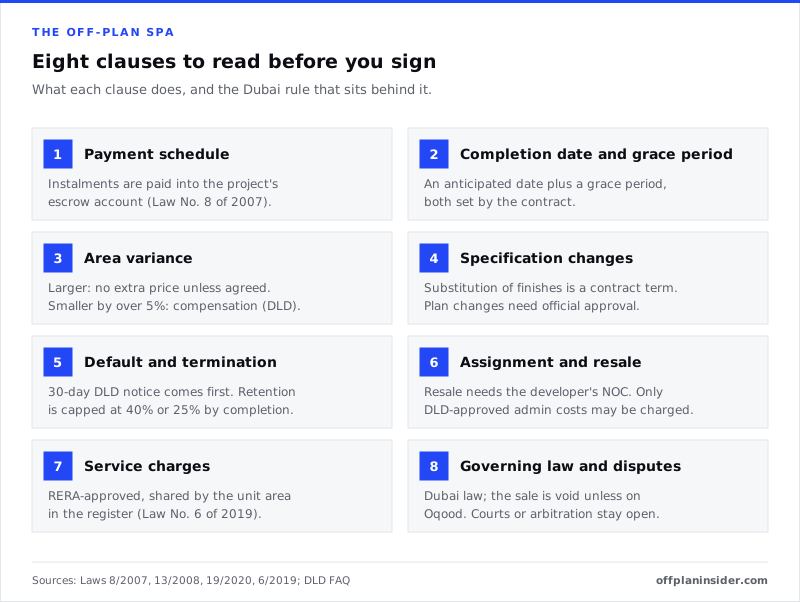
The sections below take each one in turn. For each clause we set out what the contract usually does, what the law says, and what to check.
05How does the payment schedule clause work?
The payment schedule sets how much you pay and when: a deposit, instalments during construction, a handover payment and, on some plans, instalments after handover. Every payment made before completion goes to the project's escrow account.
Two kinds of trigger. Instalments are tied either to dates ("every three months") or to construction milestones ("on completion of 50%"). Date-linked instalments are due even if the build slows. Milestone-linked instalments move with the build, and progress is certified by the project's consultant.
Where the money goes. Article 7 of Law No. 8 of 2007 says buyers' payments are deposited into an account opened in the name of the project. Article 9 dedicates that account to building the project and protects it from the developer's creditors. Under Article 12, you may see your own records in the account and ask for copies.
Check the account. The SPA names the escrow bank. Before every transfer, check that it matches the account shown for the project in the Dubai REST app, and pay only into that account. The full mechanics are in our guide to Dubai's escrow law.
Late payment. Most SPAs charge interest or a penalty on late instalments. That is a contract term, so read the rate and when it starts. Persistent non-payment is dealt with under the termination procedure below, not by a private notice from the developer.
What to check:
- Every instalment, its amount and its trigger, adding up to the full price.
- Whether the 4% DLD fee and any administration fee are payable on top, and when.
- The handover payment and any post-handover instalments. Our guide to off-plan payment plans compares the common structures, and the payment plan calculator shows a plan in money terms.
- What the contract says about payments by a third party, such as a bank or a family member.
06What do the completion date and grace period clauses say?
The SPA gives an anticipated completion date and a grace period after it. Handover within the combined period is not a breach, so the real latest date is the completion date plus the grace period.
The anticipated date. This is the date the developer expects the building to be finished. Read whether it is a fixed date or a quarter, and whether it refers to completion of the building or handover of your unit. Those can be months apart.
The grace period. Grace periods are set by the contract, not by law. Some SPAs also allow extensions for listed events, such as force majeure or changes required by the authorities. Read that list carefully, because each item can push the latest date back.
What the law adds. Dubai's off-plan laws focus on what happens when a buyer defaults. For delay by the developer, the remedy is in the contract and in the general civil law: the buyer may ask a court or arbitrator to enforce the contract or to end it, with compensation where it is due. Article 11(g) of Law No. 13 of 2008, as amended, confirms that a buyer's right to go to court or arbitration is not affected by the default procedure.
A safeguard against projects that never start. Under Article 17 of Law No. 8 of 2007, a developer that fails without acceptable reason to start construction within six months of receiving permission to sell off-plan is struck off the developer register. If a project is cancelled by RERA, buyers are refunded in full under Article 11(b).
What to check:
- The anticipated completion date, and whether it is for the building or your unit.
- The length of the grace period and every event that can extend it.
- Whether the SPA sets compensation for delay beyond the grace period, how much and from when.
- How you will be notified of a new date, and to which address.
The steps at the end of construction are in our handover guide. You can follow projects close to completion on the near-handover page.
07What does the area variance clause mean?
It deals with the difference between the area in your SPA and the area of the finished unit. Dubai law sets the rule, and it is not symmetrical: a larger unit cannot cost you more, unless the contract expressly says so, but a smaller one can mean compensation.
Article 12 of Law No. 13 of 2008 says the area of a sold unit is deemed to be correct. If the area increases after delivery, the developer may not claim any increase in price. If it decreases, the developer must compensate the buyer unless the decrease is inconsequential.
The Dubai Land Department's published answers fill in the detail. Where the finished unit is larger than in the sale contract, the increase is not counted and the developer may not claim its value, "unless otherwise expressly agreed in the sale contract". Where it is smaller, the developer must compensate the buyer for a decrease that exceeds 5% of the net area of the unit.
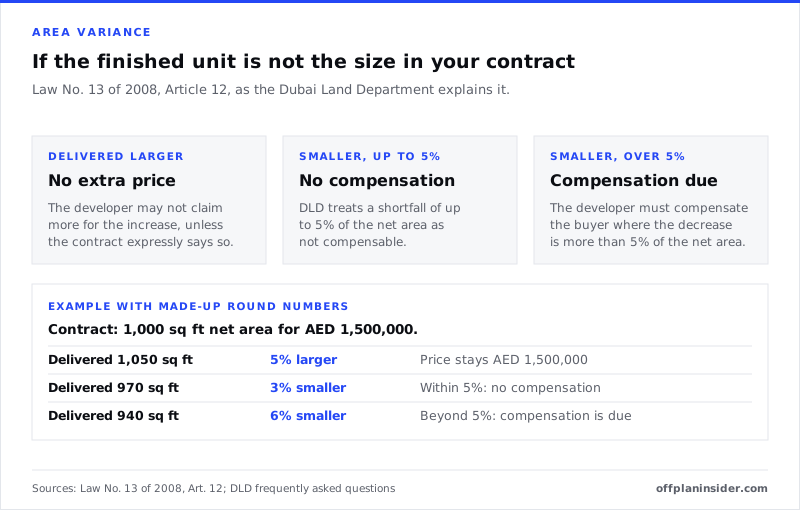
A worked example. Say, purely as an illustration, your SPA is for a unit with a net area of 1,000 sq ft at AED 1,500,000. If it is delivered at 1,050 sq ft, 5% larger, the price stays at AED 1,500,000 unless the SPA expressly allows a charge. At 970 sq ft, 3% smaller, the shortfall is within 5%. At 940 sq ft, 6% smaller, compensation is due.
Read the measuring rule. The clause only makes sense once you know which area the SPA uses: the suite area, the total area including the balcony, or another measure. Our guide to BUA, GFA and plot area explains the terms. Also read how the SPA calculates compensation, since the law does not give a formula.
Parking is part of the unit. Under Article 10 of Law No. 6 of 2019, car parks designated to a unit are an integral part of it and may not be sold separately. Check that the SPA lists your bays.
08Can the developer change the specification or the plans?
Within limits. Most SPAs let the developer substitute finishes, fittings and appliances with ones of similar quality, and make design changes required by the authorities. Changes to approved plans and community rules need official approval.
Finishes and fittings. A substitution clause is a contract term. Read whether it requires materials of "equal or better" quality, whether you must be told, and whether any change in price is passed on. Keep the specification schedule from the SPA, because at handover you inspect against it. Our snagging guide shows how.
Plans and shared areas. Article 17 of Law No. 6 of 2019 bars converting, subdividing or disposing of common parts without the approval of the DLD and the competent authority, even while the building is under construction. Article 21 says any amendment to a master community declaration that affects buyers' rights needs RERA's approval first.
What to check:
- How much freedom the substitution clause gives, and in what words.
- Whether changes to the unit's layout or area require your consent.
- Which amenities the SPA promises, and whether the brochure is excluded from the contract. Many SPAs say marketing material does not form part of the agreement.
09What happens if the buyer stops paying?
The developer cannot simply cancel. Article 11 of Law No. 13 of 2008, as replaced by Law No. 19 of 2020, sets a fixed procedure and a cap on what the developer may keep, based on how complete the project is.
The procedure runs in four steps. The developer notifies the DLD on its form, listing the obligations not met. The DLD serves a dated 30-day written notice on the buyer, and where possible mediates a settlement, which is then signed as an addendum to the agreement. If the notice expires without payment or settlement, the DLD issues an official document confirming that the procedure was followed and stating the project's completion percentage, calculated under RERA's standards.
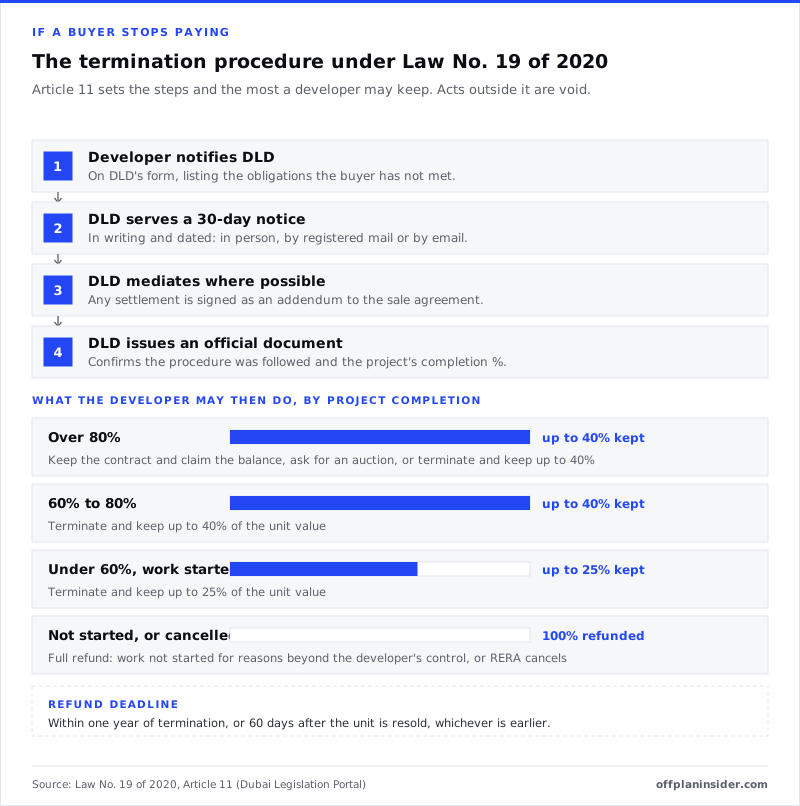
What the developer may then do. With the official document in hand, and without going to court, the developer may act according to the project's completion:
| Project completion | What the developer may do |
|---|---|
| Over 80% | Keep the contract, retain everything paid and claim the balance; or ask the DLD to sell the unit at public auction, with the buyer liable for the costs; or terminate and keep up to 40% of the unit value in the contract |
| 60% to 80% | Terminate and keep up to 40% of the unit value, refunding the rest |
| Under 60%, work started | Terminate and keep up to 25% of the unit value, refunding the rest |
| Work not started, or project cancelled | Where work has not started for reasons beyond the developer's control and without its fault, or RERA cancels the project, all payments are refunded under the escrow law |
The refund deadline. Where the developer terminates and keeps a share, it must refund the rest within one year of termination or within 60 days of reselling the unit, whichever is earlier.
Why this matters for your SPA. Article 11(f) makes these rules part of public order, so a contract term or act that does not follow them is void. Article 11(d) applies them to agreements signed before and after the 2020 law. When you read the default clause in your SPA, compare it with the table above. A clause that allows a larger forfeiture, or termination without the DLD procedure, cannot be enforced as written.
The older rule is gone. Before 2020, Article 11 allowed a developer to keep up to 30% of payments after a 30-day notice. That text has been replaced, though it still appears in old summaries. Options before a default, such as a payment rescheduling or a resale, are in our guide to what to do if you cannot pay your instalments.
10Can you sell or assign your SPA before handover?
Usually, yes, with the developer's consent. Article 6 of Law No. 13 of 2008 allows a unit on the interim register to be sold, mortgaged or otherwise disposed of, and the DLD says resale is possible after obtaining a no objection certificate (NOC) from the developer.
What the SPA adds. Developers commonly set conditions before they issue a NOC, such as a minimum share of the price paid, or a period before resale is allowed. Those are contract terms, so read the assignment clause before you buy if an early exit is part of your plan.
What a developer may charge. Article 7 of Law No. 13 of 2008 says a developer may not charge any fees on a sale, resale or other disposition except administrative costs approved by the DLD. Ask for the NOC fee in writing.
How it is done. The new buyer and the seller sign the DLD's standard resale contract, Form F, and the registration moves from one Oqood record to another. Our guides to Form F and selling off-plan before handover cover the steps and costs.
11What does the SPA say about service charges?
It usually says when you start paying service charges and gives an estimate. The charges themselves are set under Law No. 6 of 2019, which requires RERA to approve them before anyone collects them.
Your share. Article 25 says each owner pays a share of the annual service charges based on the ratio of the unit's area to the total area of the jointly owned property, using the area recorded in the Real Property Register.
Who pays before handover. The developer pays the service charges on unsold units. Under the same article, it also pays them on sold units where it has agreed to in the sale contract or reservation agreement. Some SPAs include a period of developer-paid service charges, so check the wording and the dates.
No charge without approval. Article 27 says a management entity must not collect any amount from owners without RERA's approval, given only after an audit. The figure in the SPA is therefore an estimate until a budget is approved. Our guides to service charges and owners associations and committees explain how the budget is set.
Defects after handover. Article 40 of Law No. 6 of 2019 makes the developer liable for structural defects for ten years from the completion certificate, and for defective installations for one year from handover of the unit. Any agreement that contradicts it is void, so a shorter warranty in an SPA does not reduce those periods.
12Which law governs the SPA, and where do disputes go?
A Dubai off-plan SPA is governed by the laws of Dubai and the UAE. The Dubai real estate laws covered in this guide override any clause that conflicts with them, and the general civil law of contract fills the gaps.
The main laws. Law No. 8 of 2007 on escrow, Law No. 13 of 2008 on the interim register and default, as amended by Law No. 19 of 2020, and Law No. 6 of 2019 on jointly owned property. Registration of the completed unit follows Law No. 7 of 2006 on real property registration.
Disputes. The SPA names a forum: usually the Dubai courts, and sometimes arbitration. Article 11(g) preserves a buyer's right to go to court or arbitration even when the DLD default procedure applies. Disputes over service charges and the rights in Law No. 6 of 2019 go exclusively to the Rental Disputes Settlement Centre under Article 42 of that law; see our guide to the Rental Disputes Centre.
What the DLD does not decide. The department's published answers say its complaints service does not consider contractual disputes between a customer and a real estate company, such as refunds and compensation, or complaints about contracts concluded more than six months earlier. Those go to the forum in your SPA.
Language. Read which language version prevails if the English and Arabic texts differ, and ask for both if the SPA is bilingual. Dubai's official English translations of its laws carry a note that the Arabic text prevails in a conflict.
13SPA checklist before you sign
Go through this list with the SPA and its schedules in front of you.
- Parties and unit. Your name exactly as on your passport, the unit number, floor, type and parking bays.
- Area. The area figure, how it is measured, and whether the balcony is included.
- Price and fees. The price, the 4% DLD fee, and any administration fee, with when each is due.
- Payment plan. Each instalment, its trigger and amount, adding up to the full price.
- Escrow account. The bank named in the SPA matches the project in the Dubai REST app.
- Completion. The anticipated date, the grace period and every event that can extend it.
- Delay. Any compensation for late handover, and from when it runs.
- Specification. The schedule of finishes, the substitution clause and the floor plan.
- Default. The default clause is consistent with Article 11 as amended in 2020.
- Resale. The conditions for a NOC and the fee.
- Service charges. The estimate, when you start paying and any developer-paid period.
- Community documents. References to the master community declaration and the building management regulation.
- Law and disputes. The governing law, the forum and the prevailing language.
- Notices. The address and email to which the developer will send notices. Keep them up to date.
Once the SPA is signed, check the Oqood certificate against it, keep every receipt, and diarise the payment dates. Costs beyond the price are in our guide to the true cost of buying off-plan in Dubai.
14Key terms
- SPA. Sale and purchase agreement: the contract between the developer and the buyer of an off-plan unit.
- Oqood. The Dubai Land Department's Interim Real Property Register, and the system developers use to register off-plan sales on it.
- Escrow account. A bank account opened in the project's name, into which buyers' payments go under Law No. 8 of 2007.
- Grace period. Extra time after the anticipated completion date, set by the SPA, within which late handover is not a breach.
- Net area. The area of the unit as defined in the SPA, against which the DLD's 5% rule on decreases is measured.
- NOC. No objection certificate: the developer's consent to a resale or other transaction.
- Form F. The Dubai Land Department's standard sale contract between a seller and a buyer on a resale.
- Management entity. The developer or management company that runs the common parts after completion under Law No. 6 of 2019.
15Where to go next
If you are comparing projects before you get to an SPA, browse all off-plan projects in Dubai or the latest new launches. For the protection around your money, read off-plan buyer protection, the escrow law and Oqood. When an SPA is in front of you, ask the developer to answer anything unclear in writing before you sign.
FAQQuestions buyers ask.
What is a sale and purchase agreement in Dubai?
A sale and purchase agreement, or SPA, is the contract between a buyer and a developer for an off-plan home in Dubai. It sets the unit, its area, the price and payment plan, the anticipated completion date and grace period, the specification, what happens on default, and the rules on resale and service charges. The developer registers it on Oqood, the Dubai Land Department's interim register.
Does the SPA have to be registered with the Dubai Land Department?
Yes. Article 3 of Law No. 13 of 2008 says any sale of an off-plan unit is void unless it is entered on the Interim Real Property Register, known as Oqood. The developer registers it and you receive a registration certificate. Registration is when the 4% DLD fee is paid. Check the certificate against the SPA as soon as you receive it.
Can a developer cancel my SPA if I miss a payment?
Not on its own. Under Article 11 of Law No. 13 of 2008, as replaced by Law No. 19 of 2020, the developer must notify the Dubai Land Department, which gives you 30 days' written notice and tries to broker a settlement. Only after the department issues an official document confirming the procedure and the project's completion may the developer act, within the limits the law sets.
How much can a developer keep if an off-plan SPA is terminated?
It depends on how complete the project is. Above 60% completion the developer may terminate and keep up to 40% of the unit value in the contract. Below 60%, once work has started, it may keep up to 25%. Where work never started for reasons beyond its control, or RERA cancels the project, all payments are refunded. Above 80% it may instead keep the contract and claim the balance.
What happens if the finished unit is smaller than in the SPA?
Article 12 of Law No. 13 of 2008 says the developer must compensate the buyer for a decrease in area unless the decrease is inconsequential. The Dubai Land Department explains this as compensation where the decrease exceeds 5% of the net area. If the unit is larger, the developer may not charge more unless the contract expressly allows it.
What happens if the developer is late with handover?
Read the anticipated completion date and the grace period in your SPA together. Handover within both is not a breach. After that, the contract's own delay clause applies, and you keep the right to go to court or arbitration. Before acting, check the project's progress in the Dubai REST app and ask the developer for a revised date in writing.
Can I sell my off-plan unit before handover?
Usually, yes. Article 6 of Law No. 13 of 2008 allows an off-plan unit on the interim register to be sold or mortgaged, and the Dubai Land Department says resale needs a no objection certificate from the developer. The SPA sets the conditions, such as the share of the price paid first. Article 7 limits developer charges to administrative costs approved by the department.
What is the difference between an SPA and Form F?
The SPA is the contract between the developer and the first buyer of an off-plan unit. Form F, or Contract F, is the Dubai Land Department's standard contract between a seller and a buyer on a resale, often called the MOU. If you buy an off-plan unit from another buyer before handover, you sign Form F with them and take over the original SPA through an assignment.
Should I have a lawyer review my SPA?
It is your choice, and many buyers do, particularly for a high-value unit or an unfamiliar contract. This guide explains what the law says about common clauses but is not legal advice. A UAE-qualified lawyer can tell you how a specific clause in your SPA is likely to be read, and whether anything in it conflicts with Dubai law.
Sources & methodWhere these figures come from.
Sources
- Dubai Legislation Portal: Law No. (13) of 2008
- Dubai Legislation Portal: Law No. (19) of 2020 Amending Law No. (13) of 2008 Regulating the Interim Real Property Register in the Emirate of Dubai
- Dubai Legislation Portal: Law No. (8) of 2007
- Dubai Legislation Portal: Law No. (6) of 2019 Concerning Ownership of Jointly Owned Real Property in the Emirate of Dubai
- Dubai Land Department: Frequently asked questions
- Dubai Land Department: Request to register the initial sale
What we could not verify
- Dubai's off-plan laws do not appear to set a standard compensation for late handover; we found no official statement either way, so the text says delay compensation is whatever the SPA states or a court or arbitrator awards.
- The Dubai Land Department's 5% figure for area decreases comes from its published answers, while Article 12 of Law No. 13 of 2008 itself says 'inconsequential' without a number. Whether compensation then covers the whole shortfall or only the part beyond 5% is not stated; the text tells buyers to read their SPA.
- Grace periods, late-payment charges, specification substitution rights, resale thresholds, NOC fees and the period for which a developer pays service charges are set by each SPA, not by statute, and vary between developers. They are described as contract terms, not as rules.
7 Nov 2026 · Reviewed by OffPlan Insider Research. First published 7 Nov 2026.