
You can sell a Dubai off-plan property before handover by assigning your sale and purchase agreement to another buyer, but only once you have paid the developer's threshold, which is typically 30% to 40% of the price, and obtained a no objection certificate. The all-in transaction cost is roughly 7% to 11% of the sale price, which means you need about 8% to 11% capital appreciation simply to break even.
Key takeaways
- Selling before handover is an assignment: you transfer your contract, and the buyer inherits your payment plan and handover date.
- Most developers require 30% to 40% of the price paid before issuing a no objection certificate. Some require 50%, and some add a separate lock-in period.
- All-in exit costs run about 7% to 11% of sale price, so you need roughly 8% to 11% appreciation just to break even.
- Since DLD Circular 29/R/2025, sale proceeds can only be paid into a UAE account in the registered owner's name. A power of attorney holder can sign but cannot receive funds.
- JVC is the most liquid community in Dubai at over 1,500 transactions a month, but that same supply caps appreciation. Liquid is not the same as profitable.
- Establish the assignment threshold, lock-in and fees in writing before you buy. They are not negotiable afterwards.
01Yes, you can sell before handover. It is called an assignment
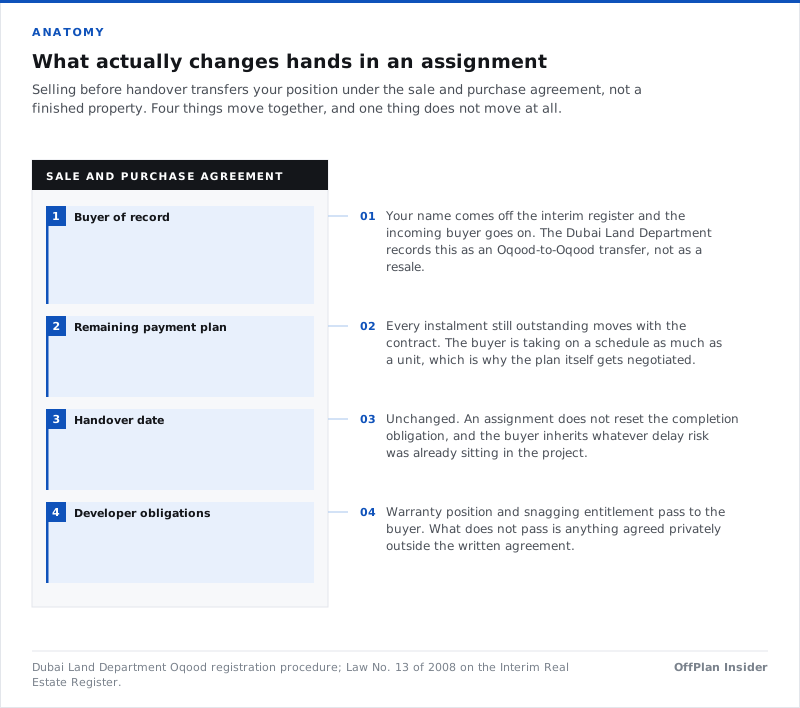
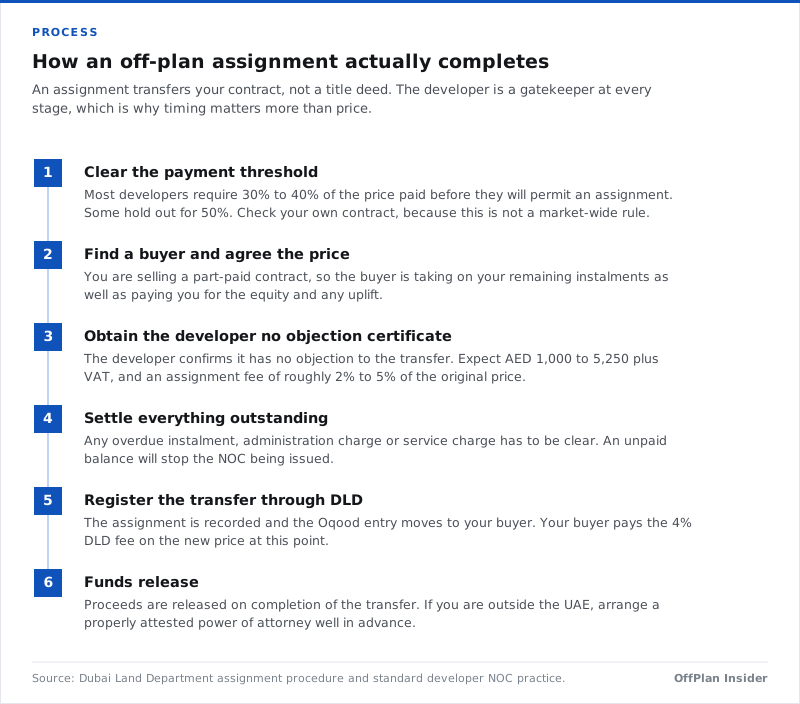
Selling an off-plan unit before it completes is not a resale in the ordinary sense, because there is nothing to hand over yet. What you are actually doing is assigning your position under the sale and purchase agreement to somebody else, who then inherits your payment plan and your handover date. The Dubai Land Department records it as an Oqood-to-Oqood transfer.
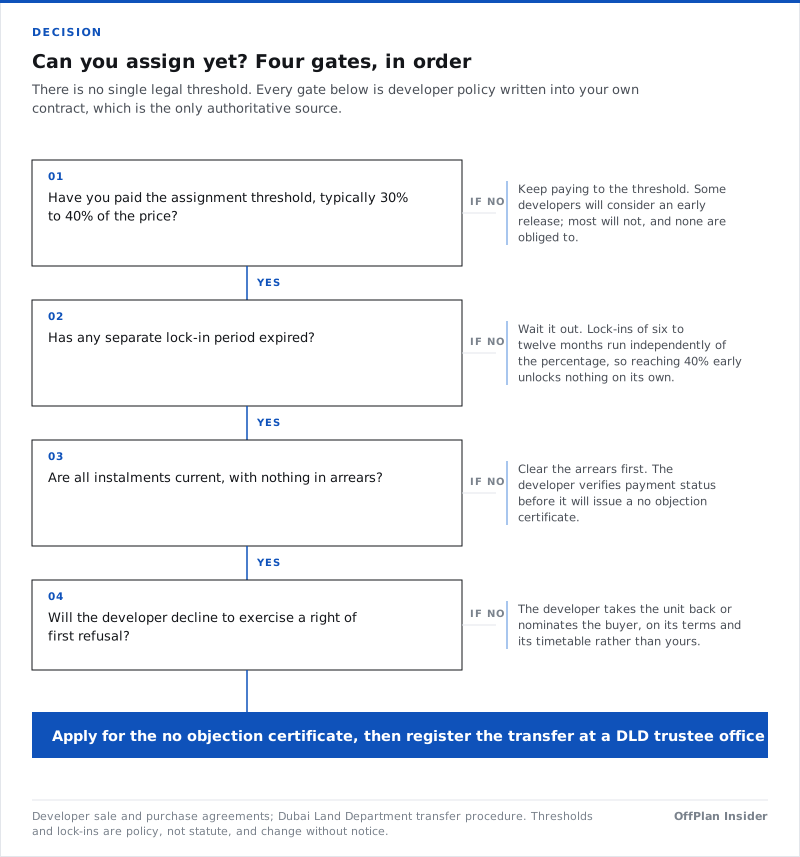
Three things have to be true before you can do it: you must have paid enough, the developer must issue a no objection certificate, and the transfer must be registered. Miss any one and the sale does not exist in law.
02The threshold: how much you must have paid
Most developers will not issue a no objection certificate until you have paid 30% to 40% of the purchase price. Some require 50%. Some add a lock-in period of six to twelve months that runs independently of the percentage, so hitting 40% early does not always unlock an exit.
There is no single legal threshold. It is developer policy, it varies by project, and it changes without notice. The only authoritative source is your own contract. If you are still at the buying stage, ask for the threshold, the fee and any lock-in in writing before you sign, because you will not be able to negotiate them later.
03The full cost of getting out
This is where the arithmetic turns uncomfortable, and it is the part most buyers discover only when they try to sell.
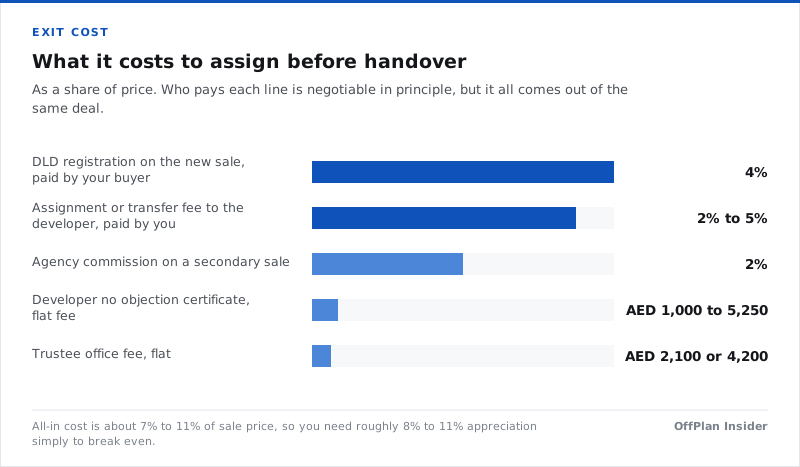
| Item | Typical range | Who pays |
|---|---|---|
| Developer no objection certificate | AED 1,000 to 5,250 plus VAT | Seller, usually |
| Assignment or transfer fee | about 2% to 5% of the original price | Seller, usually |
| DLD registration on the new sale | 4% of the new price | Buyer |
| Trustee office fee | AED 2,100 or 4,200 including VAT | Buyer, usually |
| Agency commission | 2% | Buyer, on a secondary sale |
| All-in transaction cost | about 7% to 11% of sale price | Split, but it comes out of the deal |
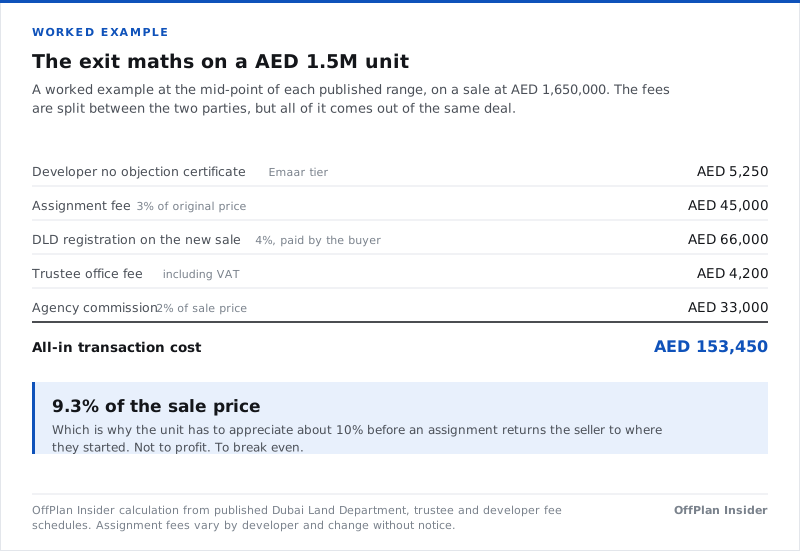
The consequence is a number worth writing down: you need roughly 8% to 11% capital appreciation just to break even on an assignment. Not to profit. To get back to where you started.
That is the honest test of whether an off-plan flip works. It is also why the trade got much harder in 2026: with the ValuStrat price index down about 10% between late February and June, a 2025-vintage buyer trying to exit was very likely underwater even where the developer's list price had held. Two caveats belong with that number. The fall dates from the regional escalation of 28 February 2026 rather than from oversupply, and on an annual basis the index was broadly flat, at 0.1% year-on-year growth in June.
04The step-by-step process
- Check your contract. Confirm the paid percentage threshold, any lock-in, the assignment fee and whether the developer holds a right of first refusal.
- Confirm you have hit the threshold. Request a statement of account from the developer showing exactly what has been paid against the price.
- Find a buyer and agree terms. On an assignment the buyer is taking on your remaining payment plan, so they are buying a schedule as much as a unit. Expect that to be negotiated.
- Apply for the no objection certificate. The developer verifies that payments are current, charges the NOC and assignment fees, and issues the e-NOC.
- Attend a DLD trustee office with both parties or their registered attorneys. The buyer pays the 4% DLD fee on the new price.
- DLD registers the Oqood transfer. The new buyer replaces you on the interim register and inherits the remaining instalments and the handover date.
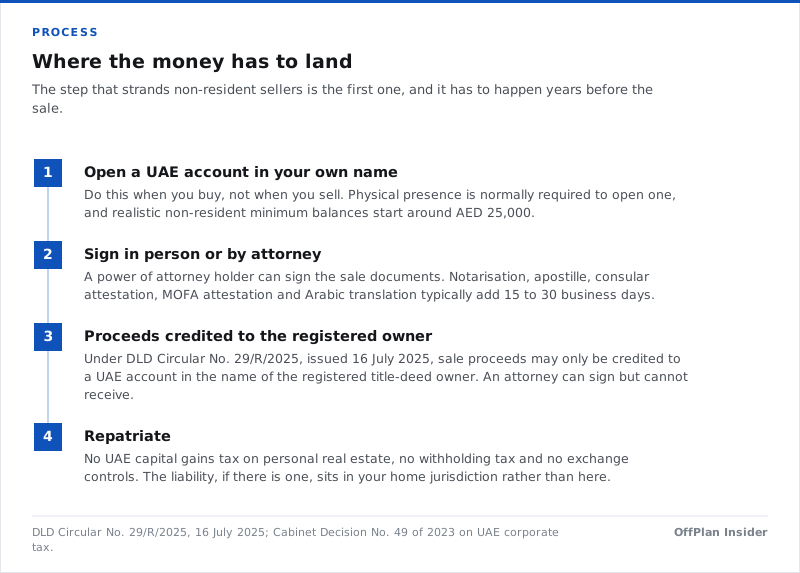
Allow four to eight weeks end to end, most of which is the developer's NOC processing rather than DLD's. If either party is overseas, add the power of attorney chain: notarisation, apostille, consular attestation, MOFA attestation and Arabic translation, which typically takes another 15 to 30 business days.
Selling from outside the UAE: the trap that catches non-residents
This one is recent and it strands people. Following DLD Circular No. 29/R/2025, issued 16 July 2025, sale proceeds may only be credited to a UAE bank account in the name of the registered title-deed owner. A power of attorney holder can sign the sale documents but cannot receive the funds. A manager's cheque issued in the attorney's name will be rejected unless both the power of attorney and the sale agreement expressly authorise it and the receipt confirms it was received on the seller's behalf.
The practical instruction is simple: open your UAE bank account when you buy, not when you sell. Physical presence is normally required to open one, and realistic non-resident minimum balances start around AED 25,000. A buyer who never opened an account can complete a purchase and then hit a wall at exit.
05Where an exit is hard, and where it is easy
Liquidity and profitability are not the same thing, and Dubai makes that distinction unusually stark.
| Factor | What it means for your exit |
|---|---|
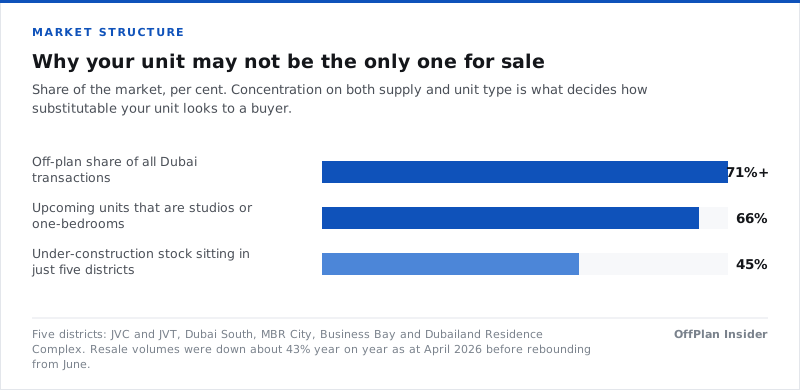
| Supply concentration | About 45% of all under-construction stock sits in five districts: JVC and JVT, Dubai South, MBR City, Business Bay and Dubailand Residence Complex. |
| Unit type | Roughly 66% of upcoming units are studios and one-bedrooms, the most substitutable product in the city. |
| Secondary volumes | Resale volumes were down about 43% year on year as at April 2026, though the market turned mid-year: ValuStrat recorded ready-home transactions up 46.8% month on month in June, the strongest monthly rise in three years, and up a further 11.4% in July. Off-plan share remained above 71%. |
| What still moves | Ready villas, townhouses and well-priced vacant units. |
| What does not | Overpriced apartments in high-supply areas, where marketing periods have lengthened. |
The JVC paradox
Jumeirah Village Circle recorded 18,782 transactions across full-year 2025, more than 1,500 a month, which makes it comfortably the most liquid community in Dubai. In June 2026 it alone accounted for about 11% of all ready-property transactions. You can always sell in JVC.
That same depth of supply is why appreciation is capped there. JVC is a yield play, not a growth play, and treating it as the latter is the most common mistake in Dubai mid-market investing. Constrained-supply communities such as Downtown, Palm Jumeirah and Dubai Hills offer the better exit at a materially higher entry price. Choose the one that matches your actual objective.
06The service charge nobody prices into the exit
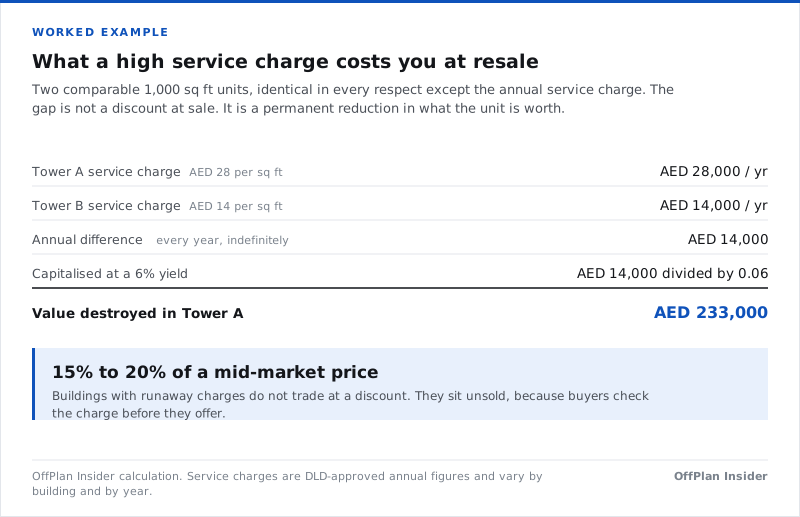
A high service charge does not cost you a small discount at resale. It costs you a structural one, and in 2026 buyers check before they offer.
A tower at AED 28 per square foot against a comparable at AED 14 costs an extra AED 14,000 a year on a 1,000 square foot unit. Capitalised at a 6% yield, that is roughly AED 233,000 of value destruction - somewhere between 15% and 20% of a typical mid-market unit price. Buildings with runaway charges do not trade at a discount; they sit unsold. If you are still choosing a project, this belongs in the decision, and the detail is in our guide to the true cost of buying off-plan.
07If you cannot sell: the other exits
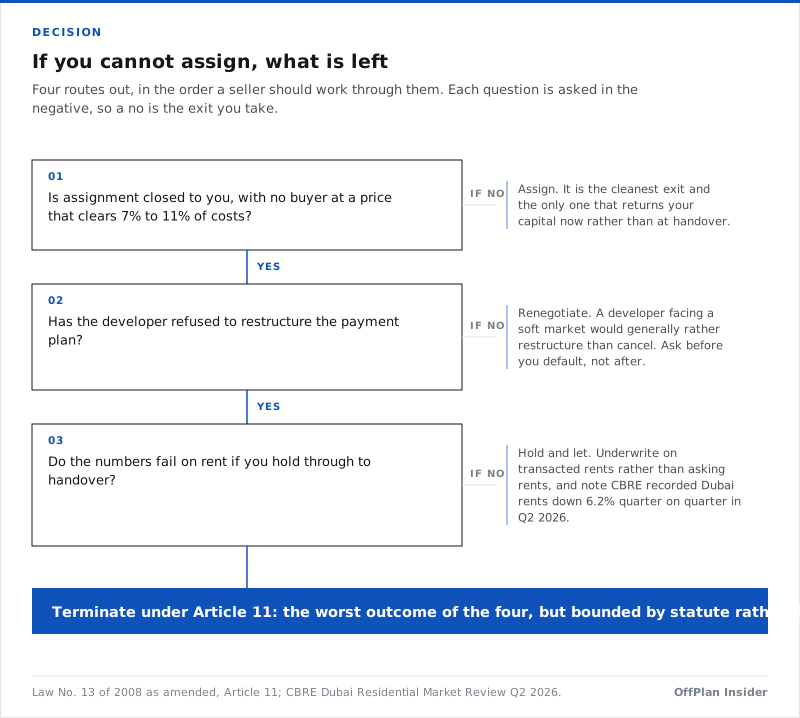
Assignment is not the only route out, and it is not always the best one.
- Renegotiate the payment plan. Developers facing a soft market would generally rather restructure than cancel. Ask before you default, not after.
- Hold to handover and let. If the numbers work on rent, holding through a weak window is often cheaper than exiting into one. Underwrite on transacted rents, and remember CBRE recorded Dubai rents down 6.2% quarter on quarter in Q2 2026.
- Terminate under Article 11. The statutory route, with the retention tiers set by law rather than by your contract. It is the worst financial outcome of the three but it is bounded and predictable, and it is covered in full in our guide to off-plan buyer protection.
What you should not do is stop paying and hope. Article 11 has a mandatory procedure and a 30-day DLD notice, and silence simply starts that clock without you having chosen anything.
08Is flipping off-plan in Dubai still profitable?
The trade that dominated 2022 to 2024 was straightforward, and one forum user described it more honestly than any brochure: buy several units at launch on a payment plan, pay 10% of the price, sell at a later stage when prices are 20% or 30% higher, and because the whole position is leveraged through the payment plan the return on cash deployed is very large.
That model has three dependencies, and 2026 broke at least two of them.
| Dependency | 2022-2024 | 2026 |
|---|---|---|
| Rising prices | Strong | Index down about 10% from the late-February peak, but roughly flat year on year and decelerating by July |
| Deep secondary demand | Strong | Resale volumes down about 43% YoY as at April, then a sharp monthly rebound from June |
| Low exit friction | Unchanged | Unchanged, still 7% to 11% |
The friction was always there. What changed is that appreciation stopped covering it. Khaleej Times is now running the flipping reality check in mainstream Gulf press rather than it being a bear talking point, which is itself a signal about where the consensus has moved.
None of that makes off-plan a bad purchase. It makes the short-hold flip a much narrower trade than it was, and it moves the case for off-plan back to where it belongs: payment-plan leverage, unit selection and a genuine holding period, rather than a quick assignment.
09Before you buy, decide how you will leave
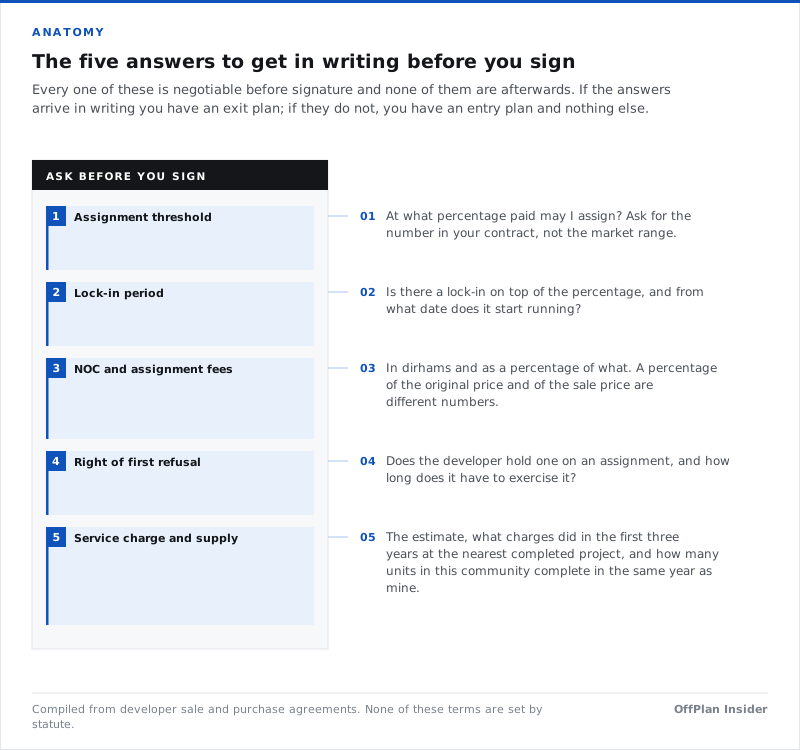
The single most useful thing a buyer can do at the point of purchase is establish the exit terms in writing, because they are non-negotiable afterwards.
- At what percentage paid may I assign?
- Is there a lock-in period on top of that percentage?
- What is the NOC fee and what is the assignment fee, in dirhams and as a percentage?
- Does the developer have a right of first refusal on an assignment?
- What is the estimated service charge, and what did charges do in the first three years at your nearest completed project?
- How many units in this community are due to complete in the same year as mine?
If the answers arrive in writing, you have a real exit plan. If they do not, you have an entry plan and nothing else, which is how most people end up holding a unit they intended to flip.
10When to sell: the three windows
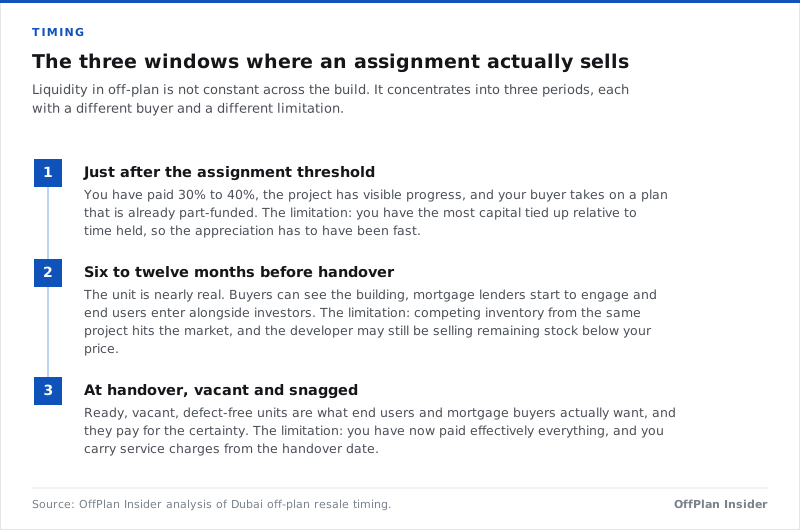
There are only three moments at which an off-plan unit is genuinely easy to sell, and they are not evenly spaced.
| Window | Why it works | What limits it |
|---|---|---|
| Just after the assignment threshold | You have paid 30% to 40%, the project has visible progress, and the buyer takes on a plan that is already part-funded. | You have the most capital tied up relative to time held, so the appreciation has to have been fast. |
| Six to twelve months before handover | The unit is nearly real. Buyers can see the building, mortgage lenders start to engage, and end-users enter the market alongside investors. | Competing inventory from the same project also hits the market, and the developer may still be selling remaining stock below you. |
| At handover, vacant and snagged | Ready, vacant, defect-free units are what actually moved in 2026 while off-plan resale stalled. | You now own the acquisition costs in full, and the service charge clock has started. |
The window to avoid is the one most people are forced into: the twelve months either side of a large completion wave in the same community. When several hundred comparable units hand over at once, you are competing with sellers who have the same floor plan, the same view and more urgency. This is the single strongest argument for asking, before you buy, how many units in that community complete in the same year as yours.
Pricing an assignment realistically
Assignment buyers price against three references, and you should check all three before setting an asking price.
- The developer's current list price for remaining inventory in the same project. If the developer is still selling, they are your competitor and they can offer a fresh payment plan you cannot.
- Recent DLD transfers in the same building or community, not portal asking prices. The gap between the two is material.
- The payment plan you are handing over. A buyer taking on a 40% remaining balance due in nine months values that very differently from one taking on 40% spread over three years post-handover.
A common mistake is pricing at original price plus your costs. Buyers do not care what you paid. They care what the same exposure costs them today from the developer, from another assignor, or from the secondary market once it completes.
11Tax, and getting the money out
On the UAE side an exit is clean. There is no capital gains tax on personal real estate, no withholding tax on a property sale, and no exchange controls restricting repatriation of the proceeds. Real estate investment income earned by a natural person sits outside UAE corporate tax under Cabinet Decision No. 49 of 2023, provided the activity does not require a licence.
The complications sit in your home jurisdiction, not here. An Indian tax resident, for example, remains liable on the gain in India despite paying nothing in the UAE, because the India-UAE treaty allocates the taxing right to the UAE, which charges zero, leaving no foreign tax credit to offset. The foreign asset must also be reported in Schedule FA. A UK long-term resident faces a separate analysis again. None of this is tax advice, and all of it should be checked with a qualified adviser in the relevant country before you exit rather than after.
The mechanical constraint is the one covered above: the proceeds must land in a UAE account in your own name first. Everything else follows from that.
12Reading the market before you list
Three indicators tell you more about your exit than any agent opinion.
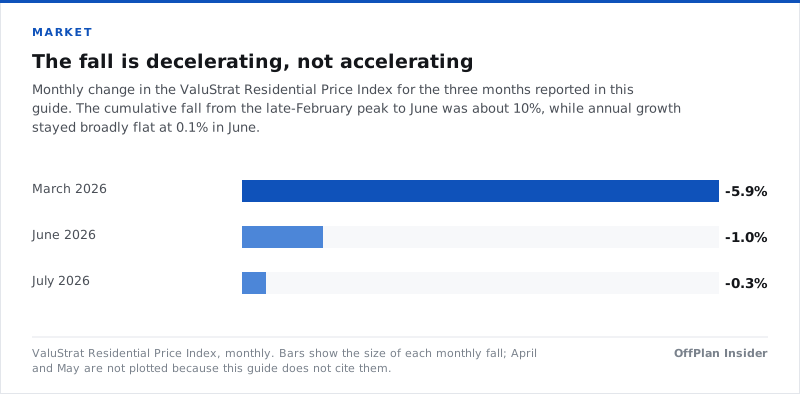
- The ValuStrat Residential VPI, published monthly. It fell 5.9% in March 2026 following the 28 February escalation, then decelerated to -1.0% in June and -0.3% in July, with annual growth broadly flat. A decelerating decline is a different market from an accelerating one.
- Secondary transaction volumes in your community, from DLD data. Falling volumes with stable prices means sellers are holding, not that demand is healthy.
- Completions scheduled in your community for the next 18 months. The widely quoted 2025 forecast was that of roughly 71,600 units projected for 2026, only about 34,700 would actually hand over. Actual H1 2026 completions ran between 18,000 and 24,800 depending on the count, so that forecast is tracking accurately or slightly conservatively. Use realisation-adjusted figures rather than headline pipeline totals either way.
Put those three together and you have a defensible view on whether to sell now, hold to handover, or let. That is a better basis for the decision than a price expectation formed at the moment you bought.
[opi_market_data]
FAQQuestions buyers ask.
Can I sell my off-plan property in Dubai before completion?
Yes, through an assignment. You transfer your position under the sale and purchase agreement to a new buyer who inherits the remaining payment plan and the handover date, and DLD records it as an Oqood-to-Oqood transfer. You need to have paid the developer's threshold, obtained a no objection certificate, and registered the transfer at a DLD trustee office.
What percentage do I need to have paid before I can sell off-plan in Dubai?
Most developers require 30% to 40% of the purchase price to have been paid before they will issue a no objection certificate. Some require 50%, and some impose a lock-in period of six to twelve months that runs independently of the percentage. There is no single legal threshold; the only authoritative source is your own contract.
How much does it cost to sell an off-plan property in Dubai?
All-in transaction costs run roughly 7% to 11% of the sale price. That comprises a developer NOC of AED 1,000 to 5,250 plus VAT, an assignment fee of about 2% to 5% of the original price, a fresh 4% DLD registration fee paid by the incoming buyer, trustee fees and 2% agency commission on the secondary sale.
How much do prices need to rise before an off-plan flip breaks even?
About 8% to 11%. Because the all-in transaction cost is 7% to 11% of sale price, appreciation below that leaves you out of pocket even if the headline price has risen. This is the single most useful number to know before committing to a short-hold strategy.
Can I sell my Dubai property if I live abroad?
Yes, but you must have a UAE bank account in your own name. Under DLD Circular 29/R/2025 sale proceeds may only be credited to a UAE account held by the registered title-deed owner. A power of attorney holder can sign the sale documents but cannot receive the funds. Open the account when you buy, not when you sell.
Is flipping off-plan property in Dubai still profitable in 2026?
It is much harder than it was. The strategy depended on rising prices and deep secondary demand.
The ValuStrat index fell about 10% from its late-February 2026 peak following the regional escalation, and resale volumes were down around 43% year on year as at April, though the market turned mid-year with ready-home transactions up 46.8% month on month in June.
Exit friction of 7% to 11% has not changed, and that is the part that does not move with sentiment. The case for off-plan now rests on payment-plan leverage and a genuine holding period rather than a quick assignment.
Which Dubai communities are hardest to sell in?
Saturation risk is concentrated in JVC, Arjan, Business Bay, International City and Dubai Silicon Oasis. About 45% of all under-construction stock sits in five districts, and roughly 66% of upcoming units are studios and one-bedrooms, which is the most substitutable product in the city. Ready villas, townhouses and well-priced vacant units continue to move.
Sources & methodWhere these figures come from.
Sources
- Dubai Legislation Portal: ECR 30 of 2013
- Gulf News: Dubai rents ease 62 while home prices stay above 2025 levels
- Khaleej Times: Is dubai off plan boom facing reality check on flipping risk
- Dubai Land Department: Real estate project status
What we could not verify
- No claims in this guide are flagged as unverified. If you spot something that has changed, tell us and we will correct it.
26 Aug 2026 · Reviewed by OffPlan Insider Research. First published 26 Aug 2026, updated 8 Oct 2026.