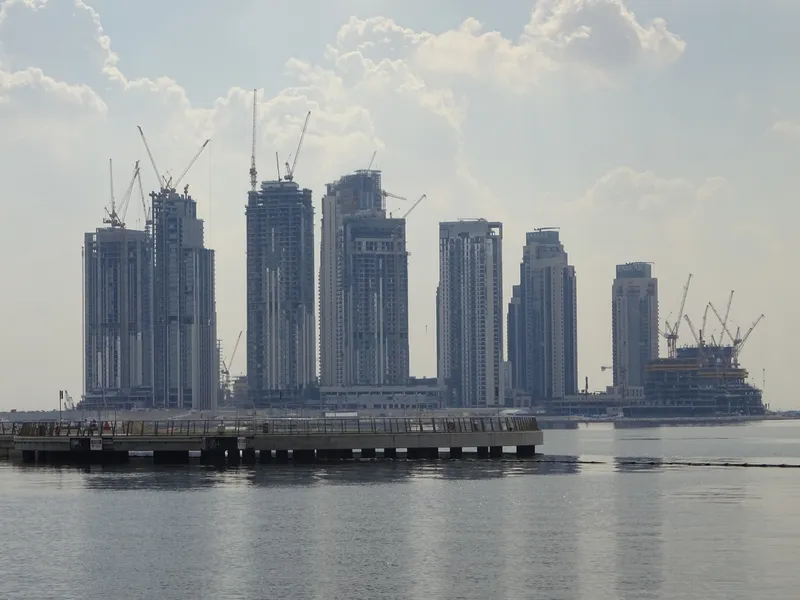
Buying off-plan in Dubai is safe when the project is registered with the Dubai Land Department and you pay only into its escrow account. Off-plan is not a scam: it is more than half of the market, and escrow, registration and licensing rules protect the money you pay. The risks that remain are market risks. UBS rates Dubai's bubble risk as elevated, 162,500 homes are scheduled for 2027, and prices are now rising slowly. Buyers who can hold for years are far less exposed than those counting on a quick resale.
Key takeaways
- Off-plan sales in Dubai are regulated: payments go into a project escrow account, the sale is registered with the Dubai Land Department, and a project must be licensed before it is sold.
- Fraud is rare and follows a pattern. Payment outside escrow, an unregistered project, an unlicensed broker, an advert without a permit, guaranteed returns and pressure to pay today are the six warning signs.
- UBS scored Dubai 1.16 on its 2026 bubble index, fourth of 23 cities and in the elevated-risk band. It also found Dubai the most affordable city it surveyed.
- Prices are rising slowly, not falling: up 1.9% in the year to the second quarter of 2026. Only 6% of off-plan projects have cut prices by 5% or more since February.
- Supply is the real risk for investors: 162,500 homes are scheduled for 2027 and 128,200 for 2028, mostly studios and one-bedroom apartments in a few districts.
- Your risk depends on what you buy and why. A home you will hold for five years, priced near its neighbours, from a developer with completed projects, is a different proposition from a studio bought to flip.
01Is buying off-plan property in Dubai safe?
For a registered project bought the right way, yes. Dubai regulates off-plan sales more tightly than most markets:
- Your money goes into escrow. Under Law No. 8 of 2007 every off-plan project has its own escrow account, and the developer can draw on it only as construction is certified.
- Your purchase is registered. The sale is recorded in the Dubai Land Department's interim register, known as Oqood, under Law No. 13 of 2008.
- The project and developer are licensed. A project must be registered with RERA, the Real Estate Regulatory Agency, before a single unit is sold.
- A cancelled project means a refund. If the regulator cancels a project, the money in escrow is returned to buyers.
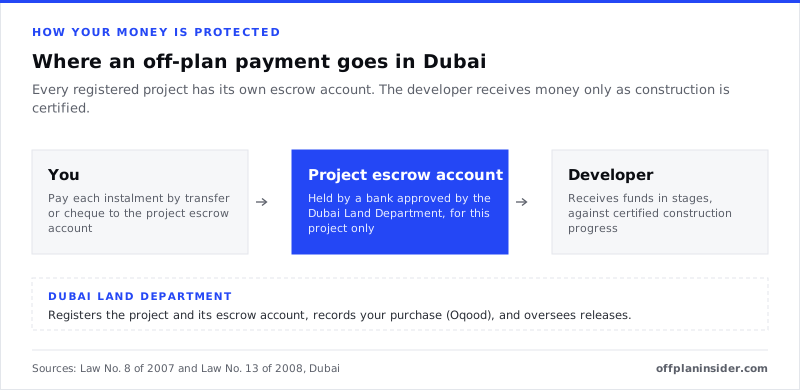
What the law does not do is guarantee that prices rise, that handover is on time, or that the person selling to you is honest. Those are the three risks the rest of this guide covers.
Our buyer protection guide explains each law in detail.
02What does the law protect, and what does it leave to you?
| Covered by regulation | Not covered: your own judgement |
|---|---|
| Payments held in a project escrow account | Whether the price is fair for the area |
| Registration of your purchase with the Dubai Land Department | Whether prices or rents will rise |
| A licensed developer and a registered project | Whether you can resell before handover, and at what price |
| A refund if the regulator cancels the project | Whether you can afford every instalment |
| A set procedure, with limits, if you default | Whether the finished home matches your expectations beyond the contract |
| Defects liability after completion | How many similar homes will compete with yours |
03Is off-plan in Dubai a scam?
No. Off-plan is the largest part of the Dubai market: more than half of all homes sold are bought before completion, many from developers that have delivered for decades. You can see the range on our off-plan projects and developers pages.
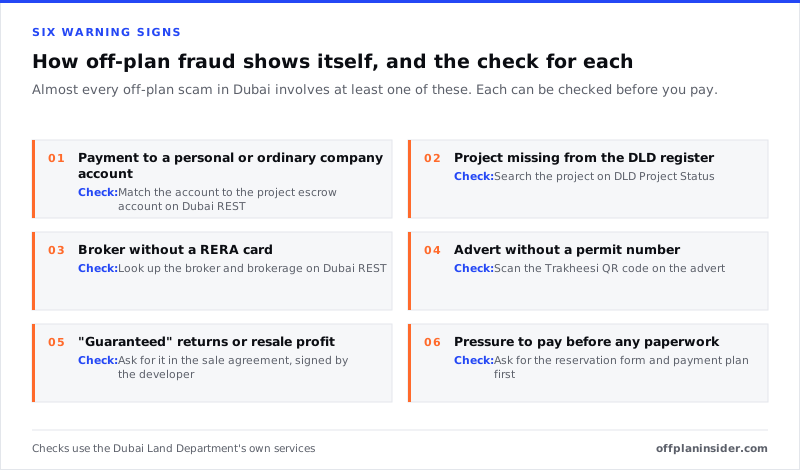
Fraud does happen at the edges, and it nearly always takes one of these forms.
| Warning sign | Why it matters | How to check |
|---|---|---|
| You are asked to pay into a personal or ordinary company account | Off-plan payments must go to the project's escrow account | Match the account on your payment request to the project's escrow account on the Dubai REST app |
| The project is not on the DLD register | An unregistered project cannot legally be sold | Search the project on the Dubai Land Department's Project Status service |
| The broker has no RERA card | Only licensed brokers may sell property in Dubai | Look up the broker and the brokerage on Dubai REST |
| The advert has no permit number | Every property advert needs a Trakheesi permit | Scan the advert's QR code; it should open a DLD page for that listing |
| "Guaranteed" returns or resale profit | No one can guarantee a price or a rent | Ask for the guarantee in the sale agreement, signed by the developer |
| Pressure to pay today, before seeing a contract | A genuine reservation comes with paperwork | Ask for the reservation form, the payment plan and the sale agreement first |
Each check takes minutes. Our guide on how to check a project and developer walks through them step by step.
04Is Dubai property in a bubble?
There is risk, and it is measured. In its September 2026 Global Real Estate Bubble Index, UBS scored Dubai 1.16, fourth of 23 cities, in the elevated risk band alongside Miami, Seoul, Geneva and Lisbon. Only Zurich and Tokyo were rated high risk.
The same report found Dubai the most affordable of the cities it surveyed: a skilled worker needs about five years of income to buy a 60 sq m apartment, against 11 years in London and 15 in Hong Kong.
Prices have cooled rather than fallen:
| Measure | Latest reading |
|---|---|
| Home prices, year on year (second quarter of 2026) | Up 1.9%; apartments up 1.3%, villas up 5.7% |
| Home prices after inflation | Up 0.4% |
| Rents after inflation | Down 4% |
| Home sales, first half of 2026 | 79,300, down 14% on a year earlier |
| Off-plan projects that have cut prices by 5% or more since February | 44 of 717, or 6% |
A slower market is not a crash. It does mean a buyer should no longer count on a quick resale profit, which is the assumption that hurts most when it fails.
05What does "elevated bubble risk" actually mean?
It is a statement about imbalance, not a forecast of a fall. An index of this kind compares prices with incomes and rents, and looks at how fast lending and construction are growing. A high score says prices have run ahead of those anchors. It does not say when, or whether, they will correct.
Two readings sit side by side for Dubai in 2026. Prices rose quickly for several years, which lifts the score. Yet homes remain affordable against local incomes, and rents are high relative to prices, which is why the same report still rates buying as attractive compared with renting.
For a buyer the practical meaning is simple: do not rely on the rise continuing.
06Has Dubai's market fallen before?
Yes, twice in recent memory, and both episodes shape today's rules.
- 2008 to 2009. Prices fell by roughly half after the global financial crisis. Many off-plan projects stalled, and buyers who had paid developers directly struggled to recover their money.
- 2014 to 2020. Prices slid by about a third over six years as a large wave of homes completed.
What is different now:
- Escrow is compulsory. The escrow law dates from 2007, and its oversight has tightened since. Payments are tied to certified progress.
- Lending is capped. Since 2013 the Central Bank has limited mortgages, including a 50% cap on homes bought off-plan, so far fewer purchases rest on borrowed money.
- Default rules are fixed. Since 2020 the law has set what happens, and how much is at stake, when a buyer cannot pay.
These rules make a disorderly collapse less likely. They do not stop prices from falling.
07Is there too much supply coming?
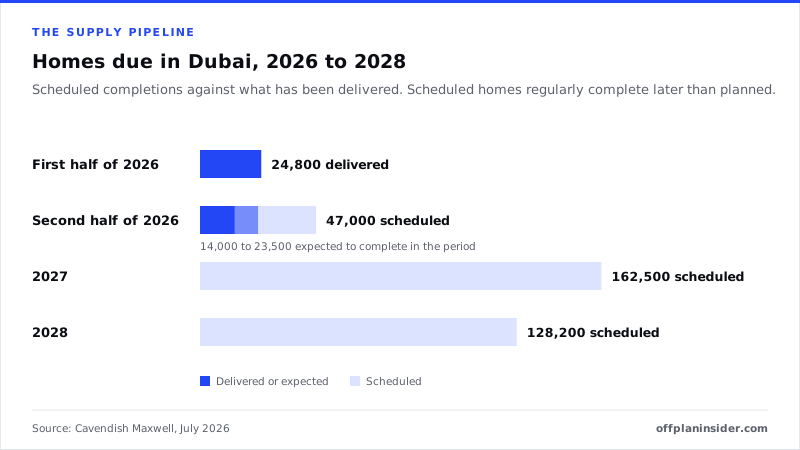
This is the real question for anyone buying to rent out or resell. The pipeline is large:
| Period | Homes |
|---|---|
| Delivered, first half of 2026 | 24,800, up 38% on a year earlier |
| Scheduled, second half of 2026 | 47,000, of which 14,000 to 23,500 are expected to complete |
| Scheduled for 2027 | 162,500 |
| Scheduled for 2028 | 128,200 |
Three things soften the headline numbers:
- Not everything scheduled is delivered on time. Less than half of what was scheduled for late 2026 is expected to complete in that period.
- New launches have dropped sharply. Developers launched 28,000 homes in the first half of 2026, against 102,000 a year earlier.
- Supply is uneven. Most new homes are studios and one-bedroom apartments in a handful of districts.
That last point matters most. Three in four off-plan homes sold in the third quarter of 2026 were studios or one-bedrooms, and Dubai South alone took almost one in five sales. The more identical homes complete around yours, the more competition you face for tenants and buyers.
08How do I check supply for the home I am considering?
City-wide totals tell you little. What matters is how many similar homes complete near yours, in the same year.
- Look at the district. Our area guides list the projects selling in each one. A long list of similar towers means a crowded handover year.
- Look at the handover year. Browse projects due in 2027 and 2028 to see what completes alongside yours.
- Look at the home type. Compare how many apartments are on offer against villas and townhouses in the same community.
- Look at the price band. Homes under AED 1 million are where most new supply sits. Fewer homes are built at AED 3 to 5 million and above.
09Which purchases carry more risk, and which less?
| Lower risk | Higher risk |
|---|---|
| You plan to live in the home or hold it for five years or more | You need to resell before handover to afford the final payment |
| The price per sq ft is close to completed homes nearby | The price is well above comparable homes in the same area |
| A home type in short supply locally, such as family villas and townhouses | One of thousands of similar studios completing in the same district in the same year |
| A developer with completed projects you can visit | A first project, with nothing delivered yet |
| Construction is under way and on the DLD register | Launch stage, with a long wait before work starts |
| Instalments you can meet from income | A plan that only works if prices rise |
If the left column describes you, market noise matters less. If the right column does, think again or change the plan.
10Stress-test the purchase before you sign
Take the numbers you have been given and ask what happens if three things go against you. The example is a AED 1,200,000 one-bedroom apartment, bought to rent out, with an expected rent of AED 84,000 a year.
| If this happens | What it does to the example | Can you live with it? |
|---|---|---|
| Prices are flat for three years | No resale gain. Selling would cost you the 4% registration fee you paid, plus resale costs | Yes, if you planned to hold and rent |
| Rent comes in 15% lower | AED 71,400 a year instead of AED 84,000: a gross yield of about 6% instead of 7% | Yes, if the instalments do not depend on the rent |
| Handover is 12 months late | A year without rent, about AED 84,000, while you may still be paying instalments | Only with a cash reserve |
If the purchase still makes sense in all three rows, it is robust. If any row would force you to sell, the plan is too tight.
11Why do so many people warn against off-plan?
The complaints you read online usually come down to four experiences:
- Delays. Handover dates move. Check the construction progress on the register before you buy, and look at projects near handover if timing matters to you.
- Resale was harder than promised. Selling before handover needs a buyer, the developer's consent and fees of several per cent. See how to sell before handover.
- The instalments became a strain. A default is expensive. See what happens if you can't pay.
- The sales pitch outran the facts. Projected yields and "sold out in hours" claims are marketing. Rely on the contract and the register.
None of these is fraud, and all four can be planned for.
12Ten questions to ask before you pay a dirham
Ask the person selling to you, and ask for the answers in writing.
- What is the project's registration number with the Dubai Land Department?
- What is the escrow account number, and at which bank?
- How far is construction, according to the register, and when was that figure updated?
- What handover date is written in the sale agreement, and what happens if it is missed?
- What is the full payment schedule, with dates, including the 4% registration fee and any administration fees?
- What are the estimated service charges per sq ft?
- How much of the price must I pay before I am allowed to resell, and what does the developer charge for that?
- Which projects has this developer completed, and can I visit one?
- How does this price per sq ft compare with completed homes in the same area?
- Are you a licensed broker, and what is your RERA number?
A seller who answers all ten without hesitation is doing the job properly. Evasion on the first three is a reason to stop.
13How to buy off-plan safely: a short checklist
- Verify the project on the Dubai Land Department register, with its escrow account.
- Pay only into escrow, never to an individual.
- Compare the price with completed homes and other launches in the same area. Our area guides list what is selling in each district.
- Choose the payment plan for your income, not for the headline. Compare payment plans, including post-handover plans.
- Read the sale agreement for the handover date, delay terms and resale rules before you sign.
- Check current terms. Developer offers change the real cost more often than list prices do.
- Keep a reserve for at least six months of instalments.
14Key terms
- Escrow account: the project's regulated bank account, into which every off-plan payment must go.
- Oqood: the Dubai Land Department's interim register for off-plan sales.
- DLD and RERA: the Dubai Land Department and its regulatory arm, the Real Estate Regulatory Agency.
- Trakheesi permit: the department's permit for a property advert, shown as a number and QR code.
- Dubai REST: the department's app for checking projects, brokers and ownership records.
- Gross yield: a year's rent divided by the purchase price, before costs.
15Where to go next
- Browse off-plan projects and new launches, each checked against the developer and the register
- Homes by budget: under AED 1 million, AED 1 to 2 million and AED 2 to 3 million
- Buying for rental income or as a first-time buyer
- Off-plan vs ready property in Dubai
- Get a free shortlist of three to five projects that fit your budget and goal
FAQQuestions buyers ask.
Is it safe to buy off-plan property in Dubai?
Yes, if the project is registered with the Dubai Land Department and every payment goes into the project's escrow account. Those two checks, plus a licensed broker and a signed sale agreement, protect the money you pay. They do not protect you from a late handover or a fall in prices, so choose a payment plan and a holding period you can sustain.
Is off-plan property in Dubai a scam?
No. Off-plan sales make up more than half of the Dubai market and are regulated by escrow, registration and licensing laws. Scams do occur, almost always involving payment to a personal account, an unregistered project or an unlicensed seller. Each can be checked in minutes on the Dubai Land Department's services before you pay.
Is the Dubai property market a bubble in 2026?
UBS rated Dubai's bubble risk as elevated in September 2026, with a score of 1.16, fourth of the 23 cities it covers. Zurich and Tokyo were rated higher. Price growth has slowed to 1.9% a year and rents have fallen after inflation. That points to a cooling market, in which quick resale gains are no longer a safe assumption.
Is Dubai oversupplied with new homes?
The pipeline is large: about 162,500 homes are scheduled for 2027 and 128,200 for 2028. Completions regularly arrive later than scheduled, and new launches fell sharply in 2026. The pressure is uneven. Studios and one-bedroom apartments in high-volume districts face the most competition; family villas and townhouses face less.
What are the risks of buying off-plan in Dubai?
The main risks are a late handover, a market price below what you paid when you want to sell, difficulty reselling before completion, and instalments that become hard to meet. Fraud is a smaller risk that proper checks remove. Reduce the others by buying from a developer with completed projects, paying a price close to nearby homes and keeping a cash reserve.
How do I avoid off-plan scams in Dubai?
Find the project on the Dubai Land Department's Project Status service, match the escrow account to every payment, check the broker's licence on the Dubai REST app, and look for the Trakheesi permit on the advert. Never pay an individual, and do not pay before you have seen the reservation form and payment plan in writing.
Will Dubai property prices fall in 2027?
Nobody can say with certainty. Forecasts in 2026 range from a modest adjustment to stable prices, and outcomes will differ by area and home type because supply is concentrated. If your purchase only works when prices rise, treat that as a warning. If you can hold through a flat period, short-term moves matter far less.
Is off-plan safer than ready property in Dubai?
They carry different risks. A ready home can be inspected, rented at once and financed with a larger mortgage, but needs more cash up front. Off-plan spreads the payments and can cost less, but you wait for completion and take construction and market risk in the meantime. Which is safer depends on your savings, timeline and purpose.
Sources & methodWhere these figures come from.
Sources
- Dubai Legislation Portal: Law No. (8) of 2007
- Dubai Legislation Portal: Law No. (13) of 2008
- The National: Buy dubai property bubble strong rents demand ubs report
- indexbox.io: Dubai adds 24800 new homes in H1 2026 as market shifts to completions
- Khaleej Times: Dubai developers hold off plan pricing as only 6 projects cut prices by 5 or more since february
What we could not verify
- The price falls of roughly half in 2008 to 2009 and about a third between 2014 and 2020 are approximate figures from widely published indices, not from a single source we opened.
- Supply figures are Cavendish Maxwell's from July 2026, and the bubble index figures are UBS's as reported by The National. Other consultancies publish different pipeline totals.
- The lower-risk and higher-risk table, the stress test and the ten questions are our own judgement and illustration. Nothing in this guide is a forecast of prices.
6 Oct 2026 · Reviewed by OffPlan Insider Research. First published 6 Oct 2026.