If you stop paying for an off-plan home in Dubai, the developer cannot simply cancel. Under Law No. 19 of 2020 it must report the default to the Dubai Land Department, which gives you 30 days' written notice and tries to broker a settlement. After that the developer may end the contract and keep up to 25% of the unit's price if the project is under 60% built, or up to 40% if it is 60% built or more. A buyer has no automatic right to cancel and get a refund.
Key takeaways
- A buyer cannot cancel an off-plan purchase and claim the money back just because plans have changed. The sale and purchase agreement is binding once it is signed and registered.
- A developer cannot terminate on its own either. It must notify the Dubai Land Department, which serves a 30-day written notice on you and, where possible, mediates a settlement.
- What the developer may keep depends on construction progress: up to 25% of the unit's price below 60% complete, and up to 40% from 60% complete. Above 80% it can also keep the contract and claim the balance, or ask for the unit to be auctioned.
- Anything you paid above that limit must be refunded within one year of termination, or within 60 days of the unit being resold, whichever comes first.
- If the developer has not started work for reasons beyond its control, or the regulator cancels the project, it must refund everything you paid.
- Act before you miss a payment. Rescheduling, selling your contract, moving to a cheaper unit, a mortgage near completion or an agreed exit all cost less than a default.
01What happens if I stop paying my off-plan instalments?
Three things, in this order.
- The developer chases the payment. Your sale and purchase agreement (SPA) sets any late-payment charge and grace period. This stage is between you and the developer.
- The developer reports the default. It must notify the Dubai Land Department on the department's form, with the details of the unit and the obligation you have missed.
- The department gives you 30 days. It serves a written, dated notice asking you to meet your obligations, and where possible it mediates a settlement between you and the developer.
Only when the 30 days pass without payment or a settlement can the developer act. The department then issues an official document confirming two things: that the developer followed the procedure, and how far the project is built. That percentage decides what the developer may do.
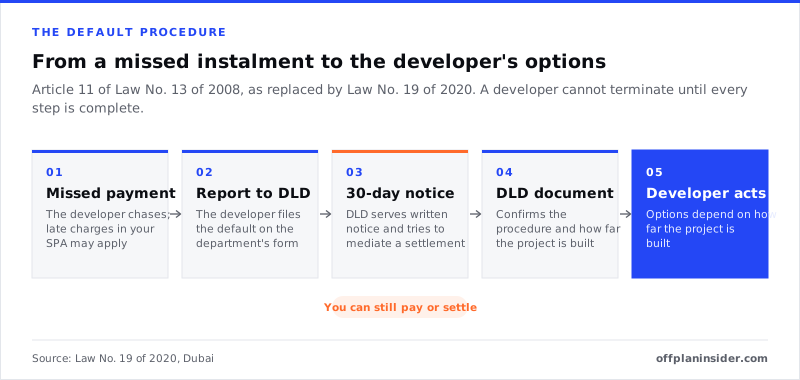
This procedure is in Article 11 of Law No. 13 of 2008, as replaced by Law No. 19 of 2020. The law calls the rules part of public order: a termination that skips them is void.
02What counts as a default?
The law speaks of a buyer who "fails to fulfil his contractual obligations" under the sale agreement. In practice that almost always means a missed instalment, but the SPA defines it. Read three clauses:
- Payment dates. Some plans are tied to calendar dates, others to construction milestones. A milestone instalment falls due when the developer notifies you that the milestone is reached.
- Grace period and late charges. Many SPAs allow a short grace period and then charge interest or a fixed fee on the overdue amount.
- Notices. The SPA names the address and email the developer will use. A notice sent there is valid even if you did not read it.
The department checks that a breach has occurred before it serves its own notice. If you dispute the amount or the date, say so in writing as soon as you hear from the developer, with your receipts.
03How much can the developer keep?
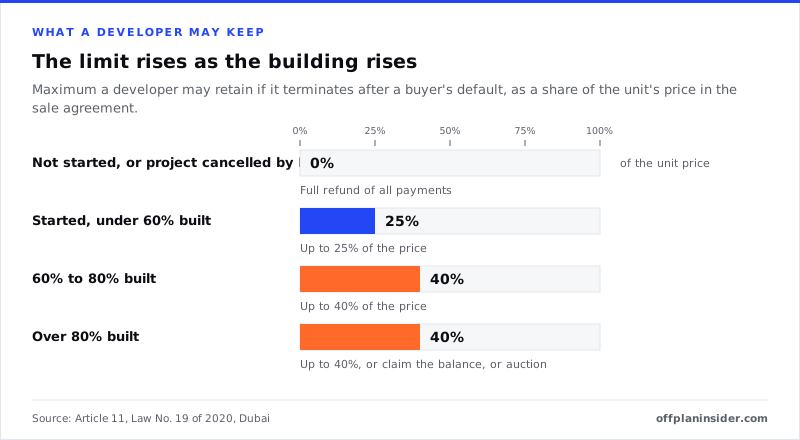
It depends on how far the project is built on the day the department issues its document.
| Construction progress | What the developer may do | What it may keep |
|---|---|---|
| Not started, for reasons beyond the developer's control, or the project is cancelled by RERA | Nothing against you | Nothing. It must refund all payments |
| Started, under 60% built | Terminate the contract | Up to 25% of the unit's price |
| 60% to 80% built | Terminate the contract | Up to 40% of the unit's price |
| Over 80% built | Keep the contract and claim the balance; or ask for the unit to be auctioned; or terminate | If it terminates, up to 40% of the unit's price |
Three points buyers often miss:
- The percentage is of the price, not of your payments. On a AED 1.5 million home, 25% is AED 375,000 and 40% is AED 600,000.
- The risk grows as the building rises. The same default costs more at 65% built than at 55% built.
- The percentage is measured by the regulator. The completion figure comes from the department's document, calculated to RERA's standards, not from the developer's marketing updates.
04What are the developer's options when the project is over 80% built?
Near completion the law gives the developer three choices, and it picks.
- Keep the contract and claim the balance. The developer retains everything you have paid and can pursue you for the rest of the price.
- Ask for a public auction. The department sells the unit to recover what the developer is owed, and you are liable for the costs of the sale.
- Terminate. The developer ends the contract, keeps up to 40% of the price and refunds anything above that.
This is why a default late in construction is the most serious. If your project is close to handover and you cannot fund the final payment, read the section on borrowing below and take legal advice before the deadline, not after it.
05What would I get back? A worked example
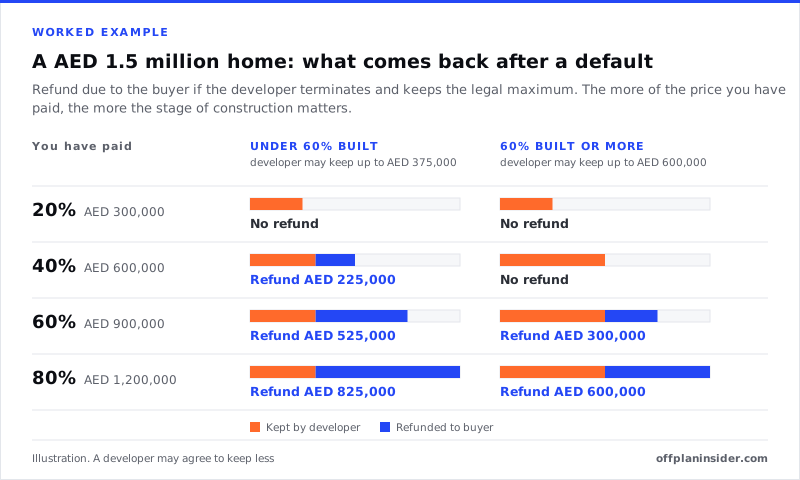
Take a AED 1,500,000 apartment. The table shows the refund due if the developer terminates and keeps the legal maximum.
| You have paid | Under 60% built (developer keeps up to AED 375,000) | 60% built or more (developer keeps up to AED 600,000) |
|---|---|---|
| 20% · AED 300,000 | No refund | No refund |
| 40% · AED 600,000 | AED 225,000 | No refund |
| 60% · AED 900,000 | AED 525,000 | AED 300,000 |
| 80% · AED 1,200,000 | AED 825,000 | AED 600,000 |
Two notes on the arithmetic:
- The 4% Dubai Land Department fee and any administration fees you paid at booking are separate from the price and are not part of this calculation.
- Where you have paid less than the limit, the law lets the developer keep what it holds. Whether it can pursue you for more depends on your contract and the stage of the project. Take legal advice on that point.
06When is the refund paid?
Whatever you paid above the developer's limit must be refunded within one year of the termination, or within 60 days of the unit being resold to another buyer, whichever comes first.
Ask the developer to confirm the termination date and the refund amount in writing, and keep your bank details up to date with it.
07Can I cancel and get my money back?
Not as of right. Once the SPA is signed and the sale is registered, it binds both sides. A change of plans, a job loss or a fall in prices does not give a buyer the right to cancel and recover the payments.
A full refund is due in two cases set out in the law:
- the developer has not started work for reasons beyond its control, without negligence on its part; or
- the project is cancelled by a final decision of RERA, the Real Estate Regulatory Agency.
In both, the money is returned under the escrow rules of Law No. 8 of 2007.
08What if the developer is the one at fault?
A buyer's default and a developer's delay are separate questions. If handover is well past the date in your SPA, or the home is materially different from what was sold, you may have claims of your own under the contract.
Do not stop paying on your own initiative because the project is late. A missed instalment still starts the default procedure, and your complaint about delay does not pause it. Raise the delay in writing, keep paying if you can, and get advice. Our buyer protection guide covers late handover and cancelled projects.
09Five ways out that cost less than a default
Speak to the developer before you miss a payment. Every option below is easier while your account is up to date.
- Ask to reschedule. Developers can agree a revised plan, a short deferral or a move of instalments to handover. Get it in writing, signed by both sides, as an addendum to the SPA. Check the developer's current offers first: a longer plan may already be available.
- Sell your contract. Once you have paid the share the developer requires, commonly 30% to 40%, you can assign the SPA to a new buyer who takes over the remaining instalments. See how to sell off-plan before handover.
- Move to a cheaper unit. Some developers will transfer what you have paid to a smaller home or another project of theirs, for example one of the homes under AED 1 million. This is at the developer's discretion.
- Borrow near completion. Banks lend up to 50% of the value of a home bought off-plan, usually once construction is well advanced. See off-plan mortgages in the UAE.
- Negotiate an agreed exit. A developer may accept a termination by mutual agreement and keep less than the legal maximum, particularly if it can resell the unit quickly.
| Option | Needs the developer's consent? | Typical cost to you | Works best when |
|---|---|---|---|
| Reschedule | Yes | None, or a fee set by the developer | The problem is timing, not affordability |
| Sell the contract | Yes, through a no objection certificate | Resale costs, and any gap between your price and the market | You have paid the resale threshold and the area is in demand |
| Move to a cheaper unit | Yes | Usually a transfer fee; terms vary | The developer has unsold stock at a lower price |
| Mortgage near completion | No, but the bank must approve you | Bank fees and interest | You can show income, and the project is nearly complete |
| Agreed exit | Yes | Whatever deduction you negotiate | The unit is easy for the developer to resell |
| Default | No | Up to 25% or 40% of the price | Rarely the best option |
10How do I ask the developer for help?
Write, do not only call, and write early. A request made a month before the due date is treated very differently from one made after a default notice. A useful message covers five things:
- your name, the project, the unit number and the SPA reference;
- which instalment you cannot meet, and its due date;
- the reason, briefly, and whether it is temporary;
- what you are asking for: a new date, smaller instalments, a transfer to another unit, or consent to resell;
- what you can pay now, as a sign of good faith.
Ask for the reply in writing, and for any agreement to be issued as a signed addendum.
11What should I do when the notice arrives?
- Do not ignore it. The 30 days run from the date on the notice.
- Check the facts. Compare the amount claimed with your SPA, your payment plan and your receipts.
- Use the mediation. Tell the department and the developer in writing that you want a settlement, and propose one.
- Get any settlement signed. The law requires it to be attached to the SPA as an addendum signed by both sides.
- Take legal advice early, above all if the project is more than 80% built, where the developer can claim the full balance.
The law states that these rules do not stop a buyer from going to court or arbitration.
12I live abroad. Will I even know about a default notice?
The department may serve its notice in person, by registered post, by email or by another method it sets. For an overseas buyer that usually means email.
- Keep the email address, phone number and postal address on your SPA current. Tell the developer in writing when they change.
- Check that the developer's emails are not going to a junk folder, especially around instalment dates.
- If you will be unreachable, give someone a power of attorney to act for you.
A notice sent to the address on file counts, whether or not you saw it.
13Does this apply to my contract?
- Old contracts: yes. The rules apply to off-plan sale agreements signed before or after the 2020 law.
- Land: no. A plain land sale with no off-plan element follows the terms of its own contract.
- Completed homes on post-handover plans: the instalments you owe after you take the keys are governed by your SPA and by any charge registered over the unit. Ask a lawyer how a default would be handled before you rely on the rules above.
- Other emirates: this guide covers Dubai. Abu Dhabi, Sharjah and Ras Al Khaimah have their own rules, so check with the regulator in that emirate.
14How to protect yourself before you buy
- Choose a payment plan you can meet from income or savings, not from a hoped-for resale. Compare payment plans: a 60/40 plan asks for more during construction than a 30/70 plan or a post-handover plan.
- Remember that a back-loaded plan moves the pressure to handover. Know today how you will fund the final 60% or 70%.
- Keep a reserve for at least six months of instalments.
- Read the SPA clauses on late payment, termination and resale before you sign.
- Check the project's construction progress on the Dubai Land Department register; our project pages show it where it is published, and projects near handover carry less construction risk.
- Run the numbers with our payment plan calculator before you reserve.
15Key terms
- SPA: the sale and purchase agreement between you and the developer.
- Oqood: the Dubai Land Department's interim register, where an off-plan sale is recorded until the title deed is issued.
- DLD: the Dubai Land Department.
- RERA: the Real Estate Regulatory Agency, the department's regulatory arm.
- NOC: a no objection certificate, the developer's written consent to a resale.
- Escrow account: the project's regulated bank account, into which every off-plan payment must go.
16Where to go next
FAQQuestions buyers ask.
What happens if I miss an off-plan instalment in Dubai?
The developer will first chase the payment and may charge the late fee set in your sale and purchase agreement. If it stays unpaid, the developer must notify the Dubai Land Department, which serves a 30-day written notice on you and may mediate a settlement. Only after that notice expires can the developer terminate the contract or take the other steps the law allows.
How much can a developer keep if I default on an off-plan property in Dubai?
It depends on how far the project is built. Below 60% complete, with construction started, the developer may keep up to 25% of the unit's price. Between 60% and 80% it may keep up to 40%. Above 80% it may keep up to 40% if it terminates, or keep the contract and claim the full balance, or ask for the unit to be sold at auction.
Can I cancel my off-plan purchase in Dubai and get a refund?
Not as of right. A change of mind, a job loss or a fall in prices does not entitle a buyer to cancel and recover the money. You can ask the developer for an agreed exit, sell your contract to another buyer, or default and accept the statutory deduction. A full refund is due only if the developer never starts for reasons beyond its control, or the project is cancelled by the regulator.
How long do I have after the Dubai Land Department notice?
Thirty days from the date of the notice. The notice must be in writing and dated, and is delivered in person, by registered mail, by email or by another method the department sets. In that time you can pay the arrears or reach a settlement with the developer, which is then signed and attached to your contract as an addendum.
When do I get my refund after a developer terminates the contract?
Whatever you paid above the amount the developer is allowed to keep must be refunded within one year of the termination, or within 60 days of the developer reselling the unit to another buyer, whichever happens first.
Can the developer take me to court for the rest of the price?
Where the project is more than 80% complete, the law lets the developer keep the contract alive, keep what you have paid and claim the outstanding balance, or ask the Dubai Land Department to sell the unit at public auction and hold you liable for the costs of the sale. Take legal advice early if your project is near completion.
Can I sell my off-plan property instead of defaulting?
Usually, yes, once you have paid the share of the price the developer requires for a resale, commonly 30% to 40%, and it issues a no objection certificate. The new buyer takes over your remaining instalments. Selling takes time, so start before you fall behind: a developer is unlikely to approve a transfer while payments are overdue.
Does this law apply to contracts signed before 2020?
Yes. Law No. 19 of 2020 says its rules apply to all off-plan sale agreements, whether signed before or after it came into force. It also says the rules are part of public order, so a termination that skips the procedure is void, and that a buyer keeps the right to go to court or arbitration.
Sources & methodWhere these figures come from.
Sources
- Dubai Legislation Portal: Law No. (19) of 2020 Amending Law No. (13) of 2008 Regulating the Interim Real Property Register in the Emirate of Dubai
- Dubai Legislation Portal: Law No. (13) of 2008
- Dubai Legislation Portal: Law No. (8) of 2007
- Gulf News: Ask gulf news can a dubai developer forfeit your off plan property if you miss payments
What we could not verify
- The law caps what a developer may keep on termination. Whether it can claim more from a buyer who has paid less than that cap is not covered here; take legal advice.
- Late-payment charges, grace periods, rescheduling, unit swaps, agreed exits and how post-handover instalments are enforced are set by each developer and sale agreement. They are market practice, not law.
- This guide covers Dubai only. Abu Dhabi and the other emirates have their own rules.
6 Oct 2026 · Reviewed by OffPlan Insider Research. First published 6 Oct 2026.