Off-plan payment plans in the UAE are written as two numbers: the share due before handover and the share due at handover. Across the sixteen projects we analyse with a published schedule there are seven structures in use, and 60/40 is the most common with six of the sixteen. The extremes are fifty points apart, from 30/70 at Azizi Florence to 80/20 at Emaar's Golf Trails and Vindera, which on an AED 2,000,000 home is a AED 1,000,000 difference in how much you have committed before the building exists. Booking deposits run from 2 per cent to 20 per cent. What matters as much as the shape is the trigger: a calendar-linked plan falls due on fixed dates whether or not the build has progressed, while a construction-linked plan cannot outrun the concrete. Every dirham paid goes into a project escrow account under Dubai Law No. 8 of 2007, and the developer draws from it only against verified construction progress. Figures reviewed 14 September 2026.
Every off-plan payment plan in the UAE is an answer to the same three questions. How much to reserve the unit. How much while it is being built. How much when they hand you the keys. Everything else is detail.
What almost nobody publishes is what those answers actually look like across real projects. The phrase you will read everywhere is that payment plans vary. They do, but not randomly, and not evenly. We have sixteen projects on this site with a full milestone schedule attached, and they resolve into exactly seven structures. This guide is built on those sixteen.
Seven structures, and they are not evenly spread
A payment plan is usually written as two numbers. The first is the share due before handover, the second is the share due at handover. A 60/40 plan means sixty per cent of the price is paid while the building goes up and forty per cent falls due when it is finished.
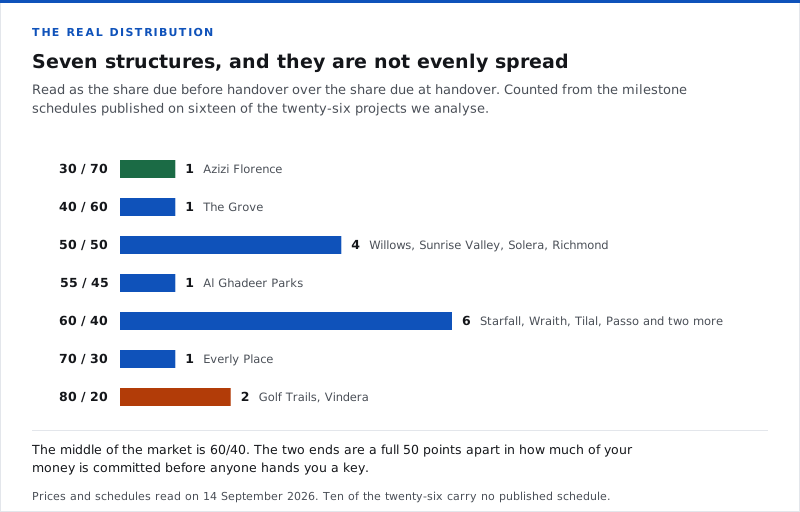
Three things fall out of that picture.
60/40 is the centre of the market. Six of the sixteen sit there, and if somebody quotes you a plan without naming it, this is the one to expect.
The ends are fifty points apart. At Azizi Florence you pay thirty per cent before handover. At Vindera and Golf Trails you pay eighty. On a AED 2 million home that is a difference of AED 1,000,000 in how much of your money is committed before anyone owes you a finished building.
Nobody is offering 20/80 or 10/90. Those exist in promotional campaigns, usually for a few days at a time, and they are worth reading as offers rather than as the shape of the market. Nothing in our standing inventory is more deferred than 30/70.
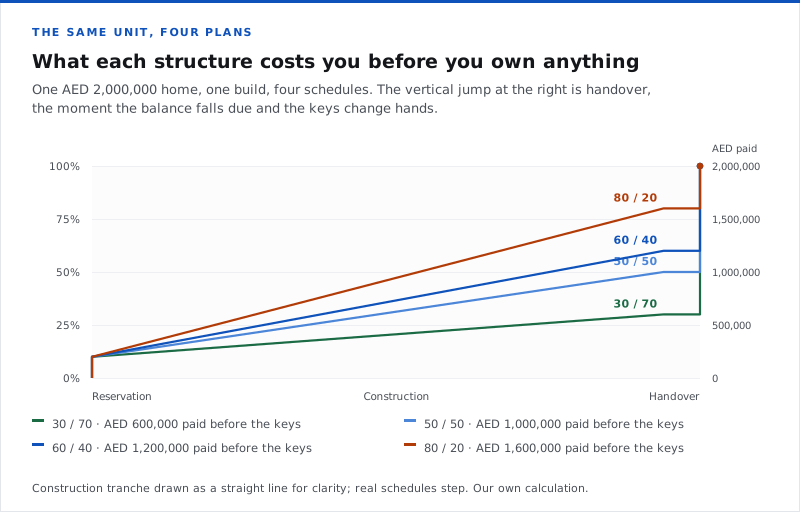
The same home, four plans, in money
Percentages are slippery. Put the same house under four of these structures and the difference becomes obvious.
| Structure | Paid before handover | Due at handover | Your money at risk during the build |
|---|---|---|---|
| 30 / 70 | AED 600,000 | AED 1,400,000 | Lowest exposure. Most of the price stays with you until the building exists. |
| 50 / 50 | AED 1,000,000 | AED 1,000,000 | Even split. |
| 60 / 40 | AED 1,200,000 | AED 800,000 | The market standard. |
| 80 / 20 | AED 1,600,000 | AED 400,000 | Highest exposure. Four fifths of the price is spent before handover. |
Here is the part that gets lost. A deferred plan does not make the home cheaper. You pay AED 2 million either way. What changes is when, and therefore what your money is doing in the meantime, and how much of it is exposed if something goes wrong with the project.
That cuts both ways, and honest advice has to say so. A deferred plan keeps your cash liquid and reduces what you have at stake in an unfinished building. A front-loaded plan often comes with a better price, because the developer is effectively borrowing less from the bank and more from you, and sometimes passes part of that saving on. Whether it is worth it depends on what else your money could be doing and how much you trust the delivery.
The reservation cheque runs from 2% to 20%
The booking deposit is the most variable number in the whole set, and almost nobody mentions it when quoting a plan.
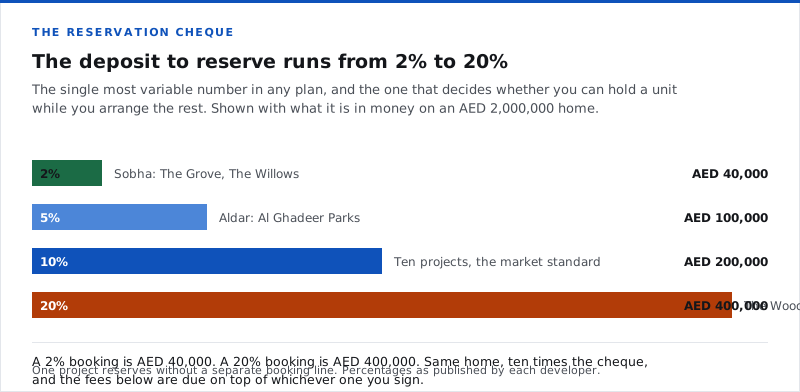
Ten of the sixteen book at ten per cent, which is the convention. The interesting ones are the outliers.
The Grove and The Willows, both by Sobha Realty, reserve at two per cent. On a AED 4 million villa that is AED 80,000 to hold a unit. At the other end, The Woods and Everly Place want twenty per cent at signing.
A low booking deposit is not generosity. It is a way of filling a launch quickly, and it usually means the second instalment arrives sooner than you expect. Read the date on instalment two before you celebrate the size of instalment one.
What you actually write on day one
The booking percentage is not the cheque. Government and administrative charges fall due at registration, and since February 2025 UAE banks no longer wrap the registration fee or the agency commission into a mortgage. They are cash.
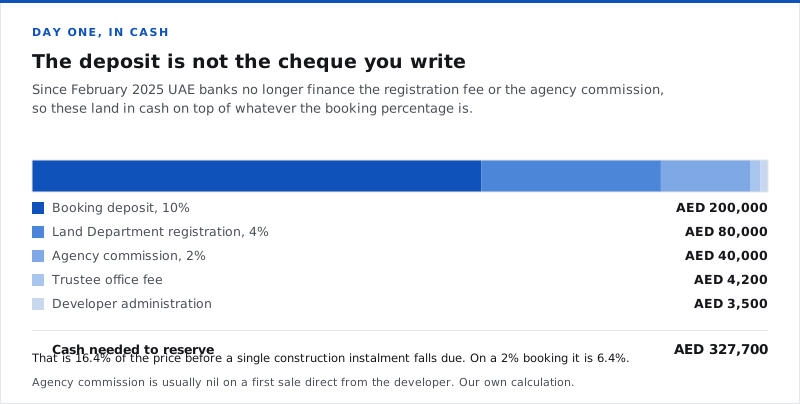
On a ten per cent booking that is about 16.4 per cent of the price in cash on day one, not ten. On a two per cent booking it is about 6.4 per cent. Buying a first release direct from the developer usually removes the agency commission, which takes two points off both figures.
Every line of that bill, including the ones that recur every year afterwards, is set out in our guide to the true cost of buying off-plan property in Dubai.
Two plans can read 60/40 and behave nothing alike
This is the most important section in this guide and the one competing pages leave out entirely.
A plan has a shape, which is the 60/40, and it has a trigger, which is the event that makes each instalment fall due. Two plans with the same shape and different triggers are different products.
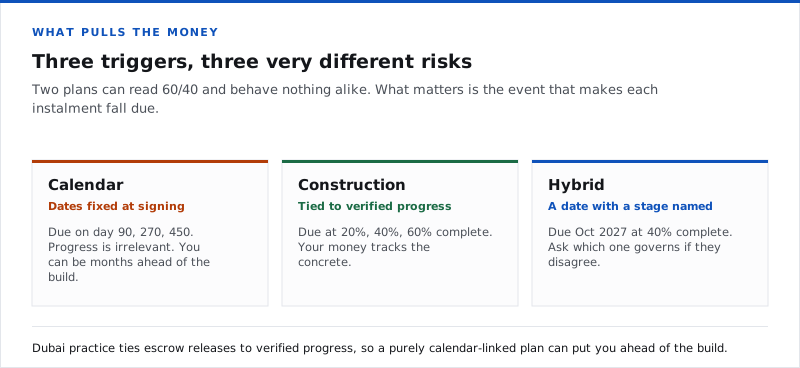
Our own set contains one of each, which makes the difference easy to show.
| Project | Schedule as published | Trigger |
|---|---|---|
| Azizi Florence | 10% on booking, then 5% at 90, 270, 450 and 630 days, 70% on completion | Calendar. Instalments fall on fixed days from signing. Construction progress does not enter into it. |
| Vindera at The Valley | 10% down, then eight instalments to Dec 2029 | Hybrid. Dated instalments, but the later ones name a construction stage: 40%, 60%, 80%, 100% complete. |
| Al Ghadeer Parks | 5% on booking, 50% during construction, 45% on handover Q2 2031 | Construction. The middle tranche is tied to the build rather than to dates. |
Why it matters: a calendar-linked plan can put you ahead of the build. Day 450 arrives whether or not the second floor does. If the project runs late, you keep paying to schedule while the thing you are buying falls behind.
A construction-linked plan cannot do that, because the instalment does not exist until the stage does. If the build stalls, your payments stall with it, which is precisely the protection you want.
The hybrid is the one to read twice. Vindera’s later instalments carry both a date and a percentage of completion. That is fine as long as you know which one governs when they disagree, and the only place that is settled is the sale and purchase agreement. Ask the question in those words: if the date arrives and the stage has not, what falls due?
Same developer, same shape, different plan
If the trigger argument still feels abstract, here is the same point made by one developer on two towers a few streets apart.
| Stage | Binghatti Starfall | Tilal Binghatti |
|---|---|---|
| On booking | 10% | 10% |
| After 3 months | 10% | — |
| After 6 months | 10% | — |
| Across construction | 30% | 50% |
| On handover | 40% | 40% |
| Shape | 60 / 40 | 60 / 40 |
Scale both to a AED 2 million home. Starfall wants AED 600,000 inside six months, because thirty per cent is front-loaded into three quick instalments. Tilal wants AED 200,000 in the same window and then spreads a million across the rest of the build.
Both are 60/40. Both are Binghatti. If you compared them on the shape alone you would conclude they were the same deal, and in the first year they are three times apart.
This is why the two-number summary is a starting point rather than an answer. Ask for the full milestone schedule, with dates, every time. A plan quoted as a ratio is a plan you have not seen yet.
What changes outside Dubai
Payment plans look broadly similar across the UAE, but the protections underneath them are set emirate by emirate, and in one case they are stricter than Dubai’s.
| Emirate | In our set | What differs underneath the plan |
|---|---|---|
| Dubai | Clusters at 60/40, with both 80/20 projects here | Law No. 8 of 2007 escrow, staged draws against certified progress, quarterly technical inspection from March 2026. |
| Abu Dhabi | Al Ghadeer Parks at 55/45, Sei Saadiyat at 60/40 | Its own registration authority and escrow regime. Plans sit close to Dubai norms. |
| Ras Al Khaimah | Solera and Richmond Residences, both 50/50 | Under Decree No. 12 of 2023, escrow runs as a main account with per-unit sub-accounts, and 5% of construction cost is retained for a year after completion. Stricter than Dubai. |
| Sharjah | Azizi Florence at 30/70 | Law No. 2 of 2022 with escrow mandatory from 2024. Freehold is granted project by project rather than by district. |
The Ras Al Khaimah detail is the one worth knowing. A per-unit escrow sub-account means your money is tracked against your own unit rather than pooled across the project, and the one-year retention after completion is a defect buffer that outlasts the handover. Neither shows up in a payment plan, and both change what the plan is worth.
It is also why comparing a Dubai 60/40 against a Ras Al Khaimah 50/50 on the percentages alone misses the point. You are not comparing two schedules. You are comparing two schedules wrapped in two different sets of rules.
Where the money actually sits between instalments
People picture their instalments going to the developer. They do not, or at least not directly, and understanding the plumbing changes how you read a plan.
Under Dubai’s Law No. 8 of 2007, every dirham a buyer pays on an off-plan purchase goes into a project escrow account, ring-fenced from the developer’s other money and from the developer’s creditors. The developer then draws from that account in stages, and each draw needs a completion certificate from an independent engineer plus regulator approval before the bank releases anything.
So the sequence is: you pay in on your schedule, the developer draws out on the building’s schedule. Those two schedules are not the same schedule, and the gap between them is your money sitting in a protected account.
This is also why the calendar-linked plan is worth a second look rather than a panic. Paying ahead of the build does not hand your money to the developer early. It parks it in escrow until the build catches up. The exposure is real but it is an exposure to the project completing, not to the developer spending your instalment on something else.
One 2026 change tightens this further. A RERA circular dated 10 March 2026, issued under Article 17 of the same escrow law, requires developers to keep a current technical inspection report on every registered project, renewed every three months. Those reports feed the escrow disbursement decision, and a developer who lets one lapse can find withdrawals restricted. In practice it means the construction progress behind your instalments is now verified quarterly rather than occasionally.
The mechanics of escrow, how to check a project’s account yourself, and what happens when things go wrong are covered properly in our guide to off-plan buyer protection in Dubai.
The plan often tells you who built it
Group the same sixteen schedules by developer instead of by structure and a pattern appears that is genuinely useful when you are comparing two launches.
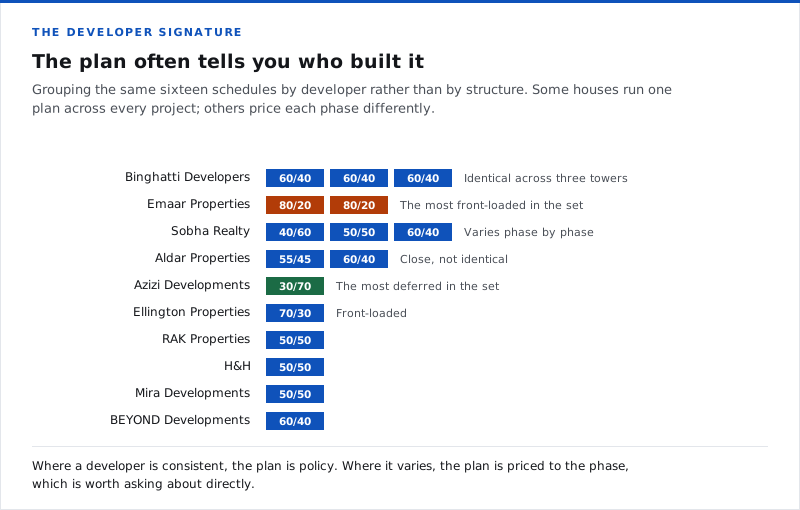
Binghatti runs 60/40 on all three towers we carry, unchanged. Emaar runs 80/20 on both of its, the most front-loaded in the set. Azizi is the other extreme at 30/70.
Sobha is the interesting case, running 40/60, 50/50 and 60/40 across three phases of the same masterplan. When a developer’s plan moves phase to phase, the plan is part of the pricing, and that is worth naming out loud at the table. Ask what the plan was on the last phase and why this one differs.
The financing constraint nobody prices in
Here is where the plan stops being an abstraction and starts deciding whether you can complete at all.
Mortgage lending on off-plan property in the UAE is capped at roughly fifty per cent of value, well below the eighty per cent a resident can borrow on a completed first home. And in practice the loan funds at or near handover, not during construction. Everything before that moment is your own money.
Line that up against the structures and the consequence is stark.
| Structure | Cash needed before the bank appears | Balance a 50% loan could cover |
|---|---|---|
| 30 / 70 | AED 600,000 | AED 1,400,000 due, up to AED 1,000,000 financeable |
| 50 / 50 | AED 1,000,000 | AED 1,000,000 due, fully coverable |
| 60 / 40 | AED 1,200,000 | AED 800,000 due, fully coverable |
| 80 / 20 | AED 1,600,000 | AED 400,000 due, fully coverable |
Read the middle column, not the right one. The more deferred the plan, the less cash you need during the build, but the more you are relying on a mortgage at the end. A 30/70 plan asks for AED 600,000 of your own money and then AED 1.4 million at handover, of which a fifty per cent loan covers at most AED 1 million. The remaining AED 400,000 is cash, and it is due on a date years away that you are committing to today.
The deferred plan is the easier one to start and the harder one to finish. The front-loaded plan is the opposite. Neither is better in the abstract. What settles it is whether your cash position in four years is more certain or less certain than it is today.
Post-handover plans, and why there is only one
A post-handover plan lets you keep paying after you have the keys, which usually means after you can start renting the place out. It is the most marketed feature in UAE off-plan and one of the rarest in practice.
Exactly one of our sixteen carries a genuine one. Richmond Residences at Mira Coral Bay splits fifty per cent during construction and fifty per cent on handover and across the three years after it.
Two things to understand about that structure. It is developer credit, not a mortgage, so it is not regulated like one, it does not appear on a credit file the same way, and the terms sit entirely in your contract. And the instalments usually run alongside your service charge, which starts the day you take handover, so the first year of ownership is the most expensive one rather than the moment things get easier.
Post-handover is genuinely useful if the rent covers the instalment. Work out whether it does before you sign, using a rent figure for a comparable finished unit rather than the projection in the brochure.
What happens if you cannot keep paying
Every plan is a commitment made years before the money is due, and circumstances move. This is the part of the conversation the sales office skips.
In Dubai the outcome is set by law rather than by your contract, and the crucial point is counter-intuitive: what the developer may keep depends on how far the building has got, not on how much you have paid. Under Law No. 19 of 2017, once the regulator has certified the completion percentage, a project over eighty per cent complete lets the developer keep the full amount paid or pursue the balance, while below sixty per cent the maximum retention is a quarter of the purchase price.
Which means the same missed instalment has very different consequences in year one and year four of the same project. The full tiers, and the two better exits to try first, are in our guides to off-plan buyer protection and selling before handover.
One practical note that belongs here rather than there: most developers will not issue the no objection certificate you need to sell until you have paid thirty to forty per cent, and some want fifty. On a 30/70 plan you may not reach that threshold until late in the build, which quietly makes a deferred plan harder to exit early. That is a real cost of deferral and it is almost never mentioned beside it.
Three buyers, three plans
Maya takes the 30/70 because the cash matters
She is buying a AED 2 million apartment and running a business that needs working capital. The deferred plan costs her AED 600,000 over the build instead of AED 1.2 million, and the AED 600,000 difference stays in her business for four years.
What she has to plan for: AED 1.4 million at handover, of which a fifty per cent loan covers at most AED 1 million. She needs AED 400,000 in cash on a date four years out, and she will struggle to sell early because she will be slow to reach the NOC threshold.
Daniel takes the 80/20 because he is paying cash anyway
No mortgage, funds already liquid, and the developer prices the front-loaded plan slightly better. He pays AED 1.6 million across the build and AED 400,000 at the end.
What he is accepting: four fifths of the price committed to an unfinished building. In exchange he clears the NOC threshold early, so if he wants out, the assignment route opens sooner for him than for Maya.
Reem reads the trigger and changes her mind
She is choosing between two 60/40 plans on similar apartments and assumes they are equivalent. One is construction-linked. The other pays on days 90, 270, 450 and 630 regardless of progress.
She takes the construction-linked one. Same shape, same money, but her instalments now stop if the build stops. That decision cost her nothing and it is the single highest-value thing in this guide.
How to read a plan you are handed
Seven questions, in order. Ask them of the schedule itself rather than of the person presenting it, and get the answers in the contract.
- What is the shape? Add up everything due before handover. That is the first number, and it should total 100 with the second.
- What triggers each instalment? A date, a construction stage, or both. If both, which one governs when they disagree.
- What is the booking deposit, and when is instalment two? A small deposit with a fast second payment is a front-loaded plan wearing a disguise.
- What falls due in cash on day one? Deposit plus 4% registration plus trustee and administration, and commission if it applies.
- What is the balance at handover, and how will you fund it? Assume a mortgage covers at most half the value and arrives at the end.
- When do you reach the NOC threshold? That is the date your exit opens. Work out which instalment gets you there.
- Is anything due after handover? If so, compare each instalment against a real rent for a comparable finished unit, not a projected one.
If you want to see how these structures land across live inventory rather than in the abstract, every project we analyse publishes its schedule on the page, and you can browse them by payment structure or start from the full list of analysed projects.
Questions buyers ask
What is the most common off-plan payment plan in Dubai?
60/40, meaning sixty per cent paid across construction and forty per cent at handover. Six of the sixteen projects we analyse with a published schedule use it, which makes it the safest thing to expect if a plan is quoted without being named.
What does a 60/40 payment plan actually mean?
Sixty per cent of the purchase price falls due before the keys, usually as a booking deposit of around ten per cent plus instalments across the build, and the remaining forty per cent is due at handover. On an AED 2,000,000 home that is AED 1,200,000 during construction and AED 800,000 at the end.
Is a deferred payment plan cheaper?
No. You pay the same price either way. A deferred plan changes when the money leaves your account and how much of it is committed to an unfinished building. Front-loaded plans sometimes carry a slightly better price, because the developer is borrowing more from you and less from a bank.
How much is the booking deposit on an off-plan property?
Ten per cent is the convention and ten of our sixteen projects use it, but the real range is two per cent to twenty per cent. Two Sobha projects reserve at two per cent; The Woods and Everly Place want twenty. Check when the second instalment falls due before judging a low deposit as generous.
How much cash do I need on day one?
More than the deposit. On a ten per cent booking with the 4 per cent registration fee, trustee fee, developer administration and agency commission, expect about 16.4 per cent of the price in cash. Since February 2025 UAE banks no longer finance the registration fee or the commission. Buying a first release direct from the developer usually removes the commission.
What is the difference between a construction-linked and a time-linked payment plan?
A construction-linked instalment falls due when a building stage is reached, so if the build stalls your payments stall with it. A time-linked or calendar-linked instalment falls due on a fixed date whether or not the work has progressed, which can put you ahead of the build. Some plans are hybrids that name both, and the contract decides which governs.
Where does my money go between instalments?
Into a project escrow account. Dubai Law No. 8 of 2007 requires every dirham a buyer pays to pass through it, ring-fenced from the developer’s creditors, and the developer may draw only in stages against progress certified by an independent engineer and approved by the regulator.
Can I get a mortgage on an off-plan property in the UAE?
Yes, but lending is capped near fifty per cent of value against eighty per cent on a completed first home, and the loan usually funds at or near handover. Everything paid during construction is your own money, which is why a deferred plan is easier to start and harder to finish.
Are post-handover payment plans common?
Much less common than the marketing suggests. Exactly one of our sixteen scheduled projects carries a genuine one. Treat it as developer credit rather than a mortgage, read the terms in the contract, and remember the instalments run alongside the service charge that begins at handover.
What happens if I cannot pay an instalment?
Under Law No. 19 of 2017 the outcome depends on how complete the project is rather than on how much you have paid. Above eighty per cent complete the developer can keep the full amount paid or pursue the balance; below sixty per cent the maximum retention is a quarter of the purchase price. Selling the unit on is usually a better outcome than termination, so explore that first.
When can I sell an off-plan property I am still paying for?
Most developers will not issue the no objection certificate you need until you have paid thirty to forty per cent of the price, and some require fifty. On a deferred plan you reach that threshold later, which quietly makes a 30/70 harder to exit early than an 80/20.
Do all developers use the same payment plan?
No, and the plan often identifies the developer. Binghatti runs 60/40 across all three towers we carry, Emaar runs 80/20 across both of its projects, and Azizi is at 30/70. Sobha varies between 40/60, 50/50 and 60/40 across phases of one masterplan, which means the plan there is part of the pricing.
Does the payment plan affect Golden Visa eligibility?
Not any more, on the current position. The ten-year visa is assessed on the registered value of the property rather than on how much you have paid, and the previous requirement to have paid half is reported to have been removed on 20 February 2026. The property still has to reach AED 2,000,000 on the Land Department’s certified valuation.
What should I ask before signing a payment plan?
Seven things: the total due before handover, what triggers each instalment, the booking deposit and the date of the second payment, the cash needed on day one including fees, the balance at handover and how you will fund it, the instalment at which your no objection certificate threshold is reached, and whether anything falls due after handover.
Last reviewed 14 September 2026 · Fact-checked by OffPlan Insider Research · How we verify
Sources
- Dubai Legislation Portaldlp.dubai.gov.ae · Law No. 8 of 2007 concerning Escrow Accounts for Real Estate Development
- Khairallahlegalkhairallahlegal.com · RERA circular of 10 March 2026 on technical inspection reports
- Kayrouzandassociateskayrouzandassociates.com · escrow disbursement mechanics and Law No. 19 of 2017 retention tiers
- OffPlan Insider project corpus, sixteen published milestone schedules read 14 September 2026Our own record
- Developer payment schedules for Azizi Florence, Vindera, Golf Trails, Al Ghadeer Parks, Richmond Residences and the three Binghatti towers, reviewed September 2026Our own record
Figures come from Dubai Land Department and RERA primary records, developer filings and named market indices. Where the market disagrees on a number we give the range and say who is measuring what, rather than picking the flattering one.