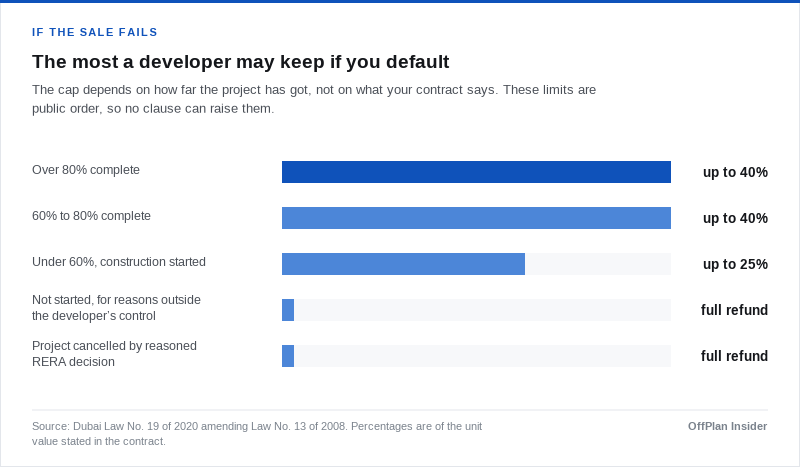
Money paid for an off-plan property in Dubai goes into a project-specific escrow account that is ring-fenced from the developer's creditors under Law No. 8 of 2007, and is released only against construction milestones certified by an independent engineer. If the purchase fails, Article 11 of Law No. 19 of 2020 sets what the developer may keep according to how far the project has progressed: up to 40% on termination, up to 25% below 60% completion, and a full refund where construction never commenced through no fault of the developer. Above 80% completion the developer may instead keep the contract alive, retain everything paid and claim the balance.
Key takeaways
- Escrow is held in the name of the project, not the developer, and is protected from the developer's creditors under Article 9(1) of Law No. 8 of 2007.
- You can verify the escrow bank, the project registration and site inspection photos yourself, free, on the Dubai REST app before paying anything.
- Where construction never commenced through no fault of the developer, or RERA cancels the project, you get a full refund. The old rule allowing the developer to keep 30% was removed in 2020.
- If RERA cancels a project, the 2010 implementing bylaw sets the clock: escrow refunds within 14 days of cancellation, and any shortfall paid by the developer within 60 days unless RERA extends it.
- On termination for buyer default the maximum retention is 40% above 60% completion and 25% below it. But above 80% completion the developer may instead keep the contract, retain everything paid and sue for the balance.
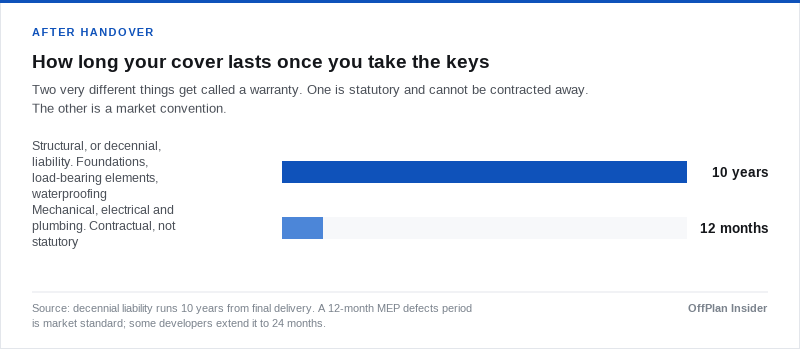
- Structural liability runs 10 years and cannot be contracted away. The 12-month cover on mechanical, electrical and plumbing is contractual, so check it is actually in your agreement.
- Treat handover delay as a live risk rather than an edge case, and read the completion date and grace period together as one combined deadline.
01The three laws that decide what happens to your money
Off-plan buyer protection in Dubai does not come from your developer's reputation, and it does not come from a clause your agent points at. It comes from three pieces of legislation, and they work whether or not the developer wants them to.
| Law | What it does for you |
|---|---|
| Law No. 8 of 2007 | Forces every off-plan project into a dedicated escrow account and ring-fences that money from the developer's creditors. |
| Law No. 13 of 2008 | Creates the Interim Real Property Register, known as Oqood. Article 3 makes an unregistered off-plan disposition void, which is what gives your purchase legal existence before the building does. |
| Law No. 19 of 2020 | Sets the maximum a developer may keep if the purchase fails, and makes those limits public order so no contract can override them. |
Everything else in this guide hangs off those three. If you take nothing else away, take this: the protections are statutory, they are specific, and most of them are things you can verify yourself in about five minutes.
02How escrow actually works
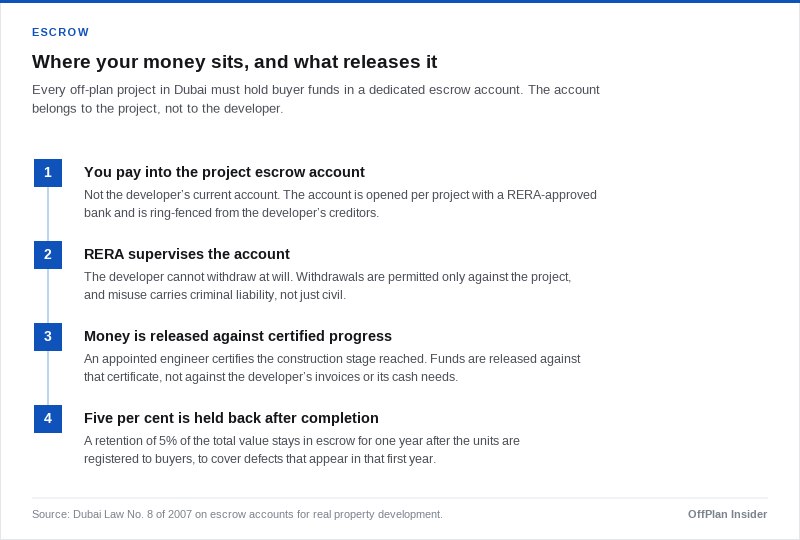
An escrow account in Dubai is not a courtesy arrangement. Article 3 of Law No. 8 of 2007 applies it to every developer selling off-plan and receiving money from purchasers or financiers. The law defines real estate development as projects for the construction of residential or commercial multi-storey buildings or compounds, which is the overwhelming majority of what is marketed off-plan in Dubai.
The account belongs to the project, not the developer
This is the clause that matters most and the one almost nobody quotes. Article 9(1) states that the escrow account is opened in the name of the project, is dedicated exclusively to that project's construction, and that no attachment may be imposed on it for the benefit of the developer's creditors. If the developer goes under, that money is not part of the wreckage.
Article 9(2) adds a second layer: one separate escrow account per project. A developer cannot move your money into a different development to plug a hole there.
Money is released against certified progress, not invoices
Funds leave the escrow account in tranches, and only after an independent trustee engineer certifies that a construction milestone has physically been reached and RERA approves the release. The escrow agent cannot release on the developer's say-so. This is why a payment schedule that front-loads cash before foundations are complete is a warning sign rather than a convenience.
The rule reaches brokers too. Article 12 of the 2010 implementing bylaw says a broker selling a project must pay the price straight into the project escrow account. It may not bank it in its own account or take its commission out first, and any agreement to the contrary is void.
If a project stalls in an emergency, Article 15 of the escrow law puts the escrow agent to work for buyers. After consulting the Land Department, it must take the steps needed either to get the project finished or to refund depositors.
Five per cent is held back after completion
Article 14 requires the escrow agent to retain 5% of the total value of the account once the developer receives the completion certificate. That retention is released one year after units are registered in purchasers' names. It is the statutory defect buffer, and it is 5% flat. Sources quoting a range of 5% to 10% are guessing.
The criminal provisions have teeth
Article 16 provides for a jail sentence and a fine of at least AED 100,000, or either penalty, for developing without a licence, offering units in fraudulent projects, misappropriating buyer money, an auditor filing a fraudulent report, or a consultant knowingly certifying fraudulent progress reports. Article 17 strikes a developer off the register entirely if they fail, without acceptable reason, to start construction within six months of receiving off-plan sale permission.
03How to verify escrow yourself in five minutes
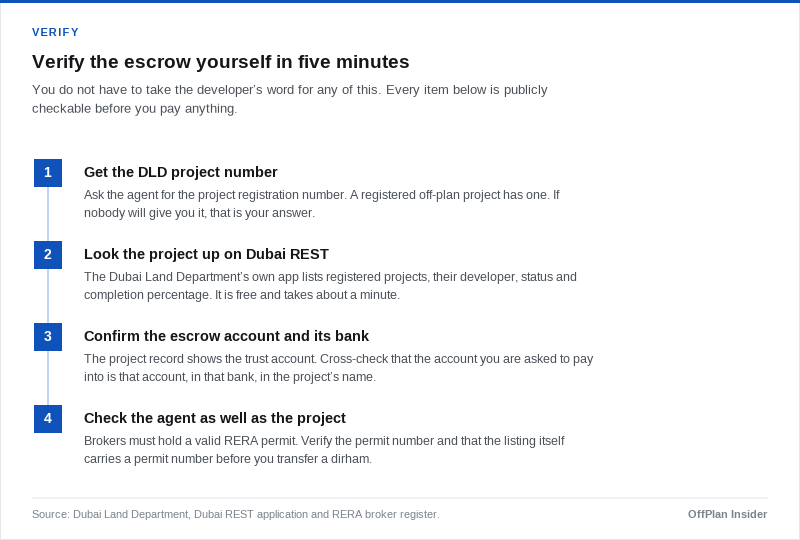
You do not have to take anyone's word for any of this. The Dubai Land Department publishes a free Project Status Enquiry tool, known as Mashrooi, on the web and inside the Dubai REST app. Do this before you pay a booking fee, not after. Our guide to the Dubai REST app walks through each screen, and the escrow law guide covers the account itself in more depth.
- Open the DLD Project Status Enquiry or the Dubai REST app and search the project by name or project number.
- Read the fact sheet: project number, plot area, number of units, registered date, start date, projected completion date and current status.
- Open the inspection details. DLD publishes site inspection records including photographs, so you can see the actual construction stage rather than the render.
- Check the developer block: developer name, developer number, licence status, phone, email and website. If the developer is not listed as active, stop.
- Read the escrow block. It names the bank and the escrow account for that project.
- Now compare that escrow account against the IBAN you were given. If they do not match, do not transfer anything.
That last step is the whole exercise. Every serious off-plan fraud in Dubai has the same shape: a payment request to somewhere other than the registered project escrow account. A personal account, a general company account, an overseas account, or a reservation fee taken "outside escrow" as a favour. There is no legitimate version of that request.
Check the agent too
Every RERA-registered agent has a BRN, a five or six digit broker registration number. Every brokerage has an ORN. Every property advertisement must carry a ten-digit Trakheesi permit number alongside the BRN. All three are verifiable in Dubai REST under Real Estate Services. An agent who hesitates when you ask for their BRN has told you what you needed to know.
04What the developer must do before selling you anything
Article 6 of Law No. 8 of 2007 requires a developer to file a specific bundle with DLD before selling off-plan: Chamber of Commerce membership, trade licence, the title deed for the land, the master or sub-developer contract, approved architectural and engineering designs, an auditor-certified cost and revenue statement, an undertaking to start construction, and a standard sale contract.
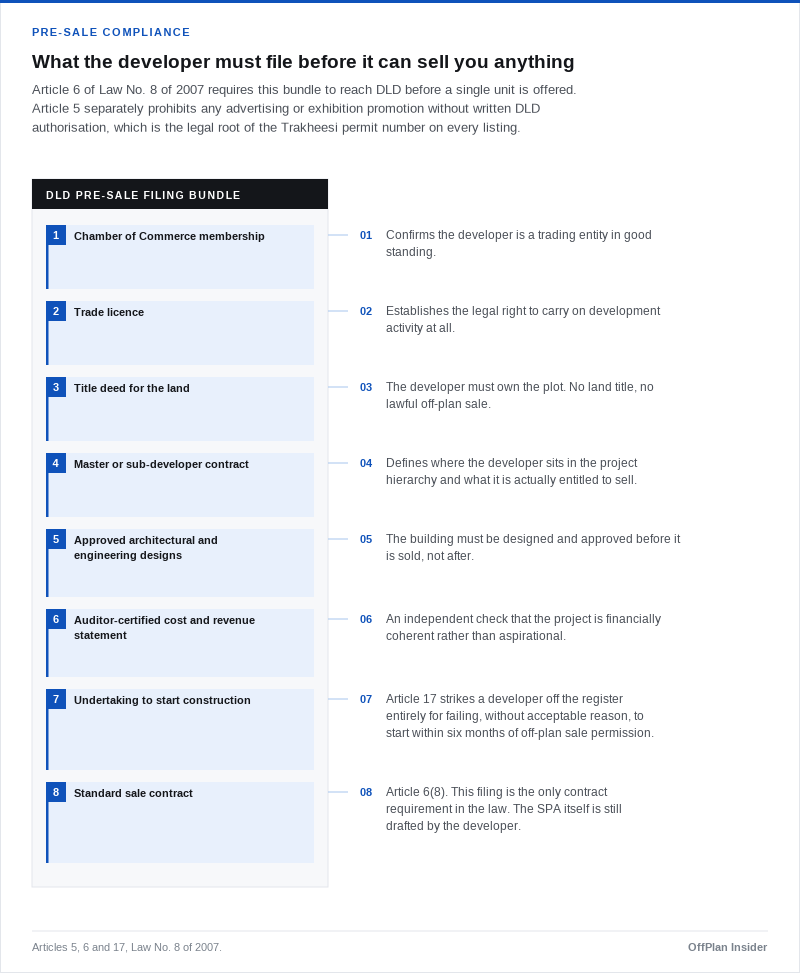
Article 5 goes further and prohibits any local or international advertising or exhibition promotion of off-plan units without written DLD authorisation. That is the legal root of the Trakheesi permit number you see on listings. An advertisement without one is not a marketing oversight; it is an unauthorised offer.
05What happens if handover is late
Late handover is the single most common off-plan complaint in Dubai. The most quoted number is a forecast made in 2025: of roughly 71,600 units projected to complete during 2026, only about 34,700 were expected to actually reach handover, a 48% realisation rate. Treat that as a planning assumption rather than a fact.
The year so far supports it. Actual completions in the first half of 2026 came in between 18,000 and 24,800 depending on whose count you use. By the end of September the total was about 33,000 according to ValuStrat and about 38,000 according to Cavendish Maxwell.
Cavendish Maxwell expects only 7,300 to 12,200 of the 24,400 homes still scheduled for the last quarter to complete on time. It also counts 136,100 homes scheduled for 2027 and 155,700 for 2028, and scheduled figures usually run ahead of what completes. If your unit is due in 2027 or 2028, read the grace period as part of the date. Delay remains common; it is not universal.
| Measure | Homes | Source |
|---|---|---|
| Delivered, January to June 2026 | 18,000 to 24,800 | Range of consultancy counts |
| Delivered, January to September 2026 | about 33,000 to 38,000 | ValuStrat; Cavendish Maxwell |
| Still scheduled for October to December 2026 | 24,400 | Cavendish Maxwell |
| Of those, expected to complete | 7,300 to 12,200 | Cavendish Maxwell |
| Scheduled for 2027 | 136,100 | Cavendish Maxwell |
| Scheduled for 2028 | 155,700 | Cavendish Maxwell |
Three things to check in your contract
- The Anticipated Completion Date. Is it a date, such as 31 December 2027, or a quarter, such as Q4 2027? A quarter is three months of ambiguity before the grace period even starts.
- The grace period. Typically six to twelve months past the anticipated completion date, and generally enforceable. Once it expires without handover, the developer is in breach.
- What actually triggers handover. Building completion certificate, RERA sign-off, or merely a notice sent to you? The third is developer-favourable drafting and worth negotiating.
Force majeure is narrower than developers imply
UAE law requires impossibility, not difficulty: the event must be external, unforeseeable and unavoidable. The Dubai Court of Cassation rejected most COVID-19 construction force majeure claims because work continued in some form, and rejected the 2008 crash as a normal economic cycle rather than an extraordinary event. The developer relying on force majeure has to prove it, not you.
For a project that never started, the 2010 implementing bylaw is specific. Article 21 lists what counts as beyond the developer's control: land expropriated for the public interest, a government suspension for re-planning, structures or utility lines found on the site, a master developer changing the plot boundaries, or other reasons RERA sets. Article 22 lists what counts as the developer's own negligence, including delay in taking the land or obtaining approvals and failing to register the project with RERA.
Useful drafting to look for: some contracts cap force majeure at six or twelve months and give either party a right to terminate after that. That is a materially better position than an open-ended suspension.
Your remedies once the grace period lapses
Under UAE civil law the non-breaching party may elect either specific performance, meaning the developer must finish and deliver, or termination with compensation. Note that the Civil Transactions Law was itself replaced: Federal Decree-Law No. 25 of 2025 came into force on 1 June 2026 and repealed Federal Law No. 5 of 1985. The principles below survive in substance, but the article numbering has changed, so any contract signed from June 2026 onwards should be read against the new code rather than the old one. The practical rule of thumb among practitioners is that a nearly complete project is worth pursuing to completion, while a stalled one is worth terminating and reclaiming.
When you can ask a court to end the contract
Delay is not the only ground. Article 20 of the 2010 implementing bylaw lets a buyer go to court to terminate where the developer:
- refuses, without a reason DLD accepts, to give you the final sale agreement;
- declines to link your payments to the construction milestones RERA proposes;
- materially departs from the specifications agreed in the contract; or
- hands over a unit that proves unfit for use because of material construction defects.
General legal grounds for termination remain open as well. The second item is worth knowing at the reservation stage: a schedule tied to dates alone, with no construction milestones, is something you can push back on.
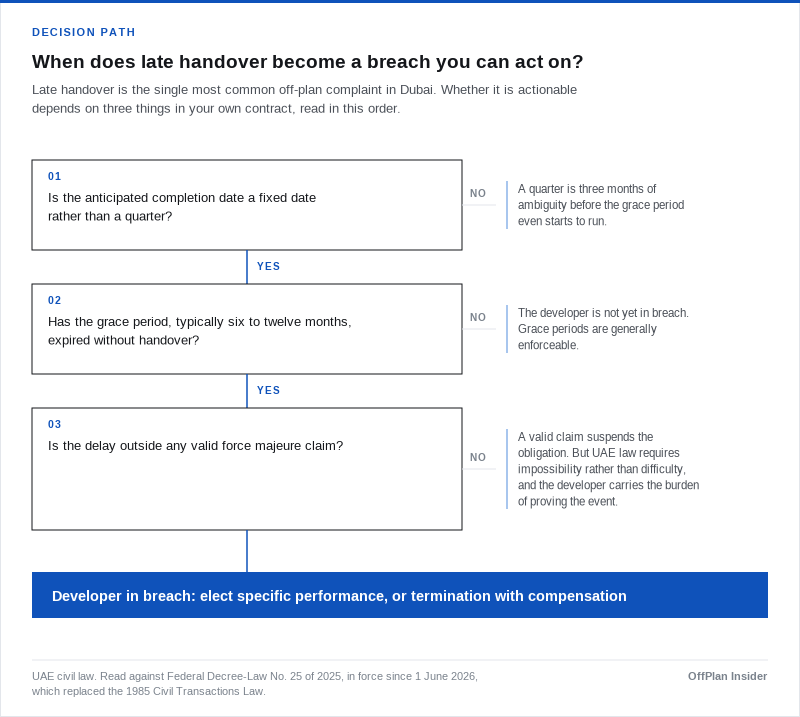
One principle worth knowing: UAE courts hold a mandatory, non-excludable power to adjust agreed compensation to the loss actually suffered, in both directions. Any contract term stating that a liquidated damages figure is final and non-adjustable is void on that point. This was Article 390 of the 1985 code and carries through into the 2025 replacement.
06What happens if you cannot pay
This is where most published guidance in Dubai is simply out of date, and the error runs in the developer's favour. Article 11 of Law No. 19 of 2020 sets out a mandatory procedure, and the developer cannot shortcut it. It applies to every off-plan contract, whether signed before or after the law took effect.
Defaults rise and fall with the market. Emaar's founder said in October 2026 that its cancellations had reached about 1,200 units during the period of regional tension and were back under 600, with buyers paying at levels comparable to 2025. If you are already behind, our guide to missed off-plan instalments covers the options before it reaches this stage.
- The developer notifies the Dubai Land Department on the prescribed form.
- DLD verifies the breach, serves a 30-day written notice on you, and where possible mediates a settlement. A settlement becomes a binding addendum to your contract.
- If the breach is not remedied, DLD issues an official document confirming procedural compliance and certifying the completion percentage of the project.
- Only then may the developer act, without going to court or arbitration, and only within the limits below.
| Completion of the project | Maximum the developer may retain |
|---|---|
| Over 80% | Keep the contract and claim the outstanding balance; or ask DLD to sell the unit at public auction, with you bearing the costs; or terminate and retain up to 40% of the unit value stated in the contract. |
| 60% to 80% | Terminate and retain up to 40% of the unit value. |
| Under 60%, construction commenced | Terminate and retain up to 25% of the unit value. |
| Not commenced, for reasons beyond the developer's control | Refund everything through the escrow procedure. |
| Project cancelled by a final reasoned RERA decision | Refund everything through the escrow procedure. |
Read the top row carefully, because it is the harshest and it is routinely summarised away. Where the project is more than 80% complete, the developer may keep the contract alive, retain everything you have paid and still sue you for the outstanding balance. There is no 40% ceiling in that scenario. The 40% cap applies where the developer chooses to terminate.
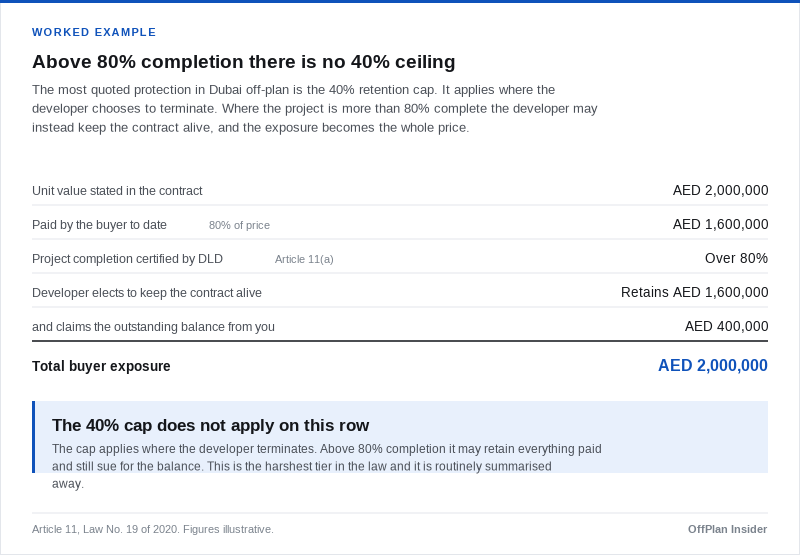
Two qualifications that materially change the outcome. First, the refund deadline of one year from termination, or 60 days from the unit being resold, whichever comes first, applies to the retention tiers only. Where the entitlement is a full refund under Article 11(b), the money is returned through the Law No. 8 of 2007 escrow procedure and Law No. 19 sets no deadline of its own. If RERA has formally cancelled the project, the 2010 bylaw supplies one: 14 days from the escrow account and 60 days for any shortfall, covered below. Where a project has simply never started and has not been cancelled, there is no fixed statutory clock, which is precisely the situation in which buyers most want to know how long they will wait.
Second, the full-refund limb is narrower than most summaries suggest. Article 11(b) applies where the developer has not commenced work for reasons beyond his control and without negligence or omission on his part. Where non-commencement is the developer's own fault, Article 11 provides no tier at all and you are thrown back on the courts. Article 11(g) preserves that right in any event.
Two things most published guidance still gets wrong
- Project, not unit. The percentage that decides the tier is the completion of the project as a whole, certified by DLD under RERA's standards. It is not the progress of your unit or your tower, and in a large phased development those can be very different numbers.
- The vanished 30%. Article 15 of the 2010 implementing bylaw let a developer that had not started for reasons beyond its control keep up to 30% of the amounts paid. The 2020 law replaced that with a full refund, and Article 2 of the 2020 law repeals anything that contradicts it. The 2010 bylaw is still published with the old wording, which is a large part of why this error is everywhere.
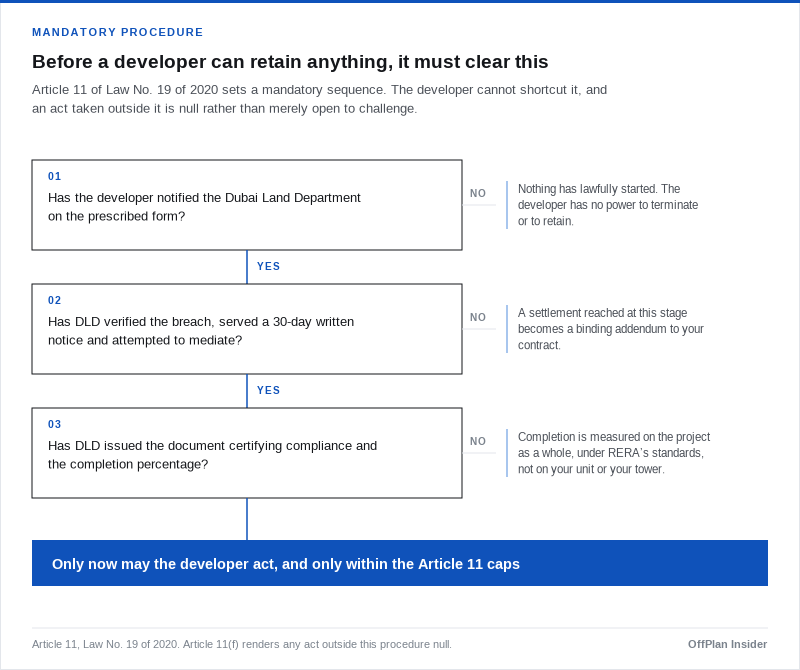
If a contract you are being asked to sign allows retention above these limits, or allows termination without the DLD procedure, Article 11(f) renders that act null. It is not a negotiating position; it is unenforceable.
07What happens if the project is cancelled outright
RERA can cancel a project, and Executive Council Resolution No. 6 of 2010, the implementing bylaw of Law No. 13 of 2008, sets out exactly how. Article 23 lets RERA cancel on a reasoned technical report on nine grounds:
- the developer fails, without valid justification, to start construction despite holding every approval;
- it commits one of the escrow-law offences in Article 16 of Law No. 8 of 2007;
- it has no genuine intention to build;
- the master developer withdraws the land because the sub-developer broke its obligations;
- the land is wholly taken by a planning or re-planning project;
- the developer fails to build through gross negligence;
- it states that it will not build, for reasons RERA accepts;
- it is declared bankrupt; or
- any other reason RERA determines.
The procedure then runs on a short, fixed clock. Under Article 24 the developer has seven working days from notice to lodge a written grievance, and RERA has seven working days to decide it. If RERA rejects it, the cancellation is final.
Article 25 then requires RERA to appoint a certified auditor, at the developer's expense, to check what was paid in and what was spent. It instructs the escrow agent to refund buyers within 14 days of cancellation. If the account cannot cover everything, Article 26 gives the developer 60 days to pay the balance, which RERA may extend for valid reasons. If the developer still does not pay, Article 27 requires RERA to act for buyers, including referring the matter to the courts.
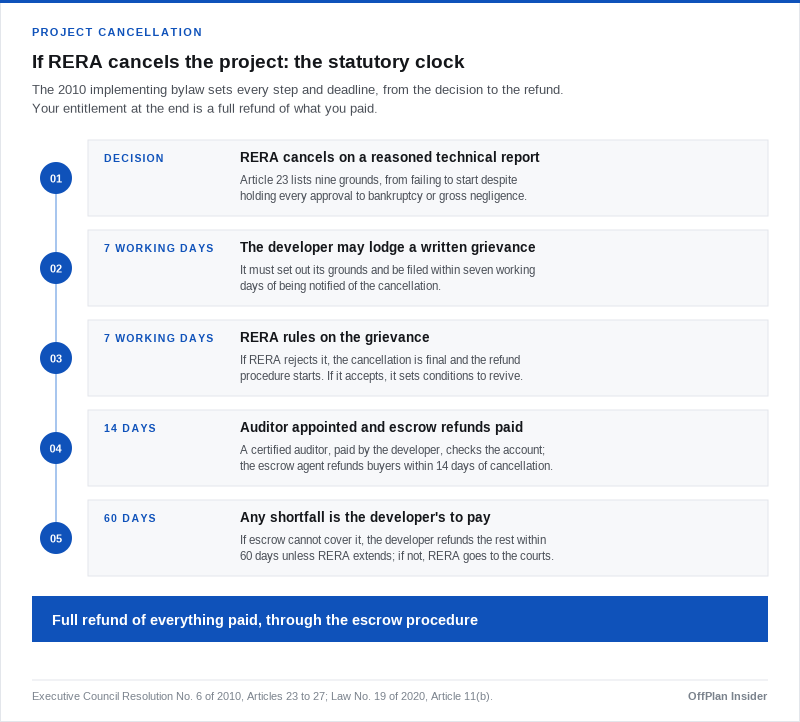
There is also a dedicated forum: the Special Tribunal for Unfinished and Cancelled Real Property Projects. It replaced the tribunal formed by Decree No. 21 of 2013 for liquidating cancelled projects, under Decree No. 33 of 2020, issued on 24 November 2020. Its jurisdiction covers stalled and unfinished projects, not only cancelled ones, which matters if your development has simply stopped rather than been formally cancelled.
08Protection that survives handover
The statutory cover does not stop when you collect the keys.
| Cover | Duration | Notes |
|---|---|---|
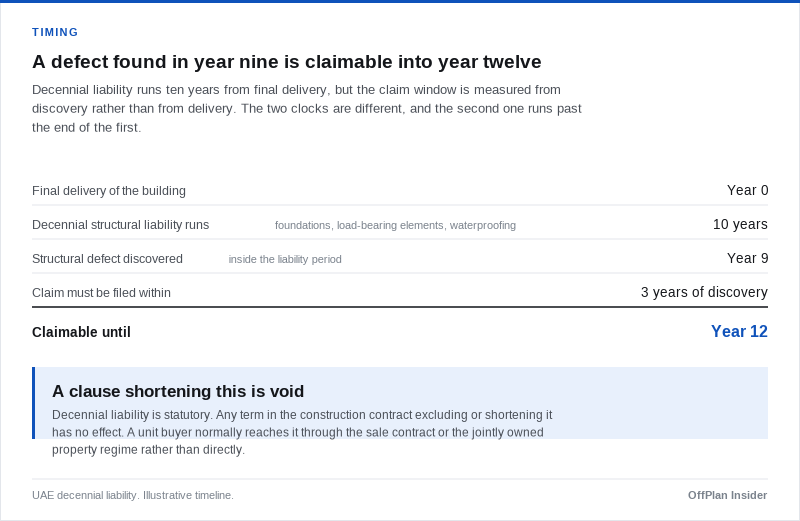
| Structural, or decennial, liability | 10 years from final delivery | Foundations, load-bearing elements, waterproofing. Statutory, and any clause in the construction contract excluding or shortening it is void. Note that the liability runs from the contractor and supervising engineer to the party who commissioned the works, so a unit buyer normally reaches it through the sale contract or the jointly owned property regime rather than directly. |
| Mechanical, electrical and plumbing | 12 months from handover | Contractual, not statutory. A 12-month defects liability period is market standard and most major developers offer it, some extending to 24 months for MEP and waterproofing, but it is a term of your contract rather than a right conferred by law. Check that it is actually there. |
| Escrow retention | 5% held for 1 year after unit registration | The statutory defect buffer under Article 14 of Law No. 8 of 2007. |
One timing point that catches people out: decennial claims must be filed within three years of discovery. A structural defect discovered in year nine is therefore claimable into year twelve.
Snagging is your responsibility to organise and your leverage to use. The average new Dubai apartment presents with 50 to 150 snags at handover, with water leakage, HVAC faults, electrical faults and finishing defects leading the complaint categories. Defects documented at inspection remain the developer's responsibility, but only if you snag before signing the handover acceptance. Our guides to snagging and the handover process set out the steps.
09The contract clauses that decide your risk
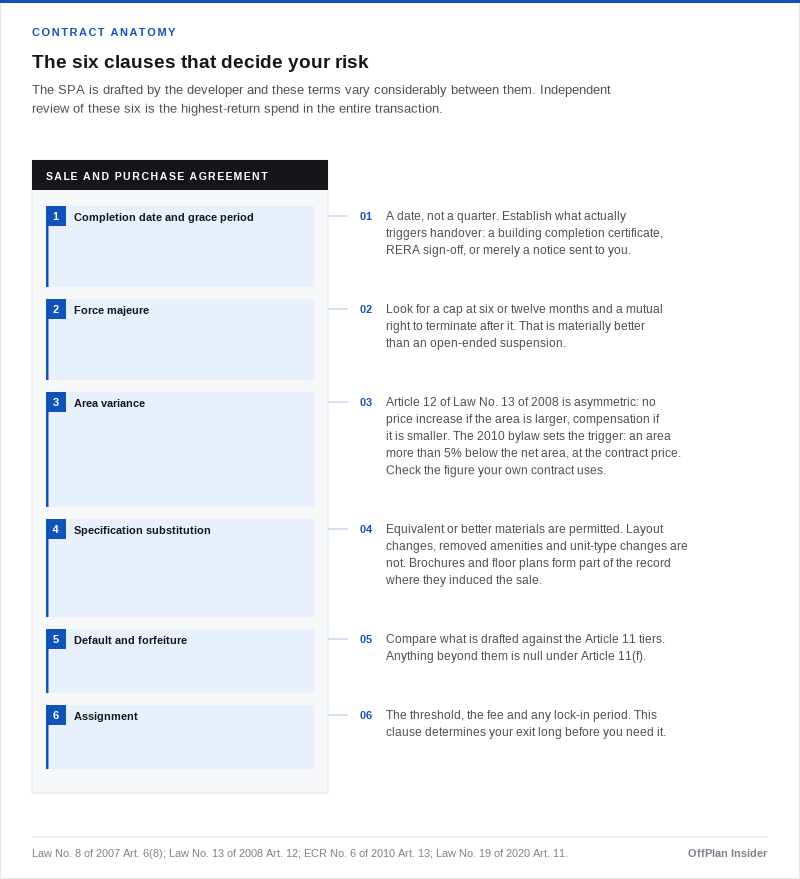
There is no single mandatory RERA template that every off-plan contract must follow. Form A, Form B and Form F are broker forms, not the sale and purchase agreement. What the law does require, under Article 6(8) of Law No. 8 of 2007, is that the developer file a standard sale contract with DLD before selling. In practice the SPA is drafted by the developer and the terms below vary considerably between them. Independent review of these clauses is the highest-return spend in the entire transaction.
- Completion date and grace period. A date, not a quarter. Know what triggers handover.
- Force majeure. Look for a cap and a mutual termination right.
- Area variance. The statutory rule in Article 12 of Law No. 13 of 2008 is asymmetric and widely misreported. If the delivered area is larger, the developer may not claim any increase in price. If it is smaller, the developer must compensate you unless the decrease is inconsequential. Article 13 of the 2010 implementing bylaw puts a number on that: compensation is due where the actual area is more than 5% below the net area in your sale agreement and plan, calculated at the agreed price. It is not a bilateral plus-or-minus tolerance, and the 3% carpet-area rule some sites cite is Indian RERA, not Dubai. Read how your own contract defines the area, because the bylaw measures against the net area it records.
- Specification substitution. Developers may substitute equivalent or better materials. They may not change the layout, remove promised amenities or change the unit type without exposure. Brochures, floor plans and specification sheets form part of the contractual record where they induced the sale.
- Default and forfeiture. Compare what is written against the Article 11 tiers above.
- Assignment. The threshold, the fee and any lock-in period. This determines your exit and is covered in detail in our guide to selling off-plan before handover.
One structural advantage worth knowing: off-plan contracts typically qualify as adhesion contracts, which lets a court modify or exempt the weaker party from arbitrary conditions and read ambiguity against the drafting party. You are not negotiating from nothing.
10Oqood is not a title deed
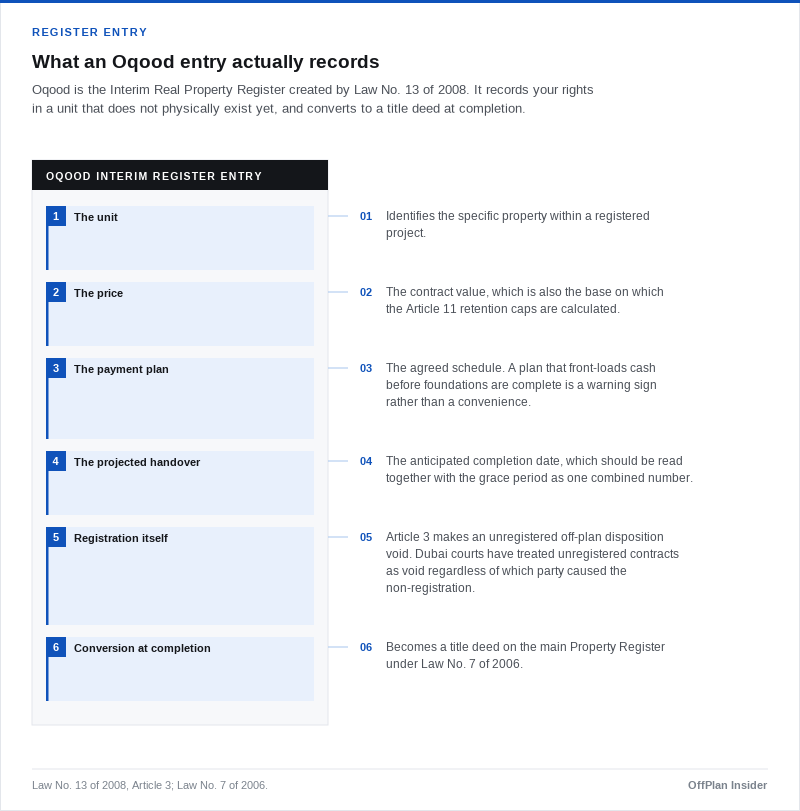
Oqood is the Interim Real Property Register created by Law No. 13 of 2008. It records your rights in a unit that does not physically exist yet: the unit, the price, the payment plan and the projected handover. At completion it converts to a title deed on the main Property Register under Law No. 7 of 2006.
The critical provision is Article 3 of Law No. 13 of 2008, which makes an unregistered off-plan disposition void. Dubai courts have treated unregistered contracts as void regardless of which party caused the non-registration. Registration is not paperwork; it is the thing that makes your purchase exist in law.
11Red flags, in order of seriousness
- Any request to pay anywhere other than the registered project escrow account.
- No RERA project registration number, or a developer who cannot produce the plot number or DLD-registered project location.
- An agent with no BRN, a brokerage with no ORN, or an advertisement with no Trakheesi permit number.
- A payment schedule that front-loads a large share of the price before meaningful construction.
- Guaranteed rental returns. There is no such thing, and offering one is a standing warning sign.
- Pressure to sign within 48 hours. Proper due diligence takes one to two weeks, and that pressure exists to prevent it.
- A booking form whose price differs from the contract that arrives later. The booking form is often not the binding agreement; the SPA is. Never treat a price as locked until the SPA is signed.
12Where to complain if it goes wrong
- DLD conciliation under Article 14 of Executive Council Resolution No. 6 of 2010, and the Centre for Amicable Settlement of Disputes under Law No. 18 of 2021.
- Dubai Courts Real Estate Circuit, the default forum for onshore property disputes.
- The Special Tribunal for cancelled and stalled projects, under Decree No. 33 of 2020.
- DIAC arbitration, but only where your contract contains a valid signed arbitration clause.
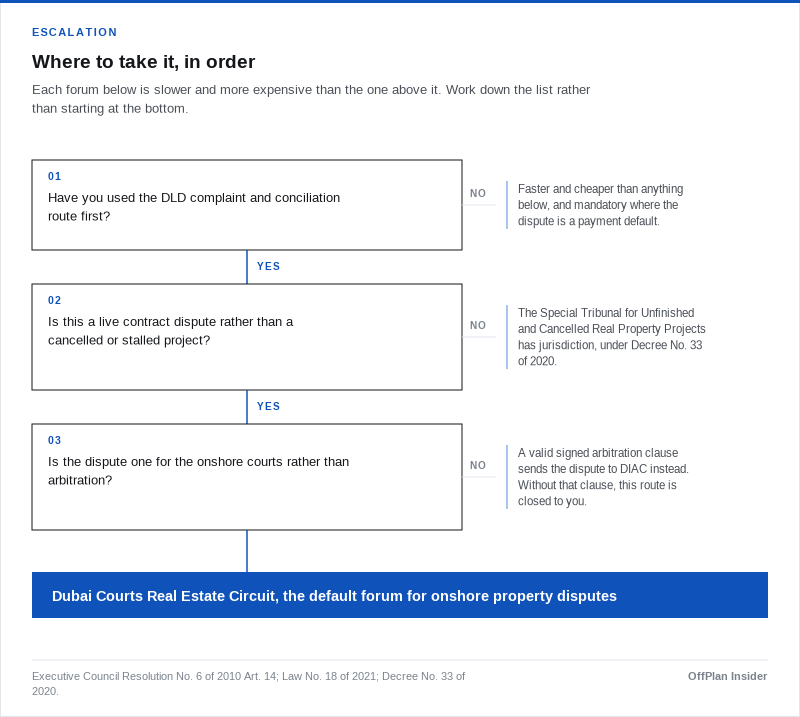
Before any of those, use the DLD complaint route. It is faster, it is cheaper, and in the case of payment default it is mandatory anyway.
13What this means in practice
Dubai off-plan is better protected than its reputation suggests, and worse protected than a brochure implies. The escrow ring-fence is real and survives insolvency. The Article 11 retention limits are real and cannot be contracted around. The 10-year structural warranty is real and cannot be shortened.
What is not protected is your timeline, and that is the risk actually worth pricing. Verify the project on Dubai REST, confirm the escrow account before you transfer anything, read the completion date and grace period as one combined number, and understand what your exit costs before you need it. Once you have done that, you have removed most of the downside that people actually experience.
Next: what the purchase actually costs, end to end, in our guide to the true cost of buying off-plan property in Dubai.
[opi_market_data]
FAQQuestions buyers ask.
Is my money safe if the developer goes bankrupt?
Article 9(1) of Law No. 8 of 2007 states that the escrow account is opened in the name of the project and that no attachment may be imposed on it for the benefit of the developer's creditors. That is the clause that survives insolvency. Each project also has its own separate account, so funds cannot be moved to cover losses elsewhere.
How do I check that a Dubai project has a real escrow account?
Use the DLD Project Status Enquiry tool or the Dubai REST app. It publishes the project number, status, site inspection photographs, developer details and the escrow bank and account for that project. Compare the escrow account it shows against the IBAN you have been given before transferring anything.
What can a developer keep if I stop paying my instalments?
It depends on how far the project has progressed, and DLD certifies that percentage, not the developer. If the developer terminates, the maximum retention is 40% of the unit value above 60% completion and 25% below it.
Above 80% completion the developer has a harsher option: keep the contract alive, retain everything you have paid and claim the outstanding balance from you. If construction never commenced for reasons beyond the developer's control, or RERA cancels the project, you are entitled to a full refund. These limits are public order and any contract term allowing more is null.
Is it true the developer can keep 30% if construction never started?
No. That was the rule in Article 15 of the 2010 implementing bylaw, which let a developer that had not started for reasons beyond its control keep up to 30% of the amounts paid.
Law No. 19 of 2020 replaced it: where the developer has not commenced work for reasons beyond its control and without negligence on its part, you get a full refund through the escrow procedure. The 2010 bylaw is still published with the old wording, which is why the 30% figure keeps resurfacing.
What happens if RERA cancels my off-plan project?
You are entitled to a full refund. Under Articles 23 to 27 of the 2010 implementing bylaw, the developer has seven working days to lodge a grievance and RERA seven working days to rule on it.
Once cancellation is final, a certified auditor is appointed at the developer's expense and the escrow agent refunds buyers within 14 days.
If the escrow account cannot cover everything, the developer must pay the rest within 60 days unless RERA extends that, and RERA takes the matter to the courts if it does not.
What happens if my Dubai off-plan handover is late?
Check the anticipated completion date and the grace period in your contract, which is typically six to twelve months. Once the grace period expires without handover the developer is in breach, and UAE civil law lets you elect either specific performance or termination with compensation.
Force majeure requires impossibility rather than difficulty, and the developer relying on it has to prove it. Delay is common: by the end of September 2026 about 33,000 to 38,000 Dubai homes had been delivered in the year, well short of the full-year schedule.
Note that the Civil Transactions Law was replaced by Federal Decree-Law No. 25 of 2025 with effect from 1 June 2026, so article numbering in older guidance no longer matches.
Does Oqood registration mean I own the property?
Oqood is the interim register under Law No. 13 of 2008. It records your rights in a unit that does not physically exist yet and converts to a title deed at completion. It is not itself a title deed, but registration is essential: Article 3 makes an unregistered off-plan disposition void.
How long is the warranty on a new Dubai property?
Structural or decennial liability runs for 10 years from final delivery and cannot be contracted away, though a unit buyer normally reaches it through the sale contract or the jointly owned property regime rather than directly against the contractor.
Cover for mechanical, electrical and plumbing is typically 12 months from handover, extended to 24 months by some developers, but that is a contractual term rather than a statutory right, so confirm it is in your agreement. Decennial claims must be filed within three years of discovering the defect.
Sources & methodWhere these figures come from.
Sources
- Dubai Legislation Portal: Law No. (8) of 2007
- Dubai Legislation Portal: Law No. (13) of 2008
- Dubai Legislation Portal: Executive Council Resolution No. (6) of 2010 Approving the Implementing Bylaw of Law No. (13) of 2008
- Dubai Legislation Portal: Law No. (19) of 2020 Amending Law No. (13) of 2008 Regulating the Interim Real Property Register in the Emirate of Dubai
- Dubai Legislation Portal: Decree No. (33) of 2020 Concerning the Special Tribunal
- Dubai Land Department: Real estate project status
What we could not verify
- The six-to-twelve-month grace period, the 12-month MEP defects period and the 50 to 150 snags per apartment are market practice and industry figures, not statutory rules.
- That the Civil Transactions Law was replaced by Federal Decree-Law No. 25 of 2025 from 1 June 2026, and that the compensation-adjustment principle carried over, was not re-checked against the federal text on 10 November 2026.
- Delivery counts for 2026 differ by consultancy (ValuStrat about 33,000 and Cavendish Maxwell about 38,000 by the end of September), so the text gives a range.
10 Nov 2026 · Reviewed by OffPlan Insider Research. First published 26 Aug 2026, updated 10 Nov 2026.