An escrow account in Dubai is a bank account opened in the name of an off-plan project, into which every payment from buyers and from the project's lenders must be paid. Law No. 8 of 2007 requires one for every developer selling off-plan, ring-fences the money from the developer's creditors, allows it to be used only to build that project, and holds back 5% for a year after the units are registered. The account is managed by a bank approved by the Dubai Land Department and supervised by RERA.
Key takeaways
- Law No. 8 of 2007 has 22 articles in five chapters. It applies to every developer in Dubai that sells units off-plan and takes money from buyers or financiers.
- Article 9 is the core: the account is in the project's name, is used only for that project's construction, cannot be attached by the developer's creditors, and each project has its own account.
- Before selling, the developer must be on the developer register (Article 4), have written approval to advertise (Article 5) and file eight documents, including the land title deed and a standard sale contract (Article 6).
- Any loan secured on the project must be paid into the escrow account (Article 13), and 5% of the account is held back after completion until a year after the units are registered (Article 14).
- If a project stalls, the escrow agent must protect depositors by securing completion or arranging refunds (Article 15). Article 12 lets depositors see and copy their own account records.
- Seven offences carry prison and/or a fine of at least AED 100,000 (Article 16), and a developer that fails to start building within six months of sale permission is struck off (Article 17).
- Only pay into the escrow account shown for the project on the Dubai Land Department's Project Status service, and check it against every payment request.
01What is an escrow account in Dubai?
An escrow account in Dubai is a bank account opened in the name of an off-plan project. Every payment you make towards the price of an off-plan home goes into it, and the money can be used only to build that project.
The rule comes from Law No. 8 of 2007 on escrow accounts for real estate development. A bank approved by the Dubai Land Department manages the account, and RERA, the department's regulatory arm, regulates, audits and monitors it. Our guide to RERA explains who does what.
This guide goes through the law itself, chapter by chapter and article by article, and explains what each part means for a buyer. For the wider picture, including what a developer may keep if a purchase fails and what happens when handover is late, read our off-plan buyer protection guide. This is general information, not legal advice.
02What is Law No. 8 of 2007?
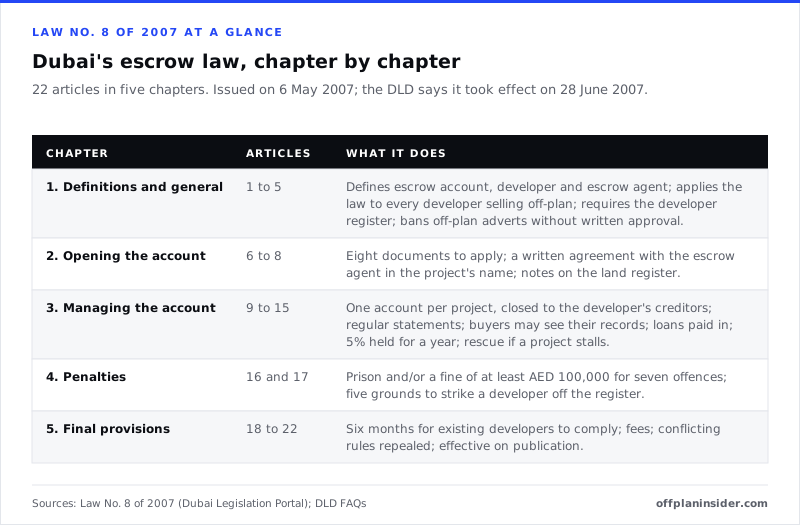
It is Dubai's escrow law. It was issued on 6 May 2007, and the Dubai Land Department says it took effect on 28 June 2007. It has 22 articles in five chapters.
The law sits alongside two others. Law No. 13 of 2008 created the interim register, Oqood, where off-plan sales are recorded. Law No. 19 of 2020 amended it to set what happens to your money if a sale is terminated. Law No. 8 of 2007 deals with the account itself: who must open one, what goes in, what comes out and who is punished for misusing it.
03Chapter 1: who does the law cover? (Articles 1 to 5)
The first chapter defines the terms, sets who the law applies to and adds two gates a developer must pass before selling: registration and advert approval.
Article 2: the definitions that matter
Four definitions shape everything else:
- Escrow account. The project's bank account into which payments from off-plan buyers or from the project's financiers are deposited.
- Escrow agent. A bank or financial institution accredited by the Dubai Land Department to manage escrow accounts. Buyers often call it the trustee.
- Developer. A licensed person that buys and sells real property for development, including both master developers and sub-developers.
- Real estate development. Projects to build residential or commercial multi-storey buildings or compounds.
The last definition is wide. It covers apartment towers and also compounds, so a townhouse or villa community sold off-plan is inside the law as well.
Article 3: every developer selling off-plan
The law applies to developers that sell units off-plan in Dubai and receive payments from buyers or financiers. The Dubai Land Department describes it as covering all real estate developers in Dubai, without exception.
The department adds two practical rules. A developer that sold units before opening an account must deposit the earlier receipts into escrow. Projects announced before the law are also covered, although RERA can grant exemptions, mainly for projects that were already well advanced.
Article 4: the developer register
No developer may operate unless it is entered in the department's Register of Real Estate Developers and licensed by the competent authorities. Registration is a gate, not a grade: it shows the developer is allowed to sell, not how good its projects are.
Article 5: no advert without approval
A developer needs the department's written authorisation before it advertises off-plan units in local or international media or at exhibitions. This article is the legal root of the advert permits issued through Trakheesi and the Madmoun QR codes on adverts today. Our project and developer checklist shows how to scan and check them.
04Chapter 2: how is an escrow account opened? (Articles 6 to 8)
Before selling off-plan, the developer must file a set of documents, sign an agreement with the escrow agent and open an account in the project's name.
Article 6: the eight documents
| Document under Article 6 | Why it matters to you |
|---|---|
| 1. Dubai Chamber of Commerce and Industry membership | Confirms the company is an established business in Dubai |
| 2. Trade licence | The company is licensed to carry on development |
| 3. Title deed to the land | The developer can show it holds the plot |
| 4. Master developer and sub-developer contract | Where a sub-developer builds within a master community, its right to do so is on file |
| 5. Approved initial designs and engineering plans | Approved by the authorities and the master developer before units are sold |
| 6. Statement of estimated costs and revenues | Certified by an accredited chartered auditor |
| 7. Undertaking to start construction | Once off-plan sales are approved; links to the six-month rule in Article 17 |
| 8. Standard sale contract | The form of agreement buyers will sign is filed in advance |
You will not see these documents yourself. What you can see is the result: a registered project on the department's Project Status service, with a named developer and an escrow bank.
Article 7: the escrow agreement
The developer and the escrow agent sign a written agreement. Payments are deposited in an account in the project's name, and the agreement sets how the account is run and each party's rights and duties. A copy goes to the Dubai Land Department.
The agreement is where the detailed release schedule lives. It is not a public document, which is why the department's own description of how releases work is useful (see below).
Article 8: notes on the land register
The department may note on the master developer's plot record that a sale agreement with a sub-developer exists. An off-plan buyer may also ask the department to note the buyer's purchase agreement with the sub-developer on the plot record. In practice, registration of your sale on Oqood under Law No. 13 of 2008 is the step that gives your purchase legal effect.
05Chapter 3: how is the account managed? (Articles 9 to 15)
This chapter holds the protections most buyers have heard of, and several that are rarely quoted.
Article 9: one project, one account, no creditors
Article 9 has two parts. First, the account is in the project's name, is used only for that project's construction, and the developer's creditors cannot attach the funds in it. Second, a developer with several projects must keep a separate escrow account for each.
Together they stop two things: money being taken by the developer's creditors, and money from one project being used to finish another.
Article 10: the register of escrow agents
The department keeps a Register of Escrow Agents, and agents must be qualified to manage escrow accounts. The Dubai Land Department says eligible agents are banks or financial institutions licensed by the UAE Central Bank to take third-party deposits, operating in Dubai and approved by RERA. A trustee may also lend to the project.
Article 11: statements and outside auditors
The escrow agent must send the department regular statements of revenue and expenditure. The department may ask for information at any time and may appoint outside auditors. If it proves a violation, it gives the agent written notice and a deadline to correct it.
Article 12: your right to your records
Depositors, or their representatives, may see and copy their own accounting records with the escrow agent. Official authorities may do the same.
This is a quiet but useful right. If you want proof that your instalments reached the project account, you can ask the escrow agent for your records, in addition to the developer's receipts and your own bank confirmations.
Article 13: loans go into escrow too
If a developer mortgages the project to borrow money, the lender must deposit the loan into the project's escrow account. The department adds that a project may be mortgaged for a bank loan only on that basis. A construction loan therefore ends up under the same controls as buyers' money.
Article 14: the 5% retention
After the developer obtains the completion certificate, the escrow agent holds back 5% of the total value of the escrow account. That amount is released one year after the units are registered in buyers' names.
The department describes the purpose as guaranteeing that defects, whether visible at completion or appearing within a year of handover, are fixed promptly. Our handover guide explains how to record defects so the retention period works for you.
Worked example. If a project's escrow account has received AED 200 million in total, the escrow agent holds back AED 10 million once the completion certificate is issued. That AED 10 million stays in the account until one year after the units are registered in buyers' names.
Article 15: if the project stalls
If a project stalls or is not completed, the escrow agent must, after consulting the department, take steps to protect depositors' rights. The law names two outcomes: making sure the project is completed, or arranging refunds.
Law No. 19 of 2020 adds the refund rule. Where a project is cancelled by a final reasoned RERA decision, or construction never started for reasons beyond the developer's control, buyers are entitled to a full refund through the escrow procedure.
06What goes into the account, and what may come out?
Everything paid towards the price goes in. What comes out is limited to building the project, and only as construction progresses.
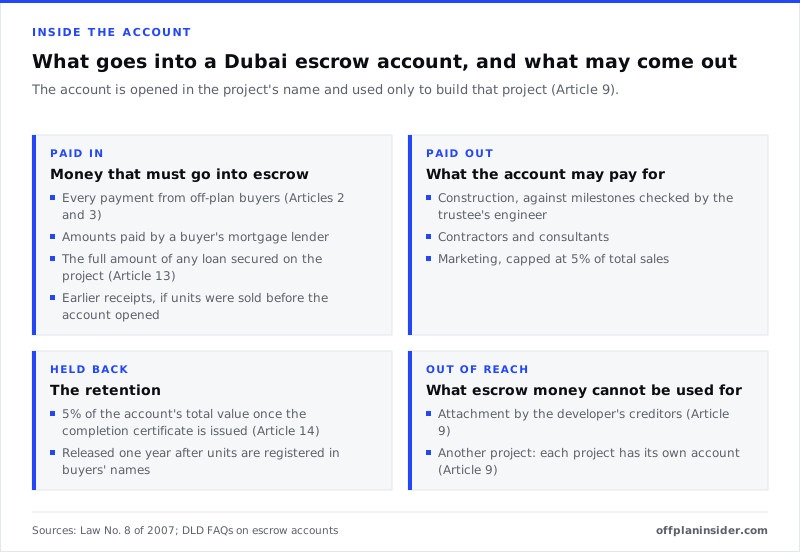
In. The Dubai Land Department lists all receipts from buyers, including amounts paid by buyers' mortgage lenders, and the project's financing.
Out. The department says payments go mainly to contractors and consultants, and to marketing, which is capped at 5% of total sales. Releases are tied to construction milestones: the developer notifies the trustee that a milestone has been reached, the trustee's engineer inspects the site, and the funds are then released.
Not in the account. The 4% Dubai Land Department fee and the developer's administration charge are not instalments of the price and may be paid differently. Ask the developer to set out in writing which amounts go to escrow and which do not.
Worked example: a booking payment
Say you reserve an off-plan apartment priced at AED 1,200,000 with a 20% down payment. The AED 240,000 down payment is a payment towards the price, so it goes to the project's escrow account. The 4% Dubai Land Department fee, AED 48,000, is a government fee and is paid separately.
Before transferring, compare the escrow bank and account in the payment request with those shown for the project on Project Status. If they differ, stop and ask. Our cost guide lists every other charge from booking to handover.
07How does an escrow account work from launch to handover?
The account follows the project through seven stages, from registration to the release of the last 5%.
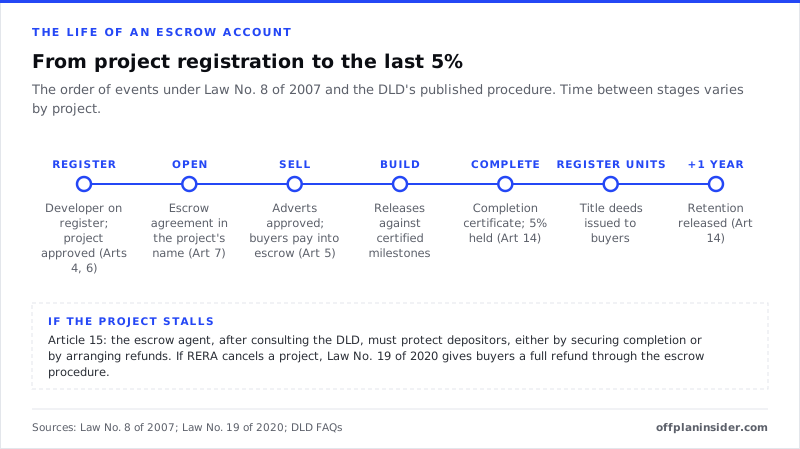
Two points follow for buyers. First, your instalment dates and the developer's release dates are different things. Your plan may ask for payments by date, while releases to the developer follow inspected progress.
Second, you can follow the same progress the trustee sees. Project Status shows the certified completion percentage. Before paying a construction-linked instalment, the department says a buyer can ask for a letter from the DLD-approved project consultant confirming the completion percentage. Our payment plans guide explains milestone-linked plans.
08Chapter 4: what are the penalties? (Articles 16 and 17)
The law backs the account with criminal penalties and with removal from the register.
Article 16: seven offences
Without prejudice to other laws, each of these carries imprisonment and/or a fine of at least AED 100,000:
- Carrying on real estate development in Dubai without a licence.
- Giving incorrect documents or information to obtain a licence.
- Knowingly offering units in fraudulent projects.
- Stealing, misappropriating or squandering money paid for building a project.
- An auditor deliberately preparing a false report or leaving out essential facts.
- A consultant knowingly certifying false project reports.
- A developer dealing with a real estate broker not registered with the department under Bylaw No. 85 of 2006.
The last offence is often missed. It puts a duty on the developer, not only the broker, to deal with registered brokers. Check your broker's BRN as described in our RERA guide.
Article 17: five grounds for striking off
A developer is removed from the register if it:
- Is declared bankrupt.
- Fails, without an acceptable reason, to start construction six months after permission to sell off-plan was granted.
- Has its licence revoked by the licensing authority.
- Commits an offence under Article 16(2), (3), (4) or (5).
- Breaks any law or bylaw regulating the activity in Dubai.
09Chapter 5: final provisions (Articles 18 to 22)
The last chapter deals with the transition and the mechanics:
- Article 18. Developers already operating had six months from publication to comply, which the department could extend.
- Article 19. The department may charge fees for its services under the law.
- Article 20. Any provision in other laws that conflicts with this one is repealed to that extent.
- Article 21. The department's chairman issues the resolutions needed to implement the law.
- Article 22. The law takes effect on publication in the Official Gazette.
10How does the escrow law fit with Oqood and Law No. 19 of 2020?
The three laws work as a set. Law No. 8 of 2007 protects the money, Law No. 13 of 2008 records the sale, and Law No. 19 of 2020 decides what happens to the money if the sale fails.
| Question | Law that answers it | Short answer |
|---|---|---|
| Where must my payments go? | Law No. 8 of 2007, Articles 3, 7 and 9 | The project's escrow account |
| Who supervises the account? | Law No. 4 of 2019, Article 5 | RERA regulates, audits and monitors it and approves the banks |
| Does my purchase exist in law? | Law No. 13 of 2008 | Only once it is registered on Oqood |
| What if I stop paying? | Law No. 19 of 2020, Article 11 | A DLD notice and mediation first; then limits on what the developer may keep, set by project completion |
| What if the project is cancelled? | Law No. 19 of 2020, Article 11; Law No. 8 of 2007, Article 15 | A full refund through the escrow procedure |
| What protects against defects? | Law No. 8 of 2007, Article 14 | 5% held until a year after the units are registered |
The retention tiers in Law No. 19 of 2020, and how they apply at each stage of completion, are set out in our buyer protection guide and our guide to missing off-plan instalments.
11What does the escrow law not cover?
The law protects the project's money. It does not decide your contract terms, your handover date or the price you pay.
- Delays. The law does not set a completion date or a penalty for late handover. Those are in your sale and purchase agreement and in civil law.
- Payment plan terms. How much you pay and when is set by your contract. The law controls when the developer is paid from escrow, not when you pay in.
- Fees outside the price. Government and administration fees may be paid separately, as above.
- Buying from another buyer. The law is written around developers receiving payments. If you buy an off-plan unit from an existing buyer, ask the developer and the registration trustee how the payments in that resale are handled. Our guide to selling off-plan before handover covers the process.
- Investment outcome. A protected account protects the money for construction. It does not protect the resale value of the unit.
12How is Dubai's escrow law different from Abu Dhabi's?
Both emirates require a separate escrow account for each project, but the release rules differ. Abu Dhabi's rules are in Law No. 3 of 2015, as amended by Law No. 2 of 2025.
In Abu Dhabi, nothing may be paid out of the account until the developer has completed at least 20% of construction, unless the regulator accepts a bank guarantee of at least 20% of the construction value instead. The account may not be used for the land price or brokers' commissions. The performance bond is at least 5% of the overall value of the project, held for a year from the completion certificate. Our guide to ADREC covers the Abu Dhabi rules in full.
13Your escrow checklist before any transfer
- Find the project on Project Status in Dubai REST or on the Dubai Land Department website, by name or project number.
- Note the escrow bank and account shown on the project's record.
- Match them against your reservation form, your sale and purchase agreement and every payment request, including the booking payment.
- Never pay elsewhere. A request to pay a personal account, a general company account or an overseas account is a reason to stop and check.
- Keep proof: the developer's receipt and your bank's confirmation for every payment. Under Article 12 you can also ask the escrow agent for your records.
- Before milestone payments, check the completion percentage on Project Status.
- Confirm your Oqood registration once the sale is signed.
This guide does not list any escrow account details. Always take them from the project's official record, not from a message, a brochure or this or any other website.
14Key terms
- Escrow account. The project's bank account for buyers' and financiers' payments.
- Escrow agent or trustee. The approved bank or financial institution that manages the account.
- Escrow agreement. The written contract between the developer and the escrow agent under Article 7.
- Retention. The 5% held back after the completion certificate under Article 14.
- Completion certificate. The authority's confirmation that the building is complete; it starts the retention.
- Oqood. The interim register where off-plan sales are recorded.
- Project Status (Mashrooi). The Dubai Land Department service that shows a project's status, completion and escrow bank.
15Where to go next
If you are comparing projects, browse registered off-plan homes on our projects page and the latest new launches, then run each one through the checklist above. For the full sequence of a purchase, read our guide to buying off-plan property in Dubai.
FAQQuestions buyers ask.
What is an escrow account in Dubai real estate?
It is a bank account opened in the name of an off-plan project. Every payment from buyers, and from lenders financing the project or its buyers, goes into it. Under Law No. 8 of 2007 the money may be used only to build that project, cannot be attached by the developer's creditors, and is released in stages as construction progresses.
What is Law No. 8 of 2007 in Dubai?
It is the Dubai law on escrow accounts for real estate development, issued on 6 May 2007. It requires every developer selling off-plan to open a project escrow account with a bank approved by the Dubai Land Department, sets what the developer must file before selling, holds back 5% after completion, and sets penalties of prison and fines for misusing buyers' money.
Who holds the escrow account for a Dubai off-plan project?
A bank or financial institution licensed by the UAE Central Bank to take deposits and approved to act as an escrow trustee. The law calls it the escrow agent. It manages the account under a written agreement, sends regular statements and must protect depositors if the project stalls.
How do I find the escrow account for a Dubai project?
Search the project on the Dubai Land Department's Project Status service or in the Dubai REST app. The project record names the escrow bank and account. Compare it with the payment details in your reservation form, sale agreement and every payment request before you transfer anything.
Is the DLD 4% fee paid into the escrow account?
Not necessarily. The escrow account receives payments towards the price of the unit. The 4% Dubai Land Department fee and the developer's administration charge are not instalments of the price and may be paid differently. Ask the developer to set out in writing which amounts go to escrow and which do not.
When is money released from a Dubai escrow account?
In stages, against construction milestones. The Dubai Land Department says the developer notifies the trustee that a milestone has been reached, the trustee's engineer inspects the site, and only then are funds released. After the completion certificate, 5% of the account is retained until one year after the units are registered in buyers' names.
What happens to escrow money if the developer goes bankrupt?
Article 9 of Law No. 8 of 2007 says the developer's creditors cannot attach the funds in the escrow account. Bankruptcy is also a ground for striking the developer off the register under Article 17. Article 15 then requires the escrow agent, after consulting the Dubai Land Department, to secure completion or arrange refunds.
Can I see the statements of my project's escrow account?
Partly. Article 12 lets depositors, or their representatives, see and copy their own accounting records with the escrow agent. The law does not give buyers a right to the full account statements, which go to the Dubai Land Department under Article 11.
Sources & methodWhere these figures come from.
Sources
- Dubai Legislation Portal: Law No. (8) of 2007
- Dubai Legislation Portal: Law No. (4) of 2019 Concerning the Real Estate Regulatory Agency
- Dubai Legislation Portal: Law No. (13) of 2008
- Dubai Legislation Portal: Law No. (19) of 2020 Amending Law No. (13) of 2008 Regulating the Interim Real Property Register in the Emirate of Dubai
- Dubai Land Department: Frequently asked questions
- Dubai Land Department: Real estate project status
- adrec.gov.ae: Regulations
- adrec.gov.ae: Faqs
What we could not verify
- How releases work in practice (developer notice, trustee's engineer inspection, then release) and the 5% cap on marketing payments come from the Dubai Land Department's FAQs, not from the text of Law No. 8 of 2007; the detailed release schedule for a given project is set in its escrow agreement, which is not public.
- We did not open any implementing resolutions or Director General decisions issued under Article 21, so any later administrative rules on escrow releases, exemptions or fees are not covered.
- The law says it takes effect on publication in the Official Gazette; the 28 June 2007 date is as stated in the Dubai Land Department's FAQs. We did not check the Gazette.
4 Nov 2026 · Reviewed by OffPlan Insider Research. First published 4 Nov 2026.