ADREC, the Abu Dhabi Real Estate Centre, is the regulator of Abu Dhabi's property sector. It was launched in November 2023 within the Department of Municipalities and Transport and exercises that department's powers under Law No. 3 of 2015, as amended by Law No. 2 of 2025. ADREC licenses developers, brokers, valuers and surveyors, registers projects and off-plan sales, supervises project escrow accounts, approves service fees and owners committees, and handles complaints. Buyers deal with it mainly through TAMM, DARI and the Madhmoun listings service.
Key takeaways
- ADREC is Abu Dhabi's real estate regulator, launched in November 2023 inside the Department of Municipalities and Transport under Executive Council Resolution No. 223 of 2023.
- Its main rule book is Law No. 3 of 2015 on the real estate sector, amended by Law No. 2 of 2025 and put into effect by four administrative decisions announced in March 2026.
- Off-plan money goes into a project escrow account. Nothing may be paid out before 20% of construction unless ADREC accepts a bank guarantee of at least 20% of construction value, and land and broker commissions may not be paid from it.
- If a buyer defaults, the developer must give 60 days' notice, involve ADREC and try settlement before terminating. The developer's share then follows a table: from 10% to 40% of the contract value by completion, or a full refund if work never started for reasons beyond its control.
- ADREC may impose a delay penalty in the buyer's favour when a project is more than six months late, unless the developer proves the delay was beyond its control.
- Anyone practising real estate activities needs an ADREC licence. Practising without one can mean up to six months in prison and a fine of AED 50,000 to 200,000; other breaches carry administrative fines of up to AED 2,000,000.
- Use DARI for a project's completion rate and escrow details, and ADREC's verification service for Madhmoun permits, title deeds, site plans and tenancy contracts.
01What is ADREC?
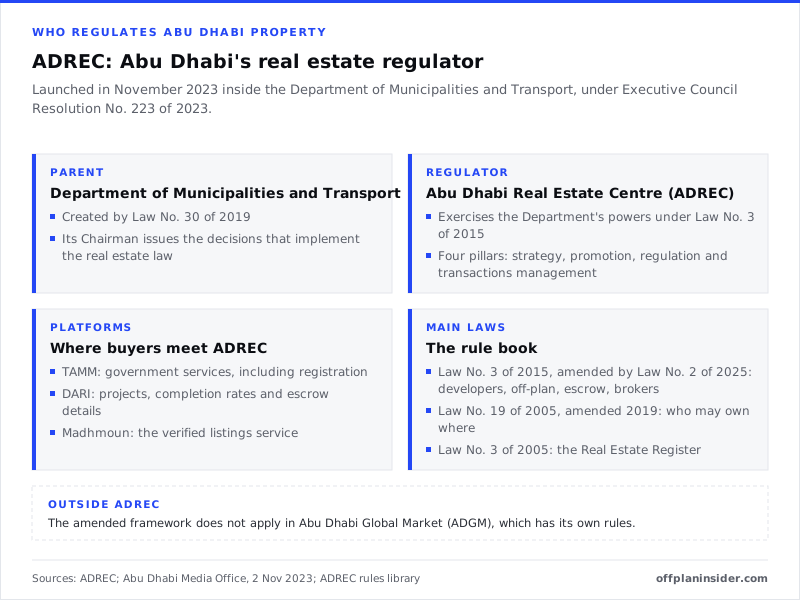
ADREC is the Abu Dhabi Real Estate Centre, the regulator of Abu Dhabi's property sector. It licenses the people who build, sell and manage property, registers projects and off-plan sales, supervises escrow accounts and oversees how buildings are run.
The Department of Municipalities and Transport launched ADREC on 2 November 2023 to bring the sector under a single regulatory framework. ADREC describes four pillars: strategy, promotion, regulation and transactions management. In the administrative decisions issued since, ADREC exercises the department's powers under the real estate sector law.
If you are buying off-plan in Abu Dhabi, ADREC is the body behind your project's escrow account, the interim register that records your purchase, and the rules on what happens if either side defaults. This guide explains how it works. It is general information, not legal advice. For the full buying process, fees and ownership zones, see our guide to buying property in Abu Dhabi as a foreigner.
02Where does ADREC sit in the Abu Dhabi government?
ADREC sits within the Department of Municipalities and Transport (DMT). The department was created by Law No. 30 of 2019, and ADREC's own basis is Executive Council Resolution No. 223 of 2023.
The division of work is simple. The department's Chairman issues the decisions that implement the real estate law, and ADREC applies them day to day. In the decision on escrow guarantees, for example, ADREC is given all the powers the department holds under Law No. 3 of 2015 for that purpose, and its Director General issues the forms and instructions.
Before ADREC, the same powers sat with the department and, earlier, with the emirate's municipalities. That history explains why buyers still hear older names. "ADM fees", for example, refers to Abu Dhabi Municipality, which once handled registration.
03Which laws does ADREC apply?
Three laws do most of the work, with a set of decisions under them. ADREC publishes them all in the rules and regulations library on its website.
| Law or decision | What it covers |
|---|---|
| Law No. 3 of 2015, amended by Law No. 2 of 2025 | The real estate sector: licensing, developers and projects, off-plan sales, escrow, the Interim Real Estate Register, mortgages of projects, jointly owned property and penalties |
| Law No. 19 of 2005, amended by Law No. 13 of 2019 | Who may own property and where, including the investment zones open to foreign buyers |
| Law No. 3 of 2005 | The Real Estate Register and registration of transactions |
| Administrative Decision No. 24 of 2025 | When a developer may draw on escrow before 20% completion, against a bank guarantee |
| Administrative Decision No. 25 of 2025 | Ownership, use and management of jointly owned property, common parts and facilities |
| Administrative Decision No. 26 of 2025 | A unified bylaw for owners committees |
| Administrative Decision No. 165 of 2025 | What a developer may keep, and refund timelines, when an off-plan unit is cancelled and resold |
Law No. 2 of 2025 made several changes that matter to buyers. It replaced "owners' associations" with owners committees, defined service fees as fees approved by the regulator, and rewrote the rules on off-plan default, escrow payments, management of common parts and penalties. It takes effect 90 days after its publication in the Official Gazette.
04What does ADREC regulate?
Article 2 of Law No. 3 of 2015 gives the regulator a broad remit: to organise and develop the real estate sector and to supervise everything related to it. For a buyer, its functions fall into five groups.
- Licensing. Issuing licences for real estate activities. Since 2025 the law defines licensees as developers, brokers, brokers' employees, auctioneers, appraisers and surveyors.
- Developers and projects. Keeping the Real Estate Development Register, registering developers and their projects, and approving the plans and documents behind them.
- Escrow. Approving the banks that act as escrow trustees, and supervising and auditing project escrow accounts.
- Registers. Managing the Real Estate Development Register, the Interim Real Estate Register for off-plan sales and the Real Estate Register for completed property.
- Buildings and buyers. Forming owners committees and overseeing them, controlling advertising and marketing, publishing market data, examining customer complaints and providing ways to resolve disputes.
ADREC's own FAQs sum this up as simplifying processes, strengthening regulation, improving data transparency, ensuring compliance and overseeing dispute resolution.
05How does ADREC protect off-plan buyers' money?
Through the project escrow account. Every payment from off-plan buyers goes into an account opened for that project, managed by a bank or financial institution approved by the regulator, and ADREC supervises it.
The rules are in Articles 18 to 26 of Law No. 3 of 2015, as amended:
- One account per project. An escrow account is opened for each development project, and the money is used only to build that project and to repay its financing.
- What it cannot pay for. Since 2025, the account may not be used to pay for the project's land or brokers' commissions, in whole or in part.
- The 20% rule. Nothing may be paid out until the developer has completed at least 20% of construction.
- Not open to attachment. Escrow funds cannot be attached, subject to the rights of buyers, contractors and financiers if a project is cancelled, abandoned or suspended.
- Statements. The trustee sends the regulator statements every three months and an audited annual report. Any buyer who has paid into the account may see and copy its statements held by the trustee.
- Loans paid in. A developer may mortgage the project land only to finance that project, must tell buyers in the sale contract, and the lender must pay the whole loan into the escrow account.
- The performance bond. The trustee keeps at least 5% of the overall value of the project for a year from the completion certificate, to cover defects.
ADREC's FAQs say only institutions it authorises can manage escrow accounts, and that a project's escrow account number can be found on the DARI platform.
Can a developer draw on escrow before 20%?
Yes, but only with a bank guarantee that ADREC accepts. Administrative Decision No. 24 of 2025 sets strict conditions.
| Condition | What the decision requires |
|---|---|
| Track record | Registered as a developer in the emirate for at least four years, with a valid licence |
| Delivery | At least three projects completed and handed over in Abu Dhabi, on time or delayed only by causes beyond its control |
| Clean record | No legal violations or administrative penalties in the 12 months before applying |
| Guarantee size | At least 20% of the construction cost, based on an engineering report no more than 30 days old |
| Guarantee form | Unconditional, payable on first demand into the escrow account, held by the trustee |
| Early return | Only after at least 60% of construction, with enough left in escrow to finish the project |
For a buyer, the point is that early drawdowns are replaced by a bank's promise of at least the same 20%, callable by ADREC, rather than simply waived.
06What happens if an off-plan buyer stops paying in Abu Dhabi?
The developer must follow a set procedure under ADREC's supervision before it can terminate. Article 17(3) of Law No. 3 of 2015, rewritten in 2025, and Administrative Decision No. 165 of 2025 set the steps and the limits.
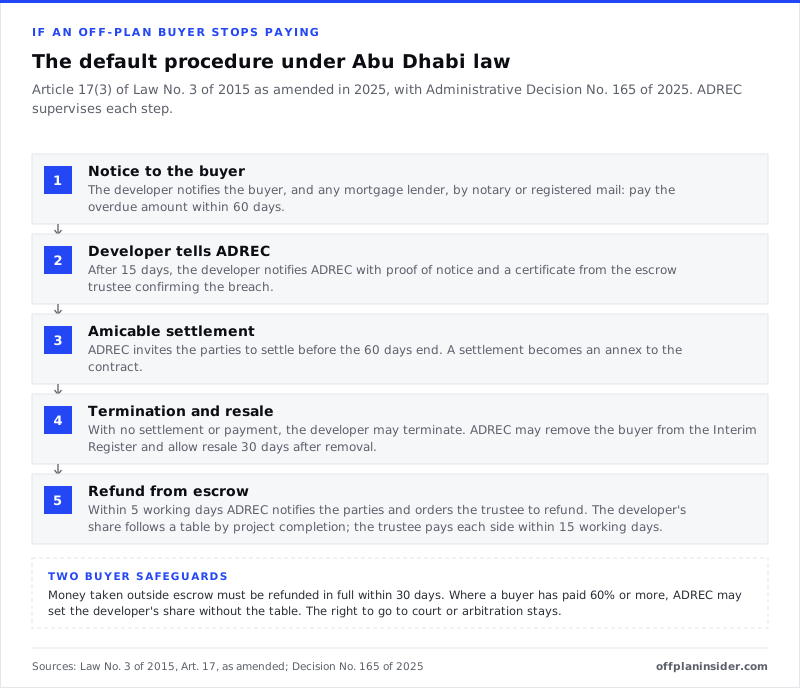
Once the contract is terminated, the developer's compensation comes out of what the buyer paid into escrow, according to how far construction has progressed.
| Project construction stage | What the developer may deduct |
|---|---|
| Not started, for reasons beyond the developer's control and without its fault | Nothing: all amounts received from the buyer are refunded, in or out of escrow |
| Started, below 10% complete | 10% of the sale contract value |
| Above 10% and up to 30% | 15% of the sale contract value |
| Above 30% and up to 60% | 25% of the sale contract value |
| Above 60% and up to 100% | 40% of the sale contract value |
Worked example: termination at 45% completion
Say a buyer agreed to buy an off-plan apartment for AED 1,500,000 and has paid AED 450,000 into escrow when they default. The project is 45% complete when the contract is terminated. The table allows the developer 25% of the contract value, which is AED 375,000.
The buyer's refund from escrow is the remaining AED 75,000, paid by the trustee within 15 working days of the buyer's request on ADREC's form, with a lender's no-objection certificate if there is a mortgage. If the buyer had paid 60% or more of the price, ADREC could set the developer's share without being bound by the table.
The same steps apply in reverse to your protection: a developer that skips them is not following the law. Your right to go to court or arbitration is preserved throughout.
07What if an Abu Dhabi project is late or never finished?
The law gives ADREC three tools: an investigation if a project has not started, a delay penalty if it is late, and a rescue or distribution procedure if it cannot be finished.
Not started. Under Article 25 of Law No. 3 of 2015, if buyers owning at least 5% of the sold units complain that the developer has not started the project in line with its obligations, the regulator must investigate.
Late. The regulator may impose a delay penalty, paid to the buyers, if the developer delivers the project more than six months after the expected date in the schedule it committed to with the regulator. This does not apply if the developer proves the delay was due to a reason beyond its control.
Not finished. Under Article 26, the escrow trustee, with the regulator's approval, must take steps to protect depositors, which can include completion by the financier or another developer. If no solution is found within six months, the trustee distributes what is left in escrow in a fixed order: the trustee's unpaid account costs within a limit, then financiers and buyers pro rata, then contractors and suppliers, and the developer last.
The 2025 amendment adds a rule for mortgaged land under construction. A court may restrict a forced sale to developers registered with the regulator, and the new developer takes over the duty to complete the project and deliver the units sold.
08How does ADREC register off-plan sales?
Every off-plan sale must be recorded on the Interim Real Estate Register, which the regulator keeps. Under Article 27, an off-plan sale does not bind the parties, or anyone else, until it is registered.
The implementing regulation puts the duty on the seller. The developer must apply for registration immediately after the sale. If it refuses or fails to register within 21 days, the buyer may apply and recover the costs from the developer, or deduct them from the price.
When you have paid in full, the developer must apply within 21 days to transfer ownership to you, moving the unit to the Real Estate Register. If it does not, you or your lender may ask the regulator to enforce the transfer, at the developer's expense. Our guide to buying in Abu Dhabi covers the fees for each step.
09How does ADREC license brokers and approve adverts?
No one may carry on a real estate activity in Abu Dhabi, or present themselves as doing so, without a licence from the regulator. That covers developers, brokers, brokers' employees, auctioneers, appraisers and surveyors.
Unlicensed work has consequences. Under the law, an unlicensed person is not entitled to any fee for the work and must repay what was received. Since 2025, practising without a licence can be punished by up to six months in prison and a fine of AED 50,000 to AED 200,000, or either penalty.
Adverts. Under Article 14, a developer may not advertise an off-plan project in local or foreign media, or show it at exhibitions, without a written permit, which the regulator issues within 30 days of a complete application. A developer that markets through a broker must register the brokerage contract.
Madhmoun. ADREC's Madhmoun service is a government listings service that admits only verified properties. ADREC says a maximum of three approved brokers can advertise each property. Each listing carries a Madhmoun permit number that you can check.
10What does ADREC do after handover?
It approves service fees and oversees how jointly owned buildings are run. Law No. 2 of 2025 and Administrative Decisions No. 25 and 26 of 2025 rewrote this area.
- Approved fees only. Service fees are fees approved by the regulator. The management company collects them and may not claim any other fees from owners.
- Owners committees. Committees replace the old owners' associations. They review budgets, monitor the management company, pass on owners' complaints and can ask for the company to be changed for poor service.
- A 60-day escalation. If the management company or developer does not deal with a complaint within 60 days, the committee may escalate it to the regulator.
- Unpaid fees. Overdue service fees must be certified by an approved auditor and the owner given 30 days' notice by notary. If they stay unpaid without justification, the regulator may issue an enforceable document and note a restriction on the unit's register.
11What penalties can ADREC impose?
Besides the criminal penalty for unlicensed practice, the regulator can impose administrative fines of up to AED 2,000,000 for breaches of the law, its regulations and decisions.
A violator may be offered conciliation and pay 75% of the fine within 60 days. Anyone penalised can file a grievance with the department within 60 days of being notified; if it is not decided within 60 days, it is treated as rejected.
12How do I check a project and a broker with ADREC?
Use three tools: DARI, Madhmoun and ADREC's verification service, with TAMM for transactions. ADREC's FAQs say account registration is not available on its own website; services are reached through TAMM.
| What you want to check | Where |
|---|---|
| The project is registered, and its completion rate | DARI |
| The project's escrow account | DARI; compare it with your sale agreement and every payment request |
| A listing is genuine | The Madhmoun permit number, on ADREC's verification service |
| A title deed or site plan is genuine | ADREC's verification service, using the certificate type, issue date and number |
| A tenancy contract is registered | ADREC's verification service, using the contract number |
| Your off-plan sale is registered | Ask the developer for confirmation of entry on the Interim Real Estate Register; registration services run through TAMM |
Do this before you pay a reservation fee. A request to pay anywhere other than the project's escrow account is a reason to stop. Under Decision No. 165 of 2025, money a developer took outside escrow must be repaid in full within 30 days if a unit is cancelled.
13How is ADREC different from Dubai's RERA?
They do the same job in different emirates, under different laws. If you are comparing projects in both, check each against its own emirate's rules.
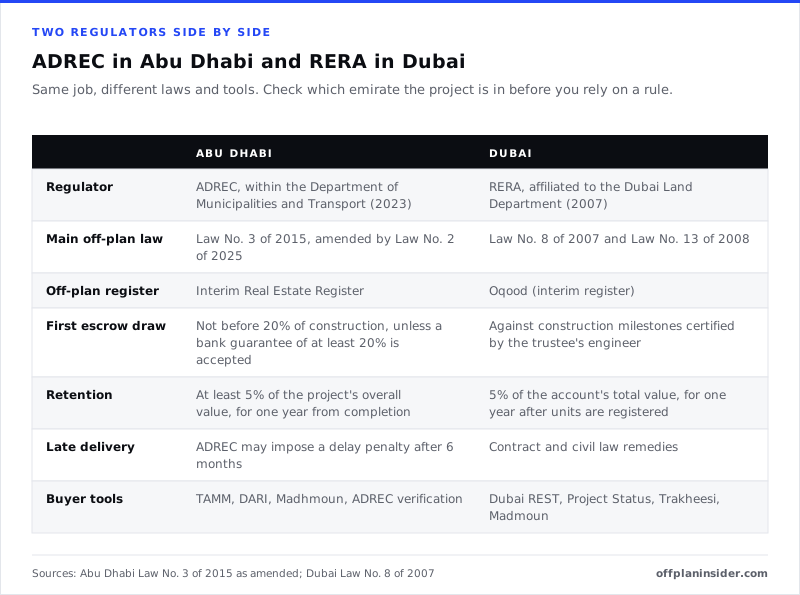
Dubai's regulator is explained in our RERA guide, and Dubai's escrow law in our guide to Law No. 8 of 2007.
14What data does ADREC publish?
ADREC publishes market reports, dashboards and an interactive map on its website. Its report for the first half of 2026, released on 18 August 2026, put residential unit sales at AED 70.4 billion, against AED 25.3 billion a year earlier.
The same report said off-plan sales made up 89% of residential sales value and 82% of deals. Investment zones held more than 22% of the residential stock, about 72,000 units, with Al Reem Island the largest at 27,500 units.
You can see off-plan projects in those zones, with prices and payment plans, on our pages for Al Reem Island, Yas Island, Al Raha Beach and Abu Dhabi as a whole. Rents in the emirate are covered in our guide to Abu Dhabi rental yields.
15Key terms
- ADREC. The Abu Dhabi Real Estate Centre, the emirate's property regulator.
- DMT. The Department of Municipalities and Transport, ADREC's parent department.
- TAMM. Abu Dhabi's government services platform, through which ADREC's services are reached.
- DARI. The platform that shows registered projects, completion rates and escrow details.
- Madhmoun. ADREC's verified listings service; each listing has a permit number.
- Interim Real Estate Register. The register of off-plan sales; a sale binds no one until it is recorded.
- Escrow trustee. The approved bank or financial institution that manages a project's escrow account.
- Performance bond. At least 5% of the project's value kept for a year after completion to cover defects.
- Owners committee. The body that represents owners in a jointly owned building since the 2025 reforms.
16Where to go next
If you are buying off-plan in Abu Dhabi, start with our guide to buying property in Abu Dhabi as a foreigner for zones, fees and the step-by-step process. Then check your chosen project on DARI, confirm the escrow account, and browse current launches on our new launches page.
FAQQuestions buyers ask.
What is ADREC?
ADREC is the Abu Dhabi Real Estate Centre, the regulator of the emirate's property sector. It was launched on 2 November 2023 by the Department of Municipalities and Transport and works across four areas: strategy, promotion, regulation and transactions management. It supervises developers, brokers, escrow accounts, registration and building management.
What does ADREC stand for?
Abu Dhabi Real Estate Centre. It sits within the Department of Municipalities and Transport, which was created by Law No. 30 of 2019, and exercises that department's powers under the emirate's real estate sector law, Law No. 3 of 2015.
Is ADREC the same as RERA?
No. RERA, the Real Estate Regulatory Agency, regulates property in Dubai and is affiliated to the Dubai Land Department. ADREC regulates property in Abu Dhabi under different laws. The ideas are similar, such as project escrow accounts and an interim register for off-plan sales, but the rules and tools differ.
How do I check an off-plan project in Abu Dhabi?
Use the DARI platform to see the project's registration, completion rate and escrow account details. Check the listing's Madhmoun permit number on ADREC's verification service. Ask the developer for the project's registration and disclosure statement, and make sure every payment goes to the project's escrow account.
What happens if I stop paying for an off-plan property in Abu Dhabi?
The developer must notify you, by notary or registered mail, to pay within 60 days, tell ADREC after 15 days and allow an amicable settlement. Only then may it terminate. Under Administrative Decision No. 165 of 2025 it may keep between 10% and 40% of the contract value, depending on project completion, and the rest is refunded from escrow within 15 working days of your request.
Can ADREC penalise a developer for late delivery?
Yes. Article 25 of Law No. 3 of 2015 lets the regulator impose a delay penalty, paid to buyers, if a project is delivered more than six months after the date in the developer's committed schedule, unless the developer proves the delay was beyond its control. If buyers of at least 5% of the sold units complain that a project has not started, the regulator must investigate.
Where is ADREC's rule book?
ADREC publishes the laws, resolutions and decisions it applies in the rules and regulations library on its website. It includes Law No. 3 of 2015 and its 2025 amendment, the real estate registration law, fee resolutions and the 2025 administrative decisions on escrow, jointly owned property, owners committees and cancelled units.
Does ADREC regulate property in ADGM on Al Reem Island?
The amended framework applies across the emirate except in Abu Dhabi Global Market, which has its own regulations. If a property sits in an ADGM-regulated area, ask the developer which registration and rules apply before you buy.
Sources & methodWhere these figures come from.
Sources
- adrec.gov.ae: About_the_centre
- adrec.gov.ae: Faqs
- adrec.gov.ae: Regulations
- adrec.gov.ae: Verify document
- adrec.gov.ae: Press 29 adrec releases the abu dhabi real estate market report for H1 2026
- mediaoffice.abudhabi: Department of municipalities and transport launches abu dhabi real estate centre
- adrec.gov.ae: Property ownership
- dmt.gov.ae: DMT Issues Regulatory Decisions to Enhance Transparency and Governance in Real Estate Sector
- aoshearman.com: Abu dhabi real estate five changes and what they mean for your next transaction
- dari.ae
- Dubai Legislation Portal: Law No. (4) of 2019 Concerning the Real Estate Regulatory Agency
What we could not verify
- The text of Executive Council Resolution No. 223 of 2023 was not available to us; ADREC's legal basis and its exercise of the Department's powers are taken from the preambles and articles of the 2025 administrative decisions in ADREC's rules library.
- Law No. 2 of 2025 takes effect 90 days after publication in the Official Gazette; we did not confirm the publication date, so the date from which the amended rules apply is not stated.
- Fees for ADREC services, including registration, Tawtheeq and DARI charges, change and are not given here; confirm them on TAMM before paying.
4 Nov 2026 · Reviewed by OffPlan Insider Research. First published 4 Nov 2026.