The Rental Disputes Centre (RDC) is the Dubai Land Department's specialist judicial body for disputes between landlords and tenants anywhere in Dubai, including most free zones. Landlords use it to recover unpaid rent, enforce bounced cheques, evict on the grounds the tenancy law allows and settle the rent at renewal. You file online at rdc.gov.ae or at a Real Estate Services Trustee centre with the Ejari-registered lease, ID, an IBAN letter and any notices served. The filing fee is 3.5% of the annual rent, between AED 500 and AED 20,000. Cases go first to conciliation, which has 15 days to reach a settlement, then to a First Instance Committee, which must decide within 30 days of referral.
Key takeaways
- The Rental Disputes Centre was set up by Decree No. 26 of 2013 and has exclusive jurisdiction over rental disputes between landlords and tenants in Dubai, including free zones that have no court of their own.
- It does not hear disputes from lease finance contracts or from long-term leases under Law No. 7 of 2006. Since 2019 it also hears disputes over jointly owned property under Law No. 6 of 2019.
- Only a registered lease can be heard. Article 4 of the tenancy law bars any dispute on a lease that is not registered, which in practice means Ejari.
- The filing fee is 3.5% of the annual rent, not less than AED 500 and not more than AED 20,000, or 3.5% of a money claim up to AED 15,000, plus AED 120 in fixed fees online. Half the filing fee is refunded if the case settles at conciliation.
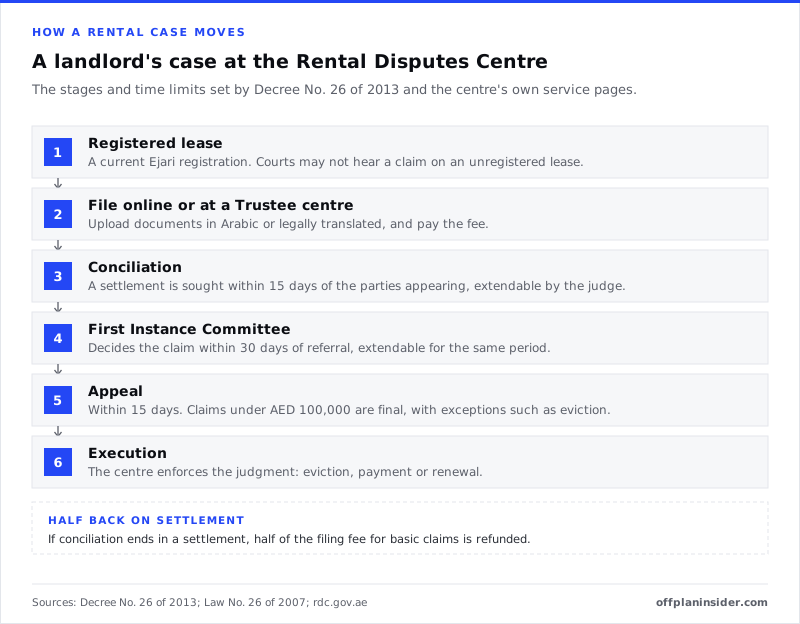
- Every case starts in conciliation, which has 15 days from the parties' appearance to reach a settlement. A First Instance Committee then decides within 30 days of referral, and both periods can be extended.
- Judgments on claims worth less than AED 100,000 are final, with exceptions such as eviction. Appeals must be filed within 15 days, with half of any money award deposited.
- The notice decides most landlord cases: 30 days to pay after a notice, 90 days before expiry to change terms, and 12 months by notary or registered mail to evict at the end of the lease.
01What is the Rental Disputes Centre in Dubai?
The Rental Disputes Centre (RDC) is the Dubai Land Department's specialist judicial body for disputes between landlords and tenants. If a tenant stops paying, refuses to leave or disputes a rent increase, the rental dispute centre in Dubai is where the case is heard, decided and enforced.
It was set up by Decree No. 26 of 2013, replacing the earlier rent committee, and began work in November 2013. It sits inside the Dubai Land Department alongside RERA, Ejari and the rental index, which is why the systems connect: the lease you register on Ejari is the document the centre asks for first.
This guide is written for landlords, including buyers who will let an off-plan home after handover. It explains what the centre decides, how to file, what it costs and how long it takes. It is not legal advice; for a large claim or a contested eviction, take advice from a lawyer licensed in Dubai.
02What cases does the Rental Disputes Centre hear?
Article 6 of Decree No. 26 of 2013 gives the centre exclusive jurisdiction over all rental disputes between landlords and tenants of property in Dubai, including free zones. It also hears counterclaims, urgent and summary applications, appeals, and the enforcement of its own judgments.
The centre's scope was extended in 2019 to disputes over jointly owned property under Law No. 6 of 2019, the law that governs service charges and building management. It has separate first instance, appeal and execution services for those cases.
What it does not hear. Article 6 lists three exclusions:
- Disputes in free zones that have their own courts or tribunals.
- Disputes arising from a lease finance contract.
- Disputes arising from long-term leases under Law No. 7 of 2006, the registered leases of up to 99 years explained in our guide to leasehold vs freehold in Dubai.
The cases landlords bring most often:
| Landlord's problem | What the centre can do | Service to use |
|---|---|---|
| Unpaid rent | Order payment and, if unpaid 30 days after notice, eviction | First instance lawsuit (rental) |
| Bounced rent cheque | Enforce the cheque directly | Execution – cheques |
| A fixed debt the tenant has acknowledged | Issue a writ of payment without a full hearing | Writ of payment |
| Breach of the lease | Evict for subletting without consent, illegal use, damage or other breaches after notice | First instance lawsuit (rental) |
| Taking the home back at expiry | Evict to sell, for own use, to demolish or to renovate, after 12 months' notice | First instance lawsuit (rental) |
| Rent at renewal | Set a fair rent where the parties cannot agree | First instance lawsuit (rental) |
| Damage at the end of the lease | Decide disputes over the condition of the property and the deposit | First instance lawsuit (rental) |
| Building and service charge disputes | Hear disputes under the jointly owned property law | First instance lawsuit (jointly owned property) |
Tenants use the same centre. The centre's own guidance notes, for example, that a landlord may not stop a tenant using building facilities such as the gym, pool or parking that come with the rent, and a tenant denied them can file a case.
03Why must the lease be on Ejari before you file?
Because the centre cannot hear a dispute on an unregistered lease. Article 4 of Law No. 26 of 2007, as amended by Law No. 33 of 2008, requires every lease covered by the law to be registered with RERA, and bars courts and other bodies from considering any dispute or claim on a lease that is not.
Ejari is that registration. The first document on every RDC claim list is "a copy of latest lease (Ejari)". If the lease was renewed but the renewal was not registered, register it before you file.
Our guide to Ejari in Dubai explains how to register, renew and cancel a lease. Registering correctly at the start is the cheapest protection a landlord has.
04What notices must a landlord give before going to the centre?
Many landlord claims turn on the notice. The tenancy law sets three periods: 30 days to pay or comply after a notice, 90 days before expiry to change the terms, and 12 months to evict at the end of the lease.
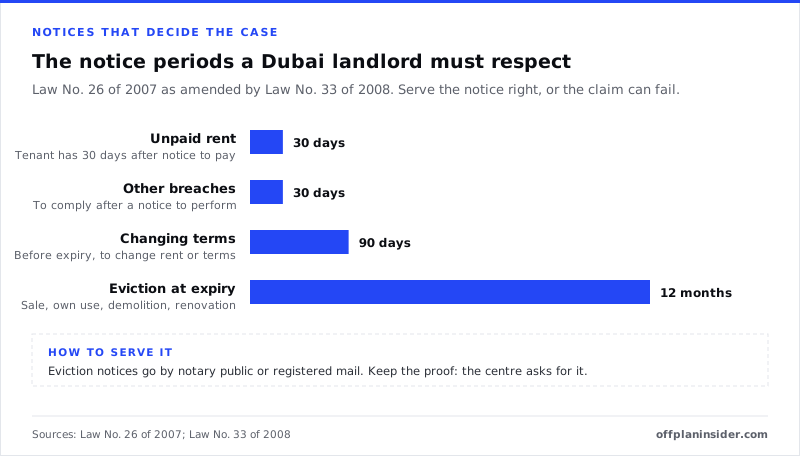
During the lease. Article 25(1) lets a landlord seek eviction before the lease ends only on listed grounds. The main ones are rent unpaid 30 days after notice, subletting without written consent, illegal use, damage that endangers safety, use for a different purpose, and any other breach not remedied 30 days after a notice to comply. Notice is served through a notary public or by registered mail.
At the end of the lease. Article 25(2) allows eviction at expiry only if the owner:
- wants to demolish and rebuild, or add structures, with the permits in place;
- needs to restore or carry out comprehensive maintenance that cannot be done with the tenant in, confirmed by a Dubai Municipality report;
- wants the home for personal use or for a first-degree relative, and has no other suitable property; or
- wishes to sell it.
For each of these, the landlord must give at least 12 months' notice of the reason, through a notary public or by registered mail. If the home is recovered for own use, Article 26 bars letting it to someone else for two years for a residential property, or the tenant can claim compensation.
Changing the terms at renewal. Article 14 requires 90 days' notice before expiry to change the rent or any other term, unless the lease says otherwise. How much the rent can rise is set by the rental index, explained in our guide to the Dubai rental index and rent increases.
A sale does not end the lease. Under Article 28, transferring ownership does not affect a tenant's right to stay for a fixed-term lease. A buyer takes the property with the tenant.
05How do I file a case at the Rental Disputes Centre?
Online, through an account on the centre's website, or in person at a Real Estate Services Trustee centre. Either way the claim is checked, the fee is paid and the case is registered; the centre lists registration as one business day.
Online, step by step. The centre's guidance sets out the order:
- Create an account on the RDC system and activate it from the email link.
- Choose the service, for example the first instance rental lawsuit.
- Enter the lease details, then the details of each party.
- Enter your claims: the amount owed, eviction, renewal terms or whatever you are asking for.
- Upload the documents in the sections the system shows.
- Submit. Once the claim has been checked, pay the fee online by card or Noqodi.
- Attend the conciliation session and any hearing by the link the centre sends, and receive the judgment through the website.
At a Trustee centre. Staff check your documents, enter the claim and take payment, including in cash. A service partner fee of AED 130 plus VAT is added.
Representation. You can file yourself or through a representative. A power of attorney is registered for AED 25, and a lawyer can be added to an existing case by electronic request.
Before you sign a new lease. The centre's Rental Good Conduct Certificate lets either party see the other's rental case history on the RDC system before a lease is drawn up. It is free and instant on the website and the Dubai REST app.
06What documents do I need?
The centre lists the same core set for conciliation and first instance rental claims. Every document must be in Arabic or legally translated into Arabic and uploaded; the centre does not accept paper copies.
| Document | Notes |
|---|---|
| The latest lease, registered on Ejari | Including the current renewal |
| Identity | Emirates ID for an individual; for a company, the trade licence and the manager's or owner's photo ID |
| IBAN | A bank letter or statement showing the claimant's IBAN, for any payment the centre orders |
| Proof of notice (eviction) | The notice served by notary public with the notification officer's report, or by registered post with the receipt of delivery |
| Supporting documents | Power of attorney, management contract, correspondence, notices, DEWA bills, cheques and letters |
For other services the list changes:
- Bounced cheque. The lease, ID, IBAN letter, a copy of the cheque and the bank's return memo.
- Writ of payment. Written proof of a fixed debt now due, the debtor's address, proof of a payment notice and the cheque return memo. The notice must go by notary public or registered mail, and you can apply if the debtor has not paid five days after it.
- Appeal. The appeal plaint and supporting documents.
If you manage the home through an agent or property manager, upload the management contract and the power of attorney so the centre can see who acts for you.
07How much does it cost to file a rental case?
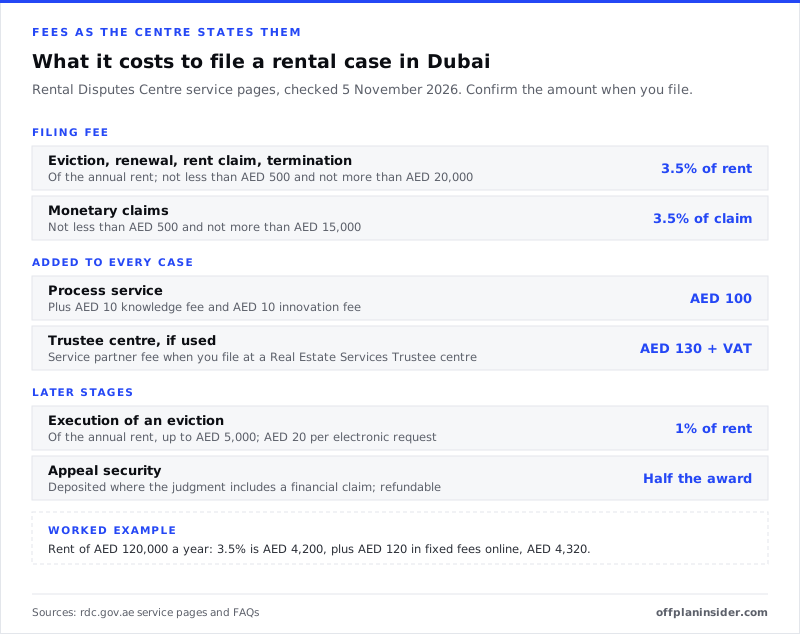
The filing fee is 3.5% of the annual rent, with a minimum of AED 500 and a maximum of AED 20,000, for eviction, renewal, rent claims and termination. A money claim is 3.5% of the amount claimed, up to AED 15,000. Fixed fees of AED 120 apply to every case filed online.
The full list, as the centre states it:
- Filing, rent-based claims: 3.5% of the annual rent, or of the lease value if the lease is longer or shorter than a year. Not less than AED 500, not more than AED 20,000.
- Filing, money claims: 3.5% of the amount claimed. Not less than AED 500, not more than AED 15,000. The same applies to a writ of payment.
- Process service: AED 100.
- Knowledge and innovation fees: AED 10 each.
- Power of attorney registration: AED 25, if used.
- Trustee centre: AED 130 plus VAT, if you file there.
- Execution of an eviction: 1% of the annual rent, up to AED 5,000, plus AED 20 for each electronic request during execution.
- Offer and deposit: AED 50, plus the knowledge and innovation fees.
- Appeal: a refundable security of half the amount awarded, where the judgment includes a money claim, plus process service and the fixed fees.
A worked example. A villa is let at AED 120,000 a year and the tenant has stopped paying. A claim for the rent and eviction carries a filing fee of 3.5% of AED 120,000, which is AED 4,200. Add AED 100 for process service and AED 20 in knowledge and innovation fees, and the total filed online is AED 4,320. Filed at a Trustee centre, add AED 130 plus VAT.
The settlement refund. If the case is settled at conciliation, half the court fee paid for the basic claims is refunded. That is a real incentive to settle early.
Exemption. The centre has a service to request an exemption from, or postponement of, the lawsuit fees. Ask the centre about the criteria before you file.
Translation of documents into Arabic and lawyers' fees are extra and vary.
08How long does a rental dispute take?
Decree No. 26 of 2013 gives conciliation 15 days from the parties' appearance to reach a settlement, and gives the First Instance Committee 30 days from referral to decide. Both can be extended, so treat them as targets rather than a guaranteed total.
| Stage | Time limit | Source |
|---|---|---|
| Registration of the claim | 1 business day | RDC service pages |
| Conciliation | 15 days from the parties' appearance, extendable by the supervising judge | Decree No. 26 of 2013, Article 10 |
| First instance decision | 30 days from referral of the file, extendable for the same period | Decree No. 26 of 2013, Article 16 |
| Appeal | Filed within 15 days of the judgment, or of notification if judged in absence | Decree No. 26 of 2013, Article 18; RDC appeal service |
| Grievance against a summary order | Filed within 8 days of the decision | RDC grievance service |
| Execution | Can be opened 15 days after the judgment; electronic requests 7 days after the tenant is notified | RDC FAQs |
Conciliation first. Every ordinary claim goes to the conciliation department before a committee sees it. A conciliator talks to both sides, by video or phone, in Arabic, English and other languages. A settlement signed by both parties and approved by the supervising judge has the force of a writ of execution, so it can be enforced like a judgment. Time limits for the claim are suspended while it is in conciliation.
How fast cases settle. In the first nine months of 2026 the centre reported 2,350 cases settled by agreement, in six days on average; our report on rental disputes settled in six days has the figures.
Hearings. If conciliation fails, the First Instance Committee hears the case, by remote session where the centre sets one. You can upload further documents before the hearing date, but not once the case is reserved for judgment. The judgment is emailed to the parties and is available on the website.
09Can a judgment be appealed?
Only some. Under Article 17 of Decree No. 26 of 2013, judgments on rental claims worth less than AED 100,000 are final and cannot be appealed, except in listed cases. Eviction judgments are among the exceptions, as are judgments made without jurisdiction or against a party who was not properly represented or served.
Where an appeal is allowed:
- File within 15 days of the day after the judgment, or from notification if you did not attend.
- Deposit half the award. Where the judgment includes a money claim, the party ordered to pay must deposit half of it with the centre. It is refundable, and the chairman may waive or reduce it.
- The panel. Appeals are heard by two judges and one experienced real estate expert. Their decision is final.
10How is a judgment enforced?
Through the centre's own Judgment Execution Department. Once the judgment is final, you open an execution file online, and the centre enforces eviction, payment or renewal orders.
The steps are straightforward:
- Open the execution file once the appeal period has passed: 15 days after a judgment given in your presence, or 15 days after the tenant was notified.
- Upload the judgment with the execution stamp, your IBAN letter if it has changed and any deposit receipts.
- Pay the execution fee. For an eviction, 1% of the annual rent, up to AED 5,000.
- Submit electronic requests to the execution judge from seven days after the tenant is notified, at AED 20 each.
For a bounced rent cheque, the centre's cheque execution service lets you enforce the cheque directly, without first winning a lawsuit. The centre's system also lets a judge approve a payment schedule where a tenant asks to pay a judgment in instalments.
11What can tenants do at the centre?
The same as landlords: file claims, defend, appeal and enforce. Knowing the tenant's options helps a landlord avoid a counterclaim.
- Offer and deposit. If a landlord refuses to accept rent or the keys, the tenant can deposit them with the centre through a summary order. It protects the tenant from a non-payment claim.
- Services and facilities. A tenant can claim if electricity, water, parking, the pool or the gym are withheld.
- The deposit. Article 20 requires the landlord to return the security deposit, or what remains of it, at the end of the lease. Disputes about the condition of the home go to the centre under Article 21.
- Rent increases. A tenant can ask the centre to set a fair rent if a proposed increase is above what the rental index allows.
The centre has also annulled a signed lease where a party hid a record of unpaid rent; see our report on the lease annulled for deception.
12How does the rental index connect to the centre?
At renewal, the rental index decides how much the rent may rise, and the centre decides if landlord and tenant cannot agree. Under Article 13 of the tenancy law, the centre may extend the lease and set the rent.
The centre sets a fair rent using RERA's criteria, including the permitted increases for the home's gap to the average rent in the Dubai Land Department's index. The 90-day notice under Article 14 still applies. The bands, the calculator and worked examples are in our guide to the Dubai rental index and rent increases.
13What does this mean for an off-plan buyer who will let the home?
Plan for the tenancy before handover, not after a dispute. A clean file is the strongest position at the centre: a registered lease, notices served the right way and payments you can prove.
At handover. Take the keys, open the utilities and register the first lease on Ejari as soon as it is signed. The steps from keys to tenant are in our handover guide.
In the lease. Record the rent, the payment dates and how cheques are held, the deposit and what it covers, and who pays for maintenance. Put any extra terms in writing in the lease or its addendum, so the centre can see them.
If you live abroad. Give your property manager a power of attorney that covers filing and attending cases at the Rental Disputes Centre, and keep your own copies of every notice and receipt. Ask the manager to check the tenant's Rental Good Conduct Certificate before the lease is signed.
Holiday homes are different. Short stays under a Department of Economy and Tourism permit are not Ejari leases. See holiday homes and short-term rental in Dubai.
14A landlord's checklist before filing
- The lease is on Ejari, including the current renewal.
- The right notice was served the right way: 30 days to pay or comply, 90 days to change terms, 12 months to evict at expiry, by notary or registered mail where the law requires it.
- You have proof of delivery for every notice.
- The claim is clear: the amount owed, with dates, and what you are asking the centre to order.
- Documents are in Arabic or legally translated.
- You have an IBAN letter in the claimant's name.
- Your representative has a power of attorney, if someone is acting for you.
- You have tried to settle. Half the filing fee comes back if the case settles at conciliation.
15Key terms
- Rental Disputes Centre (RDC). The Dubai Land Department's judicial body for rental and jointly owned property disputes, set up by Decree No. 26 of 2013.
- Conciliation. The first stage of every ordinary claim, where a conciliator seeks a settlement within 15 days.
- First Instance Committee. The panel that hears and decides a claim if conciliation fails.
- Writ of payment. A summary order to pay a fixed, acknowledged debt without a full hearing.
- Offer and deposit. A summary order that lets a tenant deposit rent or keys with the centre.
- Execution. Enforcement of a final judgment by the centre's own department.
- Ejari. The registration of a lease with RERA, required before the centre will hear a dispute.
- Real Estate Services Trustee centre. An accredited service centre that can file claims for you, for an added fee.
For the wider protections that apply while a home is still being built, see our guide to off-plan buyer protection in Dubai. For RERA's role across the market, see RERA in Dubai.
FAQQuestions buyers ask.
What is the Rental Dispute Centre in Dubai?
It is the Dubai Land Department's specialist judicial body for rental disputes, set up by Decree No. 26 of 2013. It hears disputes between landlords and tenants of property in Dubai, including free zones without their own courts, through conciliation, First Instance Committees and an Appeal panel, and it enforces its own judgments.
How do I file a case at the Rental Dispute Centre?
Create an account on the RDC website, enter the lease details, the parties and your claims, upload the documents, and pay the fee after the claim is checked. You can also file at a Real Estate Services Trustee centre, which adds a service fee of AED 130 plus VAT. The centre lists registration as one business day.
How much does it cost to file a rental case in Dubai?
For eviction, renewal, rent claims and termination the fee is 3.5% of the annual rent, not less than AED 500 and not more than AED 20,000. For a money claim it is 3.5% of the amount claimed, up to AED 15,000. Add AED 100 for process service and AED 20 in knowledge and innovation fees. Half the filing fee is refunded if the case settles at conciliation.
What documents does a landlord need for a rental case?
The latest Ejari-registered lease, the landlord's Emirates ID or, for a company, the trade licence and the manager's ID, and a bank letter or statement showing the landlord's IBAN. For an eviction claim, add the notice served by notary public or registered post with proof of delivery. Supporting documents such as cheques, letters and a power of attorney go in too, all in Arabic or legally translated.
How long does a rental dispute take in Dubai?
Decree No. 26 of 2013 gives conciliation 15 days from the parties' appearance to reach a settlement and gives the First Instance Committee 30 days from referral to decide, both extendable. An appeal must be filed within 15 days of the judgment. In the first nine months of 2026 the centre reported that cases settled by agreement took six days on average.
Can a landlord evict a tenant to sell the property in Dubai?
Only at the end of the lease, and only with notice. Article 25 of Law No. 26 of 2007, as amended by Law No. 33 of 2008, allows eviction at expiry if the owner wishes to sell, with at least 12 months' notice served through a notary public or by registered mail. A sale during the lease does not end a fixed-term tenancy.
Can I appeal a Rental Disputes Centre judgment?
Judgments on claims worth less than AED 100,000 are final under Article 17 of Decree No. 26 of 2013, except in listed cases such as eviction. Where an appeal is allowed, it must be filed within 15 days, and the party ordered to pay must deposit half the amount awarded. The appeal panel's decision is final.
Does the Rental Disputes Centre handle service charge disputes?
Its jurisdiction was extended in 2019 to disputes over jointly owned property under Law No. 6 of 2019, and it has separate first instance, appeal and execution services for them. Ask the centre which service fits your claim before you file.
Can a tenant file a case against a landlord at the RDC?
Yes. Either party can file. Tenants bring cases over deposits, services cut off, access to building facilities and disputed rent increases, and can deposit rent with the centre through the Offer and Deposit service if a landlord refuses it.
Sources & methodWhere these figures come from.
Sources
- rdc.gov.ae: About rental disputes center
- rdc.gov.ae: Dispute lawsuit for amicable settlement
- rdc.gov.ae: Register first instance lawsuit rental
- rdc.gov.ae: Register an appeal rental
- rdc.gov.ae: Register an execution proceeding rental
- rdc.gov.ae: File an execution cheques
- rdc.gov.ae: Register a writ of payment
- rdc.gov.ae: Register an offer and deposit
- rdc.gov.ae: Register a grievance
- rdc.gov.ae: Request an exemption from lawsuit fees
- rdc.gov.ae: Rental good conduct certificate
- rdc.gov.ae: Frequently asked questions
- Dubai Legislation Portal: Decree 26 of 2013
- Dubai Legislation Portal: Law No. (26) of 2007
- Dubai Legislation Portal: Law No. (33) of 2008 Amending Law No. (26) of 2007
- Dubai Legislation Portal: Law No. (7) of 2006
- Dubai Legislation Portal: Law No. (6) of 2019 Concerning Ownership of Jointly Owned Real Property in the Emirate of Dubai
- Dubai Land Department: Rental disputes settlement centre commences operations
- Khaleej Times: Dubai rental disputes settled six days average 2026
What we could not verify
- The Decree No. 26 of 2013 text we read on the Dubai Legislation Portal is the original decree. Later amendments, for example to the AED 100,000 appeal threshold or to the list of appealable cases, were not checked, so confirm the current rule with the centre before relying on it.
- The decree sets no separate time limit for the appeal panel to decide, and the 15-day and 30-day limits for conciliation and first instance can be extended, so no total case length is given. The six-day average is the centre's reported figure for cases settled by agreement in January to September 2026, as reported in the press.
- The fees are as listed on the centre's service pages on 5 November 2026. Translation, attestation and lawyers' fees are extra and vary. The criteria and process for the fee exemption or postponement service are not published on its service page.
5 Nov 2026 · Reviewed by OffPlan Insider Research. First published 5 Nov 2026.