Short-term rental in Dubai is legal, but only as a licensed holiday home. Under Decree No. 41 of 2013, anyone letting a furnished home to paying guests on a regular basis needs a licence from the Department of Economy and Tourism, and each home needs a holiday home permit, renewed every year. The permit fee in law is AED 300 per bedroom, up to AED 1,200 per home a year, and guests pay a Tourism Dirham of AED 10 or AED 15 per occupied room per night.
Key takeaways
- Letting a Dubai home by the night is legal only as a licensed holiday home, regulated by the Department of Economy and Tourism (DET) under Decree No. 41 of 2013 and Administrative Resolution No. 1 of 2020.
- Each home needs its own holiday home permit, valid for one year. Owners can register their own homes, or appoint a DET-licensed holiday home operator.
- A home qualifies only if it is in an area DET allows, meets the technical standards for its class, and the sale and purchase agreement does not rule out holiday-home use.
- The permit fee in law is AED 300 per bedroom, up to AED 1,200 a year. Guests pay a Tourism Dirham of AED 10 per occupied room per night in a standard home and AED 15 in a luxury one. A May 2026 relief package exempts permit and licence fees for a period DET sets.
- Operators must let the home as a whole, sign a holiday home lease with each guest, show the permit number in every advert, carry insurance and keep guest records for three years.
- Fines run from AED 200 to AED 20,000 and double for a repeat within a year, up to AED 100,000. Developers and building managers must let licensed operators work under their permits.
01Is short-term rental legal in Dubai?
Yes, as long as it is licensed. Short-term rental in Dubai, whether through a booking platform or direct, is regulated as the holiday homes activity, and it needs a licence and a permit from the Department of Economy and Tourism (DET).
The core law is Decree No. 41 of 2013 Regulating the Activity of Leasing out Holiday Homes in the Emirate of Dubai. It defines the activity as letting holiday homes on a regular and ongoing basis, or renting them in order to sublet to guests, and says nobody may carry it on without a licence. The detailed rules are in Administrative Resolution No. 1 of 2020, the decree's implementing bylaw.
The decree applies across the emirate, including special development zones and free zones such as the Dubai International Financial Centre. It was issued when the tourism authority was called the Department of Tourism and Commerce Marketing; that role now sits with DET.
This guide explains the rules for owners. It is general information, not legal or tax advice, and it does not estimate what a holiday home earns.
02What counts as a holiday home in Dubai?
A holiday home is a furnished home that DET has approved for letting to paying guests who stay overnight. The approval for each home is called a permit.
The 2020 bylaw sets out the main terms:
- Holiday home. A furnished property unit designated for the activity under the bylaw's conditions.
- Guest. A person who stays in the home, in return for payment, with the intention of using it as overnight accommodation.
- Licensee. An individual or a company licensed by DET to carry on the activity.
- Permit. DET's approval that a particular home may be used as a holiday home, after checking that it meets the conditions.
Whole homes only. Under the decree a holiday home is let as a whole unit, by the day, week, month or year. Letting separate rooms or bed spaces is a violation, with a AED 500 fine in the fines schedule.
03Holiday home or annual tenancy: what is the difference?
They are two separate legal regimes with different regulators. An annual tenancy is a lease to a resident under Dubai's landlord and tenant law, registered on Ejari; a holiday home is a licensed hospitality activity under DET.
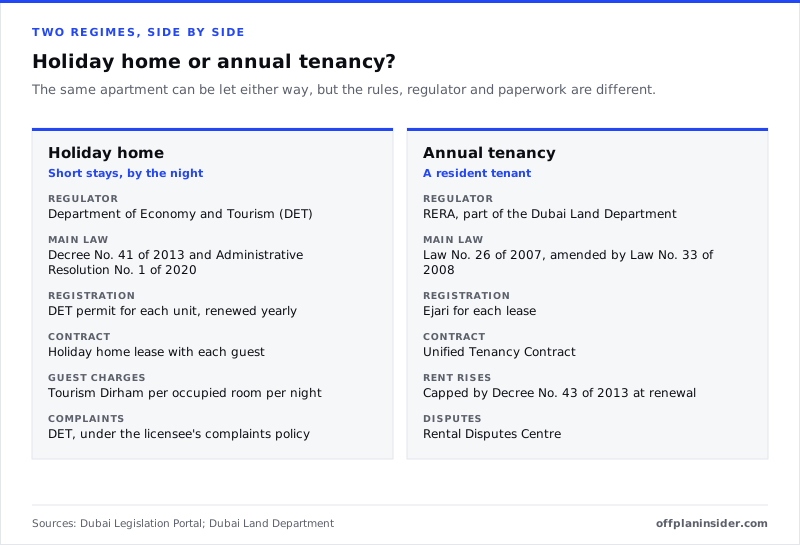
The practical differences for an owner are large. A holiday home has to be furnished and kept to DET's standards, every guest needs a contract and records, and there are nightly charges to collect. An annual tenancy has one tenant, one Ejari registration and rent rules set by the rental index.
Our Ejari guide explains the annual route step by step.
04Who can run a holiday home?
Two kinds of licensee: an individual who registers their own home, or a company licensed by DET as a holiday home operator. Owners who do not want to manage guests themselves appoint an operator.
Owners registering their own homes. An owner can register a home on DET's Holiday Homes system and hold the permit personally. There is a limit on how many homes an individual can register this way; beyond it, the owner needs a trade licence as an operator. Ask DET for the current limit before you add units.
Licensed operators. A company applies first for an initial approval, with copies of the passports and Emirates IDs of the owner, partners and managing director, a valid commercial licence and certificates of good conduct. It then has up to three months, renewable once, to complete the licence. A licence is valid for one year, and DET may approve a term of up to four years if the fees for the full term are paid.
Tenants. The permit rules accept a copy of the tenant's ID, so a tenant can apply in principle. But a tenant may not sublet without the landlord's written consent under Article 24 of Law No. 26 of 2007, and must prove the right to dispose of the unit. Without that consent, a tenant cannot lawfully run the home as a holiday let.
05Which homes qualify for a holiday home permit?
A home qualifies if it is in an area DET allows, is one of four property types, meets DET's technical standards for its class, and nothing in its sale contract rules out holiday-home use.
Article 8 of the 2020 bylaw sets the conditions:
- Location. The home is in an area where DET, with the other competent authorities, authorises the activity.
- Property type. An apartment in a building designated for holiday homes, an apartment in a residential building, a house or villa in a compound, or an independent villa.
- Standards and fittings. The home meets the technical specifications and has the fittings set in DET's guide for its classification.
- Identity. A copy of the valid passport or Emirates ID of the owner or tenant.
- Right to dispose. Proof that the applicant has the right to dispose of the unit. The sale and purchase agreement must not include an explicit provision that prevents use as a holiday home.
- Other technical requirements in DET's guide.
What developers and buildings must do. Article 17 of the bylaw says developers, owners of jointly owned property, and property management and leasing firms must enable licensees to conduct the activity under their licences and permits. So once a home has a permit, the building's managers should not stand in the way.
What that does not override. A permit is only issued where the location qualifies and the sale contract does not expressly exclude holiday-home use. Read your sale and purchase agreement for any such clause, and ask DET whether your building is in an authorised area.
06How do I get a holiday home permit, step by step?
Apply on DET's Holiday Homes system, yourself or through a licensed operator. DET checks the application, may inspect the home, and issues the permit once the fee is paid.
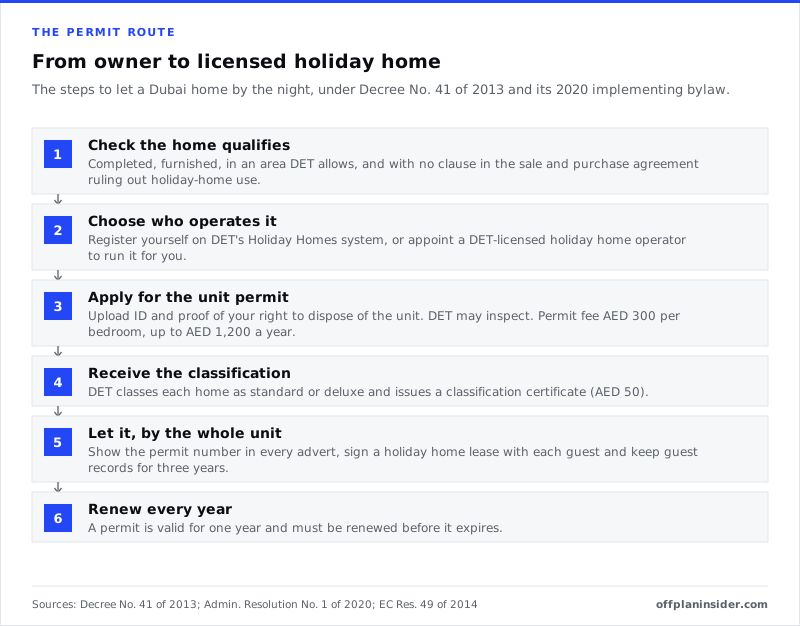
- Prepare the home. It must be complete, furnished and fitted to DET's standards for the class you are aiming for. Arrange insurance and safety equipment before you apply.
- Decide who will operate it. Register yourself as the owner on DET's Holiday Homes system, or appoint a licensed operator, who applies for the permit under its own licence.
- Apply for the permit. Submit the application through DET's electronic portal with the documents that prove the Article 8 conditions are met.
- Inspection and decision. DET reviews the application and may visit the home or ask for more documents. If it refuses, it gives reasons, and you can apply again.
- Pay and receive the permit. Once approved, you pay the fees and DET issues the permit and a classification certificate.
- Renew each year. A permit is valid for one year. Apply for renewal before it expires, on the same conditions as the first application.
07What does a holiday home permit cost?
In law, AED 300 per bedroom, up to AED 1,200 per home each year, plus AED 50 for the classification certificate. A relief package approved on 21 May 2026 exempts holiday home permit and licence fees for a period DET sets.
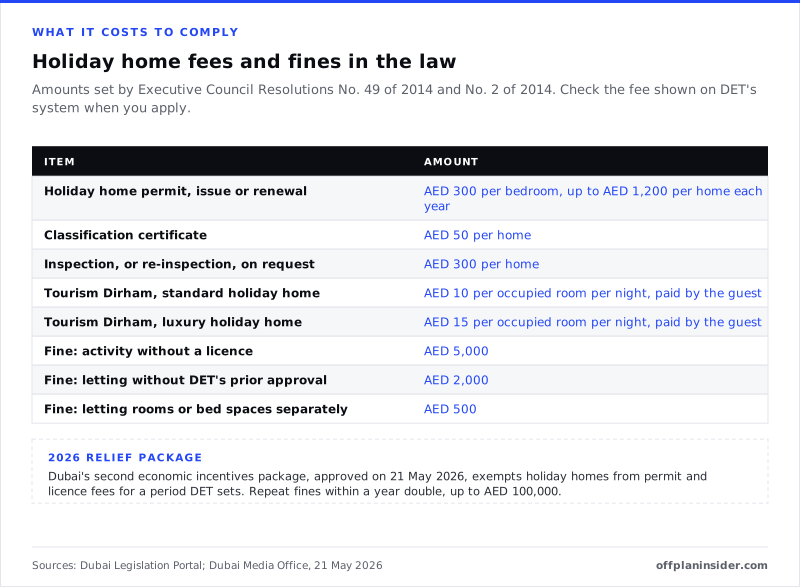
Executive Council Resolution No. 49 of 2014 sets the fees DET may charge. The ones an owner is most likely to meet are:
| Item | Fee in the resolution |
|---|---|
| Holiday home permit, issue or renewal | AED 300 per bedroom, up to AED 1,200 per home each year |
| Classification certificate | AED 50 per home |
| Inspection of a holiday home, on request | AED 300 per home |
| Re-inspection, on request | AED 300 per home |
| Re-opening a closed holiday home | AED 200 |
| Revoking a permit | AED 50 |
| Operator licence, issue or renewal | AED 500, after an AED 100 initial approval |
The 2026 exemption. On 21 May 2026 Dubai approved a second economic incentives package with 33 initiatives, each running for three to twelve months. It includes an exemption from permit and licence fees for holiday homes for establishments registered with DET. DET sets the timeline, so the fee you see on its system is the one that applies.
Costs beyond the permit. Furnishing to the required class, insurance, cleaning and linen, utilities, maintenance, safety equipment, platform commissions and any operator's fee all come on top. Service charges on the home are still payable to the building. Ask for quotes before you commit, and see our guide to the true cost of buying off-plan for the ownership costs that apply either way.
08What is the Tourism Dirham, and who pays it?
The Tourism Dirham is a charge on guests for each occupied room per night. For holiday homes it is AED 10 in a standard home and AED 15 in a luxury home.
The rates come from Executive Council Resolution No. 2 of 2014. The operator collects the charge from the guest, shows it on the guest's invoice, and pays it over to the tourism authority by the 16th of the following month.
So the operator does not pay it from its own pocket, but it is responsible for collecting and paying it on time. The May 2026 package also lists an exemption from collecting the Tourism Dirham for DET-registered establishments; ask DET whether and until when it applies to your home.
09What are the operator's obligations?
Running a holiday home is closer to running a small hotel than to letting a flat. The decree and Article 14 of the 2020 bylaw list the duties, and the main ones are:
- Insurance. A comprehensive policy from an insurer licensed in Dubai, covering damage guests may suffer, valid for the whole licence term.
- A contract for every stay. A holiday home lease with each guest, with a copy for the guest, consistent with the licence and permit.
- No hidden charges. Only the costs agreed in the contract. Charging guests extra for electricity and water is a violation.
- Guest information. Regular reporting of guest details to DET, and records kept on paper and electronically for at least three years. Guest information may be shared only with government entities or the courts.
- House rules and complaints. A written list of house rules for guests, a complaints policy displayed in the home, and a record of each complaint and what was done about it.
- Advertising. The licensee's trade name and the permit number in every printed and digital advert. No misleading descriptions.
- Occupancy. No more guests than the maximum set in the permit.
- Service and safety. Emergency and guest contact lines available 24 hours a day, seven days a week; a clean, habitable home; reasonable safety measures, particularly for fire, pools and wellness facilities.
- Neighbours. Courtesy towards neighbours and the building or community management.
- A notice board in each home showing the licensee's details and the home's classification, in Arabic and English.
Classification. DET classes each holiday home as deluxe or standard, using the criteria in its guide, and issues a classification certificate. It can upgrade or downgrade a home if it no longer meets the criteria. The Tourism Dirham schedule calls the higher class "luxury".
10What are the fines for an unlicensed holiday home?
The fines schedule runs from AED 200 to AED 20,000 per violation, and a repeat within a year doubles the fine, up to AED 100,000. DET can also warn, suspend the activity for up to six months, or cancel the licence.
Selected fines from Schedule 2 of Executive Council Resolution No. 49 of 2014:
| Violation | Fine |
|---|---|
| Carrying on the activity without a licence | AED 5,000 |
| Letting holiday homes without DET's prior approval | AED 2,000 |
| Giving DET false or incorrect information or documents | AED 5,000 |
| No valid insurance policy for the licence term | AED 2,000 |
| Charging guests extra for electricity and water | AED 2,000 |
| Operating a home DET has closed | AED 3,000 |
| Obstructing DET employees | AED 10,000 |
| Operating an establishment DET has suspended | AED 20,000 |
| Letting separate rooms or bed spaces | AED 500 |
Closure. Article 11 of the 2020 bylaw lets DET suspend or revoke a home's permit, for example if the rules are broken, the licence or permit is not renewed in time, the home stops meeting its classification, or the owner asks for closure. An owner can apply to re-open at least 15 days after closure, once the reason has been dealt with.
11Can I run a holiday home in an off-plan property?
Not until it is built, handed over and furnished. A permit is for a furnished home that meets DET's standards, so the holiday home route starts after handover. What you can do before then is check that the home will qualify.
Before you buy, check four things.
- The sale and purchase agreement. Look for any explicit clause that rules out holiday-home use. If there is one, a permit cannot be issued.
- The location. Ask DET whether the building or community is in an area where the activity is authorised.
- The building's set-up. Some buildings are designed with holiday-home or serviced use in mind, and some developers appoint an operator. Ask the developer what is planned and on what terms.
- The class you are aiming for. Furnishing and fittings must meet DET's standards for standard or deluxe. Budget for them alongside the handover payment.
After handover. Complete the handover steps in our handover guide, open the utility accounts, furnish the home, then apply for the permit. Homes already completed are on our ready projects page.
Projects that developers market for short stays are on our short-term rental page, and purpose-run homes are under serviced apartments and branded residences. In a serviced or branded building, the operator's own programme may be the way to let, so read its terms.
12Self-managing or using an operator?
Both are lawful routes. The choice is about time and responsibility, because the duties above apply either way.
| Question | Registering your own home | Using a licensed operator |
|---|---|---|
| Who holds the permit | You | The operator, under its licence |
| Who deals with guests, cleaning and complaints | You, around the clock | The operator |
| Who reports guest data and collects the Tourism Dirham | You | The operator |
| Who carries the fines | You | The licensee, as set by your agreement |
| What you agree in writing | Nothing beyond the guest contracts | Fees, term, minimum standards, reporting, how you can end the agreement |
If you use an operator, check its DET licence before you sign, read how its fee is calculated and what costs are deducted, and agree when you can use the home yourself and how you can end the agreement. Ask for monthly statements.
If you live abroad, an operator is usually the practical route, because the guest-facing duties run 24 hours a day.
13A checklist before you list a holiday home
- The home qualifies: an authorised area, an eligible property type, and no exclusion in the sale and purchase agreement.
- You have the right to let it: you own it, or you are a tenant with the landlord's written consent.
- It is furnished and fitted to the standard for its class, with safety equipment in place.
- Insurance is in force for the licence term.
- The permit is issued and the classification certificate is displayed with the licensee's notice board.
- Every advert shows the permit number and the licensee's trade name.
- A guest contract, house rules and a complaints policy are ready.
- Guest reporting and the Tourism Dirham are set up.
- A 24-hour contact line is staffed.
- The renewal date is in the diary, before the permit's first year ends.
14Key terms
- DET. Dubai's Department of Economy and Tourism, which licenses holiday homes.
- Holiday home. A furnished home approved by DET for letting to paying guests overnight.
- Permit. DET's approval for a specific home, valid for one year.
- Licence. DET's authorisation for an individual or company to carry on the activity.
- Classification. DET's grading of a holiday home as standard or deluxe.
- Tourism Dirham. A per-night charge on guests, per occupied room.
- Ejari. The register for annual tenancy contracts, explained in our Ejari guide.
FAQQuestions buyers ask.
Is short-term rental legal in Dubai?
Yes, if it is licensed. Decree No. 41 of 2013 says nobody may carry on the activity of letting holiday homes in Dubai without a licence from the emirate's tourism authority, now the Department of Economy and Tourism. Each home also needs a holiday home permit, renewed every year.
How do I get a holiday home permit in Dubai?
Apply through the Department of Economy and Tourism's Holiday Homes system, or through a DET-licensed operator. You provide a copy of the owner's or tenant's passport or Emirates ID and proof of your right to dispose of the unit. DET may inspect, and once the application is approved you pay the fee and the permit is issued for one year.
How much does a holiday home permit cost in Dubai?
Executive Council Resolution No. 49 of 2014 sets the permit fee at AED 300 per bedroom, up to AED 1,200 per holiday home each year, plus AED 50 for the classification certificate. Dubai's economic incentives package of 21 May 2026 exempts holiday home permit and licence fees for a period set by DET, so check the fee shown when you apply.
What is the Tourism Dirham for holiday homes?
It is a charge on guests for each occupied room per night. Executive Council Resolution No. 2 of 2014 sets AED 10 for a standard holiday home and AED 15 for a luxury holiday home. The operator collects it from the guest, shows it on the invoice and pays it to the tourism authority.
Can I rent out my Dubai apartment on Airbnb?
Yes, if the home has a holiday home permit and is operated by you as a registered owner or by a licensed operator. The permit number must appear in every advert, on any platform. Without a permit, letting by the night is an offence: activity without a licence carries a AED 5,000 fine.
Can a tenant run a holiday home in Dubai?
Only with the landlord's written consent. The permit rules accept a tenant's identity documents, but Article 24 of Law No. 26 of 2007 says a tenant may not sublet without the landlord's written consent unless the lease allows it, and the applicant must show the right to dispose of the unit.
Can my building or developer stop me running a holiday home?
Article 17 of Administrative Resolution No. 1 of 2020 says developers, owners of jointly owned property and management firms must enable licensees to conduct the activity under their licences and permits. But a permit is issued only in areas DET authorises, and not where the sale and purchase agreement explicitly rules out holiday-home use, so check both.
Can I let an off-plan property as a holiday home?
Not until it is complete, handed over and furnished. A permit is for a furnished home that meets DET's technical standards, so the permit route starts after handover. Before you buy, check that the sale and purchase agreement does not exclude holiday-home use and ask the developer about the building's rules.
Do holiday homes in Dubai need Ejari?
No. Ejari registers annual tenancy contracts under Dubai's landlord and tenant law. A holiday home works under a DET permit, and each guest stay is covered by a holiday home lease between the operator and the guest.
Sources & methodWhere these figures come from.
Sources
- Dubai Legislation Portal: Decree No. (41) of 2013
- Dubai Legislation Portal: Administrative Resolution No. (1) of 2020.pdf
- Dubai Legislation Portal: Executive Council Resolution No. (49) of 2014
- Dubai Legislation Portal: Executive Council Resolution No. (2) of 2014
- mediaoffice.ae: Hamdan bin mohammed
- dubaidet.gov.ae: Register as a holiday home operator
- dubaidet.gov.ae: Issue a new holiday homes permit
- Dubai Legislation Portal: Law No. (26) of 2007
- Dubai Legislation Portal: Law No. (33) of 2008 Amending Law No. (26) of 2007
What we could not verify
- The fees DET charges today, including any knowledge and innovation fees, could not be checked because DET's own service pages refused access on 4 November 2026; the amounts given are those in Executive Council Resolutions No. 49 of 2014 and No. 2 of 2014, and readers are told to check the fee shown on DET's system.
- How long the May 2026 exemption from holiday home permit and licence fees lasts, and whether the Tourism Dirham exemption in the same package covers holiday homes as well as hotel establishments, is set by DET and was not published on the pages opened.
- The limit on how many homes an individual owner may register before needing a trade licence as an operator (eight, according to a DET service page summary in search results) and DET's exact document list (title deed or sale and purchase agreement with a payment completion certificate, and a DEWA bill, as stated in our rental yield guide) could not be re-checked on DET's site.
4 Nov 2026 · Reviewed by OffPlan Insider Research. First published 4 Nov 2026.