Ejari is the Dubai Land Department's system for registering tenancy contracts, and Dubai law requires every lease to be in writing and registered with RERA. A landlord who manages their own home can now create, renew and cancel the contract on the DubaiNow app: the landlord fills in and signs the contract with UAE PASS, the tenant accepts, signs and pays, and the certificate is issued instantly. Registration costs AED 177.75 through the apps or website and AED 220 at a Real Estate Trustee Centre.
Key takeaways
- Ejari is the Dubai Land Department's register of tenancy contracts. Law No. 26 of 2007, as amended, requires every lease to be written and registered with RERA.
- Since November 2026, owners who manage their own homes can register, renew and cancel leases on the DubaiNow app with UAE PASS, and the tenant pays the DEWA deposit in the same journey.
- The Dubai Land Department's fee is AED 177.75 through DubaiNow, the Dubai REST app or its website, and AED 220 at a Real Estate Trustee Centre.
- You need the Unified Tenancy Contract, Emirates ID, and an official power of attorney if someone acts for you. Owner records must be up to date before the app will let you start.
- Changing the rent or terms at renewal needs at least 90 days' notice before expiry. Recovering the home at expiry to sell or live in needs 12 months' notice by notary or registered post.
- Off-plan buyers can register a lease once the home is handed over and set up in the system. Holiday lets are licensed by the Department of Economy and Tourism instead, not through Ejari.
01What is Ejari in Dubai?
Ejari is the Dubai Land Department's system for registering tenancy contracts. Every residential and commercial lease in Dubai is recorded on it, and the registered contract is what government services rely on when they need to know who lives where.
The duty to register comes from Law No. 26 of 2007 on the relationship between landlords and tenants, as amended by Law No. 33 of 2008. Article 4 says a lease must be in writing, must describe the property, its use, the term, the rent and how it is paid, and must be registered with RERA, the Real Estate Regulatory Agency within the Dubai Land Department.
For a landlord, Ejari is the step that turns a signed lease into an official one. It links the tenant to the home for electricity and water, gives both sides a record they can rely on, and is the starting point for renewals and the rent rules in our guide to the Dubai rental index.
This guide is for owners who are letting a home for a year or more. It is general information, not legal advice; your own contract and circumstances decide the details.
02Is Ejari registration mandatory for landlords?
Yes. Article 4 of the landlord and tenant law, as replaced in 2008, requires every lease covered by the law to be registered with RERA, and Ejari is the way that is done.
It also matters in practice. The tenant cannot connect electricity and water in their own name without a registered contract, and a registered lease is the record both sides rely on if a disagreement reaches the Rental Disputes Centre.
The scale shows how routine it is. The Dubai Land Department recorded 118,385 new rental contracts and 135,607 renewals in the first quarter of 2026, close to 254,000 in three months, with a combined value of about AED 32.2 billion.
03What changed in November 2026: Ejari on DubaiNow
The Dubai Land Department now offers the whole tenancy contract journey on the DubaiNow app. Landlords and tenants can create and register a new lease, renew it or cancel it in one place, and the tenant pays the DEWA security deposit in the same process.
The department announced the upgrade on 2 November 2026, built with Digital Dubai and the Dubai Electricity and Water Authority. Both parties sign in with UAE PASS, the national digital identity, and sign the contract electronically. Our news story on Ejari moving to DubaiNow has the announcement.
The DubaiNow route is for individuals who own and manage their own property and hold a valid Emirates ID. If a property management company runs your home, it registers the lease through its own access to the Ejari system instead.
04How do I register Ejari on DubaiNow, step by step?
The landlord starts the contract, the tenant accepts and pays, and the certificate is issued straight away. Allow a few minutes once both of you have UAE PASS ready.
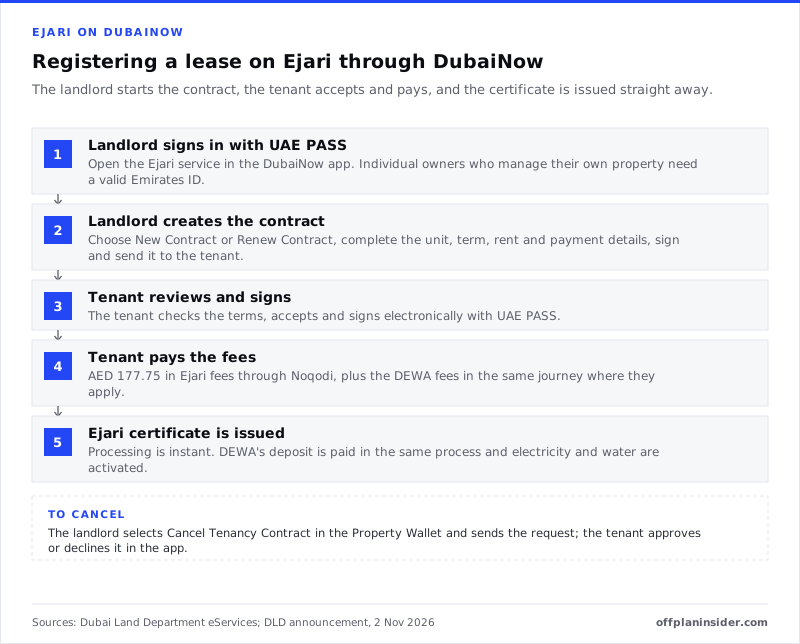
- Sign in. Open DubaiNow, go to the Ejari service and sign in with UAE PASS.
- Create the contract. Choose New Contract, or Renew Contract for an existing tenant. Complete the property, term, rent, payment method and any additional terms, then sign and submit it to the tenant.
- The tenant reviews and signs. The tenant opens the request, checks the terms, accepts and signs electronically with UAE PASS.
- The tenant pays. The tenant pays the Ejari fees and, where applicable, the DEWA fees. Payment is through Noqodi.
- The certificate is issued. The Dubai Land Department lists processing as instant. The output is the new or renewed tenancy contract, and electricity and water can be activated in the same journey.
Before you start. The app route needs the owner's data on record to be up to date. If you bought off-plan, make sure your title deed or completed registration is showing against your name before you agree a move-in date.
05What are the other ways to register Ejari?
There are four channels: DubaiNow, the Dubai REST app, the Dubai Land Department website and Real Estate Trustee Centres. Which one you use depends on who manages the property and who is applying.
| Channel | Who it suits | What you need |
|---|---|---|
| DubaiNow app | Individual owners who manage their own homes, letting to an individual tenant | UAE PASS and a valid Emirates ID for both parties |
| Dubai REST app | Individual landlords and tenants | A copy of the Unified Tenancy Contract; owner data up to date |
| Dubai Land Department website (Ejari system) | Licensed property management companies; individual owners who manage their own homes; their representatives under a legal power of attorney | Ejari system access and the contract details |
| Real Estate Trustee Centre | A tenant, or a representative with a power of attorney, where the home is not managed by a company or an owner with Ejari access | Original Unified Tenancy Contract, Emirates ID, and a power of attorney if a representative applies |
Through the Dubai REST app or website. Sign in, choose the service, enter the contract information and upload any documents, then pay. A department employee reviews and approves the request, and the e-contract registration certificate arrives by email.
At a Trustee Centre. Take the documents to the nearest Real Estate Trustee Centre, or to the management company if one runs the property. An employee reviews and approves the request while you wait, you pay and you receive the certificate. The department gives about 25 minutes for the service, not counting waiting time.
06How much does Ejari cost?
AED 177.75 through DubaiNow, the Dubai REST app or the department's website, and AED 220 at a Real Estate Trustee Centre. The difference is the service partner fee.
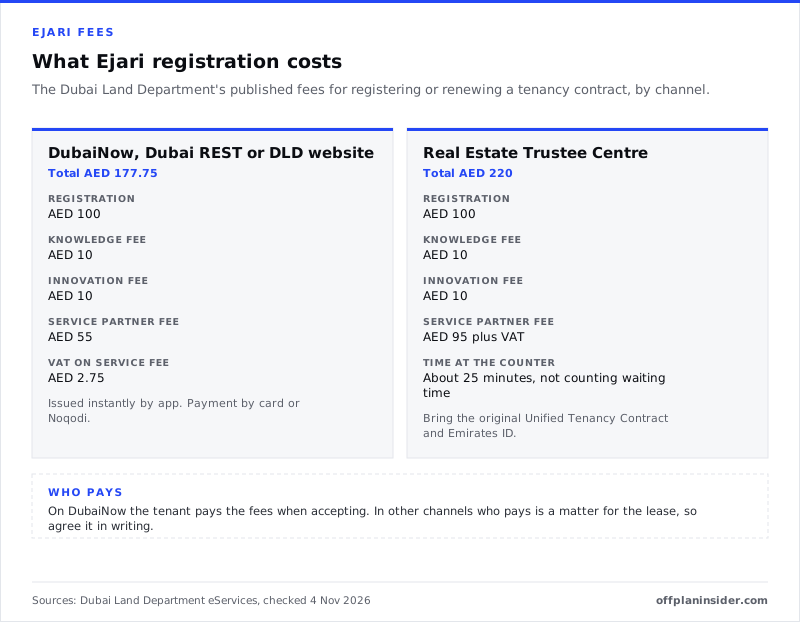
The online fee breaks down as AED 100 for registering the contract, a AED 10 knowledge fee, a AED 10 innovation fee, a AED 55 service partner fee and AED 2.75 VAT on that service fee. At a Trustee Centre the first three items are the same and the service partner fee is AED 95 plus VAT, for a total of AED 220.
Who pays. On DubaiNow the tenant pays as part of accepting the contract. In other channels the law does not fix who pays, so write it into the lease.
Other costs around a new lease. These are separate from Ejari: the tenant's DEWA security deposit and connection fees, any agent's commission, and the security deposit you take from the tenant. Article 20 of the law lets a landlord take a deposit to secure the condition of the home, and it must be returned, or the balance of it, when the lease ends.
07What documents do I need?
Less than most landlords expect. The core document is the Unified Tenancy Contract, signed by both parties, plus proof of identity.
- Through DubaiNow. UAE PASS for the landlord and the tenant, and a valid Emirates ID. The contract is created inside the app.
- Through the Dubai REST app. A copy of the Unified Tenancy Contract.
- At a Trustee Centre. The original Unified Tenancy Contract, the applicant's Emirates ID, and an official power of attorney if a representative is applying. A power of attorney issued in Dubai can be quoted by its number; one issued in another emirate must be attached.
Keep your own file as well: the title deed, the tenant's passport and visa copies, the cheques or payment schedule, the move-in condition report and photographs. None of these replaces the registered contract, but you will want them at renewal or in a dispute.
If you live abroad, a power of attorney lets a relative or property manager sign and register for you. The attestation steps for documents signed outside the UAE are in our handover guide.
08What should a Dubai lease say?
The law sets the minimum, and the Unified Tenancy Contract gives the structure. Article 4 requires the description of the property, its purpose, the term, the rent and the payment method, and the owner's name if the landlord is someone else.
Agree these points in writing before you register:
- Rent and payment. The annual amount and how it is paid. If the lease says nothing, Article 12 of the law provides for four equal instalments in advance.
- Deposit. The amount and the conditions for returning it.
- Maintenance. Who handles which repairs. Under Article 16 maintenance falls on the landlord unless the lease says otherwise, so spell out any minor repairs the tenant will handle.
- Use and occupants. Residential use, and who may live there.
- Subletting. Article 24 says a tenant may not assign or sublet without the landlord's written consent, unless agreed otherwise. That includes letting the home as a holiday home.
- Service charges and bills. As owner you remain liable to the building for service charges, even if the lease passes them on. Utilities are usually the tenant's.
- Additional terms. Pets, parking, furniture, early exit. Additional terms must not conflict with the law.
09Which dates and notices must a landlord not miss?
Three dates carry most of the risk: registration at the start, 90 days before expiry if you want to change the rent or terms, and 12 months before you need the home back.
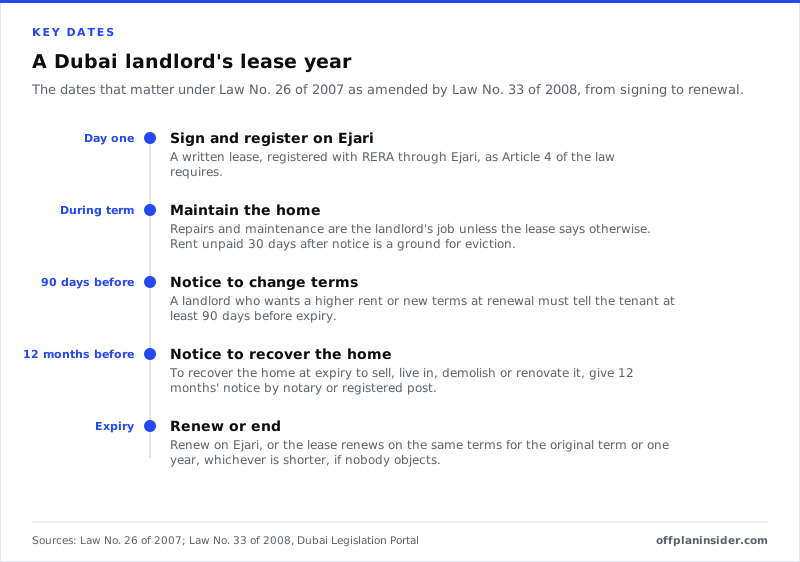
Changing the rent or terms: 90 days. Under Article 14, as replaced in 2008, a party who wants to change the terms at renewal, including the rent, must notify the other at least 90 days before the lease expires, unless the lease says otherwise. Any increase is also capped by the rental index, which is explained in our rental index guide.
Recovering the home at expiry: 12 months. Under Article 25(2), as replaced in 2008, a landlord can seek eviction at the end of the lease only for set reasons: demolition or reconstruction with permits, restoration that needs the home empty, the owner or a first-degree relative needing it with no suitable alternative, or a sale. The notice must be given at least 12 months before the eviction date, through a notary public or by registered mail.
If you recover the home to live in. Article 26 says that where the owner recovers a home for their own or a relative's use, it cannot be let to someone else for two years for a residential property. Otherwise the tenant can ask for compensation.
During the term. A landlord can seek eviction before expiry on the grounds in Article 25(1), including rent left unpaid 30 days after a notice to pay, unauthorised subletting and illegal use. Where a breach can be put right, the tenant has 30 days after notice to do so.
Automatic renewal. Under Article 6, if the tenant stays on after expiry without objection from the landlord, the lease renews on the same terms for the original term or one year, whichever is shorter. Register the renewal on Ejari so the record matches.
10What happens to Ejari if I sell the home?
The tenancy continues. Article 28 says a change of ownership does not affect the tenant's right to stay for the rest of a fixed-term lease signed with the previous owner.
If you plan to sell with vacant possession, the 12-month notice for a sale under Article 25(2) applies. If you sell with the tenant in place, the buyer takes over the lease and should register the next renewal in their own name.
11How do I renew or cancel an Ejari registration?
On DubaiNow, both are done from the app. A renewal is a new registration with updated details, and a cancellation needs the tenant's approval.
To renew. The landlord chooses Renew Contract, updates the term and any agreed rent change, signs and sends it to the tenant, who accepts and pays. The fee is the same as a new registration.
To cancel. The landlord signs in, selects the property in the Property Wallet and chooses Cancel Tenancy Contract, completes the fields and submits the request to the tenant. The tenant approves or declines it, and the landlord is notified. No document is issued on cancellation.
Cancel the old registration when a tenant leaves, so the next lease can be registered cleanly and the outgoing tenant can close their utility account.
12How does Ejari connect to DEWA?
Ejari is what lets the tenant open their own electricity and water account. On DubaiNow the DEWA security deposit is paid within the same process, and electricity and water are activated when the contract is registered.
Close your own DEWA account, or move it into the tenant's name, before the tenant moves in. Read the meters on the handover day and keep photographs, so the first bill is clean.
13Can I register Ejari on an off-plan home?
Not before handover. Until the building is complete and handed over, there is no home to let, and the unit has to be set up for tenancy registration first.
Plan the first tenancy for after you have the keys. Our handover guide covers the completion notice, snagging and the title deed, and those steps decide when you can sign a tenant.
If you are buying to let, check four things before you buy. The expected handover year, whether the building's rules suit your tenant type, the approved service charge, and whether you will manage the letting yourself or use a property manager. Homes already completed are on our ready projects page, and those close to completion on near-handover projects.
14Do holiday homes need Ejari?
No. Letting a furnished home by the night is a separate activity, licensed by the Department of Economy and Tourism under Decree No. 41 of 2013, and each unit needs a holiday home permit instead.
The two routes do not mix on the same unit at the same time. If you let a home for a year on Ejari, the tenant may not sublet it, including as a holiday home, without your written consent. The permit route, fees and rules are in our guide to holiday homes and short-term rentals in Dubai.
15What can go wrong, and how to avoid it
Most Ejari problems come from mismatched details or missed steps, not from the system itself. Check these before the tenant moves in:
- Owner details are current. The app route needs the owner's data to be up to date. If the home has just been handed over, confirm the registration shows in your name.
- Names match the IDs. The landlord and tenant names on the contract match their Emirates IDs or passports exactly.
- The unit is the right one. The building, unit number and plot details on the contract match the title deed.
- The previous lease is closed. If the unit was let before, the old registration is cancelled.
- The tenant has been checked. The free Rental Good Conduct Certificate in the Dubai REST app shows whether a person or company has a record of rental cases. Our story on a lease annulled for deception shows why it is worth asking for.
- The deposit, cheques and move-in report are documented. Keep copies with the registered contract.
- A power of attorney covers leasing, if someone is acting for you.
If a dispute does arise, the Rental Disputes Centre handles it, and most cases settled by agreement close quickly. Our report on how fast Dubai rental disputes are settled has the centre's figures.
16Key terms
- Ejari. The Dubai Land Department's system for registering tenancy contracts.
- RERA. The Real Estate Regulatory Agency, the regulatory arm of the Dubai Land Department.
- Unified Tenancy Contract. The standard lease form used for Ejari registration.
- UAE PASS. The national digital identity used to sign in and sign contracts on DubaiNow.
- Real Estate Trustee Centre. A licensed service centre where Ejari can be registered in person.
- Rental Disputes Centre. The body that hears disputes between landlords and tenants in Dubai.
17Where to go next
If you have not yet bought, start with the costs: our guide to the true cost of buying off-plan covers service charges and the running costs that come out of rent. For how rents compare across communities, read the best areas in Dubai for rental yield, and browse projects marketed for rental income.
If you already own a home and a tenant is lined up, agree the terms in writing, check the tenant, and register on DubaiNow on or before the move-in day.
FAQQuestions buyers ask.
What is Ejari in Dubai?
Ejari is the Dubai Land Department's online system for registering tenancy contracts. Law No. 26 of 2007 on landlords and tenants, as amended in 2008, says every lease must be in writing and registered with RERA, the department's regulatory arm. Ejari is how that registration is done, and the registered contract is then used by DEWA and other government services.
Is Ejari mandatory for landlords in Dubai?
Yes. Article 4 of Law No. 26 of 2007, as amended by Law No. 33 of 2008, requires all lease contracts covered by the law to be registered with RERA. In practice the tenant also needs the registration to connect electricity and water, and a registered contract is the record you rely on if a dispute reaches the Rental Disputes Centre.
How do I register Ejari online?
If you are an individual owner who manages your own property, use the DubaiNow app: sign in with UAE PASS, open the Ejari service, choose New Contract, complete and sign it and send it to the tenant. The tenant accepts, signs and pays, and the certificate is issued instantly. You can also register through the Dubai REST app or the Dubai Land Department website.
How much does Ejari registration cost?
The Dubai Land Department lists AED 177.75 through DubaiNow, the Dubai REST app or its website: AED 100 registration, AED 10 knowledge fee, AED 10 innovation fee, a AED 55 service partner fee and AED 2.75 VAT. At a Real Estate Trustee Centre the total is AED 220, because the service partner fee there is AED 95 plus VAT.
Who pays for Ejari, the landlord or the tenant?
On DubaiNow the tenant pays the fees as part of accepting the contract. Through other channels the law does not say who pays, so it is a matter for the parties. Agree it in the lease, along with who pays any agent and the DEWA deposit.
What documents are needed for Ejari registration?
Through the app, a copy of the Unified Tenancy Contract and UAE PASS for both parties. At a Real Estate Trustee Centre, the original Unified Tenancy Contract, the applicant's Emirates ID and an official power of attorney if a representative applies. A power of attorney issued in Dubai can be quoted by number; one issued in another emirate must be attached.
How do I renew or cancel Ejari?
On DubaiNow the landlord chooses Renew Contract, updates the details and sends it to the tenant to accept and pay. To cancel, the landlord selects the property in the Property Wallet, chooses Cancel Tenancy Contract and sends the request, and the tenant approves or declines it. No document is issued on cancellation.
Can I register Ejari for an off-plan property?
Not until the home is completed, handed over and set up in the Ejari system. Plan the first lease for after handover, once you have the keys and the title deed or the developer's handover documents. Ask the developer when your unit will be available for tenancy registration.
Do holiday homes need Ejari?
No. Letting a home by the night is a separate activity licensed by the Department of Economy and Tourism under Decree No. 41 of 2013. Each unit needs a holiday home permit, and each guest stay is covered by a holiday home lease, not by an Ejari tenancy contract.
Sources & methodWhere these figures come from.
Sources
- Dubai Land Department: Register renew terminate tenancy contract
- Dubai Land Department: Register renew ejari contract
- Dubai Land Department: Rental index
- Dubai Legislation Portal: Law No. (26) of 2007
- Dubai Legislation Portal: Law No. (33) of 2008 Amending Law No. (26) of 2007
- Dubai Legislation Portal: Decree No. (43) of 2013 Determining Rent Increase for Real Property
- Dubai Legislation Portal: Decree No. (41) of 2013
- Gulf News: Dubai tenants can now register renew cancel ejari pay dewa on dubainow app
What we could not verify
- Whether a new lease can be registered while an earlier registration on the same unit is still active is not stated on the Dubai Land Department's service pages; the advice to cancel the old registration first is common practice, not a published rule.
- The DEWA security deposit amounts for apartments and villas are not given, because DEWA's own pages were not opened for this guide; the text says only that the deposit is paid in the same DubaiNow journey, as the Dubai Land Department announced.
- When an off-plan unit becomes available for Ejari after handover depends on how the developer and the Dubai Land Department set the unit up in the system; no published timetable was found.
4 Nov 2026 · Reviewed by OffPlan Insider Research. First published 4 Nov 2026.