A title deed in Dubai is the certificate of ownership that the Dubai Land Department issues from its Property Register; under Law No. 7 of 2006 it has absolute evidentiary value of the rights it records. Off-plan buyers do not get one at purchase. The developer registers the sale on Oqood, the interim register, and once the building has its completion certificate the developer must enter the project in the Property Register, with each unit in the name of the buyer who has met their obligations. The deed is now issued electronically, with an e-map, and no second 4% fee is charged when Oqood converts.
Key takeaways
- A title deed is issued from the Dubai Land Department's Property Register. Article 24 of Law No. 7 of 2006 gives it absolute evidentiary value, and a transaction that is not registered is not valid.
- An off-plan buyer holds an Oqood registration, not a title deed. The deed follows completion: Article 8 of Law No. 13 of 2008 requires the developer to enter the completed project and register sold units in the names of buyers who have met their obligations.
- If the developer does not act, the Dubai Land Department may register the unit in your name at your request or on its own initiative, provided you have fulfilled the contract.
- Deeds are issued electronically. DLD emails a link to an electronic title deed and an electronic map, and you can verify a deed in the Dubai REST app or on the DLD website.
- DLD lists AED 250 for a title deed certificate, AED 120 for a map and AED 10 each for knowledge and innovation fees. The 4% DLD fee is not charged again when Oqood converts.
- Joint owners are recorded with their shares. Adding a spouse or child later is a gift registration at 0.125% of the valuation, minimum AED 2,000, rather than a new 4% sale.
- A mortgage is valid only once registered with DLD. A mortgaged home can be sold, but only with the bank's consent and through DLD's mortgaged-sale procedure.
01What is a title deed?
A title deed is the official certificate that proves who owns a property. In Dubai it is issued by the Dubai Land Department (DLD) from its Property Register, and it is the document a bank, a buyer or a court relies on.
The law behind it is Law No. 7 of 2006 on real property registration. Article 22 says title deeds are issued from the data recorded in the Property Register, and Article 24 gives them absolute evidentiary value of the rights they record. Article 7 adds that the register itself can be challenged only if an entry is proven to result from fraud or forgery.
Registration is what makes ownership real. Article 9 says a transaction that creates, transfers or ends a property right is not valid unless it is recorded, and DLD's own answers put it simply: transactions not registered in its registers are invalid.
This guide is about the deed itself: what it shows, how an off-plan buyer gets one, what it costs, and how joint names and mortgages appear on it. The wider handover process, from the notice to snagging and keys, is in our guide to the off-plan handover process in Dubai.
02Do off-plan buyers get a title deed?
Not at first. When you buy off-plan you get an Oqood registration, which records your purchase on the interim register while the building is under construction. The title deed comes after completion.
The reason is practical. A title deed describes a finished property: a unit with a measured area in a completed building. Until the building exists there is nothing to put on the Property Register, so Dubai keeps a separate interim register for off-plan sales under Law No. 13 of 2008.
The Oqood registration is not a lesser right. Article 3 of that law makes an off-plan sale void unless it is entered on the interim register, and Article 6 lets you sell or mortgage a unit while it is there. What Oqood is, and what it protects, is explained in full in our guide to Oqood in Dubai.
03How does an Oqood become a title deed?
At completion the developer must move the project onto the Property Register and register each sold unit in the name of the buyer who has met their obligations. You then receive an electronic title deed by email.
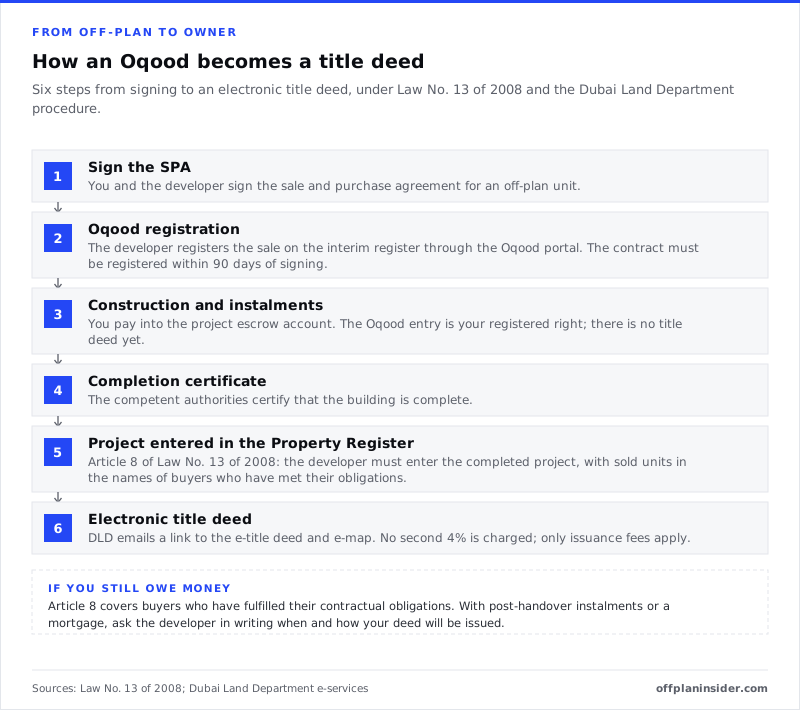
Each step has a legal basis:
- Oqood at purchase. The developer registers the sale through DLD's Oqood portal. DLD's initial sale service says the contract must be registered within 90 days of signing, and the buyer receives a provisional registration e-certificate.
- The completion certificate. The competent authorities certify that the building is complete. This, not the date on your payment plan, is what starts the move to the Property Register.
- The developer's duty. Article 8(1) of Law No. 13 of 2008 says developers must enter completed projects in the Property Register once they receive the completion certificate, including entering sold units in the names of purchasers who have fulfilled their contractual obligations.
- No refusal. Article 7(1) of the 2010 implementing bylaw says that once a project is complete, a developer may not refuse to hand over or register a unit in the name of a buyer who has met their obligations.
- The deed. DLD issues the title deed, now electronically, and emails the owner a link to it and to the property map.
If you have paid in full, the developer normally makes the application, and your deed arrives with or soon after handover. If you still owe money, for example on a post-handover plan, Article 8 does not oblige the developer to register the unit in your name yet. Ask, in writing and before you sign the handover documents, when and how your deed will be issued.
04What if the developer does not register my unit?
You can ask the Dubai Land Department to do it. Article 8(2) of Law No. 13 of 2008 lets DLD register an off-plan unit in the buyer's name, on the buyer's request or on its own initiative, provided the buyer has fulfilled all contractual obligations.
The bylaw repeats this in Article 7(3). In practice, start with the developer: ask for the application status and a date in writing. If nothing happens, take your SPA, Oqood certificate, payment receipts and a statement showing a nil balance to DLD.
DLD's answers also cover the earlier stage. If a developer refuses or delays registering the sale contract itself, an application can be made to DLD's Real Estate Registration Assurance section. The bylaw sets a fine of AED 10,000 on a developer that applies late.
05What does a Dubai title deed show?
It shows who owns what: the owners and their shares, the property and where it is, its size and use, and the certificate number used to check it. Mortgages and restrictions are recorded against the unit in the register.
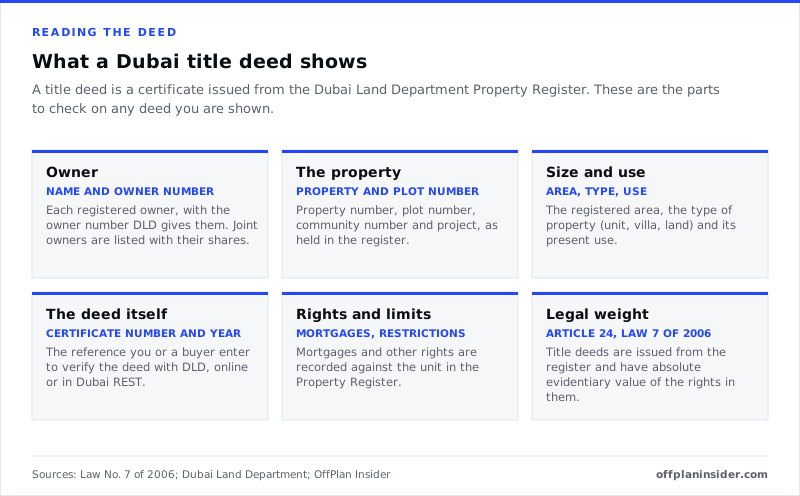
The owner and the owner number. DLD gives each owner a number, which its answers say is shown on the deed next to the owner's name. If you find you have more than one owner number, DLD asks you to update your data and unify them.
The property. The property number, plot number, community and project identify the unit. These are the same fields DLD's standard sale contract asks for, so a buyer of your home will copy them from your deed.
The area. The registered area matters beyond the deed. Under Law No. 6 of 2019 your share of the building's service charge is calculated from the area in the Property Register.
Type of deed. Most foreign buyers in freehold areas receive a freehold title deed. Article 4 of Law No. 7 of 2006 also allows usufruct and leasehold rights of up to 99 years, which are registered on their own certificates, so check which one you are being shown.
When something is wrong. If a name, nationality, passport number or date of birth is wrong, DLD's title deed modification service corrects it. It lists fees of AED 250 for the certificate plus AED 10 and AED 10, a service time of 25 minutes and an electronic title deed as the output. Article 13 of Law No. 7 of 2006 also lets DLD correct obvious errors in the register.
06What is an e-title deed, and how do I check one?
An e-title deed is the electronic certificate DLD now issues instead of a paper one. DLD's title deed services list an electronic title deed and an electronic map as the output, sent to the owner as a link by email.
It is not a copy of something else. Article 8 of Law No. 7 of 2006 gives electronically recorded documents the same evidentiary value as originals. Keep the email, save the files and store them in the DLD Document Vault in the Dubai REST app.
Verify any deed you are shown. The Dubai REST app verifies title deed certificates against DLD's register, and the DLD website has a title deed verification service. You enter the certificate number and year printed on the deed. Do this before paying a deposit on any resale, and on your own deed when it arrives.
Prove ownership without sending the deed. DLD's ownership certificate, sometimes called a "to whom it may concern" letter, costs AED 50 per letter plus AED 10 knowledge and AED 10 innovation fees, AED 70 in all, in the Dubai REST app or on the website. Trustee centres add a service partner fee of AED 50 plus VAT. It is issued instantly, and it is useful whenever a bank or an embassy asks for proof of ownership.
How the app works, from signing in to the document vault, is in our guide to the Dubai REST app.
07What does a title deed cost?
On an off-plan home, the large fee is already paid. The 4% DLD fee is charged once, at Oqood registration, and the conversion to a title deed carries only small fixed fees.
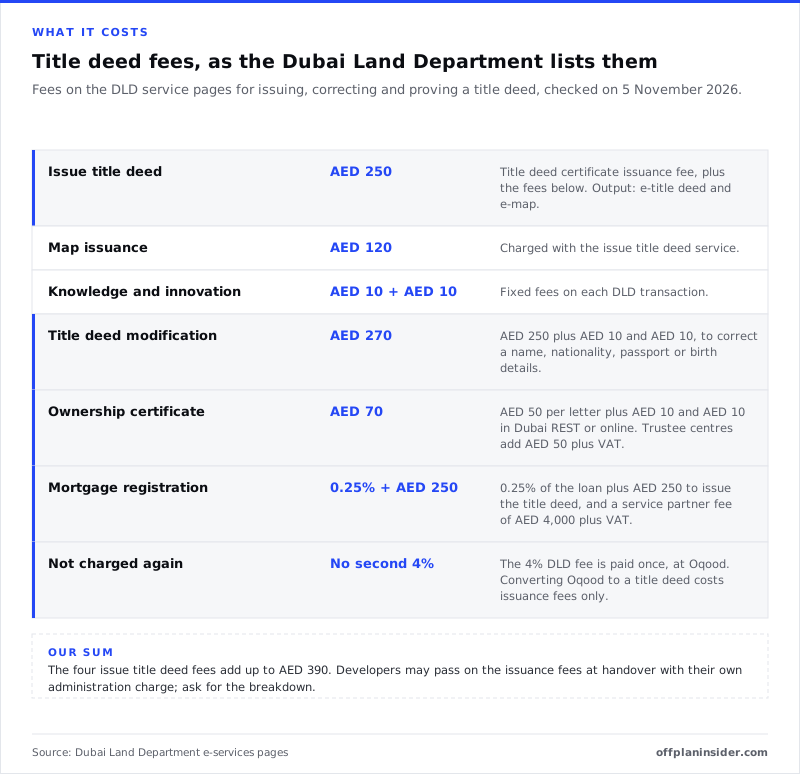
| Service | Fees DLD lists | Output |
|---|---|---|
| Issue title deed | AED 250 title deed certificate, AED 120 map, AED 10 knowledge, AED 10 innovation | Electronic title deed and electronic map; service time 5 minutes |
| Title deed modification | AED 250 certificate, AED 10 knowledge, AED 10 innovation | Electronic title deed; service time 25 minutes |
| Ownership certificate | AED 50 per letter plus AED 10 and AED 10; AED 50 plus VAT more at a trustee centre | Certificate, issued instantly |
| Ready resale (buyer's side) | 4% of the sale value (2% each by default), AED 250 title deed, AED 250 villas and apartments, AED 10 and AED 10, service partner fee | Electronic title deed and map in the buyer's name; service time 20 minutes |
| Mortgage registration | 0.25% of the loan, AED 250 title deed, AED 4,000 plus VAT service partner fee | Title deed with the mortgage registered |
At handover, the developer usually collects the issuance fees with the final payment and makes the application for you. Its statement may add an administration charge of its own. Article 7 of Law No. 13 of 2008 limits what a developer may charge on a sale or other disposition to administrative costs approved by DLD, so ask for each line to be explained.
No second 4%. The fee belongs to the sale, not the building stage. A new 4% arises only if the property is sold again. The full fee rules, including the lower rates for gifts and mortgages, are in our guide to the DLD fee.
08Can a title deed be in joint names?
Yes. A Dubai property can be owned by two or more people, and the register records each owner and their share. DLD's sale contract records each seller's selling share and each buyer's share, and both pass to the deed.
Buying together off-plan. Put every buyer on the SPA from the start, with the shares you intend, because the Oqood registration and then the title deed follow the contract. Each buyer needs to provide identity documents for the initial sale registration.
Adding someone later. Once the deed is issued, adding a name is a registered transfer of a share. DLD's gift registration charges 0.125% of the property's valuation, with a minimum of AED 2,000, where the gift is to a mother, father, spouse or child. A partial sale to anyone else is charged at the 4% sale rate on the value of the share.
| What you want to do | How it is registered | DLD rate |
|---|---|---|
| Buy with a partner from the start | Both names on the SPA, Oqood and deed | One 4% on the price |
| Add a spouse, parent or child after the deed | Gift registration of a share | 0.125% of the valuation, minimum AED 2,000, plus fixed fees |
| Add anyone else after the deed | Partial sale registration | 4% of the value of the share, plus fixed fees |
| Fix a misspelt name | Title deed modification | AED 250 plus AED 10 and AED 10 |
Joint owners and lettings. DLD's answers say one of the owners can sign a lease where there is no power of attorney.
If an owner dies. DLD says it registers the property of a foreign owner through a letter approved by Dubai Courts, and registering inherited property in the heirs' names is charged at AED 1,000 per property. If one heir refuses to sell, DLD says the case is referred to the court. A registered will avoids much of this, so take advice when you buy.
09What happens to the title deed if the home is mortgaged?
The deed is still issued in your name. The bank's rights are registered against the property with DLD, and they come off the register when the loan is repaid.
DLD's answers set out the rules:
- Registration makes it valid. A mortgage is not valid unless it is registered at the Dubai Land Department.
- Only on a property that can be dealt with. A mortgage may be made only on a property that is registered and valid to transact.
- The bank must agree to a sale. The owner may not sell the mortgaged property without the bank's consent.
- Costs. The borrower bears the costs of the mortgage contract unless agreed otherwise.
Mortgaging at handover. If you borrow to pay the final instalment, the mortgage may be registered while the unit is still on Oqood. DLD's mortgage registration page lists a service partner fee of AED 5,000 plus VAT for a provisional Oqood mortgage, against AED 4,000 plus VAT on a title deed, and an Oqood certificate among the possible outputs. The bank's own conditions on off-plan lending are in our guide to off-plan mortgages in the UAE.
Selling a mortgaged home. DLD's procedure for selling mortgaged property uses three manager's cheques: one to the bank or developer for the debt, one to the seller for any balance and one to DLD for the 4%. The registration is completed once the seller hands in the bank's mortgage release letter. That page lists a mortgage release fee of AED 1,290 plus a registrar fee of AED 315.
Paying off the loan. Ask the bank for a release letter and have the mortgage removed from the register. Until it is, the record will show the bank's interest.
10Who needs a title deed, and for what?
You need the deed to deal with a completed property: to sell it, mortgage it, gift it or prove ownership. It also matters for residence.
- Selling. A ready resale is registered at a trustee centre, and the new deed is issued in the buyer's name. See our guide to Form F, the MOU used for Dubai resales.
- Renting. Ejari registration and the tenant's utility account are linked to the registered property. See our guide to Ejari in Dubai.
- Visas. The two-year property investor visa requires a completed home with a title deed. The ten-year Golden Visa route treats an Oqood registration as proof of ownership; the conditions are in our guide to the Golden Visa through UAE property.
- Banks and embassies. An ownership certificate from the Dubai REST app is often enough, and it avoids sending the deed itself.
11Title deed checklist for off-plan buyers
- At booking, make sure every intended owner is named on the SPA with the right shares and spellings.
- Within weeks of signing, check that your Oqood certificate has arrived. The contract must be registered within 90 days of signing.
- Before handover, ask the developer whether the issuance fees are in the final statement and what any administration charge covers.
- If you will still owe money after handover, ask in writing when the deed will be issued.
- When the deed arrives, check every field: names, owner numbers, unit and plot numbers, area and type.
- Verify it in the Dubai REST app or on the DLD website, and save it in the Document Vault.
- If anything is wrong, apply for a title deed modification straight away.
- If it does not arrive, ask the developer for the application status, then go to DLD with proof that you have paid in full.
12Key terms
- Title deed. The certificate of ownership issued by DLD from the Property Register.
- Property Register. DLD's register of completed property and the rights over it, under Law No. 7 of 2006.
- Oqood. DLD's interim register for off-plan sales, and the portal developers use to register them. See our Oqood guide.
- Completion certificate. The authorities' confirmation that the building is complete; it triggers registration of the project.
- E-title deed and e-map. The electronic deed and property map that DLD emails to the owner.
- Owner number. DLD's identifier for each owner, shown next to the owner's name on the deed.
- Ownership certificate. A DLD letter confirming what a person owns, issued instantly through the app or a trustee centre.
13Where to go next
If your building is close to completion, read our handover guide for the notice, payments and snagging, and see projects near handover. If you are still choosing, our guide to off-plan buyer protection explains what protects your money until the deed is issued, and all projects lists homes by handover date.
FAQQuestions buyers ask.
What is a title deed?
A title deed is the official certificate that proves who owns a property. In Dubai it is issued by the Dubai Land Department from the data in its Property Register. Under Article 24 of Law No. 7 of 2006 a title deed has absolute evidentiary value of the property rights it records, and the register can be challenged only for fraud or forgery.
How do I get a title deed for an off-plan property in Dubai?
You do not apply from scratch. At purchase the developer registers your sale on Oqood, the interim register. When the building receives its completion certificate, the developer must enter the project in the Property Register and register each sold unit in the name of the buyer who has met their contractual obligations. The Dubai Land Department then emails a link to your electronic title deed.
How long does it take to get a title deed after handover in Dubai?
There is no fixed legal period after handover. The law requires the developer to register the completed project once it receives the completion certificate, and DLD's own service times for issuing a deed are measured in minutes once an application is made. In practice the wait depends on when the developer applies and whether your account is fully paid, so ask the developer for the application status in writing.
How much does a title deed cost in Dubai?
On an off-plan home the 4% DLD fee is paid once, at Oqood registration, and is not charged again when the deed is issued. The Dubai Land Department lists a title deed certificate issuance fee of AED 250, a map fee of AED 120 on its issue title deed service, and knowledge and innovation fees of AED 10 each. Developers may pass these on with their own administration charge, so check the handover statement.
Is an electronic title deed valid in Dubai?
Yes. The Dubai Land Department's title deed services list an electronic title deed and an electronic map as the output, sent to the owner by email link. Article 8 of Law No. 7 of 2006 gives electronically recorded documents the same evidentiary value as originals. You can verify a deed with the Dubai Land Department online or in the Dubai REST app.
Can I add my wife or husband to my title deed in Dubai?
Yes, by registering a transfer of a share. The Dubai Land Department's gift registration charges 0.125% of the property's valuation, with a minimum of AED 2,000, for a gift to a spouse, parent or child, plus fixed fees. A partial sale is also possible but is charged at the full 4% of the value. If you are still on Oqood, ask the developer whether names can be added before the deed is issued.
Is Oqood the same as a title deed?
No. Oqood is a registration on the interim register for off-plan sales under Law No. 13 of 2008; the title deed is issued from the Property Register under Law No. 7 of 2006 once the building is complete. Both are Dubai Land Department registrations, and an Oqood can be sold or mortgaged, but only a title deed shows ownership of a completed property.
Can I get a title deed if my property is mortgaged?
Yes. The title deed is issued in the owner's name, and the bank's mortgage is registered against the property with the Dubai Land Department. DLD's answers say a mortgage is not valid unless registered, and that the owner may not sell without the bank's consent. When the loan is repaid, the mortgage is released and the register is updated.
What do I do if I lose my title deed in Dubai?
Modern deeds are electronic, so the record is held by the Dubai Land Department and the link can be resent. To prove ownership to a third party, the Dubai REST app offers an ownership certificate at AED 50 plus AED 10 knowledge and AED 10 innovation fees. For a replacement certificate, check the current procedure and fee with DLD.
Sources & methodWhere these figures come from.
Sources
- Dubai Legislation Portal: Law No. (7) of 2006
- Dubai Legislation Portal: Law No. (13) of 2008
- Dubai Legislation Portal: Executive Council Resolution No. (6) of 2010 Approving the Implementing Bylaw of Law No. (13) of 2008
- Dubai Land Department: Request to register the initial sale
- Dubai Land Department: Issue title deed
- Dubai Land Department: Updating title deed information
- Dubai Land Department: Property sale registration
- Dubai Land Department: Request for mortgage registration
- Dubai Land Department: Request for sale of mortgaged property
- Dubai Land Department: Request for a certificate of owned property to whom it may concern
- Dubai Land Department: Property gift registration
- Dubai Legislation Portal: ECR 30 of 2013
- Dubai Legislation Portal: Law No. (6) of 2019 Concerning Ownership of Jointly Owned Real Property in the Emirate of Dubai
- Dubai Land Department: Frequently asked questions
- Dubai Land Department: Dubai land department enhances dubai rest real estate services via improved interactive interface
- Dubai Land Department: Contractf2021.pdf
What we could not verify
- The exact fees charged when an Oqood is converted to a title deed at handover are not set out on a single Dubai Land Department page. The text quotes the AED 250 title deed certificate fee, the AED 120 map fee and the AED 10 knowledge and innovation fees from DLD's issue title deed and related service pages, and tells buyers to check the developer's handover statement.
- How long after the completion certificate a buyer receives the deed is not fixed by law or published by DLD; the text says it depends on the developer's application and the buyer's account, and gives no number of days.
- Whether names can be added or changed while a unit is still on Oqood, and at what cost, depends on the developer and DLD's interim register procedure; the text tells buyers to ask the developer.
5 Nov 2026 · Reviewed by OffPlan Insider Research. First published 5 Nov 2026.