Oqood is the Dubai Land Department's interim register for off-plan property, and the portal developers use to record sales on it. When you buy off-plan, the developer registers your sale and purchase agreement on Oqood and you receive a provisional registration e-certificate. Registration matters: under Article 3 of Law No. 13 of 2008, an off-plan sale that is not on the interim register is void. The 4% DLD fee is paid at this stage, the contract must be registered within 90 days of signing, and at completion the Oqood entry is replaced by a title deed.
Key takeaways
- Oqood is the interim register for off-plan sales created by Law No. 13 of 2008, and the developer portal used to fill it. The word means contracts in Arabic.
- Article 3 of the law makes an off-plan sale void unless it is entered on the interim register. Your Oqood certificate is the proof that your purchase exists in law.
- The developer registers the sale, not you. DLD says the contract must be registered within 90 days of signing, and the provisional registration e-certificate is emailed to the buyer.
- DLD lists 2% for the seller and 2% for the purchaser, AED 10 knowledge and AED 10 innovation fees, and an AED 1,000 developer self-registration fee. In practice the buyer pays the 4% to the developer.
- An Oqood unit can be sold or mortgaged under Article 6. A resale needs the developer's no objection certificate, and the new buyer pays 4% on the new price.
- Developers may charge only DLD-approved administrative costs on a sale or resale, and default is governed by a fixed DLD procedure under Law No. 19 of 2020.
- At completion, the developer enters the project in the Property Register and fully paid units are registered in the buyers' names. No second 4% is charged.
01What is Oqood?
Oqood is the Dubai Land Department's interim register for off-plan property, and the online system developers use to record sales on it. When you buy a home that is not built yet, your purchase is registered on Oqood rather than on the main Property Register.
The word is Arabic for "contracts", which describes what it holds. Law No. 13 of 2008 defines the interim register as the record in which sale contracts, off-plan sales and other off-plan dispositions of property are registered before they are included in the Property Register.
So Oqood does a specific job for a specific period. It covers the years between signing and completion, when there is a contract and a payment plan but no finished unit. At completion the Oqood entry gives way to a title deed, which our guide to the title deed in Dubai covers in detail.
02Why does Oqood registration matter?
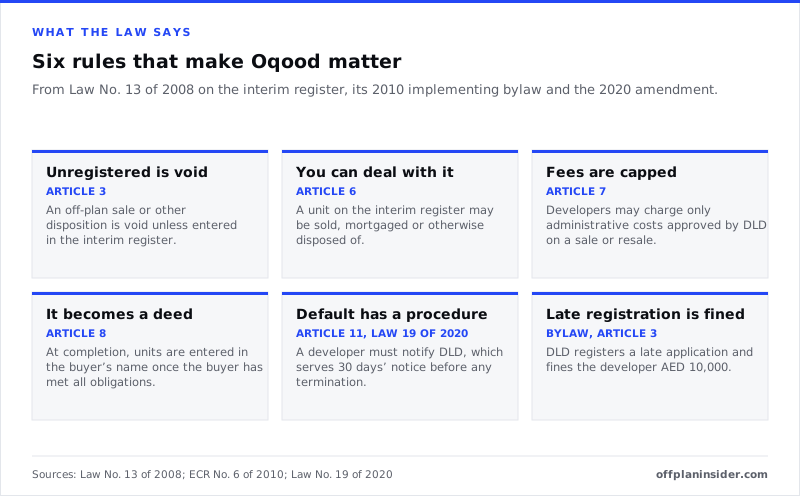
Because without it your purchase does not exist in law. Article 3 of Law No. 13 of 2008 says any sale or other disposition of a unit sold off-plan must be entered on the interim register, and is void unless it is.
That makes the Oqood certificate the most important document you receive in the first weeks after booking. A signed SPA and a receipt show that you agreed and paid. The Oqood registration shows that the Dubai Land Department has recorded the sale.
It also connects your purchase to the rest of the protection system. The project must be registered with DLD before units are sold, and Article 4 of the law says a developer may not sell off-plan before taking possession of the land and obtaining the required approvals. Your instalments go into the project's escrow account under Law No. 8 of 2007. How the pieces fit together is in our guide to off-plan buyer protection in Dubai.
03Who registers the sale on Oqood, and how?
The developer does. DLD's initial sale registration service is used by the developer through the Oqood portal, and the certificate is emailed to the buyer. You do not need to visit DLD.
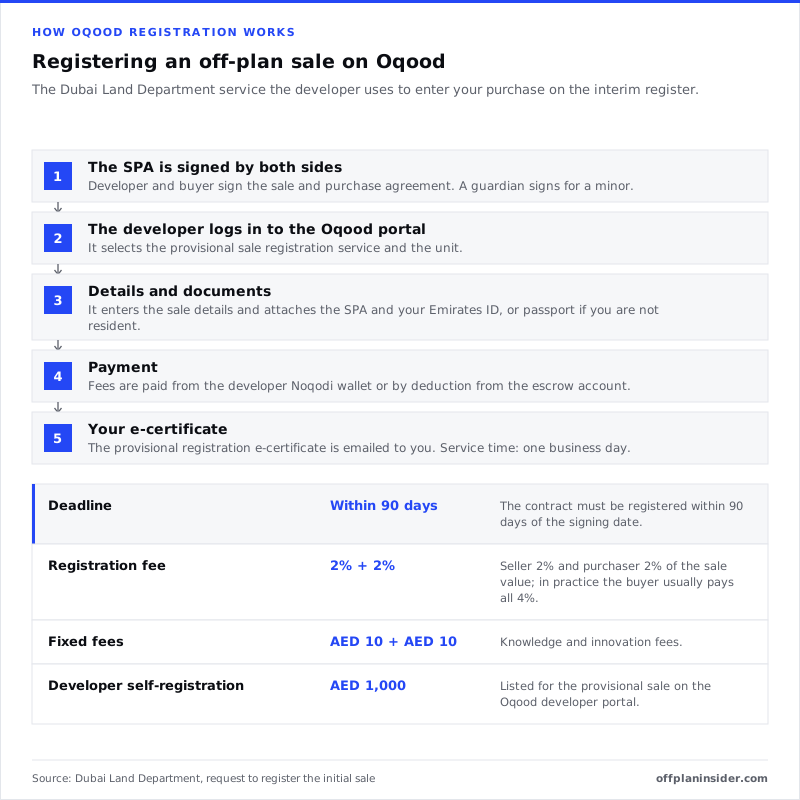
DLD lists four steps:
- The developer logs in to the Oqood portal and selects the provisional sale registration service.
- It selects the property, fills in the details, attaches the documents and chooses a payment method.
- It submits the application online.
- The output, a provisional registration e-certificate, is sent by email to the purchaser.
The conditions. The SPA must be signed by both the developer and the purchaser. If the purchaser is a minor, the guardian signs and attaches their passport or ID. And the contract must be registered in the provisional register within 90 days of the signing date.
Payment. DLD lists two payment methods for this service: the developer's Noqodi wallet, or deduction from the escrow account. The developer collects the fee from you and pays DLD.
04What documents does the developer need from me?
For an individual buyer: a copy of the signed SPA, a copy of a valid Emirates ID, and a copy of a valid passport if you are not a UAE resident. Companies provide more.
| Buyer | Documents DLD lists for the Oqood registration |
|---|---|
| Individual | Signed SPA; valid Emirates ID; valid passport for non-residents |
| Sole establishment | Valid trade licence; licence holder's Emirates ID or passport; power of attorney, if any |
| Limited liability company | Trade licence; licence holder's ID or passport; power of attorney, if any; memorandum of association and annexes legally translated into Arabic; shareholder certificate |
| Foreign company | As above, with the memorandum ratified by the Ministry of Foreign Affairs, and a free zone no objection letter valid for one year |
| GCC company | Trade licence; ID or passport; power of attorney, if any; ratified and translated memorandum; shareholder certificate |
If you are buying through a company, prepare these papers before you book. Translation and ratification can take longer than the 90 days the registration allows.
05How much does Oqood registration cost?
The main cost is the 4% DLD fee. DLD's initial sale page lists 2% for the seller and 2% for the purchaser, AED 10 knowledge and AED 10 innovation fees, and a developer self-registration fee of AED 1,000.
Who pays the 4%. Executive Council Resolution No. 30 of 2013 splits the fee equally unless the parties agree otherwise, and Article 9 of the 2010 bylaw says the developer and purchaser pay their shares of registration fees unless agreed. On off-plan sales the developer collects the full 4% from the buyer in most contracts. DLD said in 2021 that developers register after the buyer hands over fees equal to 4% of the property's value.
When it is paid. Usually with or soon after the booking payment. In May 2021 DLD told developers to pay registration fees within a maximum of 60 days and warned of penalties for delay.
Developer charges. Some developers add an administration or Oqood processing charge. Article 8 of the 2010 bylaw says a developer may not charge purchasers any amounts other than those approved by DLD, so ask for the figure and its basis before you sign.
| Item | On an AED 1,500,000 off-plan apartment |
|---|---|
| DLD fee, 4%, paid by the buyer | AED 60,000 |
| Knowledge and innovation fees | AED 20 |
| Developer self-registration fee listed by DLD | AED 1,000, borne as the SPA provides |
| Developer administration charge | On request |
The fee is paid once. When the Oqood converts to a title deed at completion, only issuance fees apply. The full picture, including waivers and the First-Time Home Buyer instalment option, is in our guide to the DLD fee in Dubai.
06Can I register Oqood in joint names or through a company?
Yes. The Oqood registration follows the SPA, so whoever is named on the SPA, with the shares written there, is who is registered. Decide this before you sign.
Joint buyers. Each buyer provides their own identity documents, and each is named on the registration. Agree the shares in writing at booking, because the title deed at completion is issued from the same record. Adding a name later is a new registered transaction with its own fee, and before completion it also needs the developer's agreement.
A minor. DLD's conditions say that where the purchaser is a minor, the guardian signs the contract and attaches a copy of their passport or ID.
A company. DLD lists separate document sets for sole establishments, limited liability companies, foreign companies and GCC companies, set out in the table above. A foreign company's memorandum must be translated into Arabic and ratified by the Ministry of Foreign Affairs, which takes time.
A power of attorney. Where someone signs for you, DLD's answers say a power of attorney issued outside the UAE must be formally ratified before it is accepted, and that one for a purchase is valid for five years from notarisation.
07What should I check on my Oqood certificate?
That it names you correctly and describes the right unit and sale. Check every field against your SPA the day it arrives.
- Your name and details, spelt exactly as in your passport, with every co-buyer included.
- The unit, including the building, unit number and project.
- The sale, including the price in your SPA.
- The developer, matching the company you signed with.
If anything is wrong, raise it with the developer in writing straight away. Names and shares on the Oqood flow through to the title deed, and correcting them later is slower and can cost more.
Check the project as well. The Dubai REST app shows each registered project's status and certified completion percentage. Our guides to the Dubai REST app and to checking an off-plan project show how.
08What if my Oqood has not been registered?
Ask the developer for the registration status in writing, then go to DLD if it does not move. An unregistered sale is void, so do not let it drift.
DLD's answers say that if a developer refuses or delays registering a sale contract, an application can be made to register it with the Real Estate Registration Assurance section. Article 3 of the 2010 bylaw adds that where a developer applies late, DLD registers the disposition and fines the developer AED 10,000.
Keep paying instalments into the project's escrow account while you resolve it, and keep every receipt. Payments into escrow are traceable; payments to an individual or a personal account are not.
09What can I do with an Oqood unit?
You can sell it, mortgage it or otherwise deal with it. Article 6 of Law No. 13 of 2008 says units on the interim register may be disposed of by sale, mortgage or any other legal disposition.
Sell it before handover. This is called an assignment, and DLD records it as a transfer from one Oqood registration to another. DLD says resale is possible after obtaining a no objection certificate from the developer. The new buyer pays the 4% DLD fee on the price they pay, and takes over your remaining instalments and handover date. The full process and costs are in our guide to selling off-plan before handover.
Developer charges on a resale. Article 7 of the law says a developer may not charge any fees on a sale, resale or other disposition of units except administrative costs approved by DLD. Ask for the NOC fee, the minimum percentage paid and any lock-in period in writing before you buy.
Mortgage it. DLD registers mortgages on provisional, Oqood, properties. Its mortgage registration page lists a developer e-NOC obtained through the Dubai REST app and a service partner fee of AED 5,000 plus VAT, against AED 4,000 plus VAT on a title deed. Lending limits are in our guide to off-plan mortgages.
Use it for residence. For the ten-year Golden Visa, an Oqood registration is read as proof of ownership in place of a title deed. The conditions are in our guide to the Golden Visa through property.
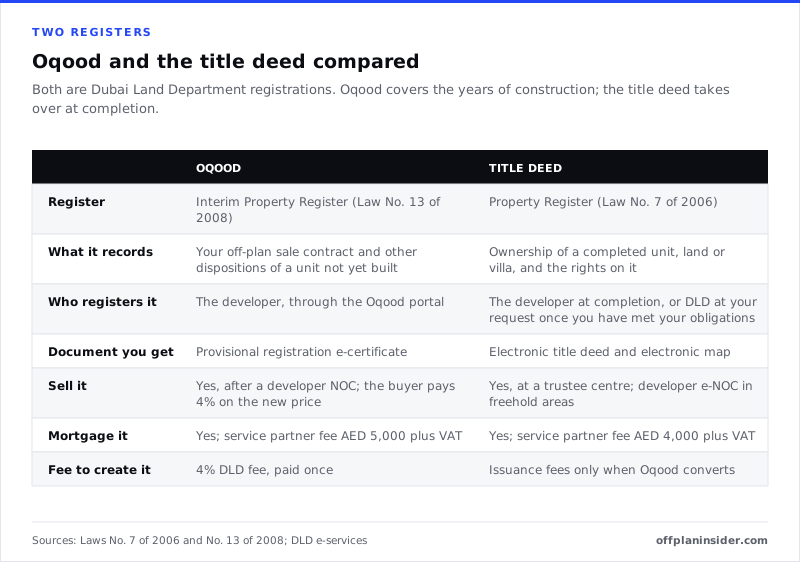
10Oqood and the title deed compared
Both are Dubai Land Department registrations, made under different laws for different stages. Oqood covers the off-plan years; the title deed takes over at completion.
11What happens to Oqood at completion?
It is replaced by a title deed. Article 8 of Law No. 13 of 2008 says developers must enter completed projects in the Property Register once they receive the completion certificate, including registering sold units in the names of buyers who have fulfilled their contractual obligations.
If the developer does not do it, DLD may register the unit in your name at your request or on its own initiative, provided you have met all your obligations. Article 7(1) of the 2010 bylaw adds that once a project is complete, the developer may not refuse to hand over or register a unit for a buyer who has met their obligations.
Two practical points. First, "fulfilled their obligations" usually means paid in full, so a post-handover plan can delay the deed. Second, no second 4% is charged; only issuance fees apply. The steps and fees at that stage are in our title deed guide, and the handover itself in our handover guide.
12What if I cannot keep paying while on Oqood?
The developer cannot simply cancel your registration. Article 11 of Law No. 13 of 2008, as amended by Law No. 19 of 2020, sets a procedure that must be followed first.
The developer notifies DLD, which serves a 30-day written notice on the buyer and, where possible, mediates a settlement. Only if the breach is not remedied may the developer act, within limits set by the project's completion:
| Project completion | What the developer may do |
|---|---|
| Over 80% | Keep the contract and claim the balance; ask DLD to sell the unit at auction; or terminate and retain up to 40% of the unit value |
| 60% to 80% | Terminate and retain up to 40% of the unit value |
| Under 60%, work started | Terminate and retain up to 25% of the unit value |
| Not started, for reasons beyond the developer's control | Refund the buyer in full |
Speak to the developer before a payment is missed, and get any arrangement in writing. The options are set out in our guide to missed off-plan instalments.
13What does Oqood not do?
Oqood records your purchase; it does not guarantee the building, the date or the price. Those are covered by other rules, and by your SPA.
- It does not hold your money. Instalments are protected by the project's escrow account under Law No. 8 of 2007, not by the registration. See our escrow guide.
- It does not fix the handover date. The anticipated completion date and any grace period are in your SPA. What happens if they pass is in our buyer protection guide.
- It does not prove the finished area. The final measured area is recorded when the unit moves to the Property Register. DLD's guidance limits what a developer may charge if the area grows and requires compensation if it shrinks by more than 5% of the net area.
- It is not a title deed for every purpose. The two-year property investor visa, for example, requires a completed home with a title deed.
- It does not replace your own checks. Verify the project, the developer and the escrow account before you pay the booking amount, not after the Oqood arrives.
14Common Oqood mistakes
- Treating the SPA as enough. Without Oqood the sale is void. Chase the certificate.
- Paying outside escrow. Instalments should go to the project's escrow account, not to an agent or a personal account.
- Missing a co-buyer. Names on the Oqood become names on the deed. Get them right at booking.
- Assuming a free exit. Reselling needs a developer NOC, and the developer sets the minimum payment first.
- Expecting a second 4% at handover. There is none on the same sale.
- Using Dubai rules elsewhere. Oqood applies only in Dubai.
15Key terms
- Oqood. Dubai's interim register for off-plan sales, and the developer portal used to fill it.
- Interim Property Register. The legal name for Oqood in Law No. 13 of 2008.
- Provisional registration e-certificate. The Oqood certificate emailed to the buyer.
- Property Register. The main register of completed property under Law No. 7 of 2006, from which title deeds are issued.
- NOC. A no objection certificate from the developer, needed to resell or mortgage an Oqood unit.
- Escrow account. The project account, regulated under Law No. 8 of 2007, into which buyers pay instalments. See our escrow guide.
16Where to go next
If you are about to book, our step-by-step guide to buying off-plan in Dubai shows where Oqood fits, and new launches lists projects now selling. If you already hold an Oqood certificate, keep it with your SPA and receipts, check your project's progress in Dubai REST, and read the title deed guide before handover.
FAQQuestions buyers ask.
What is Oqood in Dubai?
Oqood is the Dubai Land Department's interim register for off-plan property, set up under Law No. 13 of 2008, and the online system developers use to record sales on it. When you buy a home that is not yet built, the developer registers the sale on Oqood and you receive a provisional registration e-certificate. At completion it is replaced by a title deed.
What is an Oqood certificate?
It is the provisional registration e-certificate that the Dubai Land Department emails to the buyer once the developer has registered the off-plan sale. It is your proof that the purchase is entered on the interim register. Keep it with your SPA and payment receipts; you will need it to sell, mortgage or take handover of the unit.
How much is the Oqood fee in Dubai?
The main cost is the 4% DLD registration fee. DLD's initial sale page lists 2% for the seller and 2% for the purchaser, but on off-plan sales the buyer usually pays the full 4% to the developer. The page also lists AED 10 knowledge and AED 10 innovation fees and an AED 1,000 developer self-registration fee. Any developer administration charge is set by the developer; ask for it in writing.
How long does Oqood registration take?
DLD gives the service time as one business day once the developer submits the application. The contract must be registered within 90 days of the date it was signed. In 2021 DLD also told developers to pay registration fees within 60 days. If your certificate has not arrived within a few weeks of paying, ask the developer for the registration status in writing.
Is Oqood the same as a title deed?
No. Oqood records an off-plan sale on the interim register under Law No. 13 of 2008. A title deed is issued from the Property Register under Law No. 7 of 2006 once the building is complete. Both are DLD registrations, and you can sell or mortgage a unit on Oqood, but only a title deed shows ownership of a finished property.
Can I sell my property while it is on Oqood?
Yes. Article 6 of Law No. 13 of 2008 allows a unit on the interim register to be sold, mortgaged or otherwise disposed of. DLD says resale is possible after obtaining a no objection certificate from the developer. Developers set their own minimum payment before they issue one, and the new buyer pays the 4% DLD fee on the price they pay.
What happens if the developer does not register my Oqood?
An unregistered off-plan sale is void under Article 3 of Law No. 13 of 2008, so act quickly. DLD's answers say that if a developer refuses or delays registering the sale contract, an application can be made to its Real Estate Registration Assurance section. The 2010 bylaw sets a fine of AED 10,000 on a developer that registers late.
Can I get a mortgage on an Oqood property?
Yes. DLD registers mortgages on provisional, Oqood, properties. Its mortgage registration page lists a developer e-NOC obtained through the Dubai REST app and a service partner fee of AED 5,000 plus VAT for these. UAE Central Bank rules cap lending on off-plan property at 50% of its value, and the bank's own valuation applies.
Does Oqood exist outside Dubai?
No. Oqood is Dubai's system. Abu Dhabi and the other emirates have their own registers and rules for off-plan sales, run by their own land departments or regulators. Check the registration step with the authority of the emirate where the project is.
Sources & methodWhere these figures come from.
Sources
- Dubai Legislation Portal: Law No. (13) of 2008
- Dubai Legislation Portal: Executive Council Resolution No. (6) of 2010 Approving the Implementing Bylaw of Law No. (13) of 2008
- Dubai Legislation Portal: Law No. (19) of 2020 Amending Law No. (13) of 2008 Regulating the Interim Real Property Register in the Emirate of Dubai
- Dubai Legislation Portal: Law No. (7) of 2006
- Dubai Legislation Portal: Law No. (8) of 2007
- Dubai Legislation Portal: ECR 30 of 2013
- Dubai Land Department: Request to register the initial sale
- Dubai Land Department: Request for mortgage registration
- Dubai Land Department: Register project
- Dubai Land Department: Real estate project status
- Dubai Land Department: DLD calls on developers to pay property registration fees within 60 days
- Dubai Land Department: Frequently asked questions
- Dubai Land Department: Real_estate_brokerage_practice_guide_2024.pdf
- Central Bank of the UAE Rulebook: Regulations regarding mortgage loans
What we could not verify
- The exact fields printed on the provisional registration e-certificate are not listed on DLD's initial sale page; the text says it identifies the buyer, the unit and the sale and tells buyers to check it against the SPA.
- The developer's own administration or Oqood processing charge, and the minimum payment and fee for a resale NOC, are set by each developer and are given as on request.
- Whether a buyer can verify an Oqood certificate through DLD's title deed verification service, as some market guides say, could not be confirmed on a DLD page; the text points to the Dubai REST app and the developer.
5 Nov 2026 · Reviewed by OffPlan Insider Research. First published 5 Nov 2026.