
The UAE Golden Visa property route is set at AED 2,000,000, and the test is applied to the Dubai Land Department's certified valuation rather than to the price on your contract. Off-plan property does qualify: the Oqood registration stands in for a title deed, and since 20 February 2026 the amount paid so far is reported no longer to matter. A mortgaged property counts only for the equity you actually hold, not its full value. Two properties can be added together only if both are registered in the same individual name, which is why joint ownership often leaves both owners short. The visa runs for ten years and is renewable. There is no lifetime UAE visa, and the AED 100,000 version circulated in 2025 and again in 2026 was denied by the federal authority both times. Figures reviewed 14 September 2026.
Almost everything written about the UAE Golden Visa describes the same rule in the same words: buy property worth AED 2 million and you get ten years. That sentence is true and it is also the reason so many applications get refused. It leaves out which number is measured, who measures it, when the measurement happens, and what an off-plan buyer actually owns at the moment of measuring.
This guide takes the rule apart one piece at a time. Where a figure has a date, the date is printed next to it. Where a rule changed in 2026, we say who reported the change and what we could not find. And in the middle of it we do something no other page on this subject does: we take the threshold and run it against eighteen real off-plan projects we have already analysed, to show how often the line is cleared, how often it is missed, and by how little.
Two different visas wear the same name in conversation
Before any threshold matters, one distinction has to be fixed, because getting it wrong wastes months.
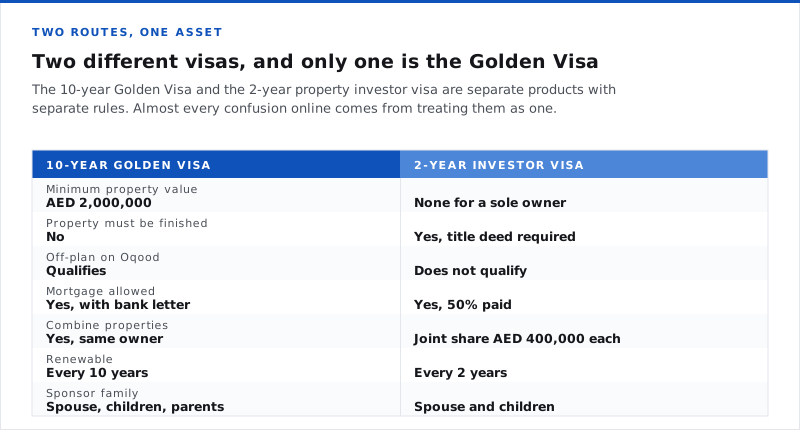
The UAE issues more than one residence visa on the back of property. The one people mean when they say Golden Visa is a ten-year renewable residence permit. There is also a two-year property investor visa, renewable every two years, sometimes called the Taskeen visa in Dubai. They are separate products, granted by different rules, and a property that qualifies for one may not qualify for the other.
The clearest way to hold them apart is this. The ten-year visa cares about value. The two-year visa cares about completion. An off-plan apartment worth AED 3 million qualifies for the ten-year visa and does not qualify for the two-year one, because the two-year route wants a title deed on a finished home and an off-plan buyer does not have one yet.
From here on, everything in this guide refers to the ten-year Golden Visa unless it says otherwise.
The number is AED 2 million, and it belongs to the Land Department
The property route to the Golden Visa is set at AED 2,000,000. That part is simple and it has been stable.
The part that catches people is which AED 2 million. There are three numbers floating around any purchase and they are rarely the same:
- The asking price. What the brochure or the agent quotes. Has no standing anywhere.
- The contract price. What you signed for on the sale and purchase agreement. This is the number you will pay.
- The certified valuation. What the Dubai Land Department, through an approved valuer, says the property is worth. This is the number the threshold is tested against.
Picture two people buying in the same building on the same day. Both sign at AED 2,050,000, comfortably over the line as far as they are concerned. One property values at AED 2,120,000 and the application goes through. The other values at AED 1,940,000, and the application is refused. Same building, same price, different outcome, and neither buyer did anything wrong. One of them simply bought a unit the valuer read differently.
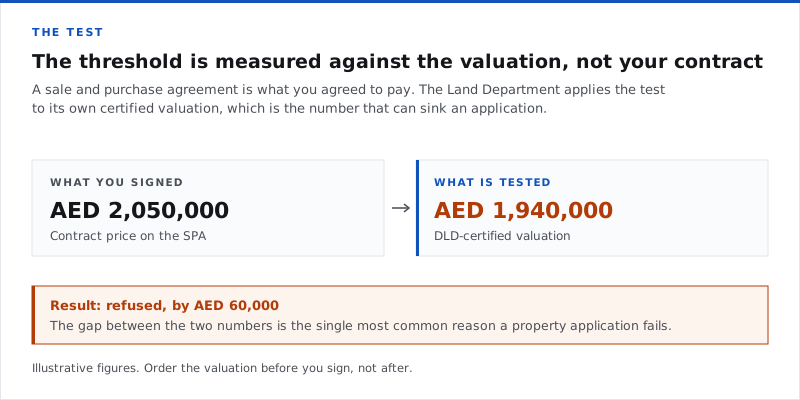
The practical lesson is unglamorous and worth more than any tip on this page: if you are buying at or near AED 2 million specifically to get the visa, do not buy at AED 2,050,000. Buy with headroom, or get the valuation before you sign rather than after. A margin of two or three per cent is not a margin at all once a valuer is involved.
Does off-plan qualify? Yes, and the Oqood is the reason
This is the question that brings most readers here, so here is the answer in one line: an off-plan property can qualify for the ten-year Golden Visa, and you do not have to wait for handover.
The mechanism is worth understanding, because it explains why so many people assume the opposite.
When you buy a completed home in Dubai you receive a title deed. When you buy off-plan, the building does not exist yet, so there is nothing to deed. Instead the developer registers your purchase with the Land Department through a system called Oqood, and you receive an Oqood certificate. It is an interim registration, and it is created at the moment the 4% registration fee is paid. It names you, it names the unit, and it sits on the government register.
That certificate is the key to the whole thing. For the purposes of this visa, the Oqood is read as proof of ownership in place of a title deed. Which is why an off-plan buyer who has paid a booking amount and nothing else can already be holding a registered interest in a property worth more than AED 2 million.
Two conditions travel with it. The unit has to sit in a designated freehold area where foreign nationals may own outright, and the developer has to be properly registered with the regulator. Both are checkable before you pay anything, and our guide to off-plan buyer protection in Dubai sets out how to read a project file on the public register.
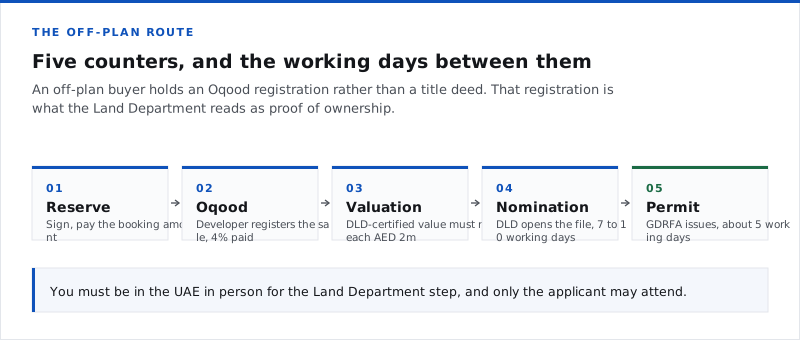
One detail that surprises applicants: the Land Department stage is done in person, inside the UAE, by the applicant. Not by an agent, not by a relative, and not remotely. Plan a trip around it.
What changed in 2026, and how certain we are about it
Two things moved this year, and both moved in the buyer’s favour. We are going to be unusually careful about how we describe them, because the way they were announced matters to how much weight you should put on them.
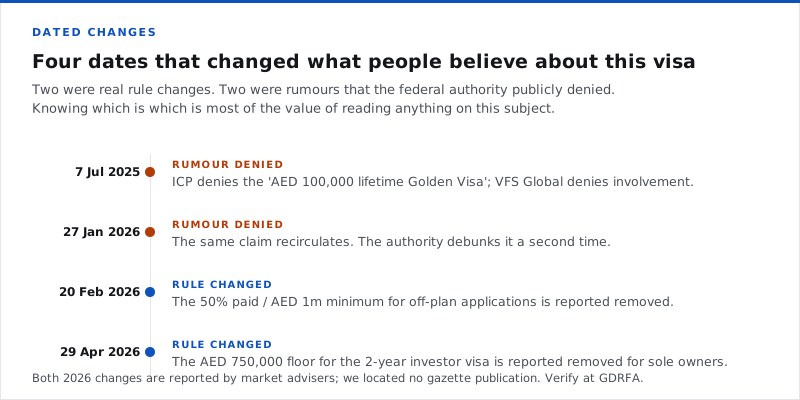
20 February 2026: the half-paid rule for off-plan
Until early 2026, an off-plan buyer could not simply register and apply. There was a payment test as well: you needed to have paid roughly half the purchase price, with a floor around AED 1 million, before the application would be entertained. On a typical construction-linked payment plan that put the visa two or three years away from the day you signed.
That test is reported to have been removed on 20 February 2026, leaving the registered value as the only test. On the new footing, how much you have paid so far stops mattering. A buyer ten per cent into a payment plan and a buyer ninety per cent into one are assessed the same way.
29 April 2026: the floor under the two-year visa
The separate two-year investor visa carried a minimum property value of AED 750,000. On 29 April 2026 that minimum is reported to have been removed for a sole owner of a completed, fully paid property, with joint owners still needing a share of at least AED 400,000 each. The change surfaced on the Land Department’s own service platform rather than through a press release, and was picked up by the UAE press the same day.
How much weight to put on both
Here is the honest position, and you will not find it stated this plainly elsewhere. Both changes are described consistently across multiple market advisers and immigration practices, and the February change is dated precisely to 20 February 2026 by more than one of them. We were unable to locate either change as a published circular or a gazette entry. They appear to have been implemented through operational guidance and service-platform updates rather than through published regulation.
That does not mean they are wrong. Operational changes in Dubai are frequently made this way and take effect immediately at the counter. It does mean that if your entire purchase decision rests on one of them, you should have the counter confirm it against your own file before you sign, rather than relying on this page or any other. Ask the question in the specific: given this project, this unit and this payment stage, will you accept the application today?
We measured the threshold against eighteen real projects
Every guide on this subject repeats the AED 2 million figure. None of them show you what it means against actual inventory. So we did that.
We took every off-plan project on OffPlan Insider that publishes a price, eighteen of them across four emirates, and plotted two things for each: the cheapest home it sells, and the dearest one on its published price list. Then we drew the AED 2 million line through the middle.
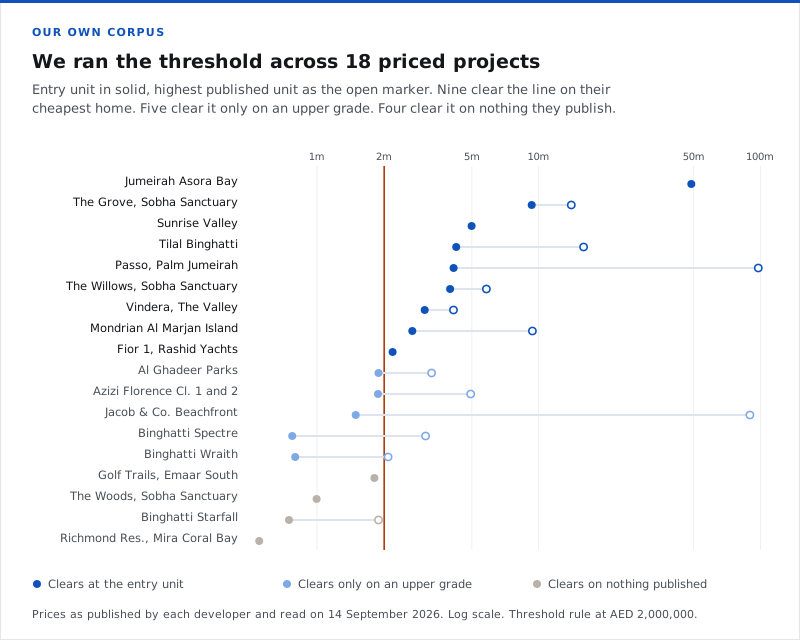
The result splits three ways.
- Nine projects clear the line on their cheapest home. Buy anything at all in these and the value test is satisfied. They are the ones now collected on our Golden Visa shortlist, and they run from Fior 1 at Rashid Yachts and Marina at AED 2.2 million to Jumeirah Asora Bay at AED 49 million.
- Five clear the line only on an upper grade. The entry home misses and something further up the price list qualifies. At Al Ghadeer Parks the two-bedroom townhouse at AED 1.9 million falls short and the three-bedroom at AED 2.2 million clears. Same masterplan, same developer, two different answers.
- Four clear the line on nothing they publish. Not the entry unit, not the top one. Whatever else these schemes are good for, this visa is not on the menu.
Here is the same test written out, so you can read it on a phone and check any single project against the line.
| Project | Cheapest home | Dearest published home | Against AED 2m |
|---|---|---|---|
| Jumeirah Asora Bay | AED 49,000,000 | On request | Clears at entry |
| The Grove, Sobha Sanctuary | AED 9,326,663 | AED 14,077,323 | Clears at entry |
| Sunrise Valley | AED 5,000,000 | AED 5,000,000 | Clears at entry |
| Tilal Binghatti | AED 4,260,000 | AED 16,000,000 | Clears at entry |
| Passo at Palm Jumeirah | AED 4,146,000 | AED 98,290,000 | Clears at entry |
| The Willows, Sobha Sanctuary | AED 3,995,908 | AED 5,831,408 | Clears at entry |
| Vindera at The Valley | AED 3,070,000 | AED 4,140,000 | Clears at entry |
| Mondrian Al Marjan Island | AED 2,700,000 | AED 9,400,000 | Clears at entry |
| Fior 1, Rashid Yachts & Marina | AED 2,200,000 | On request | Clears at entry |
| Al Ghadeer Parks | AED 1,900,000 | AED 3,300,000 | Upper grade only |
| Azizi Florence, Clusters 1 and 2 | AED 1,890,000 | AED 4,950,000 | Upper grade only |
| Jacob & Co. Beachfront Living | AED 1,500,000 | AED 90,000,000 | Upper grade only |
| Binghatti Wraith | AED 799,999 | AED 2,099,999 | Upper grade only |
| Binghatti Spectre | AED 774,999 | AED 3,100,000 | Upper grade only |
| Golf Trails at Emaar South | AED 1,819,888 | On request | Below the line |
| The Woods, Sobha Sanctuary | AED 999,000 | AED 999,000 | Below the line |
| Binghatti Starfall | AED 750,000 | AED 1,900,000 | Below the line |
| Richmond Residences, Mira Coral Bay | AED 550,000 | AED 550,000 | Below the line |
Read the chart once more with that in mind and a pattern appears. The projects that clear at entry are almost entirely villas and townhouses. The ones that clear only at the top, or not at all, are almost entirely apartment towers. That is not a coincidence, and it is the single most useful thing to take away from this section: in the current market, the AED 2 million line is roughly the line between an apartment and a house.
The hundred thousand dirhams that decide a whole tower
The clearest example of how fine this line is sits two streets apart in the same Dubai district, built by the same developer, in two towers of almost identical design.
| Tower | Cheapest home | Dearest published home | Golden Visa on the price list |
|---|---|---|---|
| Binghatti Starfall | Studio, AED 750,000 | Two-bedroom, AED 1,900,000 | Nothing qualifies |
| Binghatti Wraith | Studio, AED 799,999 | Two-bedroom, AED 2,099,999 | The two-bedroom qualifies |
Starfall’s most expensive published home is a two-bedroom at AED 1,900,000. It misses the threshold by AED 100,000, which is five per cent. There is no unit anywhere on that price list that gets a buyer a ten-year visa. Wraith’s two-bedroom is AED 2,099,999, and it clears by AED 99,999.
Nobody advertises this. Both towers are marketed to the same buyer, in the same language, at the same time. If residency is part of why you are buying, the difference between those two price lists is the entire difference between getting it and not. We set the two towers side by side, along with two more from the same developer in the same district, in Binghatti in Al Jaddaf compared.
And remember the valuation point from earlier. Wraith’s two-bedroom clears the line by AED 99,999 on the contract. If the certified valuation comes in even five per cent below the contract price, it does not clear at all.
If there is a mortgage on it
A financed property can qualify. The reasoning is more careful than most summaries suggest, and it is worth walking through slowly because the arithmetic is counter-intuitive.
The principle applied is that the bank’s money is not your investment. What counts is the part you have actually put in. So a property carrying a loan is assessed on the equity you hold in it, not on the sticker value.
Take a worked example. A home is worth AED 4,000,000 and the outstanding mortgage is AED 2,500,000. The value looks like double the threshold. The equity is AED 1,500,000, and that is what gets weighed, so the application does not succeed on that property alone. Now flip it. A home worth AED 2,400,000 with AED 300,000 still owed leaves AED 2,100,000 of equity, and the cheaper property is the one that qualifies.
Three practical points follow:
- The loan must be from a UAE-licensed lender. Financing arranged overseas against a UAE property is a different conversation and should be raised before you commit.
- You will need a letter from the bank confirming the amount paid and the amount outstanding, in the form immigration expects. Ask for it in that form specifically, because a generic statement of account is usually sent back.
- The lender’s charge on the property is expected to stay in place for the life of the visa. Clearing the loan and selling is not a neutral act while the permit is running.
There is a wider financing point that catches off-plan buyers regardless of visas. Since February 2025, UAE banks no longer finance the 4% registration fee or the agency commission as part of a mortgage. Those have to be cash. We set out every line of that bill in our guide to the true cost of buying off-plan property in Dubai.
Adding two properties together
You do not have to reach AED 2 million in one purchase. Holdings can be combined, subject to one condition that does most of the work: everything counted has to be registered in the same individual name.
So a buyer with a AED 1,200,000 apartment in Dubai and a AED 900,000 apartment elsewhere in the UAE is at AED 2,100,000 and is over the line. But a couple holding one AED 2,400,000 property jointly are each holding AED 1,200,000, and neither of them is over the line on their own share. That second case surprises people constantly, and it is the reason the name on the title matters more than the price on the contract.
If a joint purchase is what you want and residency is the point, have the conversation about whose name goes where before the sale is registered. Restructuring ownership afterwards means a transfer, and a transfer means the 4% again.
What the visa itself costs
Set against a property purchase the issuing fees are small, but they are charged per head and the family line adds up faster than people expect.
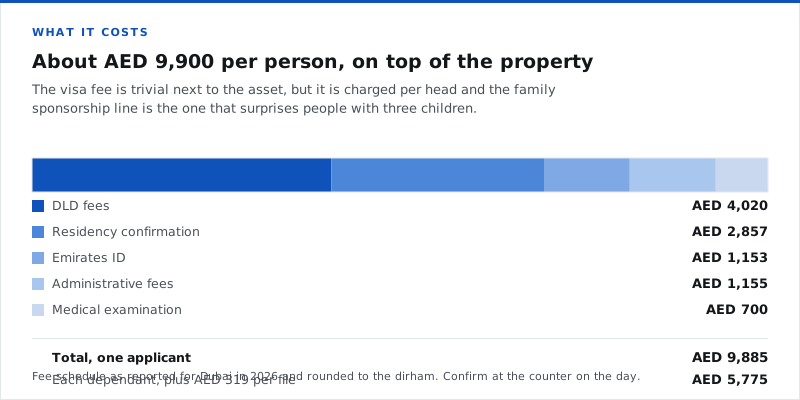
A single applicant is looking at roughly AED 9,900. A family of four is closer to AED 27,300 once three dependants are added at about AED 5,775 each. Add the valuation fee on top, which is charged separately by the approved valuer.
Fees are quoted for Dubai and were current in 2026. They move. Confirm at the counter on the day, and treat any figure printed on any website, including this one, as an estimate rather than a quotation.
Who you can bring with you
This is where the ten-year visa earns its reputation, and the detail that matters is not the list of who qualifies but the absence of the usual conditions.
- Spouse and children. Sons can be sponsored without the age cut-off that applies to an ordinary residence visa, and daughters likewise.
- Parents. Sponsorable under the Golden Visa where an ordinary employment visa makes it difficult.
- Domestic staff. Sponsorable, with guidance differing on the number, so ask rather than assume.
- Continuity. If the primary holder dies, family members already sponsored may remain until the permit expires. For a family that has relocated, this is not a small provision.
The other structural difference is that a Golden Visa holder does not lose residency by staying out of the country for six months, which is the rule that quietly ends a lot of ordinary residence permits.
The AED 100,000 lifetime visa does not exist
In mid-2025 a story spread quickly, particularly across Indian media, that the UAE had introduced a lifetime Golden Visa for a one-off payment of about AED 100,000, with no property and no investment needed. It was covered widely, repeated by people who should have checked, and it was not true.
The Federal Authority for Identity, Citizenship, Customs and Port Security denied it directly, stating that no such scheme exists. On 7 July 2025 the visa processing company named in the reports also publicly denied involvement, saying its role had been limited to referring interested people to a private firm. The claim resurfaced in January 2026 and was debunked a second time.
Two things are worth carrying away from this. First, there is no lifetime UAE residence visa. The Golden Visa is ten years and renewable, which is a long time but is not forever. Second, and more usefully: the Golden Visa is granted by government authorities, and the application goes through them or through the Land Department. Any intermediary presenting themselves as the route to an otherwise unavailable category is describing something that does not exist. The official categories and the official channels are published by the government on the UAE government portal, and that is the page to check a claim against.
What this visa does not do
A guide that only lists benefits is a sales page. Four limits are worth knowing before you buy anything for this reason.
- It is not citizenship and not a path to it. UAE citizenship follows a separate and very narrow route. Long residence does not convert into a passport.
- It does not make you tax resident by itself. Holding a residence permit and qualifying as a tax resident are different tests, and your home country applies its own. Take advice on this specifically rather than assuming the visa settles it.
- Renewal depends on still holding the property. The visa rests on a qualifying asset. Selling it does not cancel the permit on the spot, but renewal in ten years is assessed on what you hold then, not on what you held when you applied. If you are thinking about an exit before handover, read our guide to selling off-plan property before handover, because the visa consequence is rarely mentioned in that conversation.
- It is a residence permit, not an obligation to reside. Which cuts both ways. The flexibility is genuine, and so is the fact that you are buying a permit rather than a life.
Three buyers, three outcomes
Rules are easier to hold onto when they are attached to people. These three are built from real prices on real projects we carry.
Priya buys a two-bedroom for AED 1,900,000
She wants a Dubai apartment and a ten-year visa, and she has AED 1.9 million to spend. The dearest home on Binghatti Starfall‘s price list is exactly that. She buys it, registers it, and discovers the visa is not available on any unit in that building.
What would have changed the outcome: AED 200,000 more, spent in a different tower. Two streets away, Binghatti Wraith‘s two-bedroom is AED 2,099,999. Same developer, same district, same year of handover. The extra AED 199,999 is not buying a better apartment. It is buying the threshold, and she would still want a valuation before she relied on a AED 99,999 margin.
Tom and Sara buy one home together for AED 2,400,000
Comfortably above the threshold, and they both expect a visa. They register the property jointly, in equal shares, as most couples do without thinking about it.
Each of them now holds AED 1,200,000. Neither is over the line, and neither qualifies. The property is fine. The ownership structure is what fails.
What would have changed the outcome: a conversation before registration. Registering the whole property in one name gets that person the visa, and the other can then be sponsored as a spouse, which is the outcome they wanted anyway. Sorting this out after registration means a transfer, and a transfer means paying the 4% a second time.
Ahmed buys an off-plan villa for AED 4,260,000 and pays 10%
He reserves a four-bedroom townhouse at Tilal Binghatti on a plan reported as 10% on booking, 50% across construction and 40% at handover. He has paid AED 426,000, about a tenth of the price, and the building does not exist.
Under the rules as they stood before 2026 he would have waited years, until half the price was paid. On the current footing he is assessed on the registered value of AED 4,260,000, which is more than double the threshold, and the paid amount is not the test. His Oqood is the proof of ownership and his application can proceed.
What he should still check: that the certified valuation supports the contract price, and that the counter accepts the current position for his specific payment stage on the day he applies. At more than double the line he has enormous headroom, which is exactly why his case is the easy one.
Outside Dubai: what changes in the other emirates
The Golden Visa is federal, so the AED 2 million threshold does not change when you cross an emirate border. What changes is everything underneath it: who registers the property, what document you end up holding, and whether a foreign buyer can own outright on that plot at all.
This matters because the visa rests on registered ownership. If the registration is weaker, slower or conditional, so is the application.
| Emirate | Who registers the project | Freehold for foreign buyers | Practical note for an applicant |
|---|---|---|---|
| Dubai | Dubai Land Department, with Oqood for off-plan | By designated area | The most established route. Everything in this guide describes Dubai practice first. |
| Abu Dhabi | The emirate’s own real estate authority | By designated investment zone | Applications are handled through the emirate’s own government channel rather than through Dubai’s. |
| Ras Al Khaimah | RAK RERA, under Decree No. 12 of 2023 | By designated area | Escrow runs as a main account with per-unit sub-accounts, and 5% of construction cost is retained for a year after completion. Stricter than Dubai, which is a point in the buyer’s favour. |
| Sharjah | Sharjah Real Estate Registration Department, under Law No. 2 of 2022 | Granted project by project, not district by district | Confirm the tenure on your specific plot in writing. A neighbouring project having freehold tells you nothing about yours. |
The Sharjah line is the one to read twice. Freehold there is granted to particular projects rather than to whole districts, so the question is never whether foreigners can own in Sharjah. It is whether they can own in this scheme, on this plot, and the answer has to come in writing before you pay.
The order to do things in
If residency is part of the reason you are buying, the sequence below removes most of the ways this goes wrong. It is deliberately front-loaded, because every check is cheap before you sign and expensive afterwards.
- Decide which visa you are actually after. Ten-year on value, or two-year on a completed home. They lead to different purchases.
- Set your budget above the line, not on it. If AED 2 million is the target, shop from about AED 2.2 million so a valuation has somewhere to land.
- Check the project is registered and in a freehold zone. Project number, developer entity, escrow account. All public, all free to read.
- Confirm the unit, not the project. As Starfall and Wraith show, the tower qualifying is not the same as your unit qualifying.
- Settle whose name goes on the title before you reserve. Joint ownership splits the value and can leave both owners short.
- Ask the counter the specific question. Given this project, this unit, this payment stage, will the application be accepted today.
- Get the Oqood registered and the valuation done. The valuation is the number that decides it.
- Budget the issuing fees per head, including dependants.
If you would rather start from the inventory than from the rule, our Golden Visa shortlist collects every analysed project whose entry home clears AED 2 million, and the AED 2M to 3M band is where the threshold is most often met by the smallest margin. Every project page carries the registration number and the escrow account, so the first three checks above are already done for you.
Questions buyers ask
How much property do you need for a UAE Golden Visa?
AED 2,000,000. The threshold is applied to the Dubai Land Department’s certified valuation of the property rather than to the price written on your sale and purchase agreement, so buying at exactly AED 2,050,000 leaves almost no margin if the valuation lands low.
Does off-plan property qualify for the Golden Visa?
Yes. An off-plan buyer holds an Oqood registration rather than a title deed, and that registration is read as proof of ownership. The unit must sit in a designated freehold area and the developer must be registered with the regulator.
Do I have to pay 50 per cent before I can apply?
That requirement is reported to have been removed on 20 February 2026, leaving the registered value as the only test. It is described consistently across market advisers, though we located no published circular for it, so confirm it against your own file before you rely on it.
Is the UAE Golden Visa for 5 or 10 years?
The property route is ten years and renewable. A separate two-year property investor visa also exists in Dubai, and the two are frequently confused. The ten-year visa tests the value of the property; the two-year visa requires a completed home with a title deed.
Can I get a Golden Visa with a mortgaged property?
Yes, but only the equity you hold counts. A property worth AED 4,000,000 with AED 2,500,000 outstanding represents AED 1,500,000 of investment and does not qualify on its own. The loan must be from a UAE-licensed lender and the bank must issue a letter confirming the paid and outstanding amounts.
Can I combine two properties to reach AED 2 million?
Yes, provided every property counted is registered in the same individual name. A couple holding one AED 2,400,000 property jointly hold AED 1,200,000 each, and neither of them clears the threshold on their own share.
Which number does the Land Department measure, the price or the valuation?
The certified valuation. This is the most common reason a property application is refused: a contract signed above AED 2,000,000 that values below it. Order the valuation before you sign rather than after.
What does the Golden Visa cost to issue?
Roughly AED 9,900 for one applicant in Dubai, made up of Land Department fees, residency confirmation, Emirates ID, administrative fees and the medical. Each dependant adds about AED 5,775. The valuation fee is charged separately by the approved valuer.
How long does the Golden Visa take?
The Land Department opens the nomination file in roughly seven to ten working days and immigration issues the permit in about five, so two to four weeks end to end once the paperwork is complete. The Land Department step is done in person inside the UAE, by the applicant.
Is there a lifetime UAE Golden Visa for AED 100,000?
No. The Federal Authority for Identity, Citizenship, Customs and Port Security denied that such a scheme exists, and the visa processing company named in the reports denied involvement on 7 July 2025. The claim recirculated in January 2026 and was debunked again. There is no lifetime UAE residence visa of any kind.
Who can I sponsor on a Golden Visa?
Spouse, children without the usual age cut-off, parents and domestic staff. Family members already sponsored may remain until the permit expires if the primary holder dies. A Golden Visa holder also does not lose residency by spending more than six months outside the country.
Does the Golden Visa lead to UAE citizenship?
No. Citizenship follows a separate and very narrow route, and length of residence does not convert into a passport. The Golden Visa is a renewable residence permit.
What happens to the visa if I sell the property?
Selling does not cancel the permit on the spot, but renewal is assessed on what you hold at the time of renewal rather than on what you held when you applied. If you plan to exit before handover, factor the residency consequence into that decision.
Which off-plan projects actually clear AED 2 million?
Of the eighteen priced projects we analyse, nine clear the threshold on their cheapest home, five clear it only on an upper grade, and four clear it on nothing they publish. The nine are collected on our Golden Visa shortlist, and they are almost entirely villas and townhouses rather than apartment towers.
Does a Golden Visa make me tax resident in the UAE?
Not by itself. Holding a residence permit and meeting a tax residency test are different things, and your home country applies its own rules. Take advice on your specific position rather than assuming the visa settles it.
Last reviewed 14 September 2026 · Fact-checked by OffPlan Insider Research · How we verify
Sources
- UAE Government Portalu.ae
- Gulf Newsgulfnews.com
- Visahqvisahq.com
- Visahqvisahq.com
- OffPlan Insider project corpus, 18 priced projects read 14 September 2026 (project pages linked in the text)Our own record
- Developer price lists for Binghatti Starfall, Binghatti Wraith, Al Ghadeer Parks, Fior 1 and Jumeirah Asora Bay, reviewed September 2026Our own record
Figures come from Dubai Land Department and RERA primary records, developer filings and named market indices. Where the market disagrees on a number we give the range and say who is measuring what, rather than picking the flattering one.