Freehold in Dubai is outright ownership of a property, and usually of the land beneath it or a share of it, with no time limit. Leasehold is a registered long-term lease of up to 99 years: you hold the right to use the property for the term, and the landowner keeps the title. Usufruct is a right of up to 99 years to use and benefit from someone else's property, and musataha is a right of up to 50 years to build on someone else's land and benefit from the building. Law No. 7 of 2006 lets non-UAE nationals hold freehold, usufruct or leasehold in areas the Ruler designates, and almost every off-plan home sold to foreign buyers in Dubai today is freehold.
Key takeaways
- Law No. 7 of 2006 reserves property ownership in Dubai to UAE and GCC nationals, then lets non-UAE nationals hold freehold without time limit, or usufruct or leasehold for up to 99 years, in areas the Ruler designates.
- Freehold is the only right with no end date. You can sell, let, mortgage, gift and leave it to heirs, and each step is registered with the Dubai Land Department.
- Leasehold is a registered long-term lease of up to 99 years. The landowner keeps the title, and the property returns at the end of the term unless the contract says otherwise.
- Usufruct is the right to use and benefit from another's property for up to 99 years. Musataha is the right to build on another's land and benefit from the building for up to 50 years.
- Registration costs differ: 4% of the value for a freehold sale, 2% of the rental value from each side for a long-term lease, and 1% for a musataha, on the Dubai Land Department's figures.
- Almost every off-plan home sold to foreign buyers in Dubai is freehold. Leasehold and usufruct appear mainly on specific plots and older schemes; musataha is mostly used by developers and commercial investors.
- Check the right recorded on the Oqood or title deed, not the brochure. For anything other than freehold, ask for the end date and what happens to the building when the term runs out.
01What is the difference between leasehold and freehold in Dubai?
In the leasehold vs freehold Dubai question, the difference is time and title. Freehold is ownership with no end date. Leasehold is a registered right to use a property for a fixed term of up to 99 years, while the landowner keeps the title.
Dubai law recognises two more time-limited rights you will meet in sales documents: usufruct, the right to use and benefit from someone else's property, and musataha, the right to build on someone else's land and benefit from the building. This guide sets out all four as Dubai law and the Dubai Land Department describe them, and what each lets you do.
If you are still checking whether you can buy at all, start with can foreigners buy property in the UAE?. For the list of places where non-UAE nationals can buy freehold, see freehold areas in Dubai. This guide goes one level deeper, into what the right you buy actually is.
02What does Dubai law say?
The rules come from Law No. 7 of 2006 concerning Real Property Registration in the Emirate of Dubai. Article 4 reserves the right to own property in Dubai to UAE nationals, GCC nationals, companies wholly owned by them and public joint stock companies.
It then allows, subject to the Ruler's approval and in areas the Ruler determines, that non-UAE nationals may be granted:
- freehold ownership of property without time restriction; or
- usufruct or leasehold over property for a period not exceeding 99 years.
The areas are listed in Regulation No. 3 of 2006, by land-area names and plot numbers rather than the community names in brochures. The list has been amended since 2006, and it includes at least one plot designated for usufruct or leasehold of up to 99 years rather than freehold.
Three other rules in Law No. 7 of 2006 apply to every right in this guide:
- Only the Dubai Land Department registers them (Article 6), including long-term leasehold contracts under Article 4.
- Unregistered transactions are not valid (Article 9). Creating, transferring, changing or ending a right must be recorded in the Property Register.
- The register is conclusive (Articles 7 and 24). The register and the title deed have absolute evidentiary value, and any agreement that breaches the law is void (Article 26).
Where Law No. 7 of 2006 is silent, Article 25 applies the federal Civil Transactions Law, which sets the general rules on rights such as usufruct.
03The four rights side by side
Freehold is the only right without an end date. The other three are granted for a term, recorded with the Dubai Land Department, and end when the term runs out unless the contract provides otherwise.
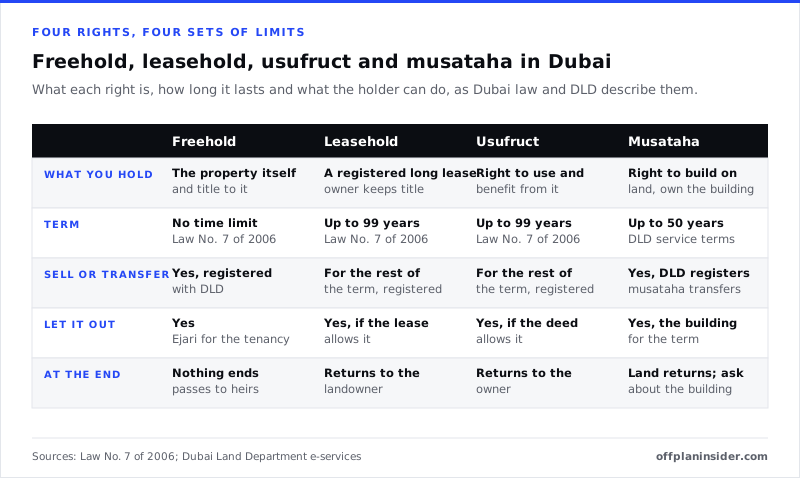
The same comparison in more detail:
| Freehold | Leasehold | Usufruct | Musataha | |
|---|---|---|---|---|
| What you hold | The property, and the land or a share of it | A registered long-term lease of the property | The right to use and benefit from the property | The right to build on the land and benefit from the building |
| Maximum term | None | 99 years | 99 years | 50 years |
| Who keeps the title | You | The landowner | The owner | The landowner |
| Sell it | Yes, registered with DLD | The remaining term, if the contract allows, registered with DLD | The remaining term, registered with DLD | Yes, registered with DLD |
| Let it | Yes, with an Ejari-registered tenancy | If the lease allows | If the terms allow | The building, for the term |
| Leave it to heirs | Yes, by registered inheritance | For the remaining term, as the contract allows | As the contract and the Civil Transactions Law allow | For the remaining term, as the contract allows |
| At the end | No end | Returns to the landowner | Returns to the owner | Land returns; the building as the contract says |
| Who usually holds it | Home buyers in designated areas | Owners on specific plots and older schemes | Owners on specific plots | Developers and commercial investors |
04What does freehold mean in Dubai?
Freehold is outright ownership with no time limit. You own the property, and for a villa usually the plot; for an apartment, the unit and a share of the building's common parts. It passes to your heirs and can be sold, let, mortgaged or gifted.
What you can do with it.
- Sell it. The sale is registered with the Dubai Land Department. Executive Council Resolution No. 30 of 2013 sets the fee at 4% of the sale value, split equally between buyer and seller unless they agree otherwise; in practice the buyer usually pays it all. See the DLD fee in Dubai.
- Let it. A long-term tenancy is registered on Ejari. See Ejari in Dubai.
- Mortgage it. The mortgage is registered with the Dubai Land Department against the title. See off-plan mortgages in the UAE.
- Leave it to heirs. Article 11 of Law No. 7 of 2006 requires a certificate of inheritance to be registered before an heir's dealings with the property take effect against others.
In an apartment building. Freehold in a tower means you own your unit outright and share the common parts with the other owners. Service charges, the management company and the owners committee are governed by the jointly owned property law, explained in our handover guide.
Off-plan. When you buy off-plan, the developer registers the sale on the Dubai Land Department's interim register, known as Oqood, and you pay the 4% fee then. The Oqood converts to a title deed at handover, without a second 4%.
05What is leasehold in Dubai?
Leasehold is a registered long-term lease of up to 99 years. You hold the right to occupy and use the property for the term; the landowner keeps the title, and the property returns to the landowner when the term ends unless the contract says otherwise.
A leasehold is not an ordinary tenancy. An Ejari tenancy is usually for a year and renews; a long-term lease under Law No. 7 of 2006 is a property right recorded in the Property Register, and the holder can usually let the property to tenants of their own.
What you can do with it. That depends on the lease:
- Live in it or let it for the term, if the lease allows letting.
- Sell the remaining term where the contract allows, with the transfer registered with the Dubai Land Department.
- Pass it to heirs for the years that remain, as the contract allows.
- Alter or rebuild only with the landowner's consent, as the contract sets out.
What it costs to register. The Dubai Land Department's service page lists 2% of the rental value from the owner and 2% from the lessee for a long-term lease. Executive Council Resolution No. 30 of 2013 lists 4% of the total value of the lease contract, split in the same way. Confirm the figure at the trustee centre when you register.
Disputes. Article 6 of Decree No. 26 of 2013 excludes disputes from long-term leases under Law No. 7 of 2006 from the Rental Disputes Centre. Take legal advice on where such a dispute is heard.
06What is usufruct in Dubai?
Usufruct is the right to use a property owned by someone else and to take its benefit, for example by living in it or letting it, for a fixed term. In Dubai a non-UAE national can hold it for up to 99 years in designated areas.
The Dubai Land Department describes its service as registering a usufruct right "within a term not exceeding 99 years (a long-term lease)". In everyday Dubai practice the two words are often used for the same thing. The legal difference is in the source: a leasehold is a contract of lease, while usufruct is a right in the property itself, governed where Dubai law is silent by the federal Civil Transactions Law.
What you can do with it. Use and let the property for the term, and transfer the remaining term where the terms allow; the Dubai Land Department's service registers usufruct sales. The owner keeps the title.
What it costs to register. Executive Council Resolution No. 30 of 2013 lists 2% of the property's value for registering a usufruct right, collected from each side unless agreed otherwise. The Dubai Land Department's service page lists the long-term lease figure above. Ask which applies to your contract.
07What is musataha in Dubai?
Musataha is the right to build on land owned by someone else and to benefit from the building for a fixed term. The Dubai Land Department registers musataha rights for terms of up to 50 years.
It is a right for builders, not for home buyers. A developer or investor uses a musataha to put up a hotel, a school, a warehouse or a residential building on land it does not own, and to operate or sell interests in that building for the term.
What it costs to register. The Dubai Land Department lists:
- Registering a musataha: 1%. Resolution No. 30 of 2013 states it as 1% of the consideration paid for the musataha, paid by the party receiving the right unless agreed otherwise.
- Reselling a musataha on bare land: 1%.
- Reselling a musataha on built-up land: 4% of the building value plus 1% of the musataha area.
What it means for a buyer. If a home you are offered sits on land held under a musataha, your interest can last no longer than the musataha itself. Ask how many years are left and what the contract says about the building when the musataha ends.
08How long does each right last?
Freehold has no end date. Leasehold and usufruct last up to 99 years, and musataha up to 50 years. A right bought on resale carries only the years left on it.
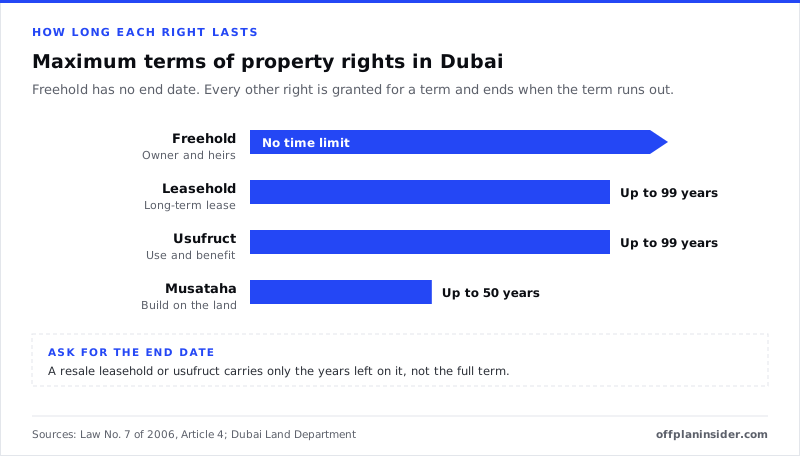
A worked example. A 99-year leasehold registered in 2010 runs to 2109. Bought on resale in 2026, it has 83 years left. Bought again in 2060, it has 49 years left. The property is the same; the right is shorter each time it changes hands.
That is why a leasehold and a freehold of the same home are not priced on the same basis, and why lenders and buyers look closely at the years remaining. Freehold does not run down.
09What does each right cost to register?
On the Dubai Land Department's figures: 4% of the value for a freehold sale, 2% of the rental value from each side for a long-term lease, and 1% for a musataha. The fixed title deed fee is AED 250.
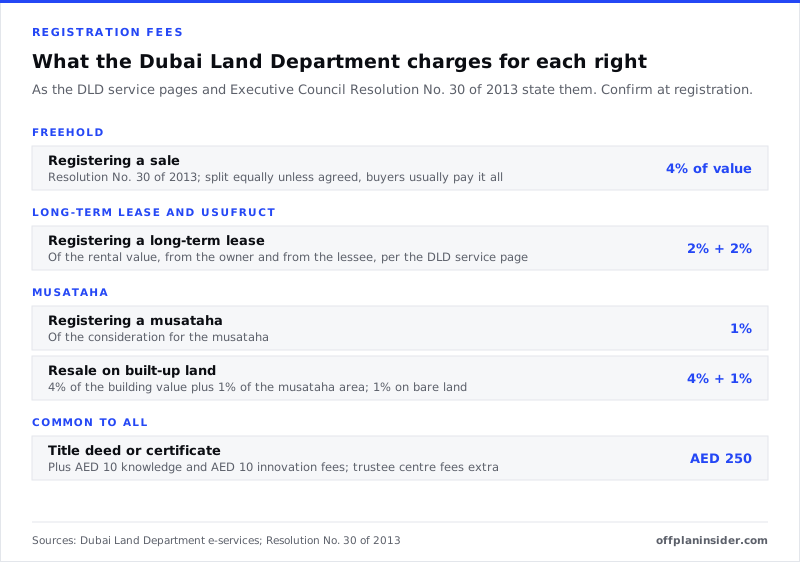
The fixed fees on the Dubai Land Department's usufruct and musataha service:
- Title deed or certificate: AED 250.
- Land plot map: AED 100 for land outside Dubai Municipality's jurisdiction, AED 225 for the map unified with Dubai Municipality.
- Knowledge and innovation fees: AED 10 each per drawing.
- Trustee centre service fee: AED 4,000 plus VAT where the value is AED 500,000 or more, and AED 2,000 plus VAT below that.
The service also asks for a no-objection certificate from the developer in freehold areas, obtained through the Dubai REST app, and the seller's ID or passport.
10Where will I meet each right in Dubai?
Freehold is what almost every foreign buyer of an off-plan home in Dubai gets. Leasehold and usufruct appear on specific plots and in some older schemes. Musataha is mostly a developer's and investor's tool.
- Freehold. The designated areas in Regulation No. 3 of 2006 cover the master communities where new homes are sold to foreign buyers, from Dubai Marina and Palm Jumeirah to Dubai Hills Estate, Business Bay and Dubai South. The list has been extended over the years, including in January 2025 for plots on Sheikh Zayed Road and in Al Jaddaf. See freehold areas in Dubai.
- Leasehold and usufruct. Regulation No. 3 of 2006 designates at least one plot in Nad Al Sheba for usufruct or leasehold of up to 99 years. Some buildings put up before the freehold regime, and some plots outside the designated areas, are held this way.
- Musataha. Land granted to developers for hotels, schools, commercial and industrial buildings, and some residential schemes on land owned by government entities.
For buying in the other emirates, where the rules and terms differ, see can foreigners buy property in the UAE?.
11Is freehold better than leasehold?
They are different products, so the right choice depends on what you need. Freehold gives you ownership with no end date; a leasehold or usufruct gives you a right for the years that remain, usually at a different price.
Points to weigh, rather than a rule:
- Time. A freehold does not run down. A leasehold with 90 years left and one with 30 years left are very different things.
- Resale. Buyers and their banks look at the years remaining on a time-limited right. Fewer buyers are set up to buy one.
- Finance. UAE mortgage lending is built around freehold. Whether a bank will lend on a leasehold, and on what terms, depends on the bank; ask before you commit.
- Residency. If you are buying with the property route to the Golden Visa in mind, confirm whether the right you are buying qualifies. See the Golden Visa and UAE property.
- Control. A freeholder decides about the property within the law and the community rules. A leaseholder's rights depend on the contract.
12How do I check which right I am buying?
Read the registration, not the brochure. The Oqood for an off-plan home, or the title deed for a ready one, records the right you hold, and the Dubai Land Department register is conclusive.
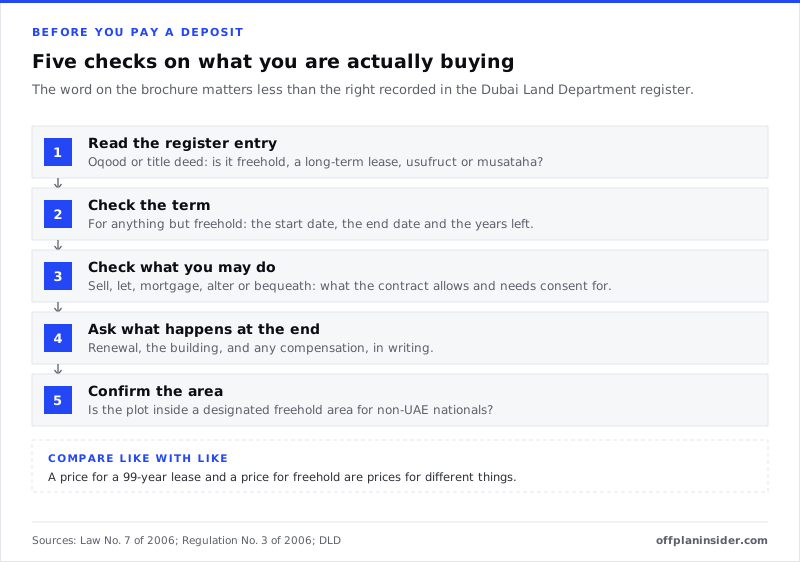
In practice:
- Ask for the registration. For off-plan, ask the developer how the unit will be registered on Oqood and what the sale and purchase agreement says about tenure. For a resale, check the title deed in the Dubai REST app or with a trustee centre.
- Check the term. For anything but freehold, write down the start date, the end date and the years left on the day you buy.
- Read what the contract allows. Letting, selling, mortgaging, alterations and inheritance. Note anything that needs the owner's consent.
- Ask what happens at the end. Renewal, the building and any compensation, in writing.
- Check the plot. Ask the developer for the plot number and confirm that it is in a designated area. Our guide to checking an off-plan project and developer shows how to verify registration and escrow.
13Key terms
- Freehold. Ownership with no time limit, available to non-UAE nationals in designated areas under Law No. 7 of 2006.
- Leasehold (long-term lease). A registered lease of up to 99 years; the landowner keeps the title.
- Usufruct. A right of up to 99 years to use and benefit from someone else's property.
- Musataha. A right of up to 50 years to build on someone else's land and benefit from the building.
- Designated area. Land listed in Regulation No. 3 of 2006, as amended, where non-UAE nationals may hold these rights.
- Oqood. The Dubai Land Department's interim register for off-plan sales, converted to a title deed at handover.
- Title deed. The certificate of a registered right, with absolute evidentiary value under Law No. 7 of 2006.
For what you pay on top of the price whichever right you buy, see the true cost of buying off-plan in Dubai. For the step-by-step purchase, see how to buy off-plan property in Dubai.
FAQQuestions buyers ask.
What is the difference between leasehold and freehold in Dubai?
Freehold is ownership with no time limit: the property, and usually the land or a share of it, is yours and passes to your heirs. Leasehold is a registered long-term lease of up to 99 years: you can use and usually let or transfer the property for the term, but the landowner keeps the title and the property returns at the end.
Can foreigners buy freehold property in Dubai?
Yes, in designated areas. Article 4 of Law No. 7 of 2006 lets non-UAE nationals hold freehold without time limit in areas the Ruler determines, listed in Regulation No. 3 of 2006 as amended. Most master communities sold to foreign buyers, from Dubai Marina to Dubai Hills Estate, are in those areas.
Is off-plan property in Dubai freehold or leasehold?
Almost every off-plan home sold to foreign buyers in Dubai is freehold, in a designated area. The developer registers your purchase on the Dubai Land Department's interim register (Oqood), and the record shows the right you are buying. Check it before you pay more than the booking deposit.
What happens when a 99-year lease ends in Dubai?
The right ends and the property returns to the landowner, unless the contract provides for renewal or for what happens to the building. The law sets the maximum term, not the end-of-term terms, so read the contract and ask for any renewal right in writing.
What is usufruct in Dubai?
Usufruct is the right to use and benefit from a property owned by someone else, including letting it, for a fixed term. In Dubai a non-UAE national can hold it for up to 99 years in designated areas under Law No. 7 of 2006. The Dubai Land Department registers it, and the owner keeps the title.
What is musataha in Dubai?
Musataha is the right to build on land owned by someone else and to benefit from the building for a fixed term. The Dubai Land Department registers musataha rights for terms of up to 50 years. It is used mainly by developers and commercial investors, not by home buyers.
Can I get a mortgage on a leasehold property in Dubai?
It depends on the bank. Lenders look at the right being offered as security and the years left on it, and policies differ. Ask the bank before you commit; a freehold home is the standard case that every UAE mortgage lender is set up for.
Is a leasehold cheaper than freehold in Dubai?
A time-limited right is a different thing from ownership, so the prices are not directly comparable. A leasehold or usufruct gives you the years left on it, while freehold has no end date. Compare what you get for the price, including the years remaining, the right to sell or let and what happens at the end.
Does the Rental Disputes Centre handle leasehold disputes?
No. Article 6 of Decree No. 26 of 2013 excludes disputes from long-term leases under Law No. 7 of 2006 from the Rental Disputes Centre. Ordinary tenancies of a freehold or leasehold home, registered on Ejari, do go to the centre.
Sources & methodWhere these figures come from.
Sources
- Dubai Legislation Portal: Law No. (7) of 2006
- Dubai Legislation Portal: Regulation No. (3) of 2006
- Dubai Legislation Portal: ECR 30 of 2013
- Dubai Legislation Portal: Decree 26 of 2013
- Dubai Legislation Portal: Law No. (13) of 2008
- Dubai Legislation Portal: Law No. (6) of 2019 Concerning Ownership of Jointly Owned Real Property in the Emirate of Dubai
- Dubai Land Department: Usufruct musataha right registration application
- Dubai Land Department: Request for usufruct registration
- Dubai Land Department: Request to register the initial sale
- UAE Government portal: Expatriates buying a property in the UAE
What we could not verify
- Whether UAE banks lend against a leasehold, usufruct or musataha right, and on what terms, varies by lender and is not set out on an official page, so the guide tells readers to ask the bank.
- Whether a leasehold or usufruct right counts toward the property route to the Golden Visa is not stated on the official pages we checked. Ask the residency authority or the Dubai Land Department before relying on it.
- What happens to the building at the end of a leasehold, usufruct or musataha, and whether the right can be renewed, depends on the contract. The law sets the maximum terms; we found no official Dubai text setting a general end-of-term rule for homes.
5 Nov 2026 · Reviewed by OffPlan Insider Research. First published 5 Nov 2026.