In a Dubai apartment building or community, the structure and common parts are insured by the management entity, as Law No. 6 of 2019 requires, and owners pay the premium through their service charge. That policy does not cover your belongings, your own liability inside the home or lost rent, so owners usually add contents insurance if they live there or landlord insurance if they let. Mortgage lenders set their own requirements, typically life cover assigned to the bank and often property cover, and the loan documents must state them.
Key takeaways
- Building insurance for jointly owned property in Dubai is the management entity's job. Article 41 of Law No. 6 of 2019 requires it to insure the property for maintenance and reconstruction and against liability for damage and injury, with premiums included in the service charge.
- The building policy is not a home policy. Your furniture, belongings, personal liability inside the unit and any loss of rent are outside it, so cover for those is your decision.
- Contents insurance protects what you own as the occupier. Landlord insurance is designed for a let home and may add landlord's fittings, liability to the tenant and, on some policies, loss of rent.
- Mortgage lenders set the insurance they need. Central Bank rules require the loan documents to state the insurance requirement; most lenders ask for life cover and many for property cover.
- Defects are not an insurance claim. Under Article 40 of Law No. 6 of 2019 the developer must fix defective installations for 1 year from handover and structural defects for 10 years from completion.
- Start your own cover on the day you take the keys, not the day you move in, and switch to landlord cover before a tenant arrives.
- Buy from an insurer licensed by the Central Bank of the UAE, read the exclusions, and check villa and townhouse cover with the community manager.
01How does property insurance work in Dubai?
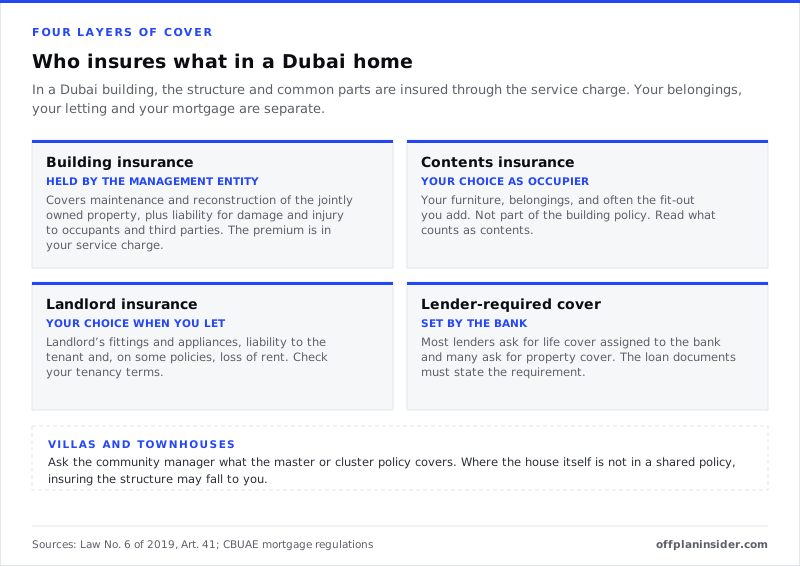
Property insurance in Dubai works in layers. The building and its common parts are insured by the management entity and paid for through the service charge; your belongings, your letting and your mortgage are covered, if at all, by policies you choose.
Most new homes in Dubai, whether apartments in a tower or houses in a community, are jointly owned property under Law No. 6 of 2019. That law puts the building policy in the hands of the management entity, so an owner of a new apartment does not buy cover for the walls, roof or lifts.
What is left to you depends on how you use the home. An owner who lives in it thinks about contents. An owner who lets it thinks about landlord cover. An owner with a mortgage follows the bank's requirements. This guide takes each in turn, then explains when to start cover around handover.
02Is building insurance compulsory in Dubai?
Yes, for jointly owned property, and it is the management entity's duty rather than yours. Article 41 of Law No. 6 of 2019 sets out what it must insure.
- Maintenance and reconstruction. The management entity must insure the jointly owned property under a policy covering its maintenance and reconstruction, with the management entity as beneficiary.
- Liability. It must also insure against liability for damage and for bodily injuries suffered by occupants or third parties.
- Who pays. The premiums owners pay are calculated under the insurance contracts and included in the service charges.
How you can see it. When a management company applies to the Dubai Land Department for approval of a building's service charges, it attaches its insurance contracts to the budget. Ask the management company for a summary of the building policy: what it covers, the sum insured and the excess. How service charges are set and checked is explained in our guide to Dubai service charges.
Who manages your building. In a major project the developer manages the common parts, often through a management company; in other projects a management company selected by RERA does. Either way, the building policy sits with that management entity.
03What does the building policy not cover?
It covers the building, not the people in it or what they own. Several important risks are left to owners and occupiers.
| Risk | Building policy | Who usually covers it |
|---|---|---|
| Fire damage to the structure and common parts | Yes, under the maintenance and reconstruction cover | Management entity, through the service charge |
| Injury to a visitor in the lobby or pool area | Yes, under the liability cover | Management entity |
| Your furniture, clothes and electronics | No | Your contents policy, if you live there |
| Furniture and appliances you supply to a tenant | No | Your landlord policy |
| The tenant's own belongings | No | The tenant's own contents policy |
| Your liability for damage you cause, such as a flood into the flat below | Depends on the policy | Often the personal liability section of a contents or landlord policy |
| Lost rent while the home cannot be lived in | No | Some landlord policies |
| Fit-out and improvements you add | Ask the management company | Often contents or landlord cover; check the definition |
| Defects in a new home | No | The developer, under Article 40 of Law No. 6 of 2019 |
The gaps are why owners add their own cover. The right one depends on whether you live in the home, let it or both at different times.
04What is contents insurance, and do owner-occupiers need it?
Contents insurance covers what you own inside the home against the events listed in the policy. It is not required by law, but it is the cover most owner-occupiers buy.
What counts as contents. Furniture, appliances you own, clothing, electronics, jewellery and personal items. Policies set a total sum insured and often a limit for any single item, with higher-value items listed separately.
Fit-out. Changes you make to the home, such as new wardrobes, flooring or lighting, are often covered as "improvements" under a contents policy. Check the definition, because the building policy may not cover them.
Personal liability. Many contents policies include cover if you are legally liable for injury to others or damage to their property, for example water from your bathroom damaging the flat below.
How much to insure for. Add up what it would cost to replace everything new. If you insure for less, many policies reduce a claim in proportion, so a low sum insured can cost you more than it saves.
05What is landlord insurance in Dubai?
Landlord insurance is a policy designed for a home you let. It typically covers the landlord's own fittings, furniture and appliances in the unit and the landlord's liability, and some policies add loss of rent.
Why landlords consider it. The Dubai Land Department's guidance says that, unless the parties agree otherwise, the landlord is responsible for maintenance and repairs during the lease. A landlord policy can help with sudden damage, such as a burst pipe, that you would have to put right.
The tenant's belongings are theirs. A landlord policy does not cover a tenant's own possessions. Tenants buy their own contents cover if they want it.
The security deposit is not insurance. Dubai tenancy guidance sometimes calls the tenant's security deposit "insurance". It is a deposit held against damage beyond normal wear and tear, not a policy, and it will not cover a fire or a flood.
Short-term letting. If you let the home as a holiday home, tell the insurer. Policies written for long-term tenancies often treat short stays differently, and holiday letting in Dubai needs a permit from the Department of Economy and Tourism. See our guide to holiday homes and short-term rentals in Dubai.
Let it properly. Register long-term tenancies on Ejari. Insurers may ask for the tenancy contract when you claim.
06What do mortgage lenders require?
Lenders set their own insurance conditions. The Central Bank of the UAE's mortgage regulations require the loan documentation to state the insurance requirement, alongside the loan amount, term, rate and repayments.
In practice, most UAE lenders ask for:
- Life cover for the loan amount, assigned to the bank, so the loan is repaid if the borrower dies.
- Property insurance, with the bank noted on the policy, on many loans.
Ask early. Ask the bank before the mortgage is drawn what cover it needs, for how much, and in whose name. Ask whether you can assign an existing policy rather than buy the bank's own, and how the premium is paid.
Budget for it in cash. Insurance is one of the costs that sit outside the loan, alongside registration, valuation and arrangement fees. Our guide to off-plan mortgages in the UAE sets out the full list, the loan-to-value caps and the timing around handover.
Read the assignment. A policy assigned to the bank usually pays the bank first. Keep a copy of the assignment and the policy schedule with your mortgage papers.
07What do home policies typically cover and exclude?
Home contents and landlord policies sold in the UAE usually cover sudden events such as fire, escape of water and theft, and exclude gradual damage, wear and tear and defects. Every policy is different, so the wording is what counts.
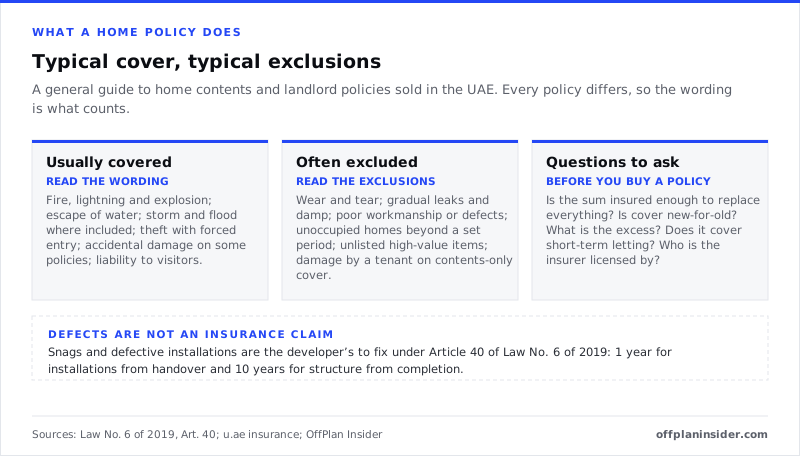
Usually covered, subject to the wording:
- Fire, lightning and explosion.
- Escape of water from burst or leaking pipes, tanks and appliances.
- Storm and flood, where the policy includes them.
- Theft involving forced entry.
- Accidental damage, on some policies or as an add-on.
- Personal liability to visitors and neighbours.
Often excluded:
- Wear and tear and gradual deterioration.
- Slow leaks, damp and mould that build up over time.
- Poor workmanship, faulty design and defects.
- Damage while the home is unoccupied beyond a period set in the policy.
- High-value items above the single-item limit that are not listed.
- Malicious damage by a tenant, unless the policy covers it.
Read three things. The schedule shows what you bought and the sums insured. The wording shows what each section covers and excludes. The excess is what you pay towards each claim.
08Defects or insurance: who pays for what in a new home?
In a new Dubai home, defects are the developer's to fix, not an insurance claim. Insurance pays for sudden events; the defects liability periods in Dubai law cover faults in the work.
Article 40 of Law No. 6 of 2019 keeps the developer liable for one year from handover to repair or replace defective installations, such as mechanical, electrical, sanitary and sewerage works, and for ten years from the completion certificate for defects in the structural parts.
| What happens | First call | Why |
|---|---|---|
| A leak from a faulty fitting under your sink, 3 months after handover | The developer | A defective installation within 1 year of handover |
| A crack in a structural column, 4 years after completion | The management company and the developer | A structural defect within 10 years of the completion certificate |
| A fire in the building's car park damages the lobby | The management company | The building policy under Article 41 |
| Water from the flat above ruins your sofa | Your contents insurer, and the neighbour's | Your belongings; the neighbour's liability cover may respond |
| A burglar forces your door and takes a laptop | The police, then your contents insurer | Theft with forced entry |
| Your tenant's washing machine floods the kitchen | Your landlord insurer | Sudden escape of water in a let home |
Snag first. The best protection against defect costs is a careful inspection before handover. Our snagging guide has a room-by-room checklist and explains how to report defects to the developer.
Water damage is the common overlap. A leak can be a defect, an insured event or both. Report it to the developer and the management company in writing, photograph the damage and tell your insurer promptly. Let them settle between them who pays.
09When should you start home insurance on an off-plan property?
Start your own cover on the day you collect the keys. Before that, the unit is not in your hands, and the building policy begins with the management entity.
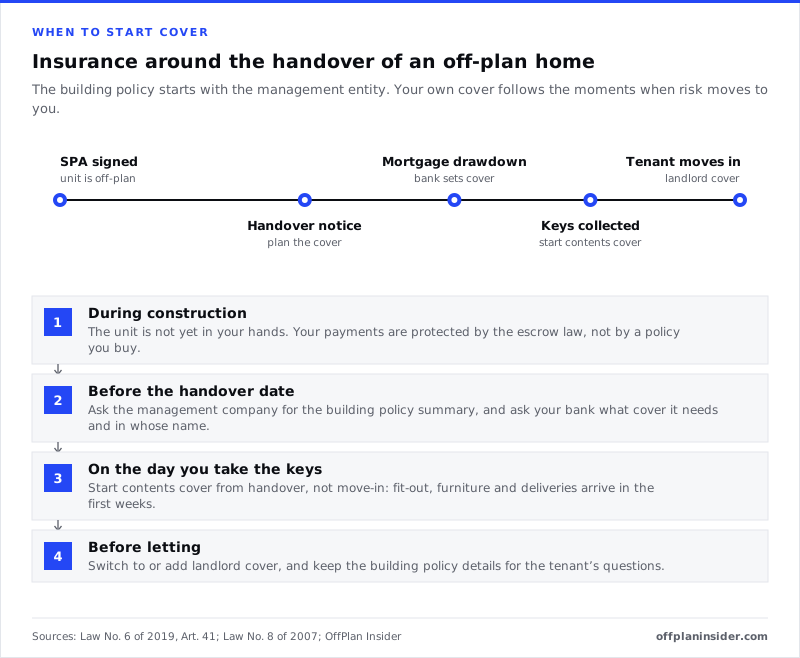
- During construction. You do not insure a unit you do not yet possess. Your instalments are protected by Dubai's escrow rules, explained in our escrow law guide.
- When the handover notice arrives. Ask the management company for the building policy summary, and ask your bank what insurance it needs before it releases the mortgage.
- On handover day. Start contents cover from the day you take the keys. Fit-out contractors, deliveries and new furniture arrive in the first weeks, and the home may stand empty in between.
- Before a tenant moves in. Switch to landlord cover, or add it, and record the tenancy start date with the insurer.
If the home will be empty. Many policies limit cover for homes left unoccupied beyond a set period. If you are abroad and the home will stand empty after handover, tell the insurer and ask what checks it expects.
10Do villa and townhouse owners need building insurance?
Possibly. In a community, shared areas such as roads, parks and amenities are insured by the management entity, but whether each house is included in a shared policy varies.
Law No. 6 of 2019 treats a town house or independent house in a community as a unit of jointly owned property, and Article 41 requires the management entity to insure the jointly owned property. How far the community policy extends to each house depends on the community's documents and the policy itself.
Ask the community manager:
- Does the community policy cover the structure of each house, or only the shared areas?
- What is the sum insured per house, and what is the excess?
- Are garden walls, pools and outbuildings included?
- If the house is not covered, what does the community expect owners to insure?
If the structure is not in a shared policy, consider a homeowner's policy that covers buildings as well as contents, insured for the cost of rebuilding rather than the price you paid. Our villas and townhouses pages list current off-plan projects by type.
11How do you choose a home insurance policy in the UAE?
Choose a policy from an insurer licensed in the UAE, compare cover rather than headline price, and read the exclusions. The Central Bank of the UAE supervises the insurance sector and licenses insurers.
- Check the licence. The Central Bank registers and licenses insurance companies in the UAE. Buy from a licensed insurer or an authorised agent or broker.
- Match the policy to the use. Owner-occupied, long-term let and holiday home are different risks.
- Set the right sums. Contents at full replacement value; buildings, where you need them, at rebuild cost.
- Compare the excess and any limits on single items, valuables and water damage.
- Ask about new-for-old. Some policies pay the cost of a new item; others deduct for age.
- Consider takaful. Sharia-compliant takaful home cover is also available in the UAE.
- Keep records. Receipts, photographs and a list of valuables make a claim faster.
If something goes wrong with an insurer. The u.ae government portal points policyholders with insurance-related complaints to Sanadak. Complain to the insurer first and keep the reference number, then escalate if the reply does not resolve it.
12How do you make a home insurance claim?
Act quickly, limit the damage, record everything and tell the insurer within the time the policy sets. A clean record makes a claim straightforward.
- Make it safe. Turn off the water at the isolation valve or the power at the board, and call the building's management for common-area problems.
- Record it. Photograph and video the damage before you clean up, and keep damaged items if you can.
- Report it. For theft, report to the police and get a reference. For leaks from a defect or the common parts, tell the developer or management company in writing.
- Notify the insurer with the policy number, what happened, when, and a first list of damage.
- Keep receipts for emergency repairs and any temporary accommodation the policy covers.
- Follow up in writing and keep the claim reference on every message.
13Home insurance checklist for Dubai owners
- Before handover: get the building policy summary from the management company and the bank's insurance requirement in writing.
- On the day you take the keys: start contents cover, including fit-out you plan to add.
- If you let: switch to landlord cover, register the tenancy on Ejari and tell the insurer about any short-term letting.
- If you own a villa or townhouse: confirm whether the structure is in a shared policy.
- Every year: review the sums insured, the excess and any change in how you use the home.
- Always: report defects to the developer, not the insurer, while the defects periods run.
14Where to go next
If your building is close to completion, read our handover guide for the payments and documents around the keys, and our snagging guide for the inspection. If you are financing the purchase, our off-plan mortgage guide covers the bank's conditions, including insurance.
Still choosing? Browse projects near handover and ready projects.
FAQQuestions buyers ask.
Is home insurance mandatory in Dubai?
For the building, yes: Law No. 6 of 2019 requires the management entity of jointly owned property to insure it, and owners pay through the service charge. For your own contents or as a landlord, no Dubai law we found requires an individual owner to buy a policy. A mortgage lender can make insurance a condition of the loan.
Does the service charge include building insurance in Dubai?
Yes. Article 41 of Law No. 6 of 2019 requires the management entity to insure the jointly owned property for maintenance and reconstruction and against liability for damage and bodily injury to occupants and third parties. The premiums are calculated under the insurance contracts and included in the service charges owners pay.
What does home contents insurance cover in Dubai?
It covers your belongings inside the home, such as furniture, appliances you own, clothing and electronics, against events listed in the policy, typically fire, escape of water and theft. Many policies add personal liability and some add accidental damage. Cover, limits and exclusions vary, so read the policy wording and schedule.
Do I need landlord insurance in Dubai?
It is not a legal requirement, but a let home has risks a building policy does not cover: your furniture and fittings in the unit, your liability as landlord and, on some policies, lost rent. Under Dubai's tenancy rules the landlord is usually responsible for maintenance and repairs, which is another reason owners who let consider it.
Do UAE banks require insurance for a mortgage?
Lenders set their own requirements, and Central Bank rules say the loan documentation must state the insurance requirement. Most lenders require life cover assigned to the bank for the loan amount, and many require property insurance. Ask the bank whether you can assign an existing policy instead of buying its own.
When should I start home insurance after handover?
Start contents cover from the day you collect the keys, because risk in the unit passes to you at handover and furniture and fit-out arrive soon after. Ask your bank before the mortgage is drawn what cover it needs. Switch to or add landlord cover before a tenant moves in.
Does home insurance cover defects in a new Dubai property?
Generally no. Policies usually exclude poor workmanship and defects, and in a new home those are the developer's to fix: defective installations for 1 year from handover and structural defects for 10 years from the completion certificate, under Article 40 of Law No. 6 of 2019. Report defects to the developer in writing.
Who insures a villa or townhouse in Dubai?
It depends on the community. Shared areas are insured by the management entity under Law No. 6 of 2019, but whether the house itself is included in a shared policy varies. Ask the community management company what its policy covers. If the house is not included, insuring the structure may fall to you.
Sources & methodWhere these figures come from.
Sources
- Dubai Legislation Portal: Law No. (6) of 2019 Concerning Ownership of Jointly Owned Real Property in the Emirate of Dubai
- Central Bank of the UAE Rulebook: Regulations regarding mortgage loans
- UAE Government portal: Insurance
- Dubai Land Department: Request for approval of service and usage charges
- Dubai Land Department: Frequently asked questions
What we could not verify
- Whether a villa or townhouse structure is insured under a community's shared policy, or left to each owner, varies by community and was not confirmed from an official source; the text tells owners to ask the community management company.
- What contents, landlord and home policies typically cover and exclude is general insurance market practice, not an official standard; the text describes it in general terms and tells readers to read each policy's wording. No premiums or prices are given.
- That most lenders require life cover and many require property insurance is lender practice, restated from our mortgage guide; the Central Bank rule found only requires loan documents to state the insurance requirement.
5 Nov 2026 · Reviewed by OffPlan Insider Research. First published 5 Nov 2026.