Service charges in Dubai are the annual amounts owners pay for the management, operation, maintenance and repair of a jointly owned building or community. Under Law No. 6 of 2019 a management company may not collect anything until RERA approves an audited budget, and invoices and payments run through the Dubai Land Department's Mollak system. You can check a building's approved rate on the department's Service Charge Index, on its website or in the Dubai REST app, and multiply it by the area in your title deed to get your annual charge.
Key takeaways
- Service charges pay for the common parts of a building or community: security, cleaning, maintenance contracts, common-area utilities, administration, insurance, master community charges and a reserve for major repairs.
- Nothing can be collected until RERA approves the budget, after an audit by a RERA-accredited firm. Since December 2025 management companies can ask for a fixed three-year budget instead of a one-year one.
- Check any completed building's approved rate on the Dubai Land Department's Service Charge Index by choosing the project, the use and the year. Your share is the approved rate multiplied by the area in your title deed.
- An off-plan building has no approved budget until it is complete, so any figure quoted at launch is an estimate. Ask what it is based on and which budget will apply at handover.
- The developer pays for unsold units. The owner pays after handover, and a buyer who holds up handover by not paying can be liable from completion. Letting the home does not move the liability to the tenant.
- Unpaid charges are a lien on the unit: it cannot be sold until they are paid, and after a 30-day notice the claim can be enforced through the Rental Disputes Center, up to a public auction.
- Owners cannot refuse approved charges, but they can challenge unapproved ones, raise service complaints through the owners committee and Dubai REST, and take disputes to the Rental Disputes Center.
01What are service charges in Dubai?
Service charges in Dubai are the annual amounts that owners of apartments, townhouses and villas in jointly owned property pay to run the shared parts of their building or community. They cover management, operation, maintenance and repair, and they are approved by RERA before anyone can collect them.
Law No. 6 of 2019, Dubai's jointly owned property law, defines service charges as the annual charges collected from owners to cover the cost of managing, operating, maintaining and repairing the jointly owned property. The same law covers apartments in towers and houses and plots in communities with shared areas.
This guide explains how the charges are set, how to check them and who pays when. For how service charges fit into the full cost of buying and holding off-plan, from the 4% Dubai Land Department fee to district cooling, see our guide to the true cost of buying off-plan in Dubai.
02What do service charges pay for?
They pay for the common parts: everything in the building or community that owners share rather than own individually. The Dubai Land Department lists the main items.
| Item | What it covers |
|---|---|
| Security | Guards, access control and CCTV for the common parts |
| Cleaning | Lobbies, corridors, car parks, pool decks and outside areas |
| Maintenance contracts | Lifts, fire systems, pumps, central plant, landscaping and pools |
| Utilities | Electricity, water and cooling for the common areas, not for your unit |
| Administration and insurance | The management company's fee and the building's insurance policy |
| Master community charges | The building's share of the wider community's costs, where it sits in a master community |
| Reserve fund | Money set aside for major repairs and replacements, such as lifts and roofs |
What they do not pay for. Electricity and water for your own unit are billed by DEWA. Cooling for your unit, where the building uses district cooling, is billed by the cooling provider. Repairs inside your unit are yours, or the developer's while the defects period runs.
Why charges differ between buildings. The Dubai Land Department says charges vary with the services provided, the size of the common areas and the number of units. A tower with a large pool deck, concierge and many lifts costs more to run per square foot than a low-rise building with few shared facilities.
03What is the difference between service charges and usage charges?
Service charges pay for the common parts of your building. Usage charges pay for the common facilities of the wider master project, such as community roads, parks and shared amenities.
Under Article 26 of Law No. 6 of 2019, a master developer may collect usage charges from owners or sub-developers. They apply to completed buildings, buildings under construction and vacant land. Like service charges, they are annual amounts approved by RERA.
In a master community you may see both: the building's service charge and a master community or usage charge. Ask which one a quoted figure covers, and whether the other sits on top.
04Which laws govern service charges in Dubai?
The main law is Law No. 6 of 2019 on the ownership of jointly owned real property in Dubai. It sets who manages a building, how charges are approved, who pays and what happens if they do not.
| Article | What it says, in short |
|---|---|
| Article 16 | The owner pays service and usage charges unless the lease says otherwise, and is not released if the tenant does not pay |
| Article 18 | Who manages the common parts: the developer in major projects, a hotel management company in hotel projects, a RERA-selected management company in others |
| Articles 22 to 24 | The owners committee: up to nine members appointed by RERA, formed once at least 10% of units are registered to owners |
| Article 25 | Each owner pays a share of the annual charges by area; the developer pays for unsold units |
| Article 26 | Master developers may collect usage charges for common facilities |
| Article 27 | Nothing may be charged without RERA approval, after audit by a RERA-recognised firm; a temporary budget may be approved |
| Article 28 | Owners may not refuse to pay approved charges |
| Article 29 | A developer or management entity may not block an owner's use of the unit or common parts to force payment |
| Article 30 | Charges go into a dedicated account within seven working days; a separate reserve account covers emergencies |
| Article 32 | Unpaid charges are a lien on the unit; enforcement through the Rental Disputes Center after a 30-day notice |
| Article 41 | The management entity must insure the property, and the premiums are part of the service charge |
| Article 42 | The Rental Disputes Center has exclusive jurisdiction over disputes under the law |
Older guides and contracts mention "owners associations". The 2019 law moved their role to management entities, with owners represented by an owners committee. Our guide to RERA in Dubai explains where RERA sits within the Dubai Land Department.
05How are service charges set and approved?
The management company prepares an annual budget, an accredited auditor checks it, and RERA approves it through Mollak. Only then can owners be invoiced.
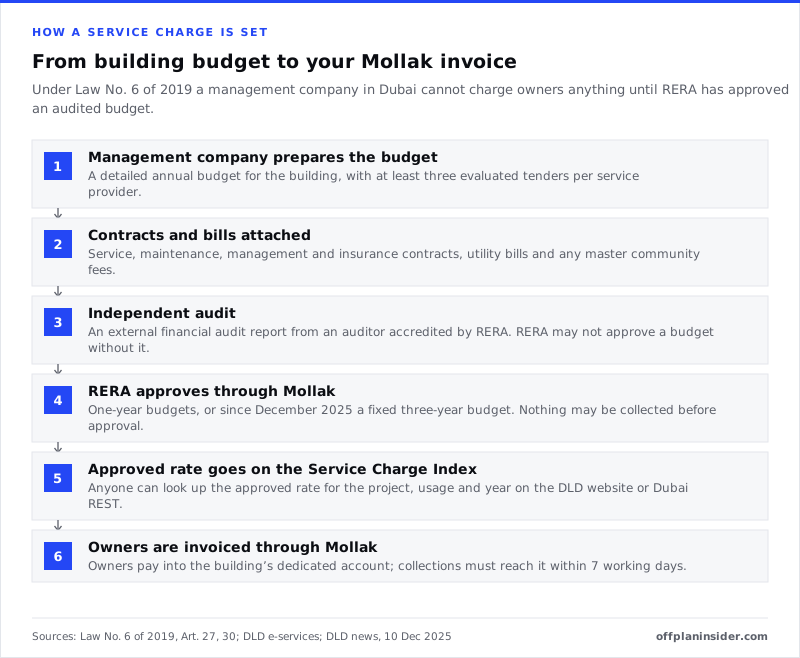
The budget. The Dubai Land Department's approval service asks the management company for a detailed annual budget and at least three evaluated tenders for each service provider. It must attach its service, maintenance, management and insurance contracts and the building's utility bills.
The audit. The budget must come with an external financial audit report from an auditor accredited by RERA. Article 27 says RERA may not approve a budget without that approval.
Temporary budgets. Where needed, RERA may approve a temporary budget. This is how a newly completed building can be invoiced before its first full budget is settled.
Three-year fixed budgets. On 10 December 2025 the Dubai Land Department announced that management companies can submit a three-year service fee budget through Mollak. The first approved under this model was the Palm Jumeirah master community. The department said all community management companies can use it, and the one-year model remains available.
Your share. Article 25 says each owner pays a share of the annual charges in proportion to the area of the unit. The Dubai Land Department says the area used is the one in your title deed.
06What is Mollak?
Mollak is the Dubai Land Department's electronic system for jointly owned property. It is where budgets are approved, invoices are issued and service charge accounts are monitored.
Mollak registers management companies and their staff, auditors, banks, buildings and the regulatory bank account for each building. The department describes its main aim as bringing governance to jointly owned property and monitoring service charges.
How you are invoiced. Owners receive service charge invoices from Mollak by email or text message. Mollak describes them as quarterly invoices.
How you pay. The Dubai Land Department lists two ways:
- Bank transfer. Pay into the regulatory bank account printed on the invoice, then send the payment slip to the management company. Its email address is at the foot of the invoice.
- Noqodi. Pay online with a wallet, credit card or net banking.
Where the money goes. Article 30 requires collected charges to be paid into the building's dedicated account within seven working days. That account cannot be seized by the management company's creditors.
Keep your details current. Invoices go to the contact details Mollak holds. The department says owners abroad who cannot use the app can update their details through its call centre, by email or at a real estate service trustee office.
07How do you check a building's approved service charge?
Use the Dubai Land Department's Service Charge Index, on the department's website through Mollak or in the Dubai REST app. Choose the project, the use and the year, and the approved rate is shown. Multiply it by your unit's area.
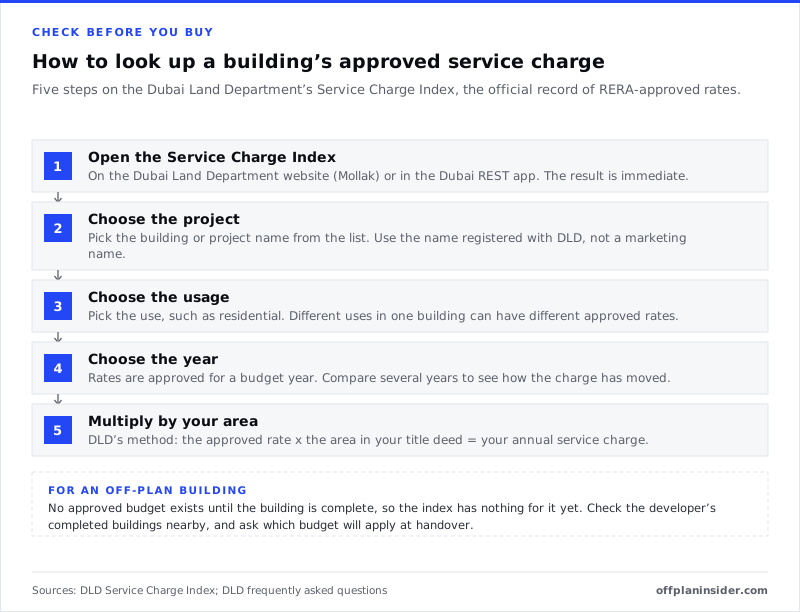
Step by step:
- Open the index. On the Dubai Land Department website, or in the Dubai REST app. Our Dubai REST app guide shows where it sits among the app's services.
- Choose the project. Search by the project name registered with the department, which can differ from the name used in marketing.
- Choose the use. A building with shops on the ground floor and homes above can have separate rates for each.
- Choose the year. Check the current year and a few before it.
- Work out your charge. The department's own method is the approved rate multiplied by the area in your title deed.
A worked example, in symbols. If the index shows an approved rate of R dirhams per square foot for the residential use this year, and your title deed shows A square feet, your annual service charge is R x A. Your invoices then split that across the periods Mollak bills.
Read it with care. A rate is for the building's whole budget year. If a building has a large one-off repair, or a new three-year budget, the rate can move. Comparing years shows you the trend and helps you ask the right questions.
08How should you judge service charges on an off-plan home?
Treat any figure you are given at launch as an estimate, because no approved budget exists until the building is complete. Ask what it is based on, then test it against completed buildings.
Ask the developer:
- What is the estimated service charge, and what is it based on?
- Does it include master community or usage charges, or do they sit on top?
- Which facilities drive the cost: pools, gyms, concierge, landscaping, lifts?
- Will there be a temporary budget in the first year, and when will the first invoice be issued?
- Does the sale and purchase agreement ask for any service charge in advance at handover?
Then check for yourself. Look up the developer's completed buildings of a similar size and specification nearby on the Service Charge Index, and compare a few years. That is a fairer guide than a single launch estimate.
Remember the area. Your share follows your unit's area in the title deed. If that area includes a balcony or terrace, the charge is worked out on the larger figure, so check the area on your contract and floor plan.
Our cost guide sets out the other running costs that sit beside the service charge, such as district cooling, and the questions worth asking before you reserve.
09Who pays service charges before and after handover?
The developer pays for unsold units, and service charges normally start for the buyer at handover. A buyer who delays handover by not paying can be liable from completion, and after handover the owner stays liable even if the home is let.
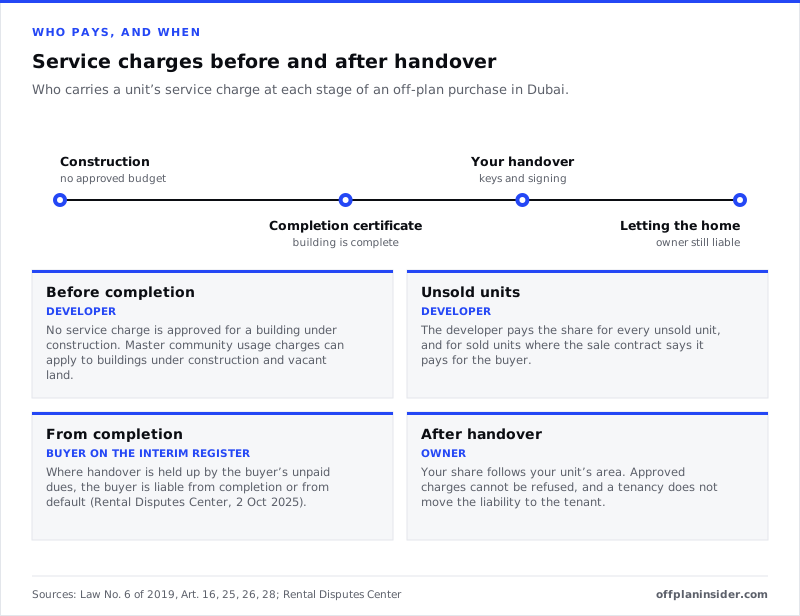
During construction. A building under construction has no approved service charge budget, so there is nothing to invoice. Usage charges for a master community are different: Article 26 lets a master developer collect them from owners or sub-developers, including for buildings under construction and vacant land.
Unsold units. Article 25 makes the developer pay the share for every unsold unit. It also pays for sold units where the sale contract or reservation agreement says the developer pays on the buyer's behalf.
At completion, if handover is delayed by the buyer. On 2 October 2025 the Rental Disputes Center set a principle that a buyer named in the interim register is liable for service charges from project completion, or from the point of payment default, even before ownership is transferred. The case involved a developer withholding handover because of the buyer's unpaid dues.
After handover. You pay your share as the owner. Many handover statements also ask for a first service charge payment. Check what period it covers and that it matches an approved budget; the payments due at handover are listed in our handover guide.
When you let the home. Article 16 keeps the owner liable unless the lease says otherwise, and even then the owner is not released if the tenant does not pay. The Dubai Land Department's guidance says the landlord is responsible for service fees on a property. Register the tenancy on Ejari.
When you sell. Unpaid charges must be cleared before a unit can be transferred. For a ready home managed through Mollak, the sale needs an eNOC from the management company, requested in the Dubai REST app.
10What happens if service charges are not paid?
Approved charges cannot be refused, and the law gives the management entity strong ways to recover them. The unit itself becomes security for the debt.
- No refusal. Article 28 says an owner may not refrain from paying approved charges, for example because of a complaint about services.
- A lien on the unit. Article 32 gives the management entity a lien on every unit for unpaid charges. The unit cannot be disposed of until they are paid.
- Enforcement. After a 30-day notice, the claim can be enforced by the execution judge at the Rental Disputes Center, who may order the unit to be sold at public auction.
- No blocking. Article 29 says a developer or management entity must not stop an owner using the unit or common parts in order to force payment.
The Dubai Land Department's guidance says an owner whose property is blocked because of service charges can contact the management company. If you are struggling to pay, talk to the management company early and keep the conversation in writing.
11How do you challenge or dispute service charges?
Start with information, then use the owners committee, then the official channels. Disputes over amounts and over services not received are the most common, and the reference point in any dispute is the RERA-approved invoice.
- Ask for the documents. Request the approved budget, the breakdown by service and the invoice calculation. Check that the rate matches the Service Charge Index and the area matches your title deed.
- Check for unapproved charges. The Dubai Land Department says management authorities may not claim charges before RERA approves them, and owners asked to pay unauthorised charges can report it.
- Use the owners committee. Under Article 24 the committee reviews the budget and passes on owners' complaints. If the management entity does not address a complaint within 14 days, the committee can take it to RERA.
- Complain about poor services. Complaints about poor services or maintenance can be filed through the Dubai REST app, using the Real Estate Violations System.
- Go to the Rental Disputes Center. Article 42 gives it exclusive jurisdiction over disputes under the jointly owned property law. Its first-instance lawsuit service for jointly owned property is filed online or at a real estate services trustee centre. The page lists a process service fee of AED 100, AED 25 to register a power of attorney where needed, and knowledge and innovation fees of AED 10 each; check the full cost of your claim with the centre.
Keep paying while you dispute. Because approved charges cannot be refused, withholding payment while you dispute a service usually makes things worse. Pay, keep records, and pursue the complaint.
12What is the reserve fund, and can owners be asked for more?
The reserve fund is money set aside within the service charge for major repairs and replacements. If it is not enough, owners can be asked to cover the gap.
Article 30 requires a cash reserve to cover emergency expenses, held in a separate account. If the reserve is insufficient, the Dubai Land Department may, with RERA's prior approval, ask owners to cover the expenses.
For a buyer, a building with a healthy reserve is less likely to need a sudden extra payment when lifts, roofs or cooling plant reach the end of their life. Ask the management company how the reserve is funded and what it holds.
13How do service charges relate to building insurance?
The building's insurance is paid through the service charge. Article 41 requires the management entity to insure the jointly owned property for maintenance and reconstruction and against liability for damage and injury, and the premiums are part of the charges.
That policy covers the building, not your belongings or your rent. What it leaves to you, and when to start your own cover, is set out in our guide to home insurance for Dubai property owners.
14Are service charges the same in Abu Dhabi and other emirates?
No. Mollak, the Service Charge Index and Law No. 6 of 2019 are Dubai's. Other emirates have their own regulators and rules for jointly owned property.
In Abu Dhabi the regulator is the Abu Dhabi Real Estate Centre; our ADREC guide explains its role. Ask the developer and the management company which rules apply, and do not assume the Dubai approval process or tools are available.
15Service charge checklist for buyers and owners
- Before you reserve: ask for the estimated charge, what it includes and whether a master community charge sits on top.
- Before you buy resale: look up the approved rate on the Service Charge Index for several years, and ask the seller for the last invoices and proof they are paid.
- At handover: check what any first payment covers and that it follows an approved or temporary budget.
- Every year: compare the new rate with the old one and read the budget breakdown.
- When you let: keep the liability in mind when you set the rent; the tenant does not take it over.
- When you sell: clear all charges and request the eNOC early.
16Where to go next
If you are comparing projects, start with buildings close to completion: browse projects near handover and ready projects, then check comparable completed buildings on the index. If your handover notice has arrived, read the handover guide and plan your snagging inspection.
FAQQuestions buyers ask.
What are service charges in Dubai?
Service charges are the annual amounts collected from owners of jointly owned property in Dubai to cover the management, operation, maintenance and repair of the common parts. The Dubai Land Department lists security, cleaning, maintenance contracts, utilities, administration and insurance, master community charges and reserve funds for major repairs as typical items.
Who approves service charges in Dubai?
RERA, the Real Estate Regulatory Agency of the Dubai Land Department. Under Article 27 of Law No. 6 of 2019 a management entity must not charge or collect any amount from owners without RERA's approval, and RERA may not approve a budget unless a RERA-recognised audit firm has approved it. Approvals and invoices run through the Mollak system.
How do I check service charges for a building in Dubai?
Use the Dubai Land Department's Service Charge Index on its website or in the Dubai REST app. Choose the project name, the use and the year, and the approved rate is shown. Multiply that rate by the area in your title deed to get your annual service charge. Comparing several years shows how the charge has moved.
What is Mollak?
Mollak is the Dubai Land Department's electronic system for jointly owned property. It registers management companies, buildings, auditors and bank accounts, handles RERA's approval of service charge budgets, and issues owners' invoices. Owners receive invoices by email or text message and pay into the building's RERA-approved account, for example through Noqodi.
Do I pay service charges before handover in Dubai?
Usually not while the building is under construction, because no service charge budget exists. The developer pays the share for unsold units. Charges normally start at handover. The Rental Disputes Center has ruled that a buyer who holds up handover by not paying dues can be liable from project completion, even before the unit is registered in their name.
Does the landlord or the tenant pay service charges in Dubai?
The owner. Article 16 of Law No. 6 of 2019 says the owner pays service and usage charges unless the lease says otherwise, and the owner is not released from liability even if the tenant fails to pay.
What happens if I do not pay service charges in Dubai?
Approved charges cannot be refused. The management entity has a lien on the unit for unpaid charges, so it cannot be sold until they are paid. After a 30-day notice the claim can be enforced through the execution judge at the Rental Disputes Center, which can order the unit to be sold at public auction.
How do I dispute service charges in Dubai?
Ask the management company for the approved budget and invoice breakdown first. Raise service problems through the owners committee, which can take a complaint to RERA if it is not addressed in 14 days. Report unapproved charges and poor services through the Dubai REST app. Disputes under the jointly owned property law go to the Rental Disputes Center.
Sources & methodWhere these figures come from.
Sources
- Dubai Legislation Portal: Law No. (6) of 2019 Concerning Ownership of Jointly Owned Real Property in the Emirate of Dubai
- Dubai Land Department: Service charge index overview
- Dubai Land Department: Request for approval of service and usage charges
- Dubai Land Department: Frequently asked questions
- Dubai Land Department: Dubai land department collaborates with dubai holding community management to approve first ever three year fixed service fees for palm jumeirah master community
- Dubai Land Department: Real estate property owner is obliged to pay service and usage charges for jointly owned property
- mollak.dubailand.gov.ae: About us
- rdc.gov.ae: Dubai s rental disputes center establishes a new legal principle on real estate service fees
- rdc.gov.ae: Register first instance lawsuit ownership of jointly owned real properties
What we could not verify
- No approved service charge rates are given for any building. The Service Charge Index page describes the lookup but shows no example rates, and rates change by project, use and year, so readers are told to check the index themselves.
- When an off-plan building's first service charge invoice starts, and whether a developer collects an advance at handover, are set by each sale and purchase agreement and developer; the law does not set a start date. The Rental Disputes Center principle of 2 October 2025 applies to buyers who delay handover by not paying dues.
- The full cost of a service charge claim at the Rental Disputes Center was not confirmed. Its jointly owned property lawsuit page lists a process service fee of AED 100, AED 25 for a power of attorney where needed and AED 10 each for knowledge and innovation fees; any fee based on the amount claimed is not stated, so readers are told to check with the centre.
5 Nov 2026 · Reviewed by OffPlan Insider Research. First published 5 Nov 2026.