Snagging in Dubai is the inspection of a newly built home for defects before you accept it from the developer. You check every room and system against your sale and purchase agreement, log each problem in writing with a photograph, and ask the developer to acknowledge and fix the list before you sign the handover. After handover, Dubai's jointly owned property law keeps the developer liable for defective installations for one year from handover and for structural defects for ten years from the completion certificate.
Key takeaways
- A snag is anything in the finished home that is defective, incomplete or different from your contract: a leaking trap, a hollow tile, a socket that does not work, a missing wardrobe, a smaller room.
- Inspect before you sign the handover acceptance. Defects you record in writing at that point are clearly the developer's to fix.
- Run tests, not just a look round: water in every tap and drain for several minutes, every socket and switch, cooling in every room, every door and window through its full movement.
- Log one defect per line with a number, room, location, description and photograph, then ask for a reference number, written acknowledgement and a target date for each item.
- Article 40 of Law No. 6 of 2019: the developer stays liable for defective installations for 1 year from handover and for structural defects for 10 years from the completion certificate. The periods cannot be signed away.
- If you delay taking possession, the one-year installations period runs from the completion certificate instead, so a late handover shortens your cover.
- Disputes under Dubai's jointly owned property law go to the Rental Disputes Center; complaints about poor building services can be filed through the Dubai REST app.
01What is snagging in Dubai?
Snagging in Dubai is the inspection of a newly built home for defects before you accept it from the developer. You check the apartment, townhouse or villa against your sale and purchase agreement (SPA), log every problem, and ask the developer to fix the list.
The word comes from the building trade, where a "snag" is a small fault left at the end of a job. In practice a snag list covers everything from a scratched window to a bathroom that drains the wrong way.
This guide goes deep on the inspection itself: what to look for, how to test it, how to write it up and what the law says afterwards. The wider handover, from the completion notice and the final payment to the keys and title deed, is in our off-plan handover guide.
02What counts as a snag?
A snag is anything in the finished home that is defective, incomplete or different from what your contract promised. If it would bother you in a year's time, log it now.
Snags fall into four groups. Sorting your list this way helps the developer send the right trade, and it helps you decide what must be fixed before you move in.
| Type | What it means | Examples |
|---|---|---|
| Defective work | Something installed that does not work or will fail | A leaking waste trap, a socket with no power, an air-conditioning unit that does not cool, a door that will not lock |
| Poor finish | Work that works but is badly done | Paint runs, chipped or hollow tiles, uneven grout, gaps at skirting, scratched glass, misaligned cabinet doors |
| Incomplete work | Something not finished or missing | A missing kitchen appliance, unfitted wardrobe shelves, unsealed joints, labels missing on the electrical board |
| Not as contracted | Different from the SPA, drawings or specification | A smaller room, a different finish or brand, a missing storage room, the wrong parking bay |
What is not a snag. Furniture you plan to add, a taste preference about a finish that matches the specification, and normal settlement marks that appear over years are not developer defects. Damage you or your contractors cause after handover is also yours to fix, which is why you inspect before fit-out work begins.
Safety first. Some snags matter more than others. Anything electrical that sparks or trips, water near electrics, loose balustrades, and smoke detectors or sprinkler heads that are covered or painted should be flagged as urgent and fixed before anyone lives in the home.
03When should you snag an off-plan property?
Snag as soon as the developer lets you inspect, and before you sign the handover acceptance. That gives the developer time to fix the list and gives you a clean record of the unit's condition on the day it was delivered.
A typical sequence looks like this:
- The handover notice arrives. It usually explains how to book an inspection. Book the earliest slot you can.
- First inspection. You or your snagging company log every defect.
- The developer fixes the list. The time this takes is agreed with the developer, not set by law.
- Re-inspection. You check each repair against the original photograph.
- Handover day. Any items still open are written into the handover document with target dates.
Why timing matters. Once you have moved in, unpacked and brought in contractors, it becomes harder to show that a scratch, a crack or a leak was there at delivery. A dated, photographed list made before you take the keys removes that argument.
If you are abroad. A representative or a snagging company can inspect for you. Ask the developer in advance whether it needs a letter of authority or a power of attorney; the attestation steps for a foreign power of attorney are in the handover guide.
04What should you take to a snagging inspection?
Take your contract documents and a small set of simple tools. Most defects are found by testing things, not by looking at them.
- Documents. The SPA, floor plan, specification or finishes schedule, and the handover notice.
- Light. A strong torch. Shine it along walls and ceilings at a low angle to show uneven paint and plaster.
- Power. A phone charger or plug-in socket tester to try every socket.
- Level and measure. A spirit level for worktops, sills and floors, and a tape or laser measure for room sizes.
- Water. A bucket to check drainage on balconies, terraces and shower floors.
- Marking. Low-tack masking tape or removable stickers to mark each defect in the room, numbered to match your list.
- Camera. Your phone, with a photograph of every snag and something in the frame for scale.
Professional snagging companies add equipment such as moisture meters and thermal cameras, which can find hidden leaks and gaps in insulation. They also produce a formatted report that developers are used to receiving.
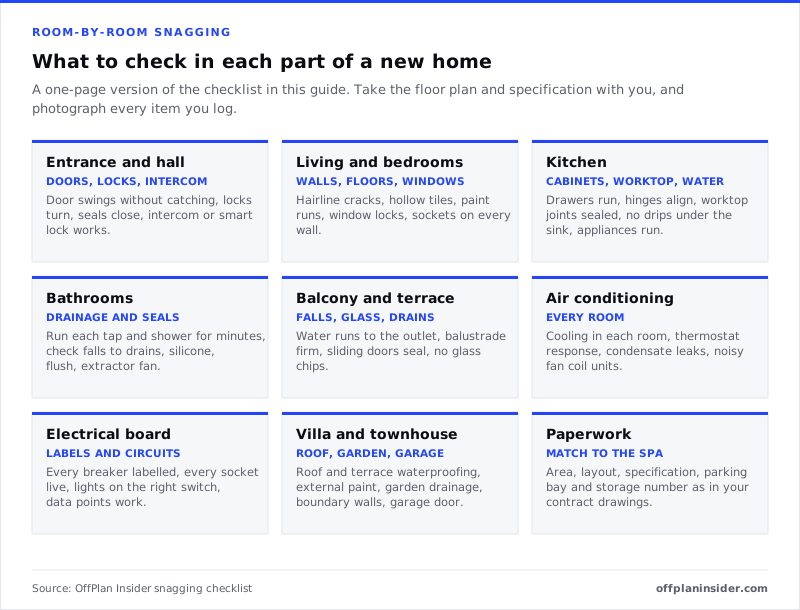
05Room-by-room snagging checklist
Work through the home in the same order every time: from the front door clockwise, then ceilings, then floors. The table below adds the tests to run to the basic checklist in our handover guide.
Entrance, hallway and internal doors
- Open and close every door fully. It should not catch the frame or floor, and it should stay where you leave it.
- Turn every lock and handle, and check that all keys work in the main door.
- Look at the door edges, including the top, for unpainted or unsealed timber.
- Test the intercom, video entry or smart lock, and the doorbell.
- Check that fire doors close by themselves and latch.
Living room and bedrooms
- Shine a torch along walls and ceilings for cracks, bumps, paint runs and patchy areas.
- Tap floor tiles with a coin or knuckle. A hollow sound can mean the tile is not fully bedded and may crack later.
- Check skirting for gaps, and grout lines for missing or uneven grout.
- Open, close and lock every window. Look for scratches on the glass and gaps in the seals.
- Try every socket and every switch, and note which light each switch controls.
- Open wardrobe doors and drawers, and check that rails and shelves are fitted and level.
Kitchen
- Open every cabinet door and drawer. They should align, close softly and not rub.
- Check worktop joints are tight and sealed, and the worktop is level.
- Run the tap hot and cold for several minutes, then look and feel under the sink for drips.
- Switch on every fitted appliance: hob, oven, extractor, fridge, dishwasher and washing machine where supplied. Check models against the specification.
- Check the splashback for cracked or loose tiles, and sealant along the worktop edge.
Bathrooms
- Run every tap and shower for a few minutes. Check pressure, hot water and how fast the water drains.
- Watch where water goes on the shower floor. It should run to the drain, not pool in a corner.
- Flush every toilet and check the cistern refills and stops.
- Look along every silicone joint at the bath, basin, shower tray and floor.
- Check the shower screen is fixed and its seals keep water in.
- Turn on the extractor fan. Check mirrors, accessories and vanity units are firmly fixed.
Balcony, terrace and outside walls
- Pour a bucket of water on the balcony floor and watch it run to the outlet.
- Push on the balustrade. It should be firm with no movement at the fixings.
- Check sliding doors run smoothly, lock and seal along the full height.
- Look for chipped glass, stains and unfinished paint on outside walls you can reach.
Air conditioning and ventilation
- Turn on the cooling in every room and wait. Each room should cool, and each thermostat should respond.
- Listen for rattles and humming from fan coil units in the ceiling.
- Look around ceiling grilles and access panels for water stains, which can point to condensate leaks.
- Check filters and grilles are clean and access panels open.
Electrical board, lighting and data
- Check that every breaker on the distribution board is labelled.
- Test every socket, including those in cupboards and on balconies.
- Check light fittings work and are fixed, and that outdoor lights are weather-sealed.
- Check data, TV and telephone points against the plan.
Plumbing, water heater and hidden areas
- Find the main water isolation valve and check it turns.
- Check the water heater works and has no leaks around it.
- Open every cupboard that hides pipes and look for damp, stains or drips.
- Check the washing machine connection and drain.
Fire and life safety
- Check smoke detectors are fitted where the plan shows them.
- Make sure sprinkler heads are uncovered and not painted over.
- Check that the fire escape route from your unit is clear.
Villa and townhouse extras
- Look at the roof and any terraces for ponding water and cracked waterproofing.
- Walk the outside walls for cracks and paint defects.
- Check garden levels slope away from the house, and drains are clear.
- Test the garage door, gate and any boundary walls and fences.
- Check external taps, lighting and any pool equipment the developer supplied.
Measurements and paperwork
- Measure the main rooms and compare them with the SPA drawings.
- Check the parking bay number, storage room and any keys, cards and remote controls listed for your unit.
- Collect manuals and warranty cards for appliances, air conditioning and the water heater.
06How do you write a snag list the developer will act on?
Write one defect per line with a number, room, exact location, description and photograph. A clear list gets fixed faster than a long email, and it gives you something to check off at re-inspection.
| No. | Room | Location | Defect | Type | Priority |
|---|---|---|---|---|---|
| 1 | Bathroom 1 | Under the basin | Drip from waste trap when the tap runs | Defective work | Urgent |
| 2 | Living room | Floor, 1 m from balcony door | Two tiles sound hollow when tapped | Defective work | Before move-in |
| 3 | Bedroom 2 | Wardrobe, left door | Door rubs the frame and does not close | Poor finish | Before move-in |
| 4 | Kitchen | Worktop joint by the hob | Joint open and unsealed | Incomplete work | Before move-in |
| 5 | Balcony | Floor by the outlet | Water pools and does not drain | Defective work | Urgent |
Be specific. "Bathroom leak" is hard to act on. "Bathroom 1, drip from the basin waste trap when the tap runs" sends the right trade to the right place.
Use one numbering system. Put the same number on the tape in the room, on the photograph and on the list. It saves time for everyone at re-inspection.
Keep the original. Save the list and photographs with the date. If a dispute arises later, a dated record made before handover is your best evidence.
07How do you report snags to the developer?
Send the list in writing through the developer's handover or customer care channel, and ask for a reference number, a written acknowledgement of every item and a target date. Then re-inspect and close items one by one.
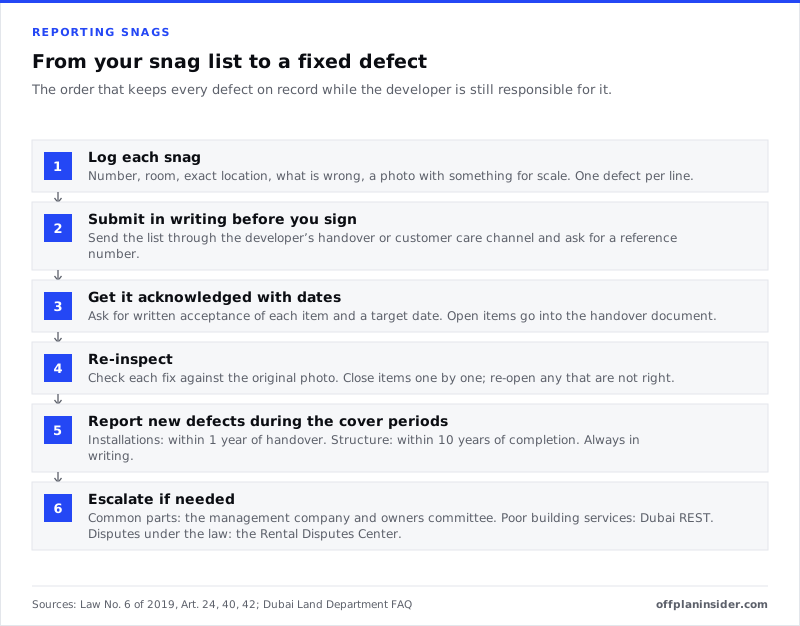
Before you sign. Do not sign a handover acceptance that says the unit is accepted in perfect condition if your list is still open. Ask for the open items to be written into the handover document, or attach the list and have it signed.
Re-inspection. When the developer says the work is done, check each item against your photograph. Close the ones that are fixed and re-open the ones that are not, with a note of what is still wrong.
Keep it in one thread. Use the same reference number and the same email chain for every follow-up. A single thread is easier to escalate than a string of phone calls.
08What is the defects liability period in Dubai?
The defects liability period is the time after handover during which the developer must repair defects. Under Article 40 of Law No. 6 of 2019, it is ten years from the completion certificate for structural defects and one year from handover of the unit for defective installations.

What the law says, in plain terms:
- Structural parts: 10 years. Article 40(a) keeps the developer liable for ten years from the date it obtains the completion certificate to remedy defects in the structural parts of the property. The law lists main supports, foundations and columns among the structural components.
- Installations: 1 year. Article 40(b) keeps the developer liable for one year from handover of the unit to the owner to repair or replace defective installations. It names mechanical and electrical works, sanitary and sewerage installations and similar installations.
- Late possession. If an owner does not take possession for any reason, the one-year period starts from the completion certificate instead. Delaying the keys does not extend your cover; it shortens it.
- Other rights kept. Article 40(c) says the law does not take away rights or warranties an owner has under other legislation.
- No contracting out. Article 40(d) makes any agreement that contradicts these periods void.
Finishes and contract warranties. Paint, joinery, tiling and similar finishes are not named in Article 40. They are covered by the warranty in your SPA, which varies by developer. Read that clause before handover so you know what is covered and for how long.
The 5% escrow retention. Article 14 of Law No. 8 of 2007 requires 5% of the project's escrow account to be held back after the completion certificate. The Dubai Land Department describes this as a way to address defects promptly. It is released one year after the units are registered in buyers' names. The wider escrow rules are in our escrow law guide.
09How do you report defects after handover?
Report each defect to the developer in writing as soon as you notice it, with the date and photographs, and keep every reply. Use the same reference system as your original snag list.
Inside your unit. Leaks, faulty sockets, air-conditioning faults and similar installation problems go to the developer's customer care team during the first year after handover. After that year, structural problems such as significant cracking in the frame remain the developer's responsibility for ten years from the completion certificate.
In the common parts. Lifts, lobbies, pools, car parks and the building's outside walls are managed by the building's management entity under Law No. 6 of 2019. Report common-area defects to the management company, which deals with the developer. If the management company does not act, the building's owners committee can take a complaint to RERA after 14 days under Article 24.
Note the dates. Write down the date you first saw each defect. If the developer later argues that a problem appeared after the one-year installations period, a dated report made inside the period is your answer.
Ten-month check. A useful habit is a second full inspection about ten months after handover. It catches slow leaks, cracking and air-conditioning faults that only show after a summer, and leaves time to report them inside the one-year period.
10What if the developer does not fix the snags?
Keep the issue in writing, escalate within the developer first, and then use the official routes. Most snag disagreements are settled at the first or second step.
- Escalate inside the developer. Ask for the customer care manager or the handover team leader, and quote your reference number.
- Involve the management company for anything in the common parts, and the owners committee if the management company does not respond.
- Complain about building services. The Dubai Land Department says complaints about poor services or maintenance can be filed through the Dubai REST app through the Real Estate Violations System. Our Dubai REST app guide shows where to find it.
- Take legal advice and consider a claim. Article 42 of Law No. 6 of 2019 gives the Rental Disputes Center exclusive jurisdiction over disputes under the law. Its first-instance lawsuit service for jointly owned property lists a process service fee of AED 100, plus AED 10 knowledge and AED 10 innovation fees. Check the full cost of a claim with the centre before you file.
How RERA, the Dubai Land Department and the Rental Disputes Center fit together is set out in our guide to RERA in Dubai, and the wider protections for off-plan buyers are in our buyer protection guide.
11Should you hire a professional snagging company?
Hire one if you are not confident testing a home yourself, if the home is large or a villa, or if you will not be in Dubai for handover. For a small apartment, a careful owner with the checklist above can cover most of it.
| Do it yourself | Snagging company | |
|---|---|---|
| Cost | Your time and a few simple tools | A fee set by the company; ask for a written quote |
| Tools | Torch, socket tester, level, tape, bucket | Adds moisture meters and thermal imaging |
| Report | Your own list and photographs | A formatted report developers are used to |
| Re-inspection | You go back yourself | Often included or offered as an add-on |
| Best for | Studios and small apartments, owners in Dubai | Villas, townhouses, large units, owners abroad |
What to ask a snagging company. What equipment it uses, whether a re-inspection is included, how soon the report is delivered, and whether it will attend the handover. Ask for a sample report so you can see how defects are written up.
Check access first. Some developers set rules on who may inspect and when. Confirm with the developer that your snagging company can attend on the booked date.
12Snagging an apartment, a townhouse and a villa: what changes?
The method is the same, but the list grows with the home. An apartment's main risks are inside the unit; a villa adds a roof, a garden and everything outside the walls.
| Home type | Pay extra attention to | Shared with the building or community |
|---|---|---|
| Apartment | Wet areas, balcony drainage, air conditioning, finishes, windows | Lifts, corridors, car park, pool and gym, outside walls |
| Townhouse | Roof terrace waterproofing, stairs and balustrades, small garden drainage | Community roads, landscaping, shared amenities |
| Villa | Roof, external walls and paint, garden levels, boundary walls, garage door, any pool equipment supplied | Community roads, parks, perimeter walls and gates |
If you are still choosing the type of home, our villas, townhouses and apartments pages list current off-plan projects by type.
13Common snagging mistakes to avoid
Most problems come from rushing or from a list that is too vague to act on. These are the mistakes buyers make most often.
- Snagging in the evening. Poor light hides paint and plaster defects. Book a daytime slot.
- Looking, not testing. A tap that looks fine may leak after two minutes. Run water, power and cooling.
- Skipping ceilings and cupboards. Water stains around ceiling grilles and in sink cupboards are early signs of leaks.
- Signing "accepted in full". If items are open, write them into the handover document.
- Starting fit-out before re-inspection. New damage from contractors blurs the record.
- Forgetting the one-year mark. Diary a full re-check before the installations period ends.
- Losing the paper trail. Keep one thread, one reference number and dated photographs.
14Where to go next
If your building is close to completion, read the handover guide for the payments, documents and keys that sit around the inspection. Running costs start at handover, so check how Dubai service charges are set and checked, and think about home insurance for the day you take the keys.
Still choosing a home? Browse projects near handover, or by year: handover in 2026 and 2027.
FAQQuestions buyers ask.
What is snagging in Dubai?
Snagging is the inspection of a new home for defects before you accept it from the developer. You or a snagging company check every room and system against the sale and purchase agreement, list each defect in writing with photographs, and send the list to the developer to fix. You then re-inspect before or soon after handover.
Is snagging mandatory in Dubai?
No. No Dubai law requires a buyer to snag a new home, and no government body carries out the inspection for you. It is the buyer's practical protection: a written defects list made before you sign the handover acceptance is the clearest record that the problems were there when the developer delivered the unit.
Can I do snagging myself or should I hire a company?
You can do it yourself with a torch, a phone charger or socket tester, a spirit level, a tape measure, a bucket of water and your floor plan. A professional snagging company adds equipment such as thermal cameras and moisture meters and a formatted report. Hiring one is common for villas, large units and owners who live abroad.
What is the defects liability period in Dubai?
Article 40 of Law No. 6 of 2019 makes the developer liable for ten years from the completion certificate to remedy defects in the structural parts of a jointly owned property, and for one year from handover of the unit to repair or replace defective installations such as mechanical, electrical, sanitary and sewerage works. Agreements that contradict these periods are void.
Can I refuse handover because of snags?
That depends on your sale and purchase agreement. Most contracts treat minor defects as items to fix after handover rather than a reason to refuse the keys, and many say the unit is treated as handed over if you do not complete in time. Record every snag in the handover documents instead of delaying, and take legal advice if a defect makes the home unusable.
How long does the developer take to fix snags in Dubai?
No law sets a deadline for fixing individual snags. The timing is agreed with the developer, which is why you should ask for a written target date against each item. Simple items such as sealant or adjustments are usually quicker than those that need parts or specialist trades, so agree dates item by item.
What if a defect appears after handover?
Report it to the developer in writing as soon as you notice it, with photographs and the date. Defective installations are the developer's to fix within one year of handover, and structural defects within ten years of the completion certificate. Problems in common areas go to the building's management company.
Where do I complain if the developer does not fix defects?
Start with the developer's customer care team in writing and keep every reply. Law No. 6 of 2019 gives the Rental Disputes Center exclusive jurisdiction over disputes under that law. Complaints about poor building services or maintenance by a management company can be filed through the Dubai REST app.
Sources & methodWhere these figures come from.
Sources
- Dubai Legislation Portal: Law No. (6) of 2019 Concerning Ownership of Jointly Owned Real Property in the Emirate of Dubai
- Dubai Legislation Portal: Law No. (8) of 2007
- Dubai Land Department: Frequently asked questions
- rdc.gov.ae: Register first instance lawsuit ownership of jointly owned real properties
What we could not verify
- No official source sets a deadline for a developer to fix individual snags, a standard snagging window before handover, or a right to refuse handover because of snags; these depend on each sale and purchase agreement and are described as contract matters.
- Warranties on finishes such as paint, joinery and tiling, and any defects cover longer than the periods in Article 40 of Law No. 6 of 2019, are contractual and vary by developer.
- The checklist tests, tools and the practice of using professional snagging companies are general building-inspection practice, not an official Dubai standard; we found no Dubai Land Department or Dubai Municipality snagging checklist.
5 Nov 2026 · Reviewed by OffPlan Insider Research. First published 5 Nov 2026.