Owners associations in Dubai no longer run buildings. Law No. 6 of 2019 on jointly owned property repealed the 2007 law that created them and transferred their rights and obligations to management entities: the developer in major projects, a hotel management company in hotel projects, and a management company chosen by RERA in all other buildings. Owners are now represented by an owners committee of up to nine resident owners appointed by RERA, which reviews the budget, checks the manager's work and passes on complaints. The service charge budget is approved by RERA after an audit, not voted on by owners, and invoices are issued through the Mollak system.
Key takeaways
- The term owners association comes from Law No. 27 of 2007. Law No. 6 of 2019 repealed that law and, under Article 49, transferred the associations' rights and obligations to management entities.
- Who manages your building depends on its category under Article 18: the developer in a major project, a hotel management company in a hotel project, and a specialised management company selected by RERA in every other building.
- Owners are represented by an owners committee of up to nine members appointed by RERA. It is formed once 10% of the units are registered to owners, and members must be owners who live in the property.
- The committee reviews and comments on the budget, checks the manager's work, passes on complaints and, in an ordinary building, can ask RERA to replace the management company. It has no vote that approves or rejects the budget.
- Service charges are shared by unit area, approved by RERA after an audit, invoiced through Mollak and paid into a dedicated account that the manager's creditors cannot touch.
- Owners cannot refuse to pay approved charges. Disputes under the law go to the Rental Disputes Settlement Centre, and service complaints can be filed through the Dubai REST app.
01What is an owners association in Dubai?
An owners association was the body that represented the owners of a jointly owned building in Dubai, such as an apartment tower or a gated townhouse cluster, and organised its management. The term comes from Dubai's first strata law, Law No. 27 of 2007.
That law no longer applies. Law No. 6 of 2019 on the ownership of jointly owned real property repealed it, and Article 49 transferred "all rights and obligations of Owners Associations" to management entities. Article 48 gave developers, management entities and owners associations six months to comply with the new rules.
So when an agent, a contract or an older article mentions the owners association, it usually means one of three things today: the management entity that runs the building, the owners committee that represents owners, or the building's service charge arrangements. This guide explains each, and what owners can and cannot control.
The money side is covered in depth in our guide to service charges in Dubai. This guide focuses on governance: who decides, who checks, and where owners have a say.
02Which law governs jointly owned property in Dubai today?
Law No. 6 of 2019 concerning ownership of jointly owned real property in the Emirate of Dubai. It was issued on 4 September 2019 and came into force 60 days after publication. It applies to every master project and jointly owned property in Dubai, including those in free zones and special development zones.
What counts as jointly owned property. The law defines it as a building, its common parts and the land beneath it, or land subdivided into units or plots for individual ownership. That covers apartment buildings, and also villa and townhouse communities where owners share roads, parks and pools.
The key players. The law names five:
| Who | Role under Law No. 6 of 2019 |
|---|---|
| Dubai Land Department (DLD) | Keeps the Jointly Owned Real Property Register, with the plans, owners, committee members, management entities and contracts (Article 4) |
| RERA | The Real Estate Regulatory Agency, part of the DLD. Approves budgets, appoints committees, selects management companies for ordinary buildings, inspects and audits (Articles 18, 22, 27 and 33) |
| Management entity | Runs, maintains and repairs the common parts, collects service charges and holds them in a dedicated account (Articles 18 and 30) |
| Owners committee | Represents owners: checks the manager's work, reviews the budget, passes on complaints (Articles 22 to 24) |
| Master developer | Manages the shared facilities of a master community, through a management company, and collects usage charges (Articles 19 and 26) |
Our guide to RERA in Dubai explains where the regulator sits within the Dubai Land Department.
03Who manages a Dubai building now that owners associations have gone?
A management entity. Which one depends on how the building is classified under Article 18 of Law No. 6 of 2019: a major project, a hotel project, or everything else.
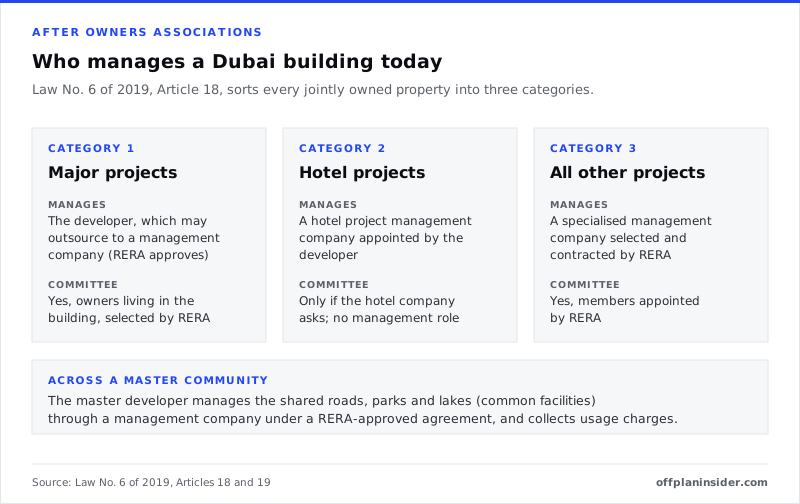
Category 1: major projects. Buildings designated as major projects under criteria set by the DLD's Director General. The developer manages the common parts and utility services. It may outsource the work to a management company for an agreed fee, under an agreement approved by RERA. The owners committee is made up of owners living in the property, selected by RERA.
Category 2: hotel projects. Properties whose units are licensed for use as a hotel establishment, including hotel apartments and hotel villas. The developer must outsource management of the common parts to a hotel project management company. An owners committee is formed only if that company wishes, and it may not take part in managing the hotel or its common parts. If you are looking at serviced apartments or a branded residence with a hotel licence, this is the category to ask about.
Category 3: everything else. Management is carried out by a specialised management company selected and contracted by RERA. The owners committee is appointed by RERA. Where a property mixes hotel and ordinary units, the common parts go to the hotel management company and there is a single owners committee.
Building rules. Every building has a building management regulation, which sets out how the common parts are maintained and each owner's share of the costs. Under Article 20, the developer issues it for major and hotel projects and RERA must approve it before any unit is sold; RERA issues it for other buildings. Under Article 6, it forms part of the title deed.
If the manager fails. In a major or hotel project, RERA's chief executive may appoint a specialised management company if the developer or hotel company is proven unable to manage (Article 37). In an ordinary building, RERA may replace the management company (Article 38). Every management entity must lodge a bank guarantee with the DLD, which can be used to repair damage caused by its negligence (Article 36).
04What does the owners committee do?
It represents owners. It does not manage the building or approve the budget; it checks the manager, reviews the budget and takes owners' concerns to the manager and to RERA.
Article 24 says the committee "will exclusively":
- Verify that the management entity manages, operates, maintains and repairs the common parts in line with the law and the building management regulation.
- Review the annual maintenance budgets and make recommendations, and for this purpose ask for the property's financial reports.
- Discuss problems with management and maintenance, and recommend solutions to the management entity or RERA.
- Receive owners' and occupants' complaints and suggestions, pass them to the management entity, and take them to RERA if they are not dealt with within 14 days.
- In an ordinary (Category 3) building, ask RERA to replace the management entity and advise on a new one.
- Notify the management entity or RERA of structural defects, or damage to common parts that needs urgent repair.
- Coordinate with RERA, the manager or the authorities on safety, environmental and security matters.
- Propose how the common parts are used, or changes to the building management regulation, which RERA must approve.
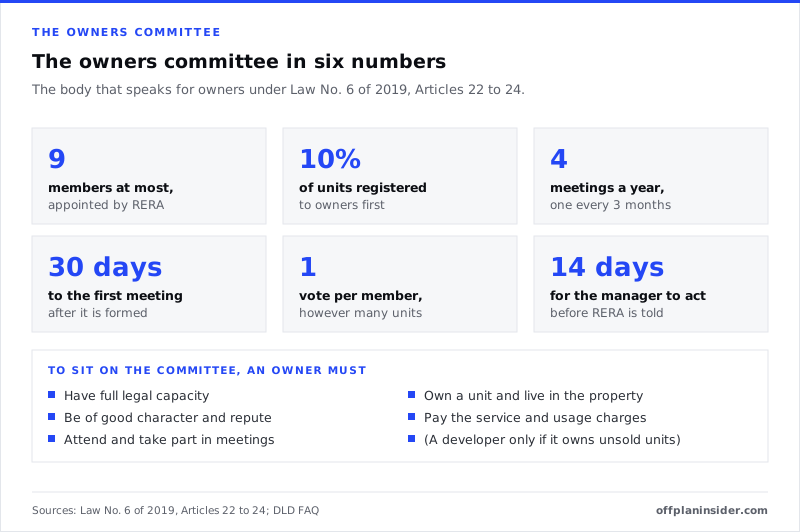
How it is formed. Under Article 22, the committee is constituted once at least 10% of the units are registered in owners' names on the Real Property Register. In an off-plan building that happens only after completion, when title deeds are issued. It has up to nine members, including a chairman and vice chairman, appointed by RERA. The committee elects its chairman, who represents it before the management entity and RERA.
Who can sit on it. A member must have full legal capacity, be an owner living in the property, be of good character and repute, pay the service and usage charges, and attend and take part in meetings. A developer may be a member only if it owns unsold units. A member who stops meeting a condition loses the seat and RERA appoints a replacement. RERA may reconstitute the committee at any time.
How it meets and votes. Under Article 23 the committee meets every three months, four times a year, with its first meeting within 30 days of being formed. A meeting is valid if a majority attends, including the chairman or vice chairman. Each member has one vote, however many units they own, and the chair has a casting vote. Extraordinary meetings are allowed with advance notice to RERA. The management entity provides the venue and a rapporteur to take minutes.
05Is there still a general assembly of owners?
No. Law No. 6 of 2019 does not provide for a general assembly of all owners, and it gives owners no vote that approves a budget or appoints a manager.
That is the clearest difference from the old system. Under the 2007 law, owners were organised into owners associations, and older guides describe owners meeting to decide on the association's business. Since 2019, owners' influence runs through four channels instead:
- The owners committee, for budget review, oversight and complaints.
- RERA, which approves budgets, audits accounts and inspects buildings.
- The Dubai REST app, where owners can file complaints about poor services and maintenance through the Real Estate Violations System, as the DLD's published answers describe.
- The Rental Disputes Settlement Centre, which under Article 42 has exclusive jurisdiction over disputes about the rights and obligations in the law.
If you read about owner votes, quorums for a general assembly or budgets "passed by the owners", check the date. It is likely to describe the pre-2019 rules.
06How is the service charge budget set, and can owners change it?
The management entity prepares the budget, an audit firm recognised by RERA approves it, and RERA approves it. Owners cannot vote it up or down, but the committee reviews it and makes recommendations, and nothing may be collected until RERA has approved it.
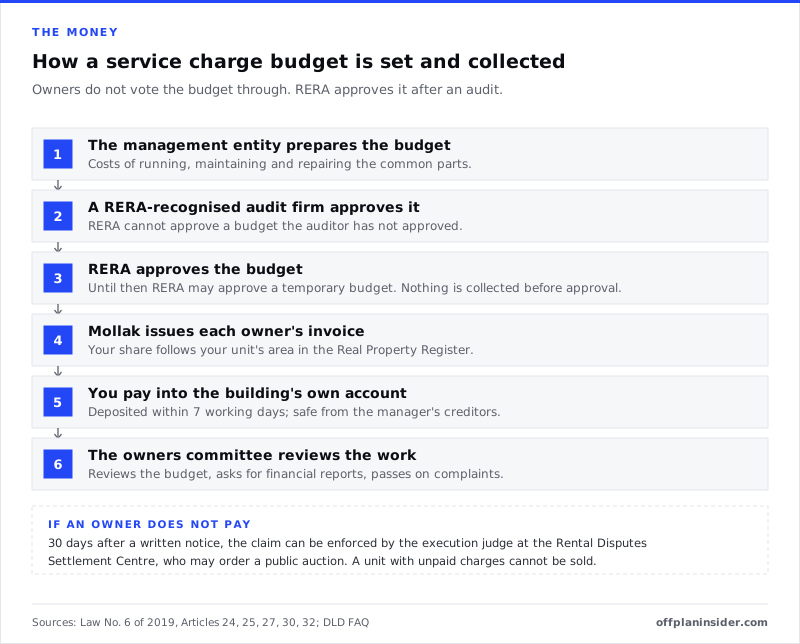
Approval. Article 27 says a management entity must not charge or collect any amount from owners for the common parts or facilities, "or for any other reason", without RERA's approval. RERA may not approve a budget unless a certified audit firm recognised by RERA has approved it first. Where necessary, RERA may approve a temporary budget in the meantime.
Your share. Article 25 sets each owner's share by the ratio of the unit's area to the total area of the property, using the area recorded in the Real Property Register. The DLD explains that you can work out your charge by taking the approved rate from its Service Charge Index and multiplying it by your unit's area.
What it pays for. Article 30 limits spending from the service charge account to listed purposes: cleaning, security and safety, operation and maintenance of the common parts, building insurance, audit fees, management fees as set by RERA, the developer's approved administrative costs in major projects, a reserve fund, RERA's inspection fees and other costs approved by RERA. The DLD's published list adds utility bills for the common areas and master community usage charges.
The reserve fund. The law requires a cash reserve for emergencies and for replacing equipment. It is kept in a separate account and may not be used, other than in a critical emergency, without RERA's approval. If it is not enough, the DLD may ask owners to cover emergency costs, with RERA's prior approval.
Insurance. Under Article 41 the management entity must insure the building against fire, damage and destruction, and against liability for injury to occupants and third parties. The premiums are included in the service charges. Cover for your own contents is separate; see our guide to home insurance in Dubai.
Usage charges. In a master community, the master developer may also collect usage charges from owners for the shared facilities, such as roads, parks and lakes, under Article 26. These need RERA's approval too, are held in a separate account and are protected from the master developer's creditors.
07What is Mollak, and how do owners use it?
Mollak is the Dubai Land Department's system for jointly owned property. The department says its main objective is to apply governance to jointly owned properties, regulate management companies and monitor service charges.
What runs through it. According to the DLD, Mollak is used to register management companies and their staff, management contracts, statutory auditors and banks; to register each building; to open its regulatory bank account; to request approval of service charges; and to issue service charge invoices to owners through approved payment channels.
What owners see. You receive an email or text message from Mollak when an invoice is issued. You pay into the RERA-approved account printed on the invoice, using the approved electronic channels. If you pay by direct transfer to that account, the DLD says you must send the payment slip to your management company.
Checking a rate. The Service Charge Index, on the DLD website and in the Dubai REST app, shows the approved rate for a project by master project, project, use and year. It is the simplest way to compare buildings before you buy.
08What can owners decide, and what can they not?
Owners have rights over their own unit and a voice through the committee and the regulator. They do not run the common parts or approve the budget.
| Question | Who decides | What owners can do |
|---|---|---|
| The annual service charge budget | RERA, after an audit | Review and recommend through the committee; ask for financial reports |
| Who manages the building | The developer, hotel company or RERA, by category | In an ordinary building, the committee can ask RERA to replace the manager |
| Contracts for cleaning, security and maintenance | The management entity, audited by RERA | Raise poor service through the committee or Dubai REST |
| Changes to the building rules | RERA approves | The committee can propose amendments |
| Converting or selling common parts | Needs DLD and competent authority approval | Object through the committee or RERA |
| Major alterations to your unit's structure or facade | The master developer, DLD and competent authority | Apply for approval before any work |
| Selling, letting or mortgaging your unit | You | Free to do so, subject to the building rules and unpaid charges |
| Paying approved charges | Compulsory | You cannot refuse, or give up your share of the common parts to avoid them |
Your unit. Article 12 lets an owner sell, dispose of or mortgage a unit freely. Article 16 lets an owner lease it, with both owner and tenant bound by the building rules. Unless the lease says otherwise, the owner pays the service charges, and an owner is never released if the tenant fails to pay. Our guide to property management in Dubai covers letting.
Your share of the common parts. Under Article 11, each owner owns an undivided interest in the common parts, in proportion to the unit's area. Parking bays designated to a unit are part of it and cannot be sold separately (Article 10).
Alterations. Under Article 39, substantial changes to the structure or external appearance of a unit, or to any part of the property, need the approval of the master developer, the DLD and the competent authority. An owner who goes ahead without it pays to put things right.
Access to records. Article 4 says any interested party may access the Jointly Owned Real Property Register and ask the DLD for certificates and documents from it.
Protection from pressure. Article 29 bars a developer or management entity from stopping an owner using the unit, the common parts or the facilities in order to force payment outside the legal procedure. The DLD's answers say owners whose services are cut off can complain through Dubai REST.
09What happens if owners do not pay?
The management entity follows a court procedure, not its own sanctions. Owners cannot refuse approved charges, and a unit with unpaid charges cannot be sold until they are cleared.
Under Article 32, the management entity has a lien on each unit for unpaid service charges. It must give the owner a written notice, in a form approved by RERA, allowing 30 days to pay. After that, its claim can be enforced by the execution judge at the Rental Disputes Settlement Centre, who may order the unit sold at public auction. A defaulting owner also bears the court and legal costs awarded. The same rules apply to usage charges owed to a master developer.
This matters to buyers as well as owners. On a resale, Article 32 means the seller must clear the service charges before the unit can be transferred, so ask for a clearance early. See our guide to the Rental Disputes Centre for how claims there work.
10How is RERA involved after handover?
RERA is the referee. It approves budgets, appoints committees, audits the service charge accounts, inspects buildings and can step in when a building is not maintained.
Under Article 33, RERA may inspect the property and its common parts, record violations, audit the revenue and spending of the service charge and usage charge accounts, consider complaints against developers, managers or committees, and audit the manager's contracts. Under Article 34, every management entity must send RERA a report on its management and maintenance every six months.
If common parts are not kept in good condition, RERA can serve a notice listing the works and dates (Article 35). If the manager does not comply, RERA may appoint another entity and charge the cost to the service charge or usage charge account. Violations of the law carry fines of not less than AED 1,000,000, doubling for a repeat within a year, up to AED 2,000,000 (Article 44).
Decisions taken under the law can be challenged. Under Article 46, an affected party may submit a written grievance to the DLD's Director General within 30 days of being notified, and a committee decides it within 30 days.
11What should an off-plan buyer ask about building management?
Ask before you buy, because the category, the manager and the likely service charge all shape your running costs. Until the owners committee is formed after completion, the developer handles management and holds service charges in the building's account (Article 30).
- Which category will the building be? A major project, a hotel project or an ordinary building. It decides who manages it and whether there will be an owners committee with an oversight role.
- Who will manage it? The developer, its management company or a company appointed by RERA.
- What is the estimated service charge, and on what area? Compare it with the approved rates of finished buildings nearby in the Service Charge Index.
- Are there usage charges? In a master community, ask for the master developer's charge as well as the building's.
- Is there a developer-paid period? Some sale contracts include one; Article 25 makes the developer pay where it has agreed to.
- Can I see the building management regulation and master community declaration? They will form part of your title deed.
- Is short-term letting allowed? The building rules and the master community declaration can restrict it; see our guide to holiday homes in Dubai.
The clauses to read in the contract itself are in our guide to the off-plan SPA. For the full set of costs from booking to resale, including service charges, see the true cost of buying off-plan in Dubai.
12What changes at handover?
At handover, the building moves from a construction site to a managed property. It is registered on Mollak, a budget is audited and approved, a service charge account is opened and the management contracts begin.
Service charges usually start at handover of your unit, unless your sale contract gives a developer-paid period. Ask which budget has been approved and what period your first invoice covers. The owners committee follows once 10% of units are registered to their owners. The developer remains liable for structural defects for ten years from the completion certificate and for defective installations for one year from handover of the unit (Article 40). The committee is one of the channels for reporting structural defects or urgent repairs.
Our handover guide covers the inspection, payments and keys, and our guide to the title deed covers registration.
13How is it different in Abu Dhabi and the other emirates?
The idea of shared ownership is the same, but the law and the systems in this guide are Dubai's. Law No. 6 of 2019, RERA, Mollak and the Rental Disputes Settlement Centre do not apply outside Dubai.
Each emirate has its own regulator and rules for jointly owned property. In Abu Dhabi, the regulator is the Abu Dhabi Real Estate Centre (ADREC). Before you buy elsewhere, ask the developer who will manage the building, how service charges are approved, and which authority handles disputes.
14Key terms
- Owners association. The body that represented owners under Dubai's 2007 strata law. Its rights and obligations passed to management entities in 2019.
- Management entity. The developer, management company or hotel project management company that runs the common parts.
- Owners committee. Up to nine resident owners appointed by RERA to oversee the manager, review the budget and pass on complaints.
- Common parts. The parts of a building or plot for shared use: structure, lobbies, lifts, pools, car park aisles and services.
- Common facilities. Shared facilities in a master community, such as roads, parks and lakes, managed by the master developer.
- Service charges. Annual charges for running and maintaining the jointly owned property, approved by RERA.
- Usage charges. Annual charges collected by a master developer for the common facilities of a master community.
- Building management regulation. The rules for maintaining the common parts and sharing their costs, part of the title deed.
- Master community declaration. The rules for developing and running a master community, approved by RERA.
- Mollak. The DLD's system for registering managers and buildings, approving budgets and invoicing owners.
15Where to go next
For the numbers behind the system, read our guide to service charges in Dubai. To plan the full cost of owning, see the true cost of buying off-plan. If you are comparing buildings, browse off-plan projects in Dubai and ask each developer which category its building will be and who will manage it.
FAQQuestions buyers ask.
What is an owners association in Dubai?
An owners association was the body that represented and managed a jointly owned building under Dubai's 2007 strata law, Law No. 27 of 2007. That law was repealed by Law No. 6 of 2019, which transferred the associations' rights and obligations to management entities. Today owners are represented by an owners committee appointed by RERA, and the building is run by a management entity.
Do owners associations still exist in Dubai?
Not as the body that runs a building. Article 49 of Law No. 6 of 2019 transferred all rights and obligations of owners associations to management entities, and Article 51 repealed the 2007 law that created them. People still say owners association, often meaning the owners committee or the management company, but the legal structure has changed.
Who is responsible for managing my building in Dubai?
The management entity. In a major project it is the developer, which may outsource the work to a management company with RERA's approval. In a hotel project it is a hotel project management company. In every other building it is a specialised management company selected and contracted by RERA. The master developer manages shared community facilities such as roads and parks.
Can owners vote on service charges in Dubai?
Not directly. The management entity prepares the budget, a RERA-recognised audit firm approves it and RERA then approves it. The owners committee reviews the budget and makes recommendations, and it can ask for the property's financial reports. No owner may refuse to pay a charge RERA has approved, and no manager may collect anything RERA has not approved.
How do I become a member of the owners committee?
Members are appointed or selected by RERA. To qualify you must have full legal capacity, own a unit and live in the property, be of good character, pay your service and usage charges, and attend and take part in meetings. The committee has up to nine members and is formed once at least 10% of units are registered to owners. Ask the management company how to register your interest.
Can owners change the management company in Dubai?
In an ordinary building, the owners committee can ask RERA to replace the management company and advise on its successor. RERA then follows a set procedure: it consults the committee, warns the company, has the service charge account audited and gives 30 days for handover. In a major or hotel project, RERA may appoint a management company if the developer or hotel company proves unable to manage.
What is Mollak?
Mollak is the Dubai Land Department's system for jointly owned property. The department says its aim is to apply governance to jointly owned properties, regulate management companies and monitor service charges. Management companies, contracts, auditors and buildings are registered on it, budgets are submitted for approval through it, and owners receive their service charge invoices from it by email or text message.
What happens if an owner does not pay service charges?
The management entity serves a written notice approved by RERA giving 30 days to pay. After that its claim can be enforced by the execution judge at the Rental Disputes Settlement Centre, who may order the unit sold at auction. The manager has a lien on the unit, so it cannot be sold until the charges are paid. The manager may not block access to the unit to force payment.
Is there a general assembly of owners in Dubai?
Law No. 6 of 2019 does not provide for a general assembly of all owners. Owners' views are channelled through the owners committee, which meets every three months, and through complaints to the management entity, RERA and the Rental Disputes Settlement Centre. References to general assemblies and owner votes on budgets describe the system before 2019.
Sources & methodWhere these figures come from.
Sources
- Dubai Legislation Portal: Law No. (6) of 2019 Concerning Ownership of Jointly Owned Real Property in the Emirate of Dubai
- Dubai Land Department: Frequently asked questions
- Dubai Land Department: Service charge index overview
- Dubai Legislation Portal: Law No. (13) of 2008
What we could not verify
- The repealed Law No. 27 of 2007 could not be opened on the Dubai Legislation Portal, so how owners associations and their general assemblies worked before 2019 is described only in outline, from what Law No. 6 of 2019 says about them.
- The Director General resolutions that set the criteria for a major project, and the owners committee Statute issued by RERA, were not opened. Which category a given building falls into, and the committee's detailed rules, should be confirmed with the management company or RERA.
- How an owner applies to join an owners committee, and whether this is done through Mollak, the Dubai REST app or the management company, was not confirmed on an official page; the text tells readers to ask the management company.
7 Nov 2026 · Reviewed by OffPlan Insider Research. First published 7 Nov 2026.