Property management in Dubai means handing your home to a licensed company that finds tenants, registers leases on Ejari, collects rent and arranges repairs for a fee. A company managing other people's homes needs the Dubai Land Department's third-party leasing and management licence, which carries an annual fee of AED 15,000 and a bank guarantee of AED 5 million, and the owner-manager contract is registered on Ejari free of charge. Fees are set by each company, so compare how they are worked out, not just the headline. Holiday-home management is a separate activity licensed by the Department of Economy and Tourism.
Key takeaways
- A property manager runs your unit for you: marketing, tenant checks, the lease and Ejari, rent collection, repairs, renewals and statements. The building's common parts are run separately by the management entity under Law No. 6 of 2019.
- Managing other owners' homes is a licensed real estate activity. The Dubai Land Department lists third-party property leasing and management with an annual fee of AED 15,000 plus AED 20 and a bank guarantee of AED 5 million.
- Building and community management is a different licence, administrative supervision for owners' associations, with its staff registered with RERA. Check that a company holds the licence that matches the job.
- The contract between owner and manager is registered on Ejari by the company. The Dubai Land Department lists the service as free, taking about 10 minutes.
- No regulator sets property management fees. Companies charge a share of rent collected, a fixed fee, letting and renewal fees, or a mix, and VAT at 5% applies. Ask for every charge in writing.
- Holiday-home management needs a Department of Economy and Tourism operator licence and a permit for each home. The permit fee in law is AED 300 per bedroom, up to AED 1,200 a year.
- Whoever manages the home, the owner stays responsible for service charges and for the landlord's duties under Dubai's tenancy law.
01What is property management in Dubai?
Property management in Dubai is a service in which a licensed company runs your home as a rental on your behalf. It finds and checks tenants, registers the lease, collects the rent, arranges repairs and reports to you, for a fee set in a written agreement.
It is useful to separate three kinds of management that Dubai owners meet:
- Unit management. A company runs your individual home as a long-term rental. This is what most owners mean by property management, and it is the main subject of this guide.
- Building and community management. A management entity runs the common parts of the building or community for all owners, paid from service charges. You do not choose it individually.
- Holiday-home management. A licensed operator lets your home by the night, under a separate set of rules from the Department of Economy and Tourism (DET).
Each has its own licence and its own regulator. Knowing which is which helps you check that a company is allowed to do the job you are hiring it for.
02What does a property manager do?
A manager takes on the landlord's day-to-day work: letting the home, keeping it let and looking after it. What is included depends on the agreement you sign, so read the scope line by line.
A full long-term management service typically covers:
- Preparing the home. Inspection, a condition report with photographs, and any work needed before marketing.
- Marketing and viewings. Advertising the home and showing it to prospective tenants.
- Tenant checks. Checking identity, residence status and ability to pay.
- The lease. Drafting the Unified Tenancy Contract, agreeing additional terms, and registering it on Ejari.
- Move-in. Handing over keys and access cards, recording meter readings and helping the tenant open a DEWA account.
- Rent collection. Collecting cheques or transfers, banking them and chasing late payments.
- Maintenance. Arranging repairs, within an agreed spending limit, and dealing with the building management on common-area issues.
- Renewals and notices. Agreeing renewal terms, serving notices within the legal deadlines, and registering the renewal.
- Move-out. Inspecting against the condition report, settling the deposit and preparing for the next tenant.
- Reporting. Regular statements of rent received and costs paid, with receipts.
What a manager does not control. The building's service charges, its maintenance contracts and its common-area rules belong to the building's management entity. A manager can raise issues with it for you, but cannot change them.
03Who regulates property managers in Dubai?
The Real Estate Regulatory Agency (RERA), part of the Dubai Land Department (DLD), regulates real estate activities in Dubai, including leasing and managing property for others. Holiday homes are regulated by the Department of Economy and Tourism.
RERA's wider role, from escrow to service charges, is covered in our RERA guide. For property management, three things matter to an owner: the company's licence, the registered management contract, and the tenancy rules the company must follow on your behalf.
04Which licence does a property management company need?
A company that manages other owners' homes needs the DLD's third-party property leasing and management licence. Building management and private management of one's own homes are separate licences.
The Dubai Land Department's real estate licensing service lists 21 real estate activities. The ones that matter for management are:
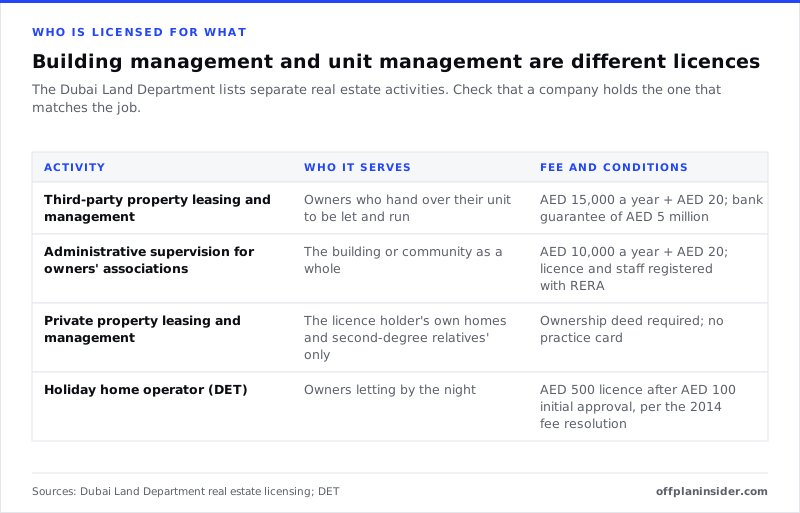
Third-party property leasing and management. This is the licence for managing homes you own. The DLD lists an annual fee of AED 15,000 plus a AED 20 knowledge and innovation fee, and requires a bank guarantee of AED 5 million. A branch must trade under the same name as the parent licence and have at least 20 administrative employees.
Administrative supervision services for owners' associations. This is the licence for managing jointly owned buildings and communities. The DLD lists an annual fee of AED 10,000 plus AED 20, and the company must register its licence and relevant staff with RERA. Staff need registration cards before they practise, and the department's registration service for these companies runs through Mollak.
Private property leasing and management. This lets the licence holder manage only their own properties and those of second-degree relatives, under Local Order No. 2 of 2003. The applicant provides a copy of the ownership deed, and no practice card is needed. It is not a licence to manage homes for the public.
How to check a company. Ask for its trade licence and its DLD licence numbers, and check them through the Dubai Land Department's services or the Dubai REST app. Make sure the activity on the licence is third-party leasing and management, not only brokerage. A leasing broker can find you a tenant for a fee; ongoing management is a different activity.
05How is a management agreement registered?
The management company registers the contract on Ejari, the DLD's tenancy system. The department lists the service as free, taking about 10 minutes, and it issues the registered contract by email.
The DLD's service for registering and renewing a real estate management contract sets these conditions:
- The company must hold a licence for a real estate activity related to tenancy, and have a user authorised on the system.
- The applicant must be the owner, or a representative under an official power of attorney or a signed management contract.
- The document is a copy of the management contract signed between the owner and the company.
Registration puts the relationship on record. It lets the company act for you in Ejari, for example in registering tenancy contracts on your home. When the agreement ends, make sure the registration is ended too.
06What should a management agreement say?
Everything you would argue about later: what the company does, what it charges, how it spends your money and how either side can end the agreement. The law does not set a standard form, so the agreement is where your protection lies.
A checklist of terms:
- The parties and the property. Your name, the company's licensed name and licence number, and the unit, with title deed or Oqood details.
- Scope. Each service included, and each service charged separately.
- Fees. How every fee is worked out, when it is due and whether VAT is included.
- Spending limit. The amount of a single repair the company may approve without asking you, and how emergencies are handled.
- Contractors. Whether the company uses its own team or third parties, and whether it adds a mark-up.
- Rent handling. Where rent is banked, how cheques are held, and how quickly your share is paid to you.
- Statements. How often you get them and what they show.
- Tenant selection. Whether you approve each tenant and the rent before the lease is signed.
- Authority. What the company may sign for you, such as leases, renewals and notices, and what needs your written consent.
- Service charges. Whether the company pays them from rent on your behalf.
- Term and exit. The length of the agreement, how it renews, the notice to end it, and what happens to a tenant the company placed.
- Records and keys. Return of keys, deposits and documents when the agreement ends.
Keep a signed copy and the Ejari registration together with your title deed.
07How are property management fees structured?
There is no official fee scale for property management in Dubai. Each company sets its own charges, so compare how fees are worked out and what they cover.
The common structures are:
- A share of rent collected. The fee is a percentage of the rent the company actually collects, so it falls if the home is empty.
- A fixed annual fee. A set amount per year, regardless of rent.
- A letting fee. A one-off charge when a new tenant is found and the lease is signed.
- A renewal fee. A charge when an existing lease is renewed.
- Charges for extras. Inspections, move-in and move-out reports, key handling, attending handover or snagging, furnishing, or dealing with disputes.
- Maintenance. Repairs billed at cost, or with a mark-up, or covered by an annual maintenance plan.
- Holiday homes. Operators commonly take a share of booking revenue, with cleaning, linen and platform commissions charged separately.
VAT applies. Management is a service, so the UAE's standard VAT rate of 5% applies to fees from a VAT-registered company. Ask whether a quoted fee includes VAT.
Compare like for like. A lower headline fee with separate charges for letting, renewals and inspections can cost more over two years than a higher all-in fee. Ask each company for a written estimate of total charges over a typical two-year lease cycle, including one change of tenant.
Fees and tax. If you own in your own name and let without a licence, the Federal Tax Authority treats your rent as real estate investment income, outside corporate tax, whether or not you use a manager. Our guide to property tax in Dubai explains when that changes.
08How do long-term management and holiday-home management differ?
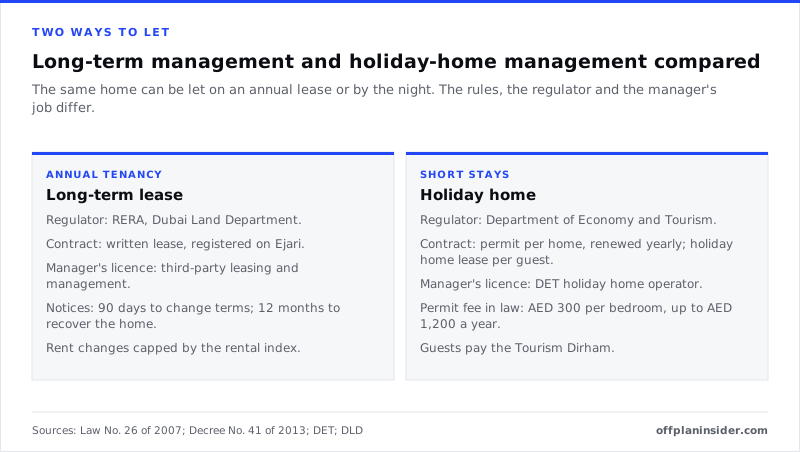
They are two different activities with different regulators, licences and contracts. A long-term lease is regulated by RERA and registered on Ejari; a holiday home is licensed by DET with a yearly permit for each home.
Long-term management
The home is let on an annual tenancy under Law No. 26 of 2007, as amended. The lease must be in writing and registered on Ejari. The manager acts for you within the law's rules:
- Maintenance. Under Article 16, maintenance falls on the landlord unless the lease says otherwise.
- Deposit. Article 20 lets a landlord take a deposit to secure the condition of the home, returned at the end of the lease.
- Changing terms. Notice at least 90 days before expiry to change the rent or terms at renewal, under Article 14.
- Recovering the home. At least 12 months' notice, by notary public or registered mail, for the reasons set in Article 25(2), such as a sale or the owner moving in.
- Rent increases at renewal are capped by Decree No. 43 of 2013 and the rental index; see our rental index guide.
Our Ejari guide covers registration, fees and these dates in full.
Holiday-home management
Under Decree No. 41 of 2013, nobody may let holiday homes in Dubai without a licence from DET, and each home needs a holiday home permit renewed every year. An owner can register their own home on DET's Holiday Homes system, within a limit set by DET, or appoint a licensed holiday home operator.
The holiday-home manager's job is different from a long-term manager's:
- Permits. Applying for and renewing the permit for each home.
- Guests. Bookings, check-in, cleaning, linen and guest support around the clock.
- Contracts. A holiday home lease with each guest, and the permit number in every advert.
- The Tourism Dirham. Collecting it from guests per occupied room per night.
- Records. Keeping guest records and reporting them as DET requires.
Fees in law. Executive Council Resolution No. 49 of 2014 sets the permit fee at AED 300 per bedroom, up to AED 1,200 per home a year, and the operator licence at AED 500 after an AED 100 initial approval. Dubai's economic incentives package of 21 May 2026 exempts holiday home permit and licence fees for a period DET sets, so check the fee shown when you apply.
Holiday homes are not on Ejari. A holiday let is not an annual tenancy, and the guest does not get a tenant's rights under the tenancy law. Our holiday homes guide covers which homes qualify, the operator's duties and the fines.
Which to choose. A long-term lease gives a steady rent with less day-to-day work. A holiday home needs more management, more furnishing and more costs, and its income changes with the season. Your building's rules and your sale and purchase agreement also decide whether holiday-home use is possible.
09How do I appoint a property manager?
Check the licence, agree the terms in writing, have the contract registered on Ejari, then hand over. The steps below are for long-term letting.
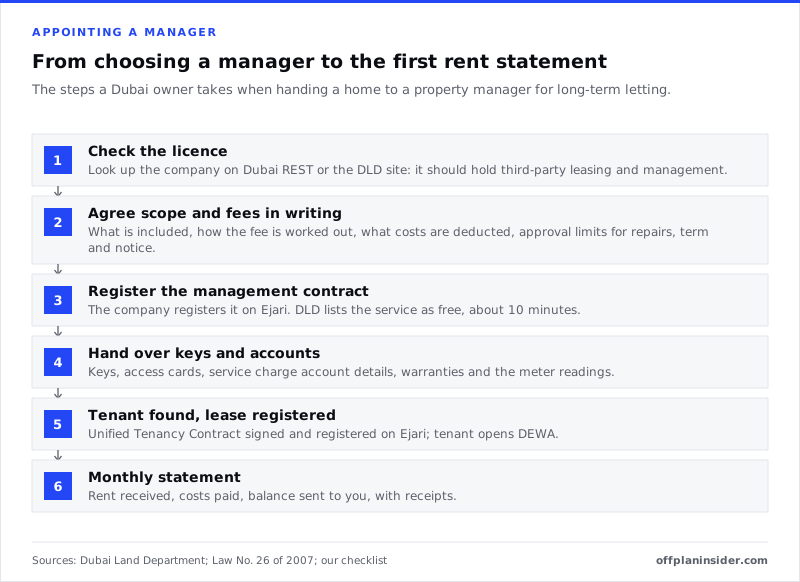
- Shortlist and check licences. Two or three companies, each holding third-party leasing and management.
- Compare written proposals. Scope, every fee, VAT, spending limits and exit terms.
- Sign the agreement and ask the company to register it on Ejari.
- Hand over. Keys, access cards, parking and storage details, appliance warranties, and the service charge account details.
- Approve the tenant and rent before the lease is signed, if your agreement gives you that right.
- Check the Ejari registration of the tenancy and the tenant's DEWA account, so the tenant pays utilities and the housing fee.
- Review the first statement against the lease and receipts.
10What if I bought off-plan?
A manager can start at handover. Many overseas owners appoint one to attend the inspection, follow up the snagging list, open the utility accounts and prepare the home for its first tenant.
Agree in writing what the manager will do at handover and what it will charge for it. The handover itself, including payments and the defects period, is covered in our handover guide. A lease cannot be registered on Ejari before handover, because the unit has to be completed and set up for tenancy registration first, so plan the first tenancy for after you have the keys.
If you are still choosing, our ready projects and near-handover projects pages list homes that can be let soon.
11What stays the owner's responsibility?
Some duties cannot be handed to a manager, because the law places them on the owner.
- Service charges. Law No. 6 of 2019 says an owner may not refuse to pay approved service charges, and remains liable even where a lease says the tenant pays. A manager can pay them for you; the liability is yours. Our service charges guide explains how they are set.
- The landlord's legal obligations. The manager acts as your agent, so a missed notice or an unregistered lease is still your problem. Keep copies of every notice and registration.
- Your consent to subletting and holiday use. A tenant may not sublet without your written consent under Article 24 of the tenancy law.
- Tax at home. Rent from Dubai may be taxed where you are tax resident.
12Self-managing or using a company?
Both are lawful. An owner can let their own home and register the lease on Ejari, including through the DubaiNow app. The choice is about time, distance and how much you want to be involved.
| Question | Managing it yourself | Using a licensed manager |
|---|---|---|
| Who finds the tenant | You, or a leasing broker for a fee | The manager |
| Who registers Ejari | You, on DubaiNow or the DLD channels | The manager, for you |
| Who handles repairs | You, with your own contractors | The manager, within an agreed limit |
| Who tracks notice dates | You | The manager, under the agreement |
| What it costs | Your time, and any broker's fee | The fees in the agreement, plus VAT |
| Best suited to | Owners living in or near Dubai | Owners abroad, or with several homes |
13Key terms
- Third-party property leasing and management. The DLD licence for managing homes owned by others.
- Administrative supervision services. The DLD licence for managing jointly owned buildings and communities.
- Management entity. The body that manages a building's common parts under Law No. 6 of 2019.
- Management contract. The agreement between owner and manager, registered on Ejari.
- Holiday home operator. A company licensed by DET to let holiday homes.
- Holiday home permit. DET's yearly permit for each home let by the night.
14Where to go next
Read our guides to Ejari, holiday homes and service charges, then the true cost of buying off-plan. To find a home to let, browse all off-plan projects or ready projects.
FAQQuestions buyers ask.
What does a property management company do in Dubai?
It runs your home as a rental for you. That usually covers marketing, viewing and checking tenants, drafting the tenancy contract and registering it on Ejari, collecting rent and cheques, arranging maintenance and repairs, handling renewals and notices, and sending you statements. The exact scope is whatever your management agreement says.
Do property managers in Dubai need a licence?
Yes. The Dubai Land Department lists third-party property leasing and management as a licensed real estate activity, with an annual fee of AED 15,000 plus AED 20 and a bank guarantee of AED 5 million. A separate licence, private property leasing and management, covers only the licence holder's own homes and those of second-degree relatives.
How much does property management cost in Dubai?
There is no official fee scale; each company sets its own. Common structures are a percentage of rent collected, a fixed annual fee, a one-off letting fee when a tenant is found, and renewal fees, with VAT at 5% on top. Compare what is included, what is charged extra and how repairs are billed, not just the headline rate.
Is a property management contract registered in Dubai?
Yes. The Dubai Land Department's Ejari system has a service for registering and renewing the management contract between an owner and a management company. The company applies with a copy of the signed contract; the department lists it as free, taking about 10 minutes, and issues the registered contract by email.
What is the difference between property management and building management in Dubai?
Property management runs your individual unit as a rental and works for you. Building management runs the common parts, such as lifts, pools, security and cleaning, for all owners, under Law No. 6 of 2019, and is paid from RERA-approved service charges. Your property manager deals with the building manager on your behalf but does not control the service charge.
Do I need a licence to manage a holiday home in Dubai?
Yes. Under Decree No. 41 of 2013, letting holiday homes needs a licence from the Department of Economy and Tourism, and each home needs a yearly holiday home permit. An owner can register their own home, within a limit set by the department, or appoint a licensed holiday home operator.
Can I manage my Dubai rental property myself from abroad?
Yes. An owner can let their own home, sign the lease and register it on Ejari, including through the DubaiNow app. From abroad, the day-to-day work of viewings, repairs and inspections is harder, which is why many overseas owners appoint a licensed manager or give someone a power of attorney.
Who pays service charges if a property manager runs my home?
You do. Law No. 6 of 2019 makes the owner liable for approved service charges, even where a lease passes them on. A manager can pay them from the rent on your behalf if the agreement says so, but the liability stays with the owner.
Sources & methodWhere these figures come from.
Sources
- Dubai Land Department: Real estate licensing application
- Dubai Land Department: Request to register renew property management contract
- Dubai Land Department: Request to register a real estate company for the activity of administrative supervision of the jointly owned properties
- Dubai Land Department: Register renew ejari contract
- Dubai Legislation Portal: Law No. (26) of 2007
- Dubai Legislation Portal: Law No. (33) of 2008 Amending Law No. (26) of 2007
- Dubai Legislation Portal: Law No. (6) of 2019 Concerning Ownership of Jointly Owned Real Property in the Emirate of Dubai
- Dubai Legislation Portal: Decree No. (41) of 2013
- Dubai Legislation Portal: Administrative Resolution No. (1) of 2020.pdf
- Dubai Legislation Portal: Executive Council Resolution No. (49) of 2014
- mediaoffice.ae: Hamdan bin mohammed
- dubaidet.gov.ae: Register as a holiday home operator
- tax.gov.ae: Real Estate Investment for natural persons 22 10 2024.pdf
- UAE Government portal: Corporate tax
What we could not verify
- No regulator publishes a scale of property management fees in Dubai, so the guide describes fee structures without percentages or amounts; owners should get every charge in writing.
- The Dubai Land Department's licensing page was read on 5 November 2026; whether the AED 5 million bank guarantee applies to every third-party leasing and management licence, or can differ for branches and existing licensees, should be confirmed with the department.
- We did not open the department's public lookup for licensed companies; the guide tells owners to check a company's licence through the Dubai Land Department or the Dubai REST app and to ask for its licence numbers.
5 Nov 2026 · Reviewed by OffPlan Insider Research. First published 5 Nov 2026.