The Dubai rental index is the Dubai Land Department's official measure of average rents for similar homes, and Decree No. 43 of 2013 uses it to cap rent increases at renewal. If the current rent is up to 10% below the index average, the rent cannot rise; the cap then steps up to 5%, 10%, 15% and a maximum of 20% for rents more than 40% below the average. The landlord must also give at least 90 days' notice before the lease expires.
Key takeaways
- The rental index is the Dubai Land Department's measure of the average rent for similar units. Its online calculator gives the permitted increase for a specific home in seconds.
- Under Decree No. 43 of 2013 there is no increase if the rent is up to 10% below the index average. The cap is 5% at 11% to 20% below, 10% at 21% to 30%, 15% at 31% to 40% and 20% at more than 40% below.
- The percentage applies to the current rent, not to the average. A rent at or above the average falls outside every band, so it cannot be raised at renewal.
- A landlord who wants a higher rent or new terms must give notice at least 90 days before the lease expires, under Article 14 of Law No. 26 of 2007 as amended.
- The Smart Rental Index, launched on 2 January 2025, adds a building classification to the average, so two buildings in the same area can have different benchmarks.
- If landlord and tenant cannot agree, either can ask the Rental Disputes Centre to set a fair rent. For off-plan investors, rent on a sitting tenant rises only in steps.
01What is the rental index in Dubai?
The rental index is the Dubai Land Department's official measure of what similar homes rent for, by area, property type and size. It is the benchmark the law uses to decide how much a landlord may raise the rent when a lease is renewed.
The rule that links the two is Decree No. 43 of 2013 Determining Rent Increase for Real Property in the Emirate of Dubai. Article 3 says the average rent for similar units is set by the rent index approved by RERA, the Real Estate Regulatory Agency within the Dubai Land Department.
For tenants the index is a protection against sudden rises. For landlords, and for anyone buying an off-plan home to let, it decides how quickly income from a sitting tenant can move with the market.
This guide explains the rules for homes let on annual leases. It is general information, not legal advice.
02How much can rent rise in Dubai?
It depends on the gap between the current rent and the index average for similar units. The closer the rent already is to the average, the smaller the permitted increase, and the cap never goes above 20%.
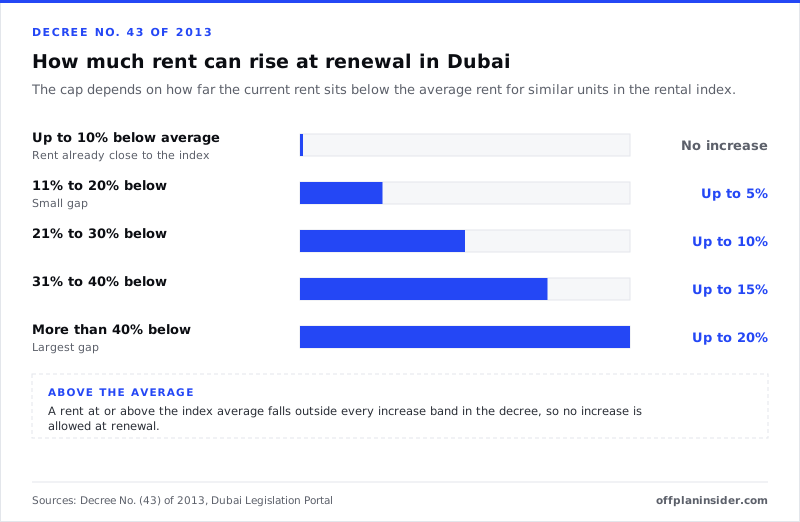
Article 1 of the decree sets the maximum increase when a lease is renewed:
| Current rent compared with the index average | Maximum increase at renewal |
|---|---|
| Up to 10% below | No increase |
| 11% to 20% below | 5% of the current rent |
| 21% to 30% below | 10% of the current rent |
| 31% to 40% below | 15% of the current rent |
| More than 40% below | 20% of the current rent |
What the table does not include. There is no band for a rent at or above the average. A rent at that level falls outside every increase band, so the decree allows no increase at renewal.
Who it covers. Article 2 applies the decree to all landlords in Dubai, private or public, including those in special development zones and free zones such as the Dubai International Financial Centre. It came into force when it was issued, on 18 December 2013.
03How is the increase worked out? Three examples
The percentage is applied to the tenant's current rent, not to the average. The steps are: find the average, measure the gap, read the band and apply the percentage.
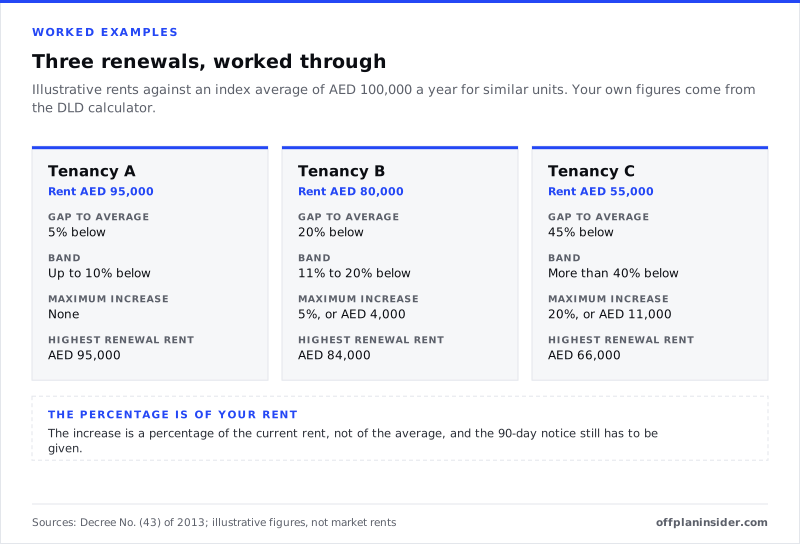
Take an illustrative index average of AED 100,000 a year for similar units:
- Tenancy A pays AED 95,000. That is 5% below the average, inside the first band. No increase is allowed, so the renewal rent stays at AED 95,000.
- Tenancy B pays AED 80,000. That is 20% below the average, in the 11% to 20% band. The cap is 5% of AED 80,000, which is AED 4,000, so the highest renewal rent is AED 84,000.
- Tenancy C pays AED 55,000. That is 45% below the average, in the top band. The cap is 20% of AED 55,000, which is AED 11,000, so the highest renewal rent is AED 66,000.
Notice what happens in Tenancy C. Even at the maximum increase, the rent is still well below the average, so the gap closes over several renewals, not in one step.
Between bands. The decree's bands are written in whole percentages. If your gap falls between two of them, rely on the calculator's result rather than your own rounding.
04How do I use the Dubai Land Department's rental index calculator?
The Rental Index service gives the average rent for similar units and the permitted increase for a specific tenancy. It is free to use and the result is immediate.
The service is available on the Dubai Land Department website, the Ejari system, the Dubai REST app and the DubaiNow app. You enter:
- The tenancy contract's expiry date.
- The property type, for example an apartment or a villa.
- The area, as the department names it.
- The number of rooms.
- The current annual rent.
The screen then shows the average rent for comparable homes and the increase allowed. Save or screenshot the result, with the date, before you send or reply to a renewal notice.
Check close to the date. The index is updated, so the figure that counts is the one that applies when the lease is renewed. Check again shortly before you give notice.
05What is the Smart Rental Index?
It is the current version of the index, launched by the Dubai Land Department on 2 January 2025. It uses artificial intelligence and a building classification system, so the benchmark reflects the building as well as the area.
The department lists the factors that shape a building's valuation:
- Technical and structural characteristics.
- The quality of finishes and maintenance.
- Location and spatial value.
- Services and facilities, such as maintenance, cleanliness and parking management.
- Real estate market conditions.
It covers all residential areas in Dubai, including the main districts, special development zones and free zones. The department has said commercial and industrial indexes will follow.
What it means for owners. Two buildings in the same district can now have different averages. A well-kept building with good facilities can support a higher benchmark, which in turn affects how much the rent on a sitting tenant can rise.
What it means for off-plan buyers. A new building's management, maintenance and facilities feed into its classification once it is complete and let. Ask the developer which facility management arrangements are planned, and check the approved service charge after handover.
06When must a landlord give notice of a rent increase?
At least 90 days before the lease expires, unless the lease says otherwise. That rule comes from Article 14 of Law No. 26 of 2007, as replaced by Law No. 33 of 2008.
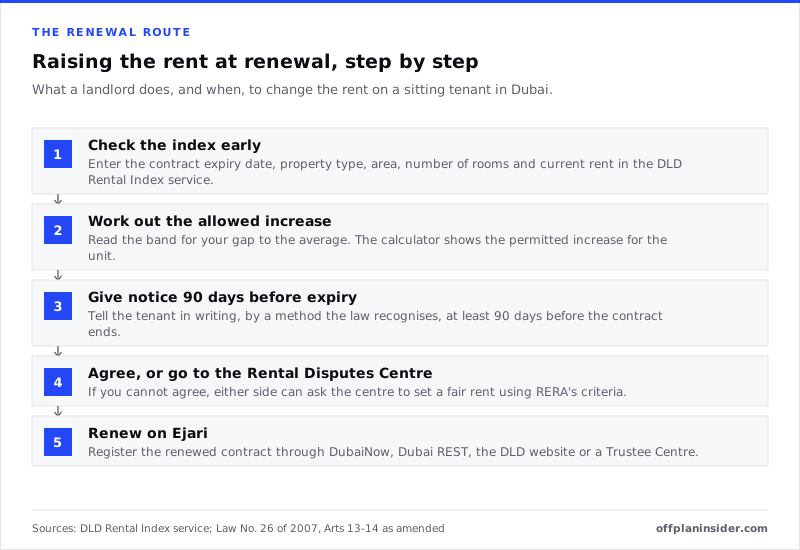
Article 13 lets landlord and tenant change the terms or revisit the rent before the lease ends. Article 14 then requires the party who wants the change to notify the other at least 90 days before expiry.
How to give notice. The law's definition of notice covers a notary public, registered mail, hand delivery and other legally approved electronic means. Use a method you can prove, and keep a copy with the date.
If notice is late or missing. The change cannot be imposed at that renewal. If the tenant stays on and the landlord does not object, Article 6 renews the lease on the same terms for the original term or one year, whichever is shorter.
Tenants can give notice too. A tenant who wants to leave at expiry, or to ask for a lower rent, should use the same 90-day window.
07What if landlord and tenant cannot agree?
Either party can take the matter to the Rental Disputes Centre. Under Article 13, if the parties do not agree on the renewal rent, the tribunal may set a fair rent.
Article 9, as replaced in 2008, lists what the tribunal weighs: RERA's criteria for rent increases, the state of the economy, the condition of the property, the average rents of similar properties nearby, and other relevant factors. In practice the rental index is the starting point.
Before filing, try to settle it. Put your figures in writing, include the calculator result, and propose a date. Many cases close by agreement; our report on how quickly Dubai rental disputes are settled has the centre's figures.
08Can rent go down at renewal?
Yes, by agreement. Article 13 lets either side revisit the rent before expiry, and nothing in the law limits renewal to an increase.
When the market softens, a tenant may ask for a lower rent, especially if similar homes are being let for less. Our coverage of the market, including Dubai rents in Q3 2026, shows how quickly conditions change between renewals.
09What does the rental index not cover?
The decree caps increases at renewal for a sitting tenant. Several things fall outside it, and owners often confuse them.
| Situation | Does the Decree No. 43 cap apply? | What applies instead |
|---|---|---|
| Renewing with the same tenant | Yes | The five bands, plus 90 days' notice |
| A new lease with a new tenant | No | Rent agreed between the parties |
| A rent cut at renewal | No | Agreement, or the Rental Disputes Centre |
| Holiday homes let by the night | No | Department of Economy and Tourism permit rules |
| Service charges | No | Paid by the owner under the RERA-approved budget |
| Homes in Abu Dhabi or Sharjah | No | Each emirate's own tenancy law |
New tenancies. Because the decree applies "when renewing" a lease, a landlord letting to a new tenant agrees the rent with that tenant. That is why a vacant home can be let at the current market level while a sitting tenant's rent catches up in steps.
Ending a lease to reset the rent. The law does not let a landlord end a lease at expiry simply to charge a new tenant more. Article 25(2) lists the only grounds for recovering a home at expiry, such as a sale or the owner's own use, each with 12 months' notice. Our Ejari guide sets them out.
10What does this mean if you are buying off-plan to let?
Plan rental income in two stages: the first lease after handover, set at the market, and later renewals, which move only within the index bands. Do not assume a sitting tenant's rent will rise in line with the market.
The first lease. It starts after handover, once the home is registered and the lease is on Ejari. The rent is agreed with your first tenant, and checking the index for similar homes in the area is a good guide to what is realistic.
Renewals. If market rents rise, the increase on that tenant is capped by the band their rent falls into. If market rents fall, a tenant may ask for less.
Costs that do not move with rent. Service charges, maintenance and any management fee come out of the rent whatever happens at renewal. Our guide to the true cost of buying off-plan sets out the running costs, and our rental yield guide shows how rents compare between communities.
If you are still choosing, compare homes marketed for rental income, and those already completed on our ready projects page.
11How does the rental index connect to Ejari?
Ejari is where the rent you agree is recorded, and the index is what decides how far it can move. Every renewal is registered on Ejari with the new rent, so the registered contract always shows the figure in force.
That is why the Rental Index service sits alongside the Ejari service on the Dubai Land Department website, Dubai REST and DubaiNow. Check the index, agree the rent, then register the renewal; on DubaiNow the landlord enters the renewed terms and the tenant accepts and pays the AED 177.75 fee.
If a renewal is not registered, the record still shows the old contract. Keep the two in step, and keep the calculator result with your copy of the renewal.
12What should a tenant check before agreeing to a rise?
Four things: the band, the notice, the arithmetic and the paperwork. A tenant who checks them can answer a renewal letter with confidence.
- The band. Run the calculator with your own current rent and contract expiry date. The result shows the increase allowed, if any.
- The notice. Check the date the notice reached you. If it arrived less than 90 days before expiry, and your lease does not set a different period, the change cannot be imposed at this renewal.
- The arithmetic. The increase is a percentage of your current rent. A 5% cap on AED 80,000 is AED 4,000, not 5% of the average.
- The paperwork. Ask for the renewed terms in writing, and make sure the renewal is registered on Ejari.
If the figures do not match, reply in writing with the calculator result and propose the permitted figure. A documented figure is the strongest basis for agreement.
13Common mistakes landlords make at renewal
Most renewal disputes come from timing and arithmetic, not from bad faith. These are the errors that come up most often:
- Sending notice too late. The 90 days run back from the expiry date. A notice sent 60 days out cannot impose a change at that renewal.
- Applying the percentage to the average. The cap is a percentage of the tenant's current rent.
- Using an out-of-date result. The index can change between one renewal and the next. Check it again shortly before you send the notice.
- Quoting the wrong unit type or size. The calculator compares like with like, so enter the correct property type, area and number of rooms.
- Threatening eviction to reset the rent. Recovering a home at expiry needs one of the grounds in Article 25(2) and 12 months' notice. Wanting a higher rent is not one of them.
- Forgetting to register the renewal. The new rent should be on Ejari, not only in an email.
14A renewal checklist for landlords
Work through this list four months before the lease ends.
- Check the index for the unit, using the current annual rent, and save the result.
- Decide what you want: renew as is, change the rent within the band, change other terms, or recover the home on a lawful ground.
- Give written notice at least 90 days before expiry, by a method you can prove. Give 12 months' notice if you need the home back to sell or live in.
- Agree the terms in writing with the tenant.
- Register the renewal on Ejari, through DubaiNow, Dubai REST, the department's website or a Trustee Centre.
- Update the payment schedule and collect any new cheques or transfer details.
- If you cannot agree, consider the Rental Disputes Centre, and keep paying or collecting the current rent in the meantime.
15Key terms
- Rental index. The Dubai Land Department's measure of average rents for similar units, used as the benchmark for increases.
- Smart Rental Index. The version launched on 2 January 2025, which adds a building classification system.
- Decree No. 43 of 2013. The Dubai decree that sets the maximum rent increase at renewal.
- Law No. 26 of 2007. Dubai's landlord and tenant law, amended by Law No. 33 of 2008.
- Rental Disputes Centre. The body that decides disputes between landlords and tenants in Dubai.
- Ejari. The system for registering tenancy contracts, explained in our Ejari guide.
FAQQuestions buyers ask.
What is the rental index in Dubai?
It is the Dubai Land Department's official measure of average rents for similar homes, by area, property type and size. Decree No. 43 of 2013 uses it as the benchmark for rent increases at renewal. You can check it through the department's Rental Index service on its website, the Dubai REST app or the DubaiNow app.
How much can a landlord increase rent in Dubai?
It depends on how far the current rent is below the index average for similar units. Up to 10% below: no increase. 11% to 20% below: up to 5%. 21% to 30% below: up to 10%. 31% to 40% below: up to 15%. More than 40% below: up to 20%. The landlord must also give at least 90 days' notice before the lease expires.
How do I use the Dubai rental increase calculator?
Open the Rental Index service on the Dubai Land Department website, the Dubai REST app or DubaiNow. Enter the contract expiry date, the property type, the area, the number of rooms and the current annual rent. The result shows the average rent for similar units and the permitted increase for that tenancy.
Can my landlord increase the rent without 90 days' notice?
Not at renewal, unless the lease says otherwise. Article 14 of Law No. 26 of 2007, as replaced by Law No. 33 of 2008, requires a party who wants to change the terms, including the rent, to notify the other at least 90 days before the contract expires. Without valid notice the lease renews on its existing terms.
Does the rent cap apply to a new tenant?
The decree applies when a lease is renewed, so it caps increases on a sitting tenant. Rent on a brand new lease with a new tenant is agreed between the parties. Many landlords still check the index before advertising, because it shows what similar homes rent for.
What is the Smart Rental Index?
It is the version of the rental index the Dubai Land Department launched on 2 January 2025. It combines artificial intelligence with a building classification system that takes account of a building's structure, finishes and maintenance, location, services and facilities, and market conditions. It covers all residential areas, including special development zones and free zones.
Can rent go down at renewal in Dubai?
Yes, if both sides agree. Article 13 of the law, as replaced in 2008, lets landlord and tenant revisit the rent before the lease expires. A tenant who wants a lower rent should also give notice at least 90 days before expiry. If they cannot agree, the Rental Disputes Centre can set a fair rent.
What if my landlord asks for more than the rental index allows?
Ask the landlord to check the figure on the Dubai Land Department calculator, and keep the conversation in writing. If you still cannot agree, either party can file a case with the Rental Disputes Centre, which sets a fair rent using RERA's criteria, including the permitted increases.
Does the Dubai rental index apply in Abu Dhabi or Sharjah?
No. Decree No. 43 of 2013 and the Dubai Land Department's rental index apply in the Emirate of Dubai only, including its free zones and special development zones. Abu Dhabi and Sharjah have their own tenancy laws and authorities.
Sources & methodWhere these figures come from.
Sources
- Dubai Legislation Portal: Decree No. (43) of 2013 Determining Rent Increase for Real Property
- Dubai Land Department: Rental index
- Dubai Land Department: Smart rental index announcement
- Dubai Legislation Portal: Law No. (26) of 2007
- Dubai Legislation Portal: Law No. (33) of 2008 Amending Law No. (26) of 2007
- Dubai Land Department: Register renew ejari contract
- Dubai Land Department: Register renew terminate tenancy contract
What we could not verify
- How the calculator treats a rent that sits between two bands, for example 10.5% below the average, is not stated in the decree; the text tells readers to rely on the calculator's result.
- The exact weighting the Smart Rental Index gives to the building classification, and whether a building's rating is visible to tenants, is not published on the Dubai Land Department pages opened; the reported one-to-five star scale from launch coverage is not repeated in the text.
- The Rental Disputes Centre's filing fees and the documents it asks for were not checked on an official page, so no amounts are given.
4 Nov 2026 · Reviewed by OffPlan Insider Research. First published 4 Nov 2026.