Tenant demand in Dubai follows transport, jobs and schools: homes near Metro stations, business districts and free zones, and family communities with schools close by, let most easily. The Dubai Land Department registered about 1.38 million tenancy contracts worth AED 126.4 billion in 2025, and 118,385 new contracts and 135,607 renewals in the first quarter of 2026. What a landlord keeps depends on the running costs: the 4% DLD registration fee at purchase, the RERA-approved service charge for the building, district cooling where it applies, Ejari registration for each lease, and a DET permit for a holiday home. Rent on a sitting tenant can only rise at renewal, within the caps in Decree No. 43 of 2013, and an off-plan home can be let only after handover. Rules and fees checked on official pages on 19 November 2026.
Key takeaways
- Tenant demand follows access to work: Metro lines, main roads, business districts, free zones and schools decide how easily a home lets, more than the building itself.
- The Dubai Land Department registered about 1.38 million tenancy contracts worth AED 126.4 billion in 2025. In Q1 2026 renewals (135,607) outnumbered new contracts (118,385).
- Running costs are set building by building. Check the RERA-approved service charge on the DLD Service Charge Index, and ask whether district cooling is billed separately.
- Every annual lease is registered on Ejari: AED 177.75 online or AED 220 at a Real Estate Trustee Centre.
- Rent on a sitting tenant rises only at renewal, within the Decree No. 43 of 2013 caps tied to the DLD rental index, and only with at least 90 days' notice.
- Letting by the night needs a Department of Economy and Tourism holiday home permit: AED 300 per bedroom, up to AED 1,200 a home a year in law.
- An off-plan home cannot be let until it is handed over, so compare projects on access, supply due nearby and running costs at completion.
Whether a Dubai home lets easily, and what it costs to keep, is decided by a handful of things you can check before you buy. The first is access: how quickly a tenant can reach work, school and the Metro. The second is the running cost of the building, which is set building by building and approved by RERA.
The third is the rules. Dubai caps rent rises on a sitting tenant, registers every lease on Ejari and licenses holiday homes separately. This guide sets out each of those in turn, using official figures only, and what changes when the home is bought off-plan and cannot be let until handover.
01What DLD's registered tenancy contracts show
Every Dubai lease is registered with the Dubai Land Department through Ejari, which makes DLD's contract figures the most complete official view of the rental market. In 2025 DLD registered about 1.38 million tenancy contracts worth AED 126.4 billion, with new leases and renewals almost level at just over 513,000 and 514,000.
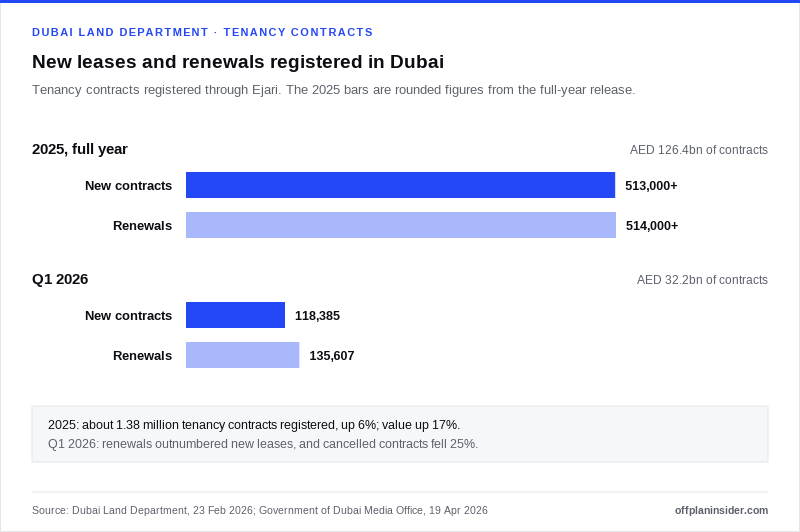
In the first quarter of 2026 renewals pulled ahead: 135,607 against 118,385 new contracts, worth AED 32.2 billion in all, and cancelled contracts fell by 25%. Renewals matter to a landlord because a sitting tenant's rent can only rise within the rent cap, while a new lease is agreed at the rent the market will bear.
02What drives tenant demand by area
Tenants choose a home by the journey it gives them. Four things decide how wide the pool of likely tenants is for a building, and each can be checked on a map before you buy.
- Rail. Homes within walking distance of a Metro station reach far more of the city without a car. The Red Line serves Dubai Marina, Jumeirah Lake Towers, Business Bay and Downtown Dubai, and its Route 2020 branch serves Discovery Gardens, Al Furjan, Dubai Investments Park and Expo City in Dubai South.
- Roads. Communities without rail, such as Jumeirah Village Circle, Arjan and Dubai Sports City, rely on Al Khail Road and Sheikh Mohammed Bin Zayed Road. Peak-hour driving time to the main business districts is the test.
- Jobs. Business districts and free zones bring tenants who want to live close by: DIFC and Business Bay, Dubai Internet City and Dubai Media City beside Dubai Marina and JLT, Dubai Silicon Oasis, and Dubai South around Al Maktoum International Airport.
- Schools and family services. Villa and townhouse communities let to families, who look first at the schools, nurseries and clinics within a short drive.
Rail is changing in the east of the city. The RTA's Dubai Metro Blue Line is under construction, due to open on 9 September 2029, with stations at Dubai Creek Harbour, International City, Dubai Silicon Oasis and Academic City. A planned station is not a working one, so judge a home on the access it has at the time you plan to let it.
Area by area: access, jobs and off-plan projects we track
The notes below cover access and nearby employment, not rents. For registered rents in a specific building, use the DLD rental index described later in this guide.
- Jumeirah Village Circle: between Al Khail Road and Sheikh Mohammed Bin Zayed Road, with no Metro station; a large stock of apartments close to Dubai Marina, Al Barsha and Dubai Hills. Projects include Binghatti Etherea. See every off-plan project in JVC and nearby Arjan.
- Dubai Silicon Oasis: a free zone and residential district on Al Ain Road, with a planned Blue Line station. Projects include Timez by Danube. See Dubai Silicon Oasis.
- Dubai Sports City: beside Motor City off Sheikh Mohammed Bin Zayed Road, with no Metro station. Projects include Aspirz by Danube. See Dubai Sports City.
- Dubai Investments Park: an industrial and business district with a Route 2020 station. Projects include DAMAC Riverside Views and the villa community at Grand Polo Club & Resort. See Dubai Investments Park.
- Al Furjan: a villa and apartment community with its own Route 2020 station. Projects include Sparklz by Danube. See Al Furjan.
- Jumeirah Lake Towers: on the Red Line beside Dubai Marina and the Internet and Media City free zones. Projects include Sobha Central. See Jumeirah Lake Towers.
- Dubai South: around Al Maktoum International Airport and Expo City, with the Expo City station on Route 2020. Projects include Golf Trails in Emaar South and homes in Expo Valley. See Dubai South.
- International City: in the east of the city near Dubai Silicon Oasis, with Blue Line stations planned. Projects include Nest Residence and Crystal Tower by VHS. See International City.
- Business Bay and Downtown Dubai: on the Red Line, next to DIFC and the Dubai Mall district. See Business Bay and Downtown Dubai.
For villas and townhouses, family demand centres on schools and community services. We track Violet 4 Phase 2 townhouses in DAMAC Hills 2, and projects across Dubailand, Tilal Al Ghaf and Mohammed Bin Rashid City. Browse all off-plan apartments, the under AED 1M and AED 1M to 2M bands, or our rental income hub of projects tagged for letting.
03What it costs to buy, run and let a home
What a landlord keeps is the rent less the costs of owning and letting. Some of those costs are fixed by Dubai law or by the authority that sets them; others are agreed privately and differ from one building or agent to the next.
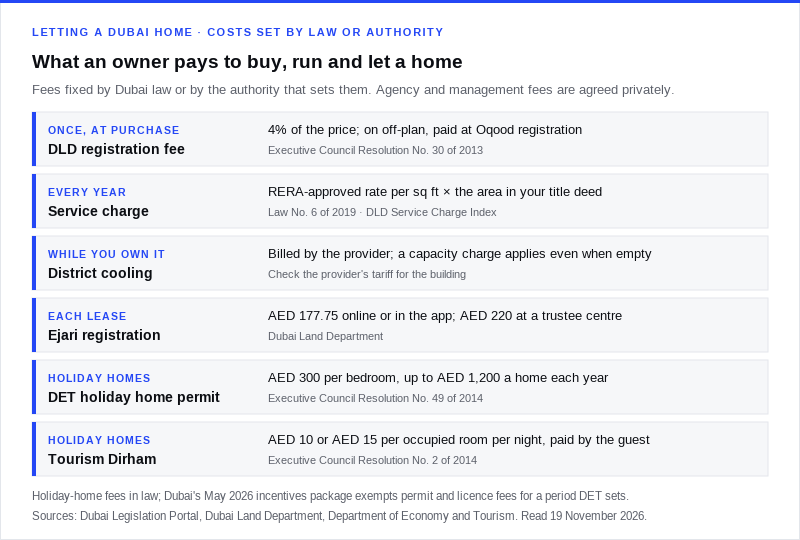
- Purchase. The Dubai Land Department charges a 4% registration fee on the price under Executive Council Resolution No. 30 of 2013. On an off-plan purchase it is paid when the sale is registered on Oqood, and it is not charged again at handover. Our DLD fee guide sets out every line.
- Service charges. Under Law No. 6 of 2019 the annual charges for a jointly owned building are approved by RERA after an audit and collected through Mollak. The DLD Service Charge Index shows the approved rate per square foot for each completed project; multiply it by the area in your title deed. Letting the home does not pass the charge to the tenant. Our service charges guide explains how budgets are set.
- District cooling. Where a building uses district cooling, the provider bills it separately from DEWA and the service charge, and a capacity charge accrues even when the home is empty. Ask which provider serves the building and how it bills.
- Ejari. Every annual lease is registered on Ejari. The Dubai Land Department's fee is AED 177.75 through DubaiNow, the Dubai REST app or its website, and AED 220 at a Real Estate Trustee Centre. Our Ejari guide walks through it.
- Letting and management. Finding a tenant and managing the home are services you agree with a RERA-licensed broker or property manager; there is no fee set in law, so get it in writing.
- Maintenance and insurance. Repairs inside the home, replacements and landlord insurance are the owner's to budget for, along with the weeks between one tenant and the next.
Running costs differ far more between buildings than between areas. Two towers in the same community can carry different service charges because of their amenities, lifts, cooling and age, so compare the specific buildings rather than the district.
04Long-term letting: Ejari, rent caps and notice
An annual tenancy in Dubai is governed by Law No. 26 of 2007, as amended by Law No. 33 of 2008. The lease must be in writing and registered on Ejari, and the rent can change only at renewal.
- Smart Rental Index 2025. The Dubai Land Department launched the Smart Rental Index on 2 January 2025. It rates each building on its structure, finishes and maintenance, location and services, and gives an average rent for similar units. Check it through the DLD rental index service.
- Rent increase caps. Under Decree No. 43 of 2013, still in force in November 2026, the maximum increase at renewal depends on how far the current rent sits below the index average: no increase within 10% of the average, then 5%, 10% and 15% in steps of ten points, and a maximum of 20% when the rent is more than 40% below.
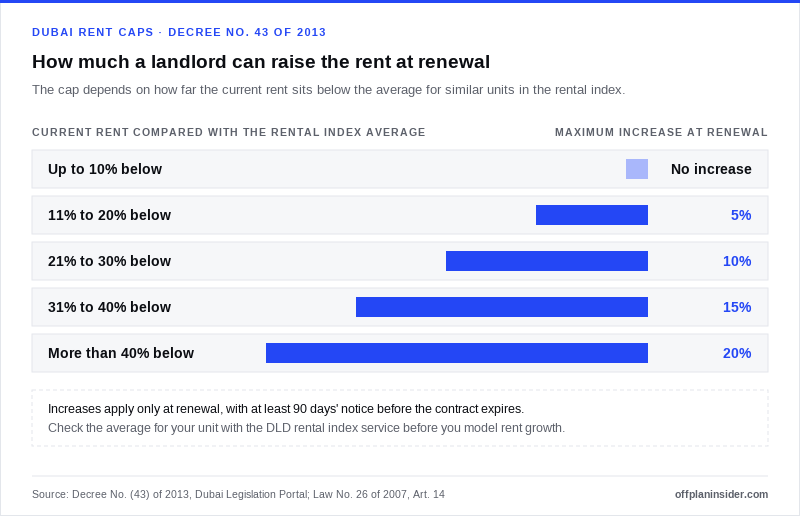
- Notice. Under Article 14 of Law No. 26 of 2007, either party wishing to change the terms of a tenancy, including the rent, must notify the other at least 90 days before the contract expires, unless they have agreed otherwise.
A worked example. A tenant renewing at AED 70,000 where the index average for similar units is AED 85,000 pays about 17.6% below the average, so the landlord can add at most 5%, or AED 3,500. Had the tenant been paying AED 80,000, within 10% of the average, there would be no increase at all.
The practical point for a landlord: rent on a sitting tenant moves only in steps, and only at renewal. Our rental index guide has more worked examples, and the Rental Disputes Centre guide covers what happens when landlord and tenant cannot agree.
05Short-term letting: the DET holiday home rules
Letting a Dubai home by the night is legal, but only as a licensed holiday home, regulated by the Department of Economy and Tourism (DET) under Decree No. 41 of 2013. It is a different regime from an annual tenancy, with its own permit, contract and charges.
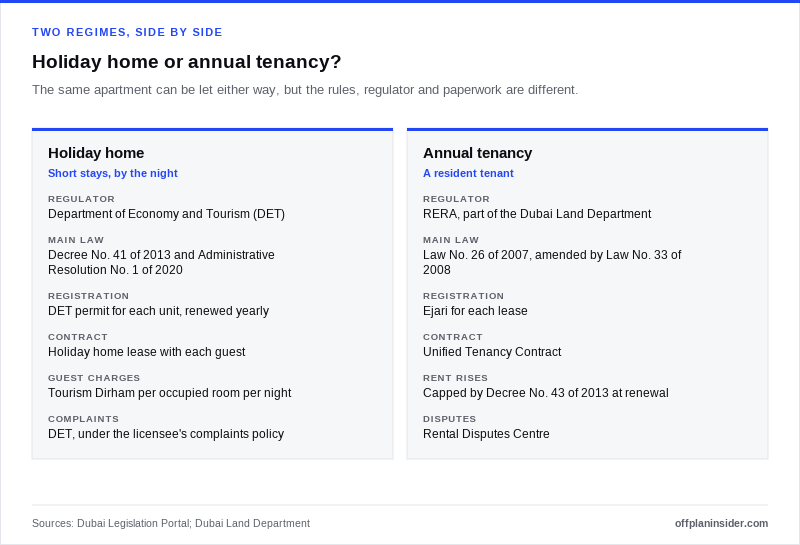
- A permit for each home. The owner registers the home on DET's Holiday Homes system, or appoints a DET-licensed holiday home operator, and obtains a permit that is renewed each year. The fee in law is AED 300 per bedroom, up to AED 1,200 a home a year, and Dubai's May 2026 incentives package exempts permit and licence fees for a period DET sets.
- The home must be complete. DET's listed documents include the title deed, or a sale and purchase agreement with a payment completion certificate, and a current DEWA bill. The sale and purchase agreement must not rule out holiday-home use, so check it before you buy if you plan to let by the night.
- Guest charges. Guests pay a Tourism Dirham of AED 10 per occupied room per night in a standard holiday home and AED 15 in a luxury one.
- Running costs. Furnishing, cleaning, linen, utilities, platform commissions and any operator's fee come out of the income, and occupancy moves with the tourist season.
Our holiday homes guide covers the full permit route, the operator's duties and the fines. The short-term rental hub lists projects where developers market holiday-home use.
06Off-plan: the rent starts at handover
An off-plan home earns nothing until it is complete. A lease can be registered on Ejari only once the home is handed over and set up in the system, and a holiday home permit needs a title deed or a completed payment. Three questions decide how an off-plan home will let.
- What will the access be at handover? Judge the Metro, roads, schools and shops that will be open when the home is finished, not those planned for later.
- How much new supply lands nearby at the same time? Homes completing in the same community around your handover compete for the same tenants. Our handover by year pages and the off-plan handover process guide help you see the timing.
- What will it cost to run? An off-plan building has no approved service charge budget until it is complete, so any figure quoted at launch is an estimate. Ask what the developer's nearest completed building is charged on the DLD Service Charge Index.
The trade-off between a home you can let now and one you can let later is set out in our off-plan vs ready guide. For the full bill at purchase, see the true cost of buying off-plan.
This guide is general information, not financial advice. Your own rent and costs depend on the home, the building and the lease you agree.
07Checklist before you buy a home to let
- Map the access from the building to the nearest Metro station, main road, business district or free zone, and to schools if you will let to a family.
- Look up registered rents for similar homes in the same building or nearby completed buildings on the DLD rental index, not advertised rents.
- Check the service charge on the DLD Service Charge Index for the developer's nearest completed building, and ask whether a master community charge sits on top.
- Ask about district cooling: which provider, how it bills and what the capacity charge is.
- Add the 4% DLD fee and other purchase costs to the price before you work out what the home costs you.
- Check the supply due in the same community around your handover date.
- Map the cash flow: how much you pay before handover, when rent can start and whether post-handover instalments continue after it.
- If you plan to let by the night, confirm the sale and purchase agreement allows holiday-home use, and budget for furnishing and an operator.
- Agree letting and management fees in writing with a RERA-licensed broker or manager before the first lease.
ProjectsProjects mentioned in this guide.
FAQQuestions buyers ask.
Which areas of Dubai have the most rental demand?
Demand is strongest where tenants can reach work easily: along the Metro Red and Green Lines, near business districts such as Business Bay, DIFC and Dubai Marina, beside free zones such as Dubai Silicon Oasis and Dubai South, and in family communities with schools nearby. Check the DLD rental index for the registered rents of similar homes in the building you are considering.
Why does this guide not give rental yield figures?
A yield depends on the price you pay, the rent you agree and the costs of your building, and published area averages use different methods. This guide gives the official rules and costs instead, so you can work out the figures for a specific home with your adviser.
What running costs does a landlord pay in Dubai?
The 4% DLD registration fee when you buy; the annual service charge approved by RERA for your building; district cooling where it is billed separately; Ejari registration for each lease, AED 177.75 online or AED 220 at a trustee centre; maintenance and insurance; and, if you use one, an agency or property manager's fee agreed with them. A holiday home also needs a DET permit.
How do I check the service charge for a Dubai building?
Use the Dubai Land Department's Service Charge Index on its website or in the Dubai REST app. Choose the project, the use and the year to see the RERA-approved rate per square foot, then multiply it by the area in your title deed. An off-plan building has no approved budget until it is complete, so any figure quoted at launch is an estimate.
Can a landlord increase rent every year in Dubai?
Only at renewal, and only within the limits of Decree No. 43 of 2013. The maximum increase depends on how far the current rent sits below the average in the DLD rental index: none if it is within 10%, then 5%, 10%, 15% and a maximum of 20% if it is more than 40% below. Either party must give at least 90 days' notice before the contract expires to change its terms.
How do I check the official rent for a Dubai building?
Use the Dubai Land Department's rental index service on its website. Since January 2025 the Smart Rental Index rates each building on its structure, finishes, maintenance, location and services, and gives an average rent for similar units. That average sets how much a landlord can raise the rent at renewal under Decree No. 43 of 2013.
Can I rent out an off-plan property before handover?
No. A lease can be registered on Ejari only once the home is handed over and set up in the system, and a holiday home permit needs the title deed, or a sale and purchase agreement with a payment completion certificate, plus a DEWA bill. Until handover you pay instalments and the home earns no rent.
Do I need a permit for short-term rental in Dubai?
Yes. Letting a furnished home to paying guests by the night is legal only as a licensed holiday home under Decree No. 41 of 2013. Each home needs a Department of Economy and Tourism permit, renewed every year, and the owner either registers on DET's Holiday Homes system or appoints a DET-licensed operator.
Sources & methodWhere these figures come from.
Sources
- Dubai Land Department: Dubai s rental sector records strong growth in 2025 underscoring market stability and the strength of the emirate s real estate ecosystem
- cd1.mediaoffice.ae: Dubai rental market shows stability amid strong regulation and confidence
- Dubai Land Department: Rental index
- Dubai Land Department: Smart rental index announcement
- Dubai Legislation Portal: Decree No. (43) of 2013 Determining Rent Increase for Real Property
- Dubai Legislation Portal: Law No. (26) of 2007
- Dubai Legislation Portal: Law No. (33) of 2008 Amending Law No. (26) of 2007
- Dubai Land Department: Register renew terminate tenancy contract
- Dubai Land Department: Service charge index overview
- Dubai Legislation Portal: Law No. (6) of 2019 Concerning Ownership of Jointly Owned Real Property in the Emirate of Dubai
- Dubai Legislation Portal: ECR 30 of 2013
- Dubai Legislation Portal: Decree No. (41) of 2013
- Dubai Legislation Portal: Executive Council Resolution No. (49) of 2014
- Dubai Legislation Portal: Executive Council Resolution No. (2) of 2014
- dubaidet.gov.ae: Issue a new holiday homes permit
- mediaoffice.ae: Hamdan bin mohammed
- rta.ae: Dubai metro blue line
What we could not verify
- Agency, letting and property management fees are agreed privately with a RERA-licensed broker or manager and are not set in law; ask for them in writing.
- District cooling tariffs differ by provider and building; ask the developer or owners association which provider serves the building and how the capacity charge is billed.
- The area notes describe access, transport and nearby employment and schools; they are not a measure of rents, and registered rents for a specific building are on the DLD rental index.
19 Nov 2026 · Reviewed by OffPlan Insider Research. First published 2 Oct 2026, updated 19 Nov 2026. Data: DLD tenancy contracts, 2025 and Q1 2026; fees and rules as at 19 November 2026.