RERA, the Real Estate Regulatory Agency, is the arm of the Dubai Land Department that regulates Dubai's property sector. It licenses and supervises developers, brokers and building managers, regulates and audits the escrow accounts that hold off-plan buyers' money, approves property adverts, monitors construction progress and approves service charges. It was created by Law No. 16 of 2007 and is now governed by Law No. 4 of 2019. The Dubai Land Department itself registers sales, Oqood contracts, title deeds and leases.
Key takeaways
- RERA is the Real Estate Regulatory Agency, a public corporation affiliated to the Dubai Land Department. Law No. 4 of 2019 sets out its 15 functions.
- For an off-plan buyer, RERA's most important job is regulating, auditing and monitoring project escrow accounts and approving the banks that run them.
- RERA licenses brokers and their offices (BRN and ORN numbers) and approves property adverts, which carry a Trakheesi permit and a Madmoun QR code.
- RERA approves projects and monitors their completion percentages, which buyers can follow on the Project Status service in Dubai REST.
- After handover, no service charge may be collected before RERA approves the budget, and charges are invoiced through Mollak.
- RERA's complaint route covers violations by licensed companies. Refunds, cancellations and contract disputes go to the courts, and lease disputes to the Rental Disputes Center.
- RERA covers Dubai only. Abu Dhabi's regulator is ADREC, and other emirates have their own.
01What is RERA in Dubai?
RERA Dubai is the Real Estate Regulatory Agency, the regulator of Dubai's property sector. It sets the rules for the people and the money in a property deal: developers, brokers, escrow accounts, adverts and building management.
RERA is not a separate ministry. Law No. 4 of 2019 describes it as a public corporation with legal personality, affiliated to the Dubai Land Department (DLD). Its funding comes mainly from support allocated in the department's budget, and its chief executive is appointed by resolution of the Chairman of Dubai's Executive Council.
For an off-plan buyer, RERA is the reason a Dubai purchase has a ring-fenced escrow account, a licensed broker, an approved advert and an approved service charge. This guide explains what RERA does, what it does not do, and how to use it. It is general information, not legal advice.
02How does RERA relate to the Dubai Land Department?
RERA sits inside the Dubai Land Department family. The department registers who owns what; RERA regulates those who build, sell, market and manage property.
The Dubai Land Department dates from 1960, and Law No. 7 of 2013 sets its current remit. The department describes its own structure as several sectors and centres. The registration sector records and audits transactions, runs the valuation system and handles leasing through Ejari. RERA manages licensing and training, oversees developers' escrow accounts, sets standards for management companies and handles investor complaints.
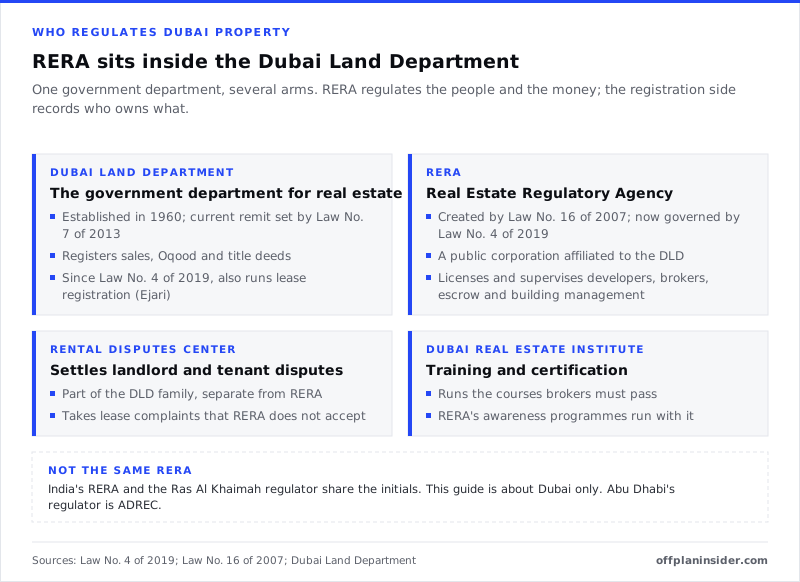
Two other bodies in the family matter to buyers. The Rental Disputes Center settles landlord and tenant disputes through conciliation and judicial procedures. The Dubai Real Estate Institute delivers the training and certification that brokers need, and RERA runs its awareness programmes in coordination with it.
03Which law created RERA, and what changed in 2019?
RERA was created by Law No. 16 of 2007, issued on 30 July 2007. Law No. 4 of 2019, issued on 4 September 2019, replaced it and is the law that governs RERA today.
The 2007 law gave RERA a wide brief, including registering and legalising tenancy contracts. The 2019 law kept RERA as a public corporation affiliated to the Dubai Land Department, but Article 10 moved lease registration and the regulation of landlord and tenant relationships to the department itself. That is why Ejari is now described as a Dubai Land Department system, although many people still call it "RERA registration".
Article 4 of the 2019 law sets five objectives. In short, RERA should develop the sector through regulation and supervision, provide a safe environment that protects developers' and investors' rights, keep pace with the sector's growth, promote the role of UAE nationals in it, and set the code of conduct for real estate activities.
04What are RERA's 15 functions under the law?
Article 5 of Law No. 4 of 2019 lists 15 functions. For a buyer, the most important are escrow supervision, licensing, project approval and monitoring, advert approval, service charge oversight and complaints.
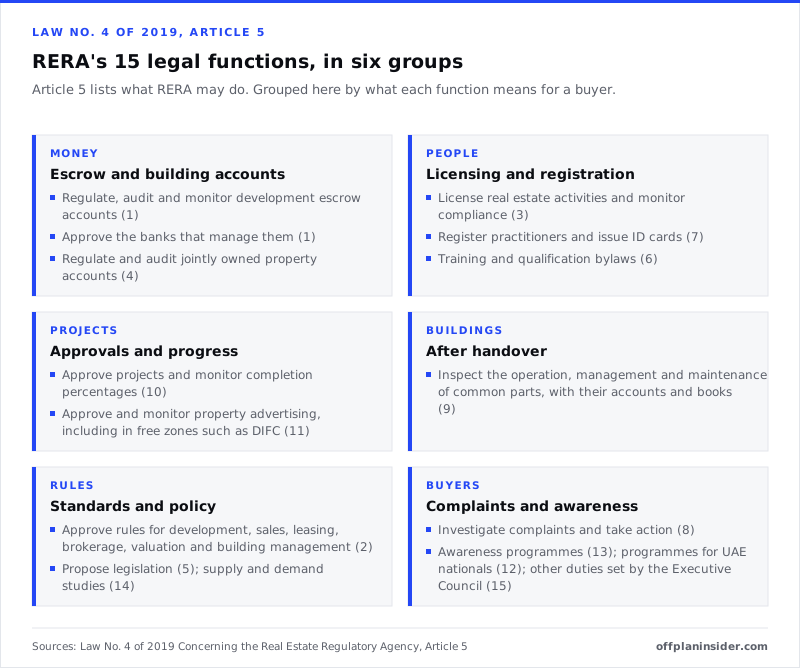
| Function in Article 5 | What it means for an off-plan buyer |
|---|---|
| 1. Escrow accounts | RERA regulates, audits and monitors project escrow accounts and approves the banks that manage them. Your payments go into one of these accounts. |
| 3 and 7. Licensing and registration | Developers, brokers and management companies must be licensed and registered. Individuals receive identification cards, such as the broker's BRN card. |
| 10. Projects | RERA approves development projects and monitors their completion percentages. That percentage drives milestone payments and, if a buyer defaults, what a developer may keep. |
| 11. Advertising | RERA approves property advertising content in Dubai, including in special development zones and free zones such as DIFC. |
| 4 and 9. Buildings after handover | RERA regulates and audits the accounts of jointly owned buildings and inspects how common parts are managed and maintained. |
| 8. Complaints | RERA considers and investigates complaints against those carrying on real estate activities and takes action. |
05How does RERA protect off-plan buyers' money?
Through the escrow system. Every developer selling off-plan in Dubai must pay buyers' money into a project escrow account, and RERA regulates, audits and monitors those accounts.
The rules come from Law No. 8 of 2007. The account is opened in the project's name, used only for that project's construction, and closed to the developer's creditors. Each project has its own account. Banks and financial institutions licensed by the UAE Central Bank to take deposits can act as trustees once approved.
Money leaves the account in stages. The Dubai Land Department's published guidance says the developer notifies the trustee that a construction milestone has been reached, the trustee's engineer inspects the site, and the funds are then released. Marketing payments from escrow are capped at 5% of total sales. After the completion certificate, 5% of the account is held back until one year after the units are registered in buyers' names.
Our guide to Dubai's escrow law goes through Law No. 8 of 2007 article by article. What happens to your money if the purchase fails is covered in our off-plan buyer protection guide.
06How does RERA approve and monitor off-plan projects?
A developer must register a project, and have it approved, before it can launch or announce it. RERA then reviews progress through the life of the project.
The Dubai Land Department describes the steps. The developer registers the project with the escrow department, appoints a DLD-approved survey company, submits the approved drawings and pays the approval fees through the developer portal. The trustee opens the escrow account on the strength of the approval certificate. Certificates are issued through the Oqood self-registration system.
During construction, RERA reviews project status periodically and asks developers to update completion dates and percentages. The department says that where a project's completion is below 5%, RERA contacts the developer and sets a deadline to correct the position; if the developer does not, cancellation procedures begin.
What you can see yourself. The Project Status service, also called Mashrooi, shows a project's number, status, developer, escrow bank, inspection photographs and completion percentage. It is free on the Dubai Land Department website and in the Dubai REST app. Our project and developer checklist shows how to read it.
07What does RERA do if a project is cancelled or stalls?
RERA can cancel a project, and the money in escrow is then returned to buyers under supervision. Law No. 19 of 2020 gives buyers a full refund where a project is cancelled by a final reasoned RERA decision.
The Dubai Land Department sets out what follows. The account passes to its liquidation function, which asks the developer to refund investors within 60 days of the cancellation decision; RERA can extend that period. If the developer does not comply, the matter goes to court. The department says liquidation has no fixed end date, because it depends on having all documents, amounts and eligible people available.
For projects that have stopped part-way, with the developer no longer active, the department says it and RERA intervene to protect the parties' rights. Disputes about cancelled and unfinished projects can go to the Special Tribunal for unfinished and cancelled real property projects, reconstituted by Decree No. 33 of 2020.
08Where does RERA appear in an off-plan purchase?
At seven points, from the first advert to life in the finished building. Each one can be checked by the buyer.
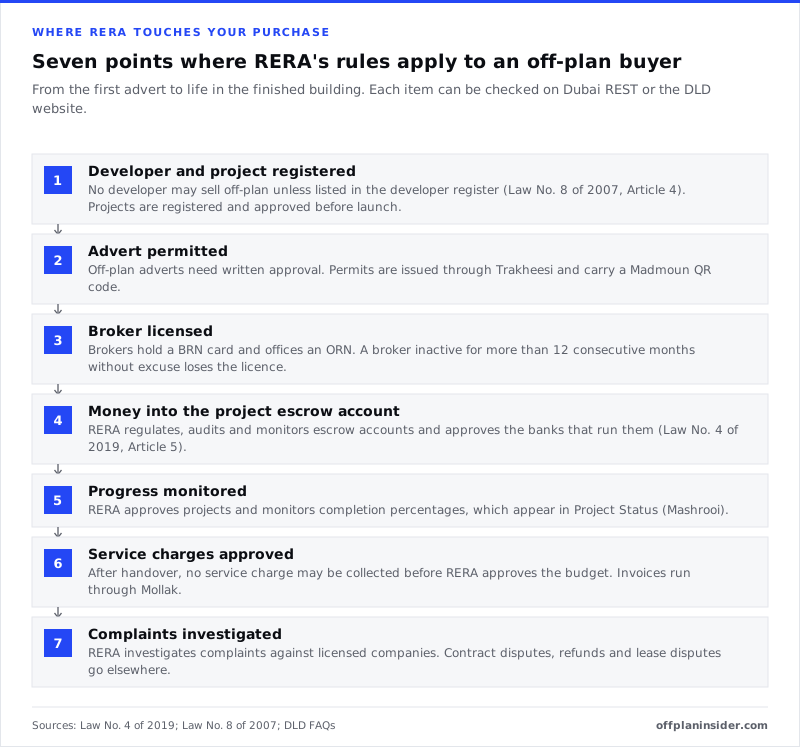
The steps before and after these checkpoints, from reservation to title deed, are in our guide to buying off-plan property in Dubai.
09How does RERA regulate property adverts?
No off-plan unit may be advertised without written approval. Article 5 of Law No. 8 of 2007 bans local or international advertising and exhibitions for off-plan sales without the Dubai Land Department's written authorisation, and the department says developers need a RERA permit to advertise a project.
Advert permits are issued through Trakheesi, the department's licensing system. Since 24 April 2023 the department has required real estate companies to show a QR code from its Madmoun service on their adverts. Scanning it confirms that the advert is approved and shows the advertising company and the authorised property details.
The law extends RERA's advertising remit beyond mainland Dubai. Under Article 5(11) of Law No. 4 of 2019, RERA approves property advertising content in the emirate, including in special development zones and free zones such as DIFC, and monitors it with the relevant authorities.
10How does RERA license brokers?
A broker in Dubai must hold a brokerage licence, be entered in the brokers' register and carry a broker card. The broker's card number is the BRN, and the office's registration number is the ORN.
The Dubai Land Department lists the conditions. Applicants must pass the qualification course and hold a Dubai Police good conduct certificate, and staff must hold residency on the same licence. A broker card costs AED 520 and is renewed through Trakheesi with a continuing education certificate.
Licences are not permanent. A broker loses the licence by leaving the profession, by being inactive for more than 12 consecutive months without a valid excuse, or by giving false information when applying. RERA can also cancel a broker's registration for a fundamental violation, and penalties range from warnings to fines and black points for the office and the broker.
On commission. The department says the commission is set by the brokerage agreement and, where the agreement is silent, by custom. It is due after the sale contract is concluded and registered with the department, unless the brokerage contract says otherwise. On an off-plan primary sale the developer usually pays; our guide to agent commission on off-plan sales explains who pays what.
11What does RERA do after handover?
It oversees how the building is run. Law No. 6 of 2019 on jointly owned property, and RERA's functions under Law No. 4 of 2019, put service charges and management companies under its supervision.
- Service charges need approval. A management company may not claim charges before RERA approves the budget, after audit by a RERA-approved auditing office.
- Mollak. Invoices and payments run through Mollak, the system that registers management companies, buildings and their accounts. Owners pay into RERA-approved accounts.
- Owners committees. A committee is formed for certain project categories once at least 10% of units are registered in owners' names. Its members must be owners who live in the building.
- Service complaints. Owners can report poor services or maintenance through the Real Estate Violations System in Dubai REST.
You can look up a building's approved rate on the department's Service Charge Index. What to expect at completion, including the first service charge payment, is in our handover guide.
12What can RERA not do for you?
RERA is a regulator, not your lawyer or a court. Several common problems go elsewhere, and knowing which saves time.
The Dubai Land Department says the complaint route is for an actual violation by a company licensed in Dubai, backed by documents and proof of identity. It does not accept cancellations, refunds or contract disputes, which are closed for lack of jurisdiction. It also does not accept complaints about contracts more than six months old, and sends lease disputes to the Rental Disputes Center.
It also cannot end your contract for you. The department says it cannot terminate a contract between a developer and a buyer at the buyer's request; the buyer must go to the real estate court, and the department's role is limited to mediation.
| Your problem | Where it goes |
|---|---|
| A broker advertised without a permit, or acted without a licence | RERA complaint through the DLD website or Dubai REST |
| You want to know the real construction progress before a milestone payment | Project Status in Dubai REST; you may also ask for a letter from the DLD-approved project consultant, or an audit report from RERA's technical auditor |
| The building's common areas are poorly maintained | Real Estate Violations System in Dubai REST; the owners committee |
| Service charges look wrong | Check the Service Charge Index and the approved budget; then the management company and the owners committee |
| You want to cancel the purchase and get your money back | Not a RERA complaint. Negotiate with the developer or go to the real estate court |
| The developer says you have defaulted | The DLD's mandatory notice and mediation under Law No. 19 of 2020 |
| The project has been cancelled or has stopped | DLD liquidation procedure; the Special Tribunal for unfinished and cancelled projects |
| A dispute with your tenant or landlord | Rental Disputes Center |
If you are behind on instalments, the procedure is in our guide to what happens if you cannot pay off-plan instalments.
13Can I check a project's progress before I pay a milestone?
Yes. Start with the completion percentage on Project Status, which is free. The Dubai Land Department also describes two formal checks.
First, before paying a construction-linked instalment, a buyer can ask for a letter from the DLD-approved project consultant confirming the completion percentage. The department's FAQs say that without that confirmation the investor is not obliged to pay. Second, a buyer can request an audit report from RERA's technical auditor for a fee of AED 15,000 per unit or villa.
Worked example: a milestone payment notice
Suppose your plan asks for 10% when the building reaches 50% completion, and you receive the payment notice. Check the project's percentage on Project Status. If it shows 50% or more, pay into the escrow account named on the project's record.
If it shows less, ask the developer for the consultant's letter confirming the milestone before you pay. Keep the reply in writing. Our guide to off-plan payment plans explains how milestone-linked plans work.
14Is "RERA approved" the same as a good investment?
No. Registration and licensing show that a developer, project, broker or advert has met the legal requirements. They do not grade the developer, the price or the location.
Treat the RERA checks as a gate. A project that fails them is a reason to stop. A project that passes them still needs your own judgement on price, timing, contract terms and fit. Browse registered projects with prices and payment plans on our projects page and new launches, and compare them on the facts.
15What about Abu Dhabi and the other emirates?
RERA's rules apply in Dubai. Each emirate regulates property under its own laws, so do not assume a Dubai rule applies to a project elsewhere.
- Abu Dhabi. The regulator is the Abu Dhabi Real Estate Centre (ADREC), launched in November 2023 within the Department of Municipalities and Transport. See our guide to ADREC.
- Ras Al Khaimah and Sharjah. Each has its own registration authority and off-plan rules. Ras Al Khaimah's regulator also uses the initials RERA, which causes confusion in searches.
- India. India's RERA is a separate national regime with no connection to Dubai.
16Key terms
- RERA. The Real Estate Regulatory Agency, the regulatory arm of the Dubai Land Department.
- DLD. The Dubai Land Department, which registers transactions, Oqood, title deeds and leases.
- Oqood. The interim register for off-plan sales under Law No. 13 of 2008.
- Escrow account. The project bank account that receives buyers' payments, under Law No. 8 of 2007.
- Trustee. The approved bank that manages a project's escrow account.
- Trakheesi. The licensing system that issues advert permits and broker and company licences.
- Madmoun. The QR code service that shows an advert is approved.
- BRN and ORN. The broker's registration number and the brokerage office's registration number.
- Mollak. The system for service charge budgets, invoices and payments in jointly owned buildings.
- Ejari. The lease registration system, now run by the Dubai Land Department.
- Dubai REST. The department's app for project status, licence checks, service charges and complaints.
17Where to go next
Before you pay anything, run the checks in our project and developer checklist: project on Project Status, escrow account matched, advert permit scanned and broker's BRN confirmed. Then read the escrow law guide to understand exactly what the law does with your money.
FAQQuestions buyers ask.
What is RERA in Dubai?
RERA is the Real Estate Regulatory Agency, the regulatory arm of the Dubai Land Department. Law No. 4 of 2019 describes it as a public corporation with legal personality, affiliated to the department. It licenses and supervises developers, brokers and management companies, regulates escrow accounts, approves adverts and projects, approves service charges and investigates complaints.
Is RERA the same as the Dubai Land Department?
No, but it is part of the same family. RERA is a separate public corporation affiliated to the Dubai Land Department. The department registers transactions, Oqood contracts, title deeds and, since Law No. 4 of 2019, lease contracts through Ejari. RERA regulates the people and accounts involved: developers, brokers, escrow and building management.
Is an off-plan project RERA approved?
Every off-plan project in Dubai must be registered before it is launched or announced, and must have its own escrow account. Search the project on the Dubai Land Department's Project Status service or in the Dubai REST app. A registered project shows its number, status, completion percentage, developer and escrow bank.
How do I check if a broker is RERA registered?
Ask for the broker's BRN and the office's ORN, then search them on the Dubai Land Department's licensed brokers service or in Dubai REST. Check that the name and office match the person you are dealing with and the agency named on your reservation form.
Does RERA protect my off-plan payments?
Indirectly, yes. Your payments go into the project's escrow account, which Law No. 8 of 2007 ring-fences from the developer's creditors. RERA regulates, audits and monitors those accounts and approves the banks that act as trustees. Funds are released against construction milestones, and 5% is held back for a year after the units are registered.
Can I complain to RERA about a developer?
Yes, about a violation of the rules by a company licensed in Dubai, through the Dubai Land Department website or the Dubai REST app, with supporting documents. Cancellations, refunds and contract disputes are not handled through the complaint route and go to the real estate court. Lease disputes go to the Rental Disputes Center.
Does RERA cover Abu Dhabi or other emirates?
No. RERA's rules apply in Dubai, including its free zones for advertising purposes. Abu Dhabi's property regulator is the Abu Dhabi Real Estate Centre (ADREC). Sharjah and Ras Al Khaimah have their own regulators and laws.
When was RERA established?
RERA was created by Law No. 16 of 2007, issued on 30 July 2007. That law was replaced by Law No. 4 of 2019, issued on 4 September 2019, which kept RERA as a public corporation affiliated to the Dubai Land Department and moved lease registration to the department itself.
Sources & methodWhere these figures come from.
Sources
- Dubai Legislation Portal: Law No. (4) of 2019 Concerning the Real Estate Regulatory Agency
- Dubai Legislation Portal: Law No. (16 ) of 2007 Establishing the Real Estate Regulatory Agency
- Dubai Legislation Portal: Law No. (8) of 2007
- Dubai Legislation Portal: Law No. (6) of 2019 Concerning Ownership of Jointly Owned Real Property in the Emirate of Dubai
- Dubai Legislation Portal: Law No. (19) of 2020 Amending Law No. (13) of 2008 Regulating the Interim Real Property Register in the Emirate of Dubai
- Dubai Legislation Portal: Decree No. (33) of 2020 Concerning the Special Tribunal
- Dubai Land Department: About dubai land department
- Dubai Land Department: Frequently asked questions
- Dubai Land Department: Real estate project status
- Dubai Land Department: Licensed real estate brokers list
- Dubai Land Department: Validate real estate licenses and permits
- Dubai Land Department: Dubai land department provides madmoun service to verify validity of real estate ads via qr codes
- Dubai Land Department: Service charge index overview
- adrec.gov.ae: About_the_centre
What we could not verify
- Fees for RERA services change. The AED 520 broker card fee and the AED 15,000 per unit audit report fee are as listed in the Dubai Land Department's FAQs on 4 November 2026; the same FAQs give AED 15,070 for a technical report requested through the trustee channel, so confirm the current fee before applying.
- The detailed procedure for cancelling a stalled project is in Executive Council Resolution No. 6 of 2010, which we did not open; the cancellation, liquidation and 60-day refund points are from the Dubai Land Department's FAQs.
- Whether a particular problem is accepted through the RERA complaint route is decided case by case. The acceptance rules quoted (a licensed Dubai company, an actual violation rather than a contractual claim, contracts not older than six months) are from the Dubai Land Department's FAQs.
4 Nov 2026 · Reviewed by OffPlan Insider Research. First published 4 Nov 2026.