Yes. A foreigner of any nationality can buy property in Abu Dhabi, including villas, townhouses and land, inside the emirate's investment zones. Since Law No. 13 of 2019, non-nationals there hold full freehold with no end date, and ADREC counted 50 zones by July 2026, among them Al Reem, Yas, Saadiyat, Al Raha Beach, Al Maryah and Masdar City. You do not need to live in the UAE to buy. The main government fee is a 2% registration fee, against 4% in Dubai. On an off-plan purchase the sale goes on the Interim Real Estate Register and every payment goes into the project's escrow account. Outside the zones, ownership is reserved for UAE nationals, and foreigners can hold only time-limited rights. Rules reviewed 26 October 2026.
Key takeaways
- Foreigners can own freehold, land included, inside Abu Dhabi's investment zones. Law No. 13 of 2019 opened them to non-national individuals and companies, and ADREC reported 50 zones by July 2026.
- Outside the zones, ownership is reserved for UAE nationals and those treated as nationals. A foreign buyer there can hold only usufruct, musataha or a long-term lease.
- Off-plan sales are governed by Law No. 3 of 2015. Each project needs an escrow account, the developer can draw on it only after 20% of construction, and every sale must go on the Interim Real Estate Register to bind the parties.
- Expect fees of about 2.3% of the price on an AED 2M off-plan home: the 2% registration fee, an AED 450 electronic fee, a developer administration fee capped at AED 5,000 and AED 950 for the title deed at handover. In Dubai the same purchase costs about AED 81,000 to 86,000 in fees.
- Mortgage caps are federal: 50% of the value for any home bought off-plan. Non-residents can borrow from some banks, on terms each bank sets.
- An Abu Dhabi property worth AED 2M or more supports a ten-year Golden Visa. For off-plan, Abu Dhabi asks for proof that at least AED 2M has already been paid to the developer, which can push the visa back to late in the payment plan.
- Demand is strong: sales reached AED 86.1 billion in the first half of 2026, foreign direct investment AED 13.8 billion, from buyers of 116 nationalities.
01Can a foreigner buy property in Abu Dhabi?
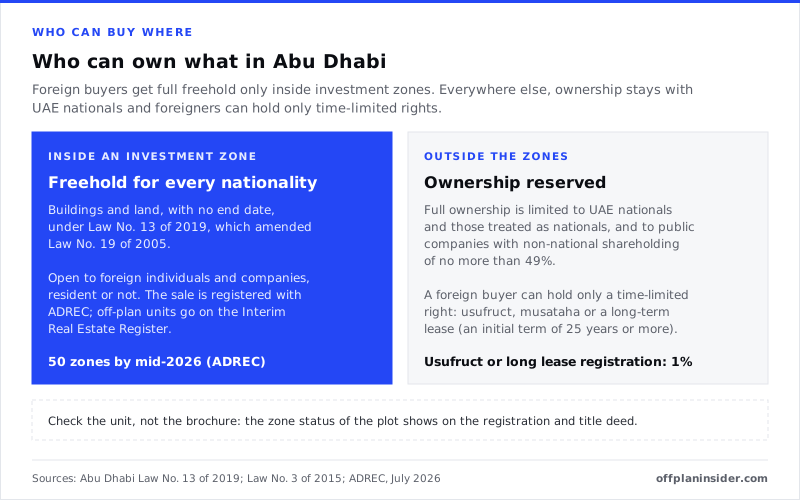
Yes. Any nationality can buy, as an individual or through a company, and you do not need to live in the UAE. The one condition is location: the property must be in one of Abu Dhabi's investment zones.
Inside a zone, a foreign buyer holds full freehold: the apartment, villa or townhouse, the land under it where the title includes land, and no end date. Outside the zones, ownership stays with UAE nationals, and a foreigner can hold only a time-limited right.
This guide covers Abu Dhabi only. For the rules in every emirate side by side, see can foreigners buy property in the UAE.
02What the law says: from 2005 to the 2019 freehold change
Three laws shape what a foreign buyer can do in Abu Dhabi. ADREC, the Abu Dhabi Real Estate Centre, publishes all of them in its rules and regulations library.
- Law No. 19 of 2005 on real estate ownership sets who may own. Investment areas are whatever the Executive Council designates.
- Law No. 13 of 2019 rewrote the ownership article. It says non-national individuals and companies "may own and acquire" every principal and secondary real right in property within investment areas, and dispose of it in any way.
- Law No. 3 of 2015 on the regulation of the real estate sector, amended by Law No. 2 of 2025, governs developers, brokers, off-plan sales, escrow and the Interim Real Estate Register.
Before 2019, a foreign owner in an investment area could hold the unit but not the land, which sat under a musataha, usufruct or long lease. The 2019 change removed that gap. A foreign buyer of a villa on Yas Island or Saadiyat Island today can hold the plot as well as the house.
Outside investment areas, the amended Article 3 limits ownership to three groups: UAE nationals and those treated as nationals, public joint stock companies in which non-nationals hold no more than 49%, and anyone named in a specific resolution of the Crown Prince or Executive Council.
03Freehold, musataha, usufruct and long lease: what each one gives you
Most off-plan homes sold to foreign buyers in Abu Dhabi are freehold. You will still meet the other three rights in contracts and on older titles, so it helps to know what each means.
| Right | What you hold | Can you sell or mortgage it? | Registration fee |
|---|---|---|---|
| Freehold (original ownership) | The unit, and the land where the title includes it, with no end date | Yes, freely | 2% on a sale |
| Musataha | The right to build on someone else's land and own the buildings for the contract term | Yes, without the owner's permission, if the term is over ten years | 1% or 2% of the consideration, by land type and area |
| Usufruct | The right to use and let a property you do not own, for the contract term | Yes, without the owner's permission, if the term is over ten years | 1% of the consideration |
| Long-term lease | A registered lease with an initial term of at least 25 years | Yes, it can be mortgaged | 1% of the consideration |
The practical test is simple. If the sale agreement and the registration describe original ownership in an investment zone, you are buying freehold. If they describe a musataha, usufruct or lease, you are buying a right that ends, however long the term.
04Where foreigners buy: the main investment zones
ADREC approved eight new investment zones in the first half of 2026, bringing the total to 50, and describes them as open to investors of all nationalities. The established zones, and the newer coastal destinations sold freehold to foreign buyers, include these.
| Area | What it is | What sells off-plan |
|---|---|---|
| Al Reem Island | High-rise island next to the city centre; the largest zone by homes | Apartments from studios upward |
| Yas Island | Leisure island with theme parks, golf and the F1 circuit | Apartments, townhouses and villas |
| Saadiyat Cultural District and Marsa Al Saadiyat | Museum district and beachfront on Saadiyat Island | Prime apartments, branded residences and villas |
| Al Raha Beach | Waterfront district between the city and Yas | Apartments and townhouses |
| Al Maryah Island | Financial district, home of ADGM | Apartments and branded residences |
| Masdar City | Low-carbon district near the airport | Apartments at some of the lowest entry prices |
| Hudayriyat Island | Sports and leisure island off the city's south-west coast | Villas |
| Ramhan Island and Al Jurf | Newer coastal destinations | Villas, apartments and branded residences |
The Abu Dhabi area guide covers every area we track, with the projects selling in each.
Two cautions apply. A brochure name is not a legal boundary, so the document to rely on is the registration. And a zone that is open to foreign ownership today was designated by a decision; the decision, not the marketing, is what gives you the right.
05Buying off-plan in Abu Dhabi: what the law requires
Off-plan sales in Abu Dhabi are tightly regulated. Article 15 of Law No. 3 of 2015 says no unit may be sold off-plan unless six conditions are met:
- The competent authorities have approved the project.
- The development plan, with the initial floor and compound plans, has been deposited with the register.
- The developer holds a property right or contractual right over the land that lets it develop and sell.
- The developer has proved that it owns the land.
- A project escrow account has been opened.
- The regulator has approved the disclosure statement for the unit.
The same article says the buyer pays according to the actual completion percentage of construction, unless agreed otherwise with the developer. In practice this is where payment plans come from: a share on booking, instalments during construction and the rest on handover.
The disclosure statement
Before you sign, the developer must give you a signed written statement describing the unit and the project, approved by the regulator. It includes a warning that you must register the purchase on the Interim Real Estate Register, and what happens if you do not.
If you later resell before completion, you must hand the new buyer a full copy of that statement. The developer guarantees its contents: if the information proves fundamentally incomplete or inaccurate, the developer is liable for two years from handover for the damage the buyer suffers.
The Interim Real Estate Register
Every off-plan sale, resale and mortgage goes on the Interim Real Estate Register. Article 27 of the law is blunt: an off-plan disposition is not binding on the parties, or on anyone else, until it is registered.
The seller, usually the developer on a first sale, must apply immediately after the contract is signed. If it has not done so within 21 days, you can apply yourself and recover the cost from the seller, deducting it from the price if necessary.
At completion, the developer registers the final plans and transfers each paid-up unit to the main Real Estate Register in the buyer's name. That is the moment you receive a title deed. If the developer does not apply within 21 days of your final payment, you or your lender can ask the regulator to make the transfer.
Escrow: where your money goes
Each project, and each phase of a phased project, has its own escrow account at a bank or financial institution approved by the regulator. Every payment from buyers, and every payment from a lender financing a buyer, goes into it. ADREC's FAQs say the escrow account number for any registered project can be found on the DARI platform, which also shows the project's completion rate.
The law sets firm rules on what the money may be used for:
- Only construction and project finance. Escrow money may not pay for the land or for broker commissions.
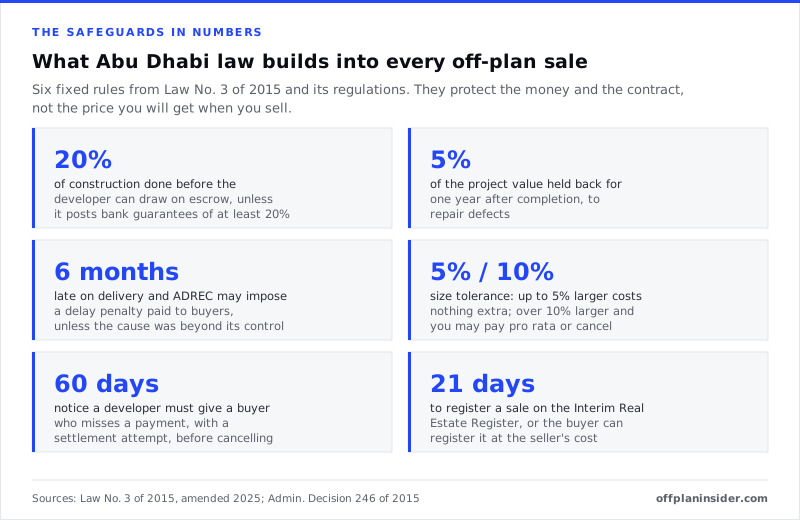
- Nothing before 20%. The developer can draw on the account only once at least 20% of construction is complete, unless it posts bank guarantees worth at least 20% of the construction value.
- Ring-fenced. Escrow funds cannot be seized by the developer's creditors, except in the cases the law lists, such as a cancelled project.
- Visible to you. Anyone who has paid into the account can see its statements held by the bank and take copies.
What happens if the project is late, changes size or is cancelled
- Defects. The escrow bank must retain at least 5% of the project value for a year after the completion certificate, to pay for repairs.
- Late delivery. If handover slips more than six months beyond the schedule the developer committed to, the regulator may impose a delay penalty payable to buyers, unless the delay was beyond the developer's control.
- A project that does not start. If buyers holding at least 5% of the sold units complain, the regulator investigates and may cancel the project and return the escrow money.
- Size. If the finished unit is up to 5% larger than contracted, you pay nothing extra. Between 5% and 10% larger, the price rises in proportion. Over 10% larger, you can pay the increase or cancel. The same bands work in reverse if it is smaller: less than 5% changes nothing, 5% to 10% cuts the price in proportion, and over 10% lets you take the cut or cancel.
- A project that cannot be completed. The escrow bank first tries to have it finished by the funder or another developer. If that fails within six months, the remaining escrow money is shared, after the bank's costs, pro rata among funders and buyers before contractors and the developer.
If you cannot pay
The 2025 amendment set out the procedure a developer must follow before cancelling a contract for non-payment. It must give you, and any lender, 60 days' notice to pay, inform the regulator, and go through an attempt at amicable settlement. Only if that fails can the unit be removed from the register and resold after 30 days.
The developer may then keep a share of what you paid, set by a table tied to the project's completion, and the rest is refunded from escrow within 15 working days of your request. Where a buyer has paid 60% or more, ADREC can set the developer's share without being bound by the table. Your right to go to court or arbitration is preserved.
06Every fee, with a worked example
Abu Dhabi's property fees come from a small number of official schedules. The headline difference from Dubai is the registration fee: 2% rather than 4%.
| Fee | Amount | When | Source |
|---|---|---|---|
| Sale registration fee | 2% of the price; split equally between buyer and seller unless the contract says otherwise | On an off-plan sale, when the contract is registered on the Interim Register | Resolution No. 49 of 2018 (range 1% to 4%); TAMM |
| Electronic services fee | AED 450 | With the registration application | TAMM |
| Developer administration fee | Up to AED 5,000 | Charged by the developer on a disposition | Resolution No. 183 of 2017 |
| Title deed at handover | AED 900 plus AED 50 | When the unit moves to the Real Estate Register | TAMM |
| Mortgage registration | 0.1% of the loan, capped | When a mortgage is registered | Decision No. 247 of 2015; Resolution No. 49 of 2018 |
| Broker commission | Up to 2% of the price, capped at AED 500,000 | If you use a broker; check who pays | Resolution No. 183 of 2017 |
Article 16 of Law No. 3 of 2015 matters here. A developer may not collect registration fees or any other charges on a disposition, except an administration fee within the regulator's limit. That limit is AED 5,000 under Resolution No. 183 of 2017.
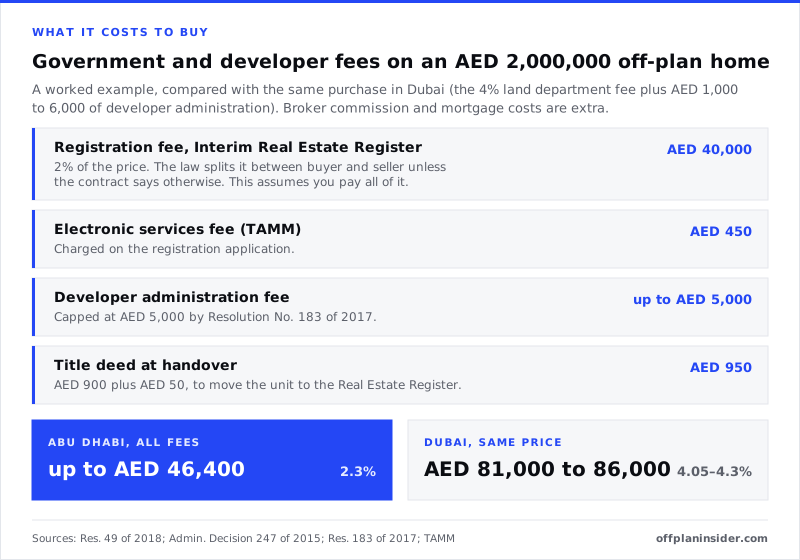
Worked example: an AED 2,000,000 apartment
Take an off-plan apartment priced at AED 2,000,000, and assume the sale agreement puts the whole registration fee on you.
| Item | Abu Dhabi | Dubai |
|---|---|---|
| Registration fee | AED 40,000 (2%) | AED 80,000 (4%) |
| Electronic services fee | AED 450 | Included in the line below |
| Developer administration | Up to AED 5,000 | About AED 1,000 to 6,000 |
| Title deed at handover | AED 950 | Title deed issuance fees |
| Total | Up to AED 46,400, about 2.3% | About AED 81,000 to 86,000 |
Our guide to the true cost of buying off-plan in Dubai breaks down the Dubai column in detail.
Worked example: the cash timeline
Now put the fees into a payment plan. Say the same AED 2,000,000 apartment is sold on a 10/50/40 plan: 10% on booking, 50% during construction and 40% on handover.
| Stage | What you pay | Running total |
|---|---|---|
| Booking and registration | AED 200,000 deposit + AED 40,000 registration + AED 450 + up to AED 5,000 administration | AED 245,450 |
| During construction, say over three years | AED 1,000,000 in instalments, into escrow | AED 1,245,450 |
| Handover | AED 800,000 + AED 950 title deed | AED 2,046,400 |
Two points stand out. You need about 12% of the price in cash on day one, because the fee is paid with the deposit. And the 40% at handover is the payment a mortgage would most often cover, within the limits in the next section.
ADM fees, municipality fees and other charges you will hear about
Buyers often search for ADM fees. ADM is Abu Dhabi Municipality, which once handled property registration. The fee schedule still sits in Executive Council Resolution No. 49 of 2018, "on municipal services fees", but registration is now handled by ADREC through DARI and TAMM.
The same schedule sets the smaller charges an owner may meet:
- Replacement title deed: AED 500.
- Property valuation certificate: AED 1,000 for residential property.
- Site map: AED 200.
- Search certificate: AED 100.
One municipal charge is not a buying cost at all. Expatriate tenants in Abu Dhabi pay a 3% municipality fee on annual rent, collected with utility bills. If you let your home, it is your tenant's charge, not yours, but it is part of what a tenant weighs.
07Mortgages for foreign and non-resident buyers
Mortgage limits in the UAE are federal. The Central Bank's Regulations Regarding Mortgage Loans apply in Abu Dhabi exactly as in Dubai.
| Buyer and property | Maximum loan-to-value |
|---|---|
| Any buyer, home bought off-plan | 50% |
| Expatriate, first home, AED 5M or less | 80% |
| Expatriate, first home, over AED 5M | 70% |
| Expatriate, second home or investment | 60% |
| Non-resident | No separate cap; each bank sets its own, usually lower |
Abu Dhabi's law adds one off-plan rule. You can mortgage your contractual right to an off-plan unit to pay its price, but only if the unit is on the Interim Real Estate Register and the lender pays the loan directly into the project escrow account. The mortgage itself must be registered there to be valid.
For a non-resident, expect a bank to ask for more: a larger deposit, proof of income abroad, bank statements and sometimes a credit report from your home country. Our off-plan mortgage guide covers debt-burden limits, tenures and the costs of borrowing.
08The Golden Visa through Abu Dhabi property
Abu Dhabi grants a ten-year Golden Visa to real estate investors, covering a spouse and children. The rules, published by the Abu Dhabi Department of Economic Development, are:
- Value. Property with a total value of at least AED 2,000,000.
- Completed property. A registered purchase agreement showing the value, or a real estate unit value certificate.
- Off-plan. A purchase agreement from an approved developer, plus evidence that at least AED 2,000,000 has been paid to the developer to date.
- Mortgaged property. Allowed through national banks for properties worth more than AED 2,000,000, with further documents.
The off-plan rule has a real consequence for timing. Here are two projects we track, using their published payment plans:
| Project | Starting price | Plan | When AED 2M has been paid |
|---|---|---|---|
| Sei Saadiyat | AED 2.95M | 5% booking, 45% construction, 50% handover | Only at handover: 50% is AED 1.475M |
| Sama Yas | AED 5.9M | 5% booking, 55% construction, 40% handover | During construction, once about 34% is paid |
If the visa is a main reason for buying, check how much you will have paid, and when, before you choose a plan. Our Golden Visa guide covers the federal rules and the Dubai route, and the Golden Visa projects page lists homes priced at AED 2M and above.
09How to buy, step by step
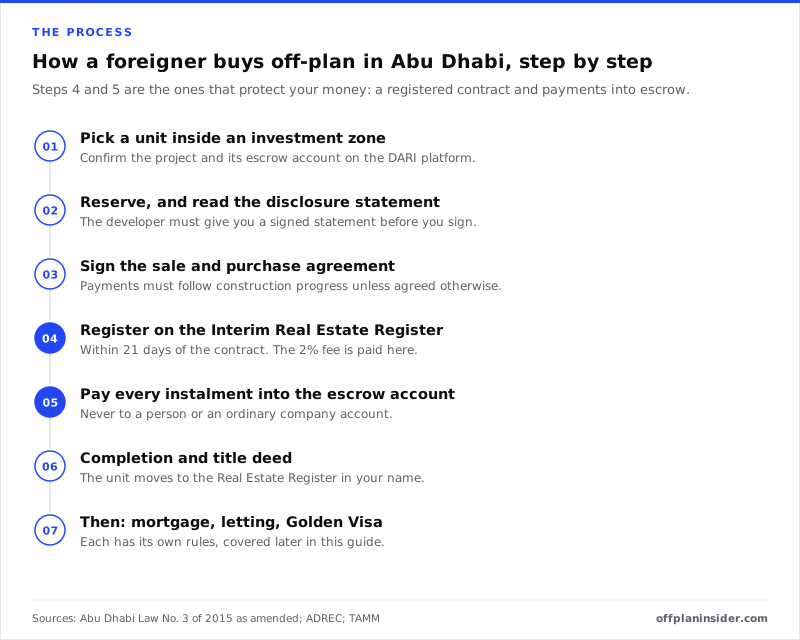
- Choose the zone and the project. Confirm the area is an investment zone and the project is registered. Look up the project, its escrow account and its completion rate on DARI.
- Check the people. Anyone selling to you must hold an ADREC licence; ADREC reported 3,302 licensed brokers in July 2026. A developer needs the regulator's written permit before it advertises an off-plan project, and adverts should carry a Madhmoun advertising permit.
- Reserve the unit. You will usually pay a booking amount. Ask for the reservation form, payment plan and draft sale agreement in writing before you pay anything.
- Read the disclosure statement and the agreement. Check the handover date, the payment schedule, the unit size, delay terms, resale rules and who pays the 2% fee.
- Sign and register. The developer registers the sale on the Interim Real Estate Register. TAMM lists a passport and the sale and purchase agreement as the buyer's documents, plus a mortgage contract if you are borrowing.
- Pay into escrow. Every instalment goes to the project's escrow account. Keep receipts and the registration certificate.
- Take handover. Inspect the unit, pay the final instalment and the AED 950 transfer fees, and the unit moves to the Real Estate Register with a title deed in your name.
- After handover. Register any mortgage, let the home through a licensed broker, or apply for the Golden Visa once you qualify.
10Abu Dhabi vs Dubai for a foreign buyer
| Abu Dhabi | Dubai | |
|---|---|---|
| Where foreigners can own | Investment zones; 50 by July 2026 | Designated freehold areas under Law No. 7 of 2006 |
| Legal basis | Law No. 19 of 2005, amended by Law No. 13 of 2019 | Law No. 7 of 2006 and Regulation No. 3 of 2006 |
| Regulator and register | ADREC, through DARI and TAMM | Dubai Land Department and RERA, through Dubai REST |
| Off-plan register | Interim Real Estate Register | Oqood |
| Registration fee | 2% | 4% |
| Developer administration | Capped at AED 5,000 | About AED 1,000 to 6,000 |
| Escrow drawdowns | None before 20% construction, unless guaranteed | Released against certified construction progress |
| Advert permits | Madhmoun | Trakheesi |
| Mortgage caps | Federal: 50% off-plan | Federal: 50% off-plan |
| Golden Visa, off-plan | AED 2M value and AED 2M paid to the developer | AED 2M value; see our Golden Visa guide for the paid-share rule |
The lower fee is the most visible saving, but not the only difference. Abu Dhabi's pipeline is far smaller: ADREC expects about 71,000 new homes by 2030, while Dubai has about 162,500 scheduled for 2027 alone. Dubai offers many more projects and price points; Abu Dhabi offers less competition from identical new stock in most districts.
On yields, Abu Dhabi's affordable districts yield the most and the prime islands less; our Abu Dhabi rental yields guide has the figures by community.
11What the market looks like in 2026
ADREC's report for the first half of 2026 shows a market growing fast, with foreign buyers a large part of it.
| Measure, first half of 2026 | Figure |
|---|---|
| Total real estate transactions | AED 117 billion, up 112% on a year earlier |
| Sales | AED 86.1 billion across 16,838 transactions |
| Mortgages | AED 26.7 billion across 8,876 transactions |
| Foreign direct investment | AED 13.8 billion, up 309% |
| Non-resident investors' nationalities | 116, against 82 a year earlier |
| Investment in investment zones | AED 75 billion, up 181% |
| New projects registered | 28 |
ADREC named the United Kingdom, China, Russia, the United States, Germany and France among the leading sources of foreign investment. Rapid growth also means more competition at launches, and more homes completing in the same years, so compare each project with what else is due nearby.
12Abu Dhabi off-plan projects to look at
These are examples from the Abu Dhabi projects we track, across price bands and zones. Prices are the lowest published starting prices.
| Project | Area | Developer | From |
|---|---|---|---|
| Plaza 2 by Reportage | Masdar City | Reportage | AED 500K |
| Vista 3 by Reportage | Al Reem Island | Reportage | AED 835K |
| Marlin II by Reportage | Al Reem Island | Reportage | AED 1.6M |
| Perla 2 by Reportage | Yas Island | Reportage | AED 1.9M, near handover |
| Sei Saadiyat | Saadiyat Cultural District | Aldar | AED 2.95M |
| Sama Yas | Yas Island | Aldar | AED 5.9M |
| Wadeem Gardens | Hudayriyat Island | Modon | AED 8.7M |
| The Ritz-Carlton Residences | Al Maryah Island | SAAS Properties | On request |
To browse more widely, filter by budget, from under AED 1 million to AED 5 to 10 million, or by type: apartments, townhouses and villas. New launches and projects near handover sit at either end of the timeline.
13What the law covers, and what it leaves to you
| Covered by Abu Dhabi law | Your own judgement |
|---|---|
| Freehold for foreigners inside investment zones | Whether the zone suits how you will use the home |
| Payments held in a project escrow account | Whether the price is fair against completed homes nearby |
| Registration of your purchase on the Interim Register | Whether you can meet every instalment |
| A disclosure statement the developer must stand behind | Whether prices and rents rise |
| Size tolerances, a delay penalty and a defects retention | How many similar homes complete in the same year |
| A fixed procedure, with notice, if you default | Tax in your home country on rent or gains |
The UAE does not tax individuals on rent or sale gains from property, but your home country may. Nothing in this guide is legal, tax or financial advice; for your own case, check with a licensed adviser.
14Stress-test your purchase
Before you sign, run three questions against the payment plan.
| If this happens | What it does to the AED 2M example | Ask yourself |
|---|---|---|
| Handover is a year late | A year without rent; ADREC can impose a delay penalty only after six months, and only where the delay is the developer's fault | Do I have a cash reserve? |
| The bank lends less than expected | At 50% off-plan, the most a lender can cover is AED 1M; a lower offer leaves a gap at handover | Can I fund the AED 800,000 handover payment another way? |
| I need to sell before completion | A resale is a new disposition: registered on the Interim Register, with the 2% fee, and the disclosure statement passed on | What does the developer require before a resale? |
15Checklist before you pay
- The unit is in an investment zone, and the agreement describes original ownership.
- The project and its escrow account appear on DARI, with a completion rate.
- The person selling holds an ADREC licence, and the advert carries a permit.
- You have a signed disclosure statement and the full payment plan in writing.
- The agreement says who pays the 2% fee and what the administration fee is.
- Every payment goes to the escrow account, never to an individual.
- The sale is on the Interim Real Estate Register within 21 days, and you have the certificate.
- You know how you will fund the handover payment, and when you reach any Golden Visa threshold.
16Key terms
- Investment zone: an area designated by Abu Dhabi's Executive Council where non-nationals may own property.
- ADREC: the Abu Dhabi Real Estate Centre, the emirate's real estate regulator and registrar.
- DARI: ADREC's digital platform for projects, escrow accounts and transactions.
- TAMM: the Abu Dhabi government's services portal, through which registrations are filed and fees paid.
- Interim Real Estate Register: the register for off-plan sales, resales and mortgages before completion.
- Musataha: a right to build on, and own buildings on, someone else's land for a set term.
- Usufruct: a right to use and let a property you do not own, for a set term.
- Madhmoun: the Abu Dhabi permit system for property adverts.
17Where to go next
- Can foreigners buy property in the UAE? The rules in every emirate.
- What rental yields to expect in Abu Dhabi
- Off-plan mortgages in the UAE
- The Golden Visa through property
- Off-plan payment plans explained
- Get a free shortlist of Abu Dhabi projects that fit your budget and goal
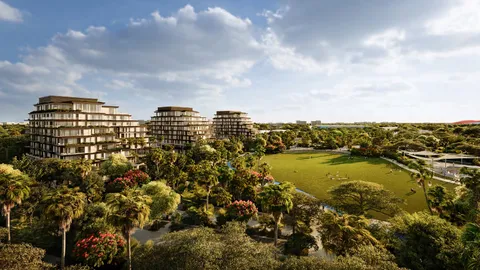
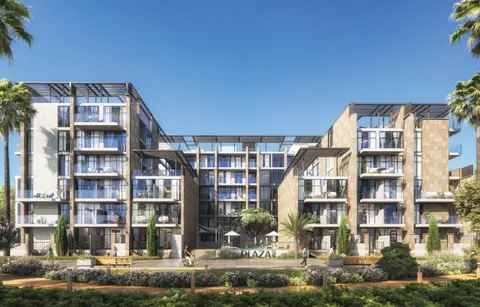
ProjectsProjects mentioned in this guide.

FAQQuestions buyers ask.
Can I buy property in Abu Dhabi as a foreigner?
Yes, inside the investment zones. Abu Dhabi's Law No. 19 of 2005, as amended by Law No. 13 of 2019, lets non-national individuals and companies own and dispose of every real right in property located within investment areas. That means full freehold, land included, with no end date. ADREC reported 50 investment zones by July 2026, open to all nationalities.
Can I buy a house in Abu Dhabi as a non-Emirati?
Yes, if the house is in an investment zone. Villas and townhouses are sold to foreign buyers on Yas Island, Saadiyat Island, Al Raha Beach, Hudayriyat Island and other zones, freehold and with the land. Outside the zones a non-Emirati cannot own a house outright and can hold only a usufruct, musataha or long-lease right. Check the zone status of the plot on the registration before you pay.
Can expats buy property for sale in Abu Dhabi without a residence visa?
Yes. The 2019 law grants ownership in investment zones to non-nationals generally, not only to residents, and ADREC recorded non-resident investors from 116 nationalities buying in the first half of 2026. TAMM lists a passport and the sale and purchase agreement as the documents for registering a purchase from a developer.
What are the Abu Dhabi municipality title deed fees?
On an off-plan home, TAMM lists AED 900 plus a AED 50 administrative fee to move the unit from the Interim Real Estate Register to the Real Estate Register, which issues the title deed in your name. The larger cost comes earlier: the 2% registration fee, paid when the sale is registered. A replacement title deed costs AED 500 under the municipal fee schedule.
What are ADM fees in Abu Dhabi?
ADM is Abu Dhabi Municipality, which used to handle property registration, so buyers still call the registration charges ADM fees. The fees are set in Executive Council Resolution No. 49 of 2018 on municipal services fees.
The main one is the sale registration fee, set between 1% and 4% and charged at 2%. Registration is now handled by ADREC through the DARI platform and TAMM. Separately, expatriate tenants pay a 3% municipality fee on rent.
How much is the property registration fee in Abu Dhabi?
2% of the price. The fee schedule splits it equally between buyer and seller unless the contract says otherwise, so read your sale agreement to see who pays. On an off-plan sale the fee is paid when the contract is entered on the Interim Real Estate Register. TAMM adds an AED 450 electronic services fee. Dubai's equivalent is 4%.
Is buying off-plan in Abu Dhabi safe?
The law builds in strong protections. Every off-plan project needs an approved escrow account, the developer cannot draw on it until 20% of construction is complete, 5% of the project value is held back for a year after completion, and ADREC can impose a delay penalty after six months. These protect your money and contract, not the resale price.
Can a non-resident get a mortgage in Abu Dhabi?
From some banks, yes. The Central Bank caps every mortgage on a home bought off-plan at 50% of its value, and caps an expatriate's first home at 80% up to AED 5M. Banks set their own rules for non-residents, usually with a lower loan-to-value and more documents. The mortgage is registered at 0.1% of the loan.
Does buying property in Abu Dhabi give you a Golden Visa?
It can. Abu Dhabi grants a ten-year Golden Visa, covering spouse and children, to an owner of property worth at least AED 2M. For an off-plan home you need a purchase agreement from an approved developer and proof that at least AED 2M has been paid to the developer so far.
Sources & methodWhere these figures come from.
Sources
- adrec.gov.ae: Property ownership
- adrec.gov.ae: Faqs
- adrec.gov.ae: Press release 27 adrec H1 2026 transaction report
- adrec.gov.ae: Press 29 adrec releases the abu dhabi real estate market report for H1 2026
- tamm.abudhabi: RequesttoRegisteraUnitforFirstSale
- tamm.abudhabi: RegistertheSaleofanOffPlanPlotorUnit
- tamm.abudhabi: TransferUnitfromInitialReregistertoRealEstateReregister
- dari.ae
- added.gov.ae: Visa for real estate investors
- Central Bank of the UAE Rulebook: Regulations regarding mortgage loans
- Dubai Legislation Portal: ECR 30 of 2013
- Dubai Legislation Portal: Law No. (7) of 2006
- Dubai Legislation Portal: Law No. (8) of 2007
- indexbox.io: Dubai adds 24800 new homes in H1 2026 as market shifts to completions
- Khaleej Times: Abu dhabi residents your rent just got higher
What we could not verify
- TAMM's fee figures (the 2% fee, the AED 450 electronic fee and AED 900 plus AED 50 for the title transfer) come from its service pages as indexed, because the live pages would not load for us; confirm the current amounts on TAMM before paying.
- ADREC confirms 50 investment zones but we did not find its full published list, so the zone status of newer areas such as Hudayriyat Island, Ramhan Island and Al Jurf rests on how they are sold to foreign buyers.
- Mortgage terms for non-residents (loan-to-value, minimum income and pricing) are set by each bank, not by the Central Bank, so the ranges described are typical bank practice.
26 Oct 2026 · Reviewed by OffPlan Insider Research. First published 26 Oct 2026. Data: October 2026 (ADREC, TAMM, Central Bank).