When a non-Muslim foreigner dies owning Dubai property without a registered will, Federal Decree-Law No. 41 of 2022 gives half to the spouse and half to the children equally. A registered will, such as a DIFC Courts Will from AED 7,500, replaces that split. Heirs then register the transfer at DLD for AED 1,000 per property plus fees.
Key takeaways
- Dubai property does not pass automatically to a spouse or co-owner. It goes through a court process, then DLD registers it to the heirs, and banks and developers will want court papers first.
- Without a registered will, a non-Muslim foreigner's UAE estate follows Federal Decree-Law No. 41 of 2022: half to the surviving spouse, half to the children in equal shares, sons and daughters alike. A heir may ask instead for the law that governs the estate under the Civil Transactions Law.
- A registered will lets a non-Muslim leave UAE property to whoever they choose. The three official routes are the DIFC Courts Wills Service (AED 10,000 for a Full Will, AED 7,500 for a Property Will), a Dubai notary (AED 2,000 to attest a non-Muslim's will) and the Abu Dhabi Judicial Department (AED 950 for a regular civil will).
- After a DIFC will, the executor obtains a Grant of Probate (USD 1,500), which the Dubai Courts enforce. Without one, heirs apply for an inheritance certificate from the courts.
- DLD's inheritance registration costs AED 1,000 per property, plus the title deed, map, knowledge and partner fees. A transfer under a will is charged 0.125% of the value, and one heir buying out the others (takharuj) 1%.
- An off-plan unit passes as contract rights on Oqood. Instalments keep falling due, DLD needs a developer no-objection letter to register the heirs, and a mortgage's life cover and the bank's NOC need checking early.
01What happens to a Dubai property when the owner dies?
It does not pass automatically to the spouse, the children or a co-owner. A court first decides who inherits, using a registered will if there is one or the default rules if there is not, and then the Dubai Land Department (DLD) registers the property to the heirs.
That process is straightforward when the paperwork is in place and slow when it is not. Banks, developers and DLD will not act on a family's word, only on a court document, so a buyer planning a purchase or a handover in 2027 is wise to sort out a will at the same time as the sale and purchase agreement.
This guide explains, as of November 2026, the rules for non-Muslim owners, the three official ways to register a will, the fees, the steps after a death, and what happens to an off-plan unit still being paid for. It is general information, not legal advice. Your family situation, nationality and assets abroad all matter, so take advice from a lawyer registered with the relevant court before you sign a will.
02Which law decides who inherits?
For a non-Muslim, the starting point is federal. Federal Decree-Law No. 41 of 2022 on Civil Personal Status, in force since February 2023, applies to non-Muslim UAE citizens and non-Muslim foreigners in the UAE, unless they choose the law of their home country for matters such as inheritance and wills.
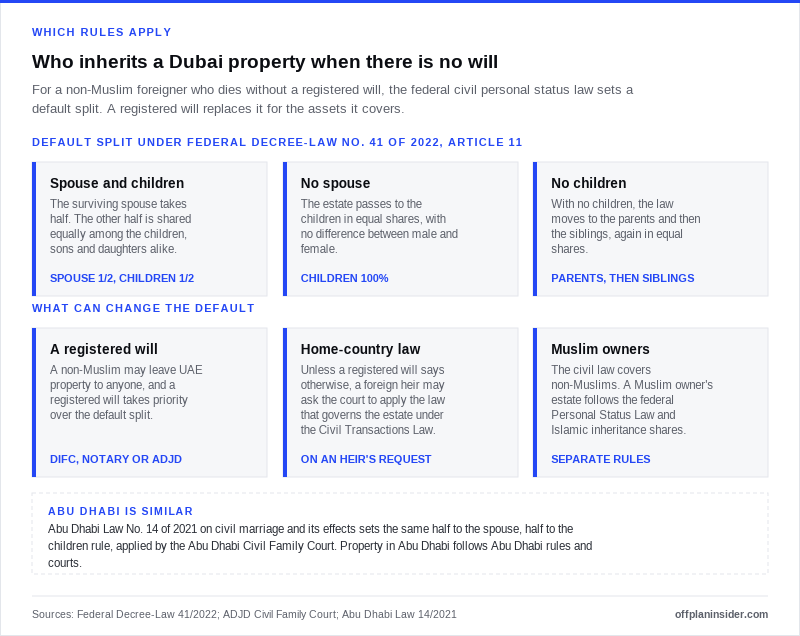
Article 11 of that law does three things. It lets a non-Muslim leave all their property in the UAE to anyone they wish by will. It sets a default split where there is no will, with men and women treated equally. And it lets a foreign heir ask the court to apply the law that governs the estate under the Civil Transactions Law, unless a registered will says otherwise.
The default split without a will
Where a non-Muslim dies with a spouse and children and no registered will, the spouse receives half of the estate. The other half is shared equally among the children, with no difference between sons and daughters.
If there are no children, the share that would have gone to them moves to the deceased's parents and, where a parent has died, to the siblings. The Abu Dhabi Judicial Department (ADJD) describes the same order under Abu Dhabi's own civil family law, Law No. 14 of 2021, which its Civil Family Court applies in Abu Dhabi.
The default can surprise families. A spouse who expected to keep the family flat may find that the children own half of it, and where the children are minors, their shares are managed under court supervision rather than freely by the surviving parent.
Muslim owners
The civil personal status law covers non-Muslims. A Muslim owner's estate follows the federal Personal Status Law and Islamic inheritance shares, which divide an estate in fixed proportions among a wider group of relatives. Muslim owners should take specialist advice; this guide focuses on the civil rules that apply to most foreign buyers.
What the law covers, and what it does not
The federal law decides who inherits UAE assets and in what shares. It does not move anything by itself: a bank still needs a court order to release an account, and DLD still needs an inheritance certificate, a probate order or an approved will before it issues a new title deed.
It also does not decide what happens to assets abroad, which follow the rules where they are. And it does not settle tax in your home country. A UK owner, for example, may still be within UK inheritance tax on a Dubai flat, as our guide to buying Dubai property from the UK explains. The UAE has no inheritance tax of its own.
03Your three options for a will
A will registered in the UAE replaces the default split for the assets it covers and gives the courts a clear instruction. There are three official routes for property in Dubai, and their fees differ widely.
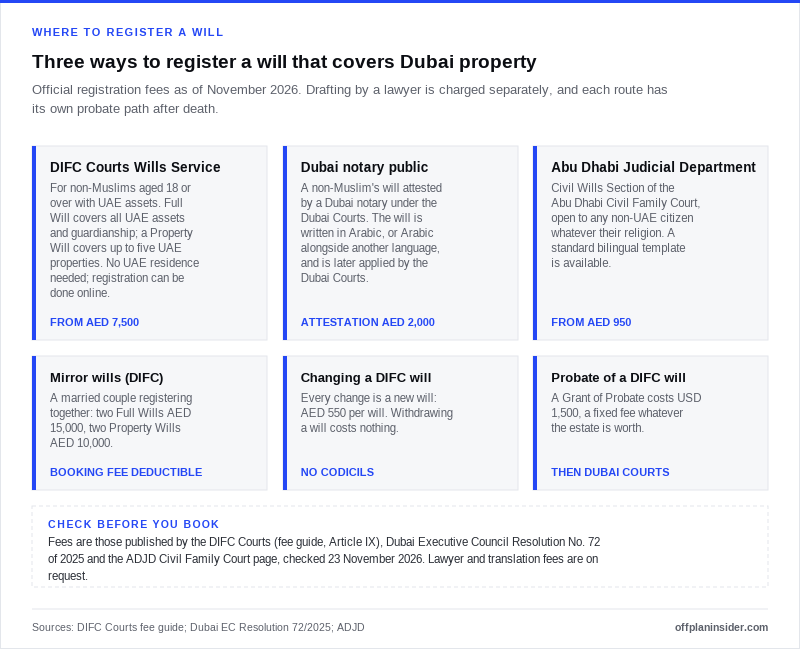
The DIFC Courts Wills Service
The DIFC Courts Wills Service registers wills for non-Muslims who have never been Muslim, are at least 18 and own assets in the UAE or have minor children living there. You do not need to live in the UAE or hold a visa, and registration can be done virtually from anywhere, with two adult witnesses who are not beneficiaries or guardians.
There are several types. A Full Will covers all movable and immovable assets in the UAE, including property acquired after you sign, and can appoint guardians for minor children living in Dubai or Ras Al Khaimah. A Property Will covers up to five named UAE properties and nothing else, so a new purchase means a new will.
The fees in the DIFC Courts fee guide (Article IX) are:
| DIFC Courts Will | What it covers | Single will | Mirror wills (couple) |
|---|---|---|---|
| Full Will | All movable and immovable UAE assets, plus guardianship | AED 10,000 | AED 15,000 |
| Property Will | Up to five UAE real estate properties | AED 7,500 | AED 10,000 |
| Guardianship Will | Guardians for children under 18 only | AED 5,000 | AED 7,500 |
| Modification | Any change; it is registered as a new will | AED 550 per will | |
| Withdrawal | Cancelling a registered will | No fee | |
| Grant of Probate | After death, whatever the estate's value | USD 1,500 | |
Mirror wills are for a married couple who register at the same time; each spouse still has a separate will. The booking fee, AED 1,000 for a single Full Will, is lost if the appointment is cancelled or moved too often, so book once the drafting is settled.
A will attested by a Dubai notary
A non-Muslim can also have a will attested by a notary public under the Dubai Courts. Executive Council Resolution No. 72 of 2025, in force since 15 September 2025, sets the fee for attesting a non-Muslim's will at AED 2,000.
Dubai notarial documents are written in Arabic, or in Arabic with another language alongside, with a certified legal translator involved where you do not read Arabic. The will is later applied through the Dubai Courts rather than the DIFC Courts. Private notaries set their own professional fees on top, which are on request.
A civil will with the Abu Dhabi Judicial Department
The ADJD's Civil Family Court runs a Civil Wills Section under Abu Dhabi Law No. 14 of 2021. It says any non-UAE citizen, whatever their religion, may register a will there, and it offers a standard will template in English and Arabic.
The ADJD lists the fee as AED 950 for a regular will and AED 2,500 for a special will. An Abu Dhabi will is a natural fit for property in Abu Dhabi. Whether it is the right instrument for a Dubai property, where the Dubai Courts and DLD act, is a question to put to your lawyer before relying on it.
Comparing the three routes
| DIFC Courts Will | Dubai notary will | ADJD civil will | |
|---|---|---|---|
| Who can use it | Non-Muslims, 18 or over, with UAE assets or children | Non-Muslims | Any non-UAE citizen |
| Official fee | AED 7,500 to 10,000 single | AED 2,000 attestation | AED 950 regular, AED 2,500 special |
| Language | English | Arabic, or Arabic with another language | English and Arabic template |
| UAE residence needed | No; virtual registration | On request | On request |
| Court after death | DIFC Courts probate, enforced by the Dubai Courts | Dubai Courts | Abu Dhabi Civil Family Court |
| Best fit | Foreign owners wanting an English-language will and guardianship | Owners content with an Arabic instrument applied in Dubai | Owners with Abu Dhabi property |
04A worked example: a family flat bought off-plan
Take a married non-Muslim couple from abroad with two children. The husband alone bought a two-bedroom flat off-plan, registered on Oqood in his name, and dies two years before handover.
Without a registered will. The default rule gives his wife half of his UAE estate and each child a quarter. Before DLD can register the unit to them, the family needs an inheritance certificate from the Dubai Courts, attested death and marriage certificates, and passports or Emirates IDs for every heir. Because the children are minors, their shares are protected under court supervision, so selling the flat later needs further approvals.
With a DIFC Property Will leaving the flat to his wife. The executor applies to the DIFC Courts for a Grant of Probate at USD 1,500. The grant is converted into a Dubai Courts judgment, and the Execution Department instructs DLD. The wife then registers the unit with a developer no-objection letter, paying DLD's will transfer fee of 0.125% of the value, which on a unit worth AED 1,500,000 is AED 1,875, plus the title deed, map and partner fees.
The registration costs are small either way. The real difference is time, family agreement and who ends up owning the flat.
05Steps after a death: from probate to a new title deed
Whatever the route, every case ends at a DLD trustee centre. The order of steps is broadly the same.
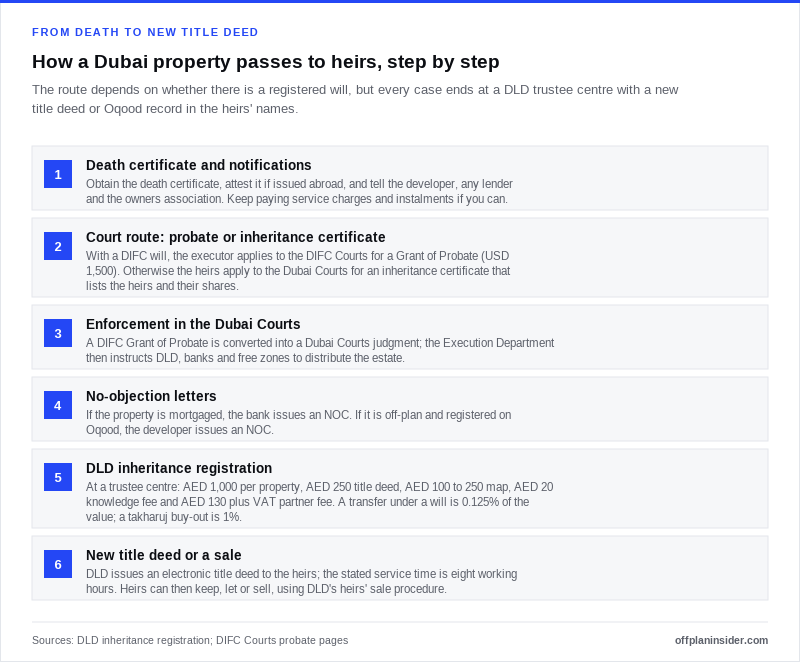
- Death certificate. Obtain it and, if it was issued abroad, have it attested by the issuing country and the UAE Ministry of Foreign Affairs and translated into Arabic by a legal translator. DLD asks for the same attestation and translation of every foreign document.
- Notify the people who hold the property. Tell the developer, any lender and, for a ready home, the owners association. Keep service charges and instalments paid where you can while the estate is settled.
- Go to court. With a DIFC Courts Will, the executor files the probate application with the DIFC Courts Registry and pays the Grant of Probate fee; a straightforward grant is normally issued within a few weeks, the Courts say. Without a DIFC will, the heirs apply to the Dubai Courts for an inheritance certificate, or for a will to be applied.
- Enforcement. A DIFC Grant of Probate is submitted to the Dubai Courts for conversion into a Dubai Courts judgment under the protocol between the two courts. The Dubai Courts' Execution Department then instructs DLD, banks and free zone authorities.
- No-objection letters. DLD asks for a bank NOC if the property is mortgaged and a developer NOC if it is still under construction and registered on Oqood.
- Register at DLD. At a trustee centre or the DLD main building, submit the inheritance certificate or court decision, the heirs' IDs or passports and any NOCs, and pay the fees.
- Title deed. DLD issues an electronic title deed in the heirs' names. Our guide to the Dubai title deed explains what it shows and how to check it.
Heirs who live abroad rarely need to fly in for every step. One heir or a lawyer can act for the others under a power of attorney, which must be notarised and, if signed abroad, attested; see our guide to power of attorney for Dubai property.
DLD's inheritance registration fees
| DLD fee | Amount | When it applies |
|---|---|---|
| Inheritance property registration | AED 1,000 per property | Every inheritance transfer |
| Transfer under a will | 0.125% of the value of the property in the will | Where the approved will or court decision makes it apply |
| Exit from inheritance (takharuj) | 1% of the property's value | Where one heir takes the property and the others give up their shares |
| Title deed | AED 250 | New deed in the heirs' names |
| Map | AED 100 to 250 | Depending on the map type |
| Knowledge and innovation fee | AED 20 | Each transaction |
| Service partner fee | AED 130 plus VAT | At a trustee centre |
DLD's inheritance page lists a flat AED 1,000 per property rather than a percentage of the price, while the DIFC Courts note that transfer fees under a will range from 0.125% to 4% of the value depending on the beneficiary's relationship to the deceased. Ask the trustee centre for the exact figure for your file before you book. If the heirs later sell, the buyer pays the usual transfer fee on that sale, and DLD's sale procedure for heirs applies; our guide to registration trustee fees in Dubai covers what a trustee centre charges.
07Off-plan property after the buyer dies
An off-plan buyer does not yet hold a title deed. They hold contract rights under the sale and purchase agreement, registered on the interim register through Oqood. Those rights, and the duty to pay the remaining instalments, form part of the estate.
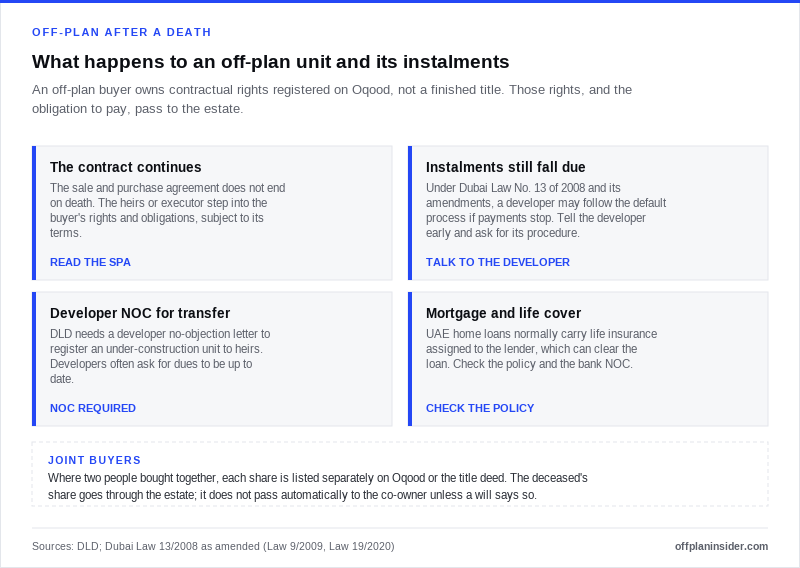
The contract continues. The SPA does not end because the buyer has died, and the payment schedule keeps running. Read the SPA for clauses on death, assignment and transfer to heirs; our guide to the sale and purchase agreement explains where to look.
Instalments still fall due. If payments stop, the developer can use the default procedure in Dubai Law No. 13 of 2008 and its amendments, which starts with a report to DLD and a 30-day notice. Our guide on what happens if you can't pay off-plan instalments sets out each stage. Contacting the developer early, with the death certificate, usually gives the family time to organise the estate.
The developer's NOC. DLD lists a developer no-objection letter among the documents needed to register an under-construction unit to heirs. The developer then updates the Oqood record, as described in our guide to Oqood in Dubai.
Mortgages and life cover. UAE home loans normally come with life insurance assigned to the lender, which may pay off the outstanding loan on the borrower's death. Find the policy, tell the insurer and the bank promptly, and ask the bank for its NOC; our guide to the off-plan mortgage in the UAE explains how these loans are structured.
Heirs who want to sell. Once the heirs are registered, they can keep the unit, resell it before handover with the developer's consent, or take handover. If the unit is close to completion, compare it with projects near handover to see what similar homes are offered at.
08Checklist for Dubai property owners
- Do I know whether the civil rules, my home-country law or Islamic rules would apply to my UAE estate?
- Have I registered a will in the UAE that covers every Dubai property I own or have bought off-plan?
- If I bought with my spouse, do we have mirror wills so each share goes where we intend?
- Does a Property Will need updating after my latest purchase? A Full Will covers later assets; a Property Will does not.
- Have I named guardians for children under 18 living in the UAE?
- Does my home-country will work alongside my UAE will without revoking it?
- Do my executor and family know where the will, the SPA, the Oqood certificate and the title deed are kept?
- Does my mortgage carry life cover, and who is the beneficiary?
- Would my heirs abroad be able to sign through a power of attorney if needed?
- Have I checked inheritance tax in my home country?
09Key terms
- Testator. The person making the will.
- Executor. The person named in a will to apply for probate and distribute the estate.
- Grant of Probate. The DIFC Courts' order confirming a DIFC will and the executor's authority.
- Inheritance certificate. A court document listing the heirs and their shares, which DLD needs where there is no probate order.
- Mirror wills. Two separate wills made at the same time by a married couple, usually leaving everything to each other.
- Takharuj. An exit from inheritance, where one heir takes a property and the others give up their shares; DLD charges 1% of the value.
- Oqood. DLD's interim register for off-plan sales, where an unbuilt unit's ownership is recorded until the title deed is issued.
- NOC. A no-objection certificate from a developer or bank, needed before DLD transfers an off-plan or mortgaged property.
10Where to go next
If you are buying from abroad, our guide on buying Dubai property from the UK covers UK inheritance tax and how a DIFC will fits alongside a UK will. To let a relative or lawyer act for you in Dubai, read power of attorney for Dubai property, and to see what a title deed records, read the Dubai title deed.
When you are ready to look at homes, browse off-plan projects in Dubai and the latest new launches, and see how a purchase works end to end in our guide on how to buy off-plan property in Dubai.
FAQQuestions buyers ask.
What happens to my Dubai property if I die without a will?
If you are a non-Muslim foreigner, the Dubai Courts apply Federal Decree-Law No. 41 of 2022 on Civil Personal Status unless a heir asks for another applicable law. The default gives half the estate to your spouse and half to your children equally. The heirs need an inheritance certificate from the courts before DLD will register the property in their names, which takes time and can be harder with heirs abroad.
How much does a DIFC will cost?
The DIFC Courts fee guide sets the registration fee at AED 10,000 for a single Full Will and AED 15,000 for mirror Full Wills for a couple. A Property Will covering up to five UAE properties costs AED 7,500, or AED 10,000 for mirror wills. Each change is charged AED 550 per will, and a Grant of Probate after death is USD 1,500. Lawyers' drafting fees are separate and on request.
Is a DIFC will better than a Dubai notary will?
Neither is better for everyone. A DIFC Courts Will is registered in English, can be done online without UAE residence and is probated in the DIFC Courts, then enforced through the Dubai Courts. A will attested by a Dubai notary costs AED 2,000, is prepared in Arabic, or in Arabic with another language alongside, and is applied directly by the Dubai Courts. A lawyer can advise which suits your assets and family.
Does my home-country will cover my Dubai property?
It may, but proving and enforcing a foreign will in Dubai means attestation, legal Arabic translation and a court process, which takes longer than using a will registered in the UAE. Many owners keep a UAE will for UAE assets and a home will for everything else, drafted so that neither revokes the other.
If I own a Dubai property jointly with my spouse, does it pass to them automatically?
Not automatically. A Dubai title deed records each co-owner's share, and the deceased owner's share forms part of their estate. It passes under their registered will or, without one, under the default rules, which may give part of it to the children. A will is the way to leave your share to your spouse.
What happens to off-plan instalments if the buyer dies?
The sale and purchase agreement continues and the instalments still fall due, so the estate or heirs need to keep paying or agree terms with the developer. If payments stop, the developer can follow the default process in Dubai Law No. 13 of 2008 and its amendments. Tell the developer early, ask for its procedure, and check whether any life cover applies.
How much does DLD charge to transfer an inherited property?
DLD's Real Estate Inheritance Registration service lists AED 1,000 per property, a title deed fee of AED 250, a map fee of AED 100 to 250, a knowledge and innovation fee of AED 20 and a trustee centre fee of AED 130 plus VAT. Where a will or court decision makes them apply, a will transfer is 0.125% of the value and an exit from inheritance (takharuj) is 1%.
Can a Muslim register a will in the UAE?
The DIFC Courts Wills Service is designed for non-Muslims and says it is not advisable for Muslims. The Abu Dhabi Judicial Department says any non-UAE citizen, whatever their religion, may register a civil will with its Civil Wills Office. A Muslim owner should take specialist advice on how Islamic inheritance rules interact with any will.
Sources & methodWhere these figures come from.
Sources
- difccourts.ae: Wills faq
- difccourts.ae: Fees
- difccourts.ae: Full will
- difccourts.ae: Property will
- difccourts.ae: Probate
- difccourts.ae: Probate costs
- uaelegislation.gov.ae: Download
- uaelegislation.gov.ae: Download
- adjd.gov.ae: CivilFamilyCourt
- Dubai Legislation Portal: Executive Council Resolution No. (72) of 2025 Amending Executive Council Resolution
- Dubai Land Department: Real estate inheritance registration
- Dubai Land Department: Inheritance title transfer
- Dubai Land Department: Sale procedure heirs
What we could not verify
- That a co-owner's share does not pass automatically to the other co-owner on death is the general position under UAE law as we understand it, not a statement on a DLD page; take legal advice for jointly owned property.
- That UAE home loans normally carry life insurance assigned to the lender, which may clear the loan on death, is market practice; whether it applies, and what it covers, depends on your loan and policy.
- That developers may ask for overdue instalments to be paid before issuing the no-objection letter for an inherited off-plan unit is practice and varies by developer and SPA; DLD's page lists only the developer NOC.
23 Nov 2026 · Reviewed by OffPlan Insider Research. First published 23 Nov 2026.