A Dubai off-plan handover is late only after the anticipated completion date plus the SPA's grace period and any allowed extensions. Before then it is not a breach. After it, the SPA's delay clause applies and you can go to court or arbitration. Stalled projects go to a Special Tribunal; a RERA cancellation means a full refund.
Key takeaways
- The anticipated completion date in an SPA is not the deadline. The deadline is that date plus the grace period, plus any extension events the contract allows.
- Dubai's off-plan laws do not set a standard penalty for late handover. Compensation is whatever your SPA says, or what a court or arbitrator awards.
- Your right to go to court or arbitration is preserved by Article 11(g) of Law No. 13 of 2008, as replaced by Law No. 19 of 2020.
- If RERA cancels a project, buyers are refunded in full. The escrow agent refunds within 14 days, and the developer must pay any shortfall within 60 days unless RERA extends it.
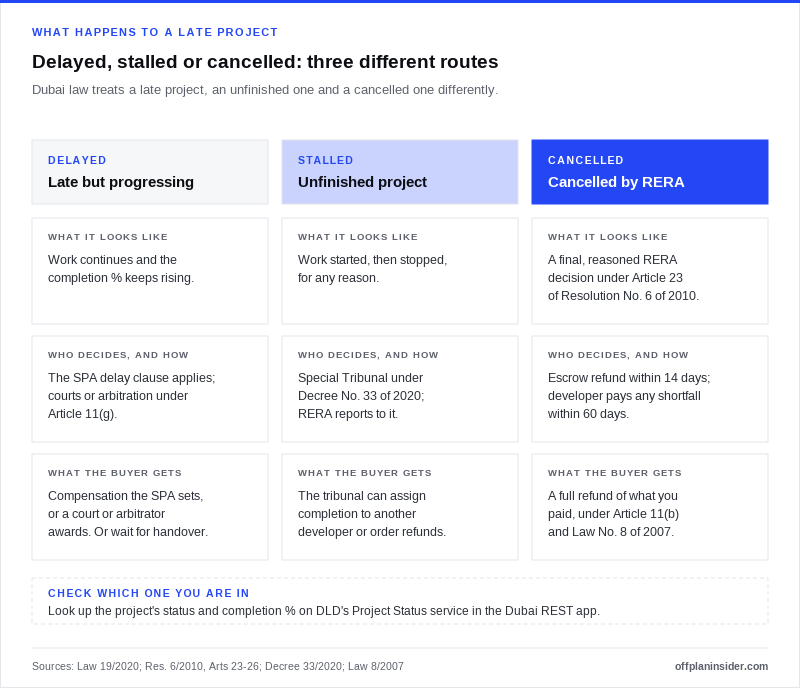
- A project that started and then stopped is an unfinished project. Claims about it go to the Special Tribunal under Decree No. 33 of 2020, not to the ordinary courts.
- Stopping your instalments in protest is risky. It can trigger the Article 11 default procedure, under which a developer may keep up to 25% or 40% of the unit value.
- Check the project's status and completion percentage on DLD's Project Status service in the Dubai REST app. It is free and immediate.
01What counts as a handover delay in Dubai?
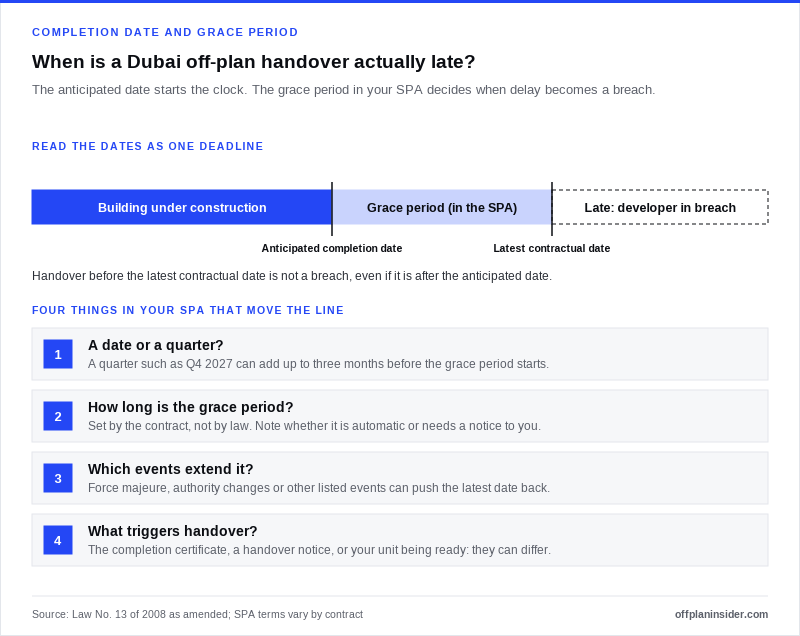
A handover is delayed, in the legal sense, only once the latest date your contract allows has passed. That date is rarely the one in the brochure. It is the anticipated completion date in your sale and purchase agreement (SPA), plus the grace period, plus any extensions the SPA permits.
Many buyers feel a project is late as soon as the anticipated date slips. That is understandable, but it is not yet a breach. This guide explains how to find your real deadline, what Dubai law says when it is missed, and what you can and cannot do about it. It explains the rules; it is not legal advice on your own contract.
For the wider safety net around an off-plan purchase, from escrow to cancellation refunds, start with our guide to off-plan buyer protection in Dubai. This guide goes deeper on one question: what happens when the keys do not arrive on time.
02What does the SPA usually say about completion and delay?
The SPA sets the timetable, not the law. Dubai's off-plan legislation regulates registration, escrow, buyer default and project cancellation, but it does not fix a completion date or a grace period. Those come from your contract.
Most SPAs deal with timing in four clauses. Read them together, because each one can move the date.
The anticipated completion date. This is the date the developer expects the building to be finished. Check whether it is a specific day or a quarter, such as Q4 2027. A quarter usually means the last day of that quarter, which can add up to three months.
The grace period. This is extra time after the anticipated date within which late completion is not a breach. Its length is a contract term. Note whether it applies automatically or only after the developer sends you a notice.
Extension events. Many SPAs list events that extend the date further, such as force majeure, changes required by the authorities, or delays caused by utility connections. Each item on that list can push your deadline back.
The handover trigger. Some contracts tie handover to the building completion certificate. Others tie it to a handover notice sent to you, or to your unit being ready. These can be weeks or months apart, so read which one your SPA uses.
Anticipated completion date vs SPA deadline: a worked example
Take a buyer whose SPA gives an anticipated completion date of "Q4 2027" and a grace period of 12 months. Read as the last day of the quarter, the anticipated date is 31 December 2027. Add the grace period and the latest contractual date becomes 31 December 2028.
Now suppose the SPA also allows extensions for force majeure, and the developer notifies a three-month extension for an event on the list. The deadline moves to 31 March 2029. A handover in February 2029 would be on time under that contract, even though it is more than a year after the anticipated date.
That is why the first step in any delay is arithmetic, not anger. Write the dates down, with the clause numbers that support each one, before you do anything else.
| Date in the SPA | What it means | Is late handover a breach? |
|---|---|---|
| Anticipated completion date | When the developer expects the building to be finished. | No. It is a target, not the deadline. |
| Grace period end | Anticipated date plus the grace period in the SPA. | No, while within it. |
| Extended date | Grace period end plus any extension the SPA allows for listed events. | No, if the extension was validly claimed. |
| After the latest contractual date | The developer has missed every date the contract allows. | Yes. The delay clause and your legal remedies apply. |
03What does Dubai law say about off-plan delays?
Dubai law protects off-plan buyers mainly through three instruments: Law No. 13 of 2008 on the interim register, its implementing bylaw, Executive Council Resolution No. 6 of 2010, and Law No. 8 of 2007 on escrow. A fourth, Decree No. 33 of 2020, created a tribunal for unfinished and cancelled projects.
None of them sets a standard penalty for late handover. Instead, they deal with what happens at the edges: when a project never starts, when it is cancelled, when it stops, and when a buyer defaults. Ordinary delay is left to the contract and to the courts.
Law No. 13 of 2008 and its amendments
Law No. 13 of 2008 created the Interim Real Property Register, known as Oqood. Article 3 makes an off-plan sale void unless it is entered on that register. Article 4 bars a developer from starting a project or selling off-plan before it has possession of the land and the approvals it needs.
Article 11 has been rewritten twice. Law No. 9 of 2009, issued on 12 April 2009, replaced it with a tiered set of rules on what a developer may keep if a buyer defaults. Law No. 19 of 2020 replaced it again with the version in force today, and made it apply to contracts signed both before and after it took effect.
Three parts of the current Article 11 matter in a delay:
- Article 11(b), the full refund rule. If the developer has not started work for reasons beyond its control and without negligence, or if RERA cancels the project by a final reasoned decision, the developer must refund everything the buyer paid, through the escrow procedure in Law No. 8 of 2007. The 2009 version had allowed the developer to keep up to 30% where work never started; that was removed in 2020.
- Article 11(a), the default procedure. If a buyer stops paying, the developer must notify DLD, which gives the buyer 30 days' written notice and tries to broker a settlement. Only then may the developer act, within retention limits tied to the project's completion percentage.
- Article 11(g), access to the courts. The buyer keeps the right to go to court or arbitration. Nothing in the default procedure takes that away.
Article 11(f) makes these rules a matter of public order, so an act that does not comply with them is void. Our guide to missed off-plan instalments explains the default procedure in full.
The implementing bylaw: when a buyer can go to court
Executive Council Resolution No. 6 of 2010 fills in the detail. Article 20 lists the grounds on which a buyer may ask a court to terminate the contract. They are a developer refusing without a reason DLD accepts to give the final sale agreement, refusing to link payments to the construction milestones RERA proposes, materially departing from the agreed specification, or handing over a unit that proves unfit for use because of material defects.
Article 20 also keeps open any other ground for termination under the general rules of law. A long delay beyond the contractual deadline is the obvious example, and it is the route most delayed buyers rely on.
Article 21 lists what counts as beyond a developer's control in a project that never started: expropriation of the land, a government suspension for re-planning, structures or utility lines found on site, a master developer changing the plot, or other reasons RERA sets. Article 22 lists what counts as the developer's own negligence, such as unjustified delay in taking the land or obtaining approvals, and failing to register the project with RERA.
The roles of RERA and DLD
RERA, the Real Estate Regulatory Agency, regulates developers and projects. The Dubai Land Department (DLD) runs the registers, the escrow system and the public services buyers use. Both have a part to play in a delay, and our RERA guide explains how they fit together.
RERA monitors progress. Under Article 17 of the 2010 bylaw, a project's completion percentage is confirmed by a technical report from a RERA-approved consultant after a site inspection. DLD says RERA reviews registered projects, asks developers to update their completion dates, and contacts the developer of a stalled project to set a period for correcting it.
RERA can cancel. Article 23 of the bylaw lets RERA cancel a project on a reasoned technical report. The grounds include a developer failing without valid reason to start work despite holding all approvals, an escrow offence under Law No. 8 of 2007, no genuine intention to build, gross negligence, and bankruptcy.
DLD mediates, but does not terminate. Article 14 of the bylaw lets DLD attempt conciliation between a buyer and a developer and propose solutions that keep the contract alive. A written settlement binds both sides once DLD approves it. DLD also states plainly that it has no power to terminate a contract between a buyer and a developer; that is for a court, an arbitrator or the Special Tribunal.
04What happens if RERA cancels the project?
If RERA cancels a project, every buyer is entitled to a full refund under Article 11(b). The 2010 bylaw sets a short, fixed timetable for it.
Under Article 24, the developer has seven working days from notice to lodge a written grievance, and RERA has seven working days to decide it. If RERA rejects the grievance, cancellation is final. Under Article 25, RERA appoints a certified auditor at the developer's expense to check what was paid in and spent, and instructs the escrow agent to refund buyers within 14 days of cancellation.
If the escrow account cannot cover every refund, Article 26 gives the developer 60 days from the cancellation decision to pay the balance, unless RERA extends that period for valid reasons. If the developer still does not pay, Article 27 requires RERA to take the steps needed to protect buyers, including referring the matter to the courts.
DLD's Real Estate Projects Liquidation Section handles the money once a project is cancelled. It withdraws the funds from the escrow account, holds them in DLD's trust account and pays them to the people entitled, in full or proportionally. DLD does not give a fixed timescale for liquidation, because it depends on documents, amounts and claimants being complete.
A worked example of the cancellation timetable
Suppose RERA notifies a developer of a reasoned cancellation decision on day 0. The developer has seven working days to object, and RERA has seven working days to rule. If RERA rejects the objection, the cancellation becomes final.
The escrow agent must then refund buyers within 14 days of cancellation. If a buyer paid AED 450,000 and the escrow account can cover only part of the total, the developer must pay the rest within 60 days of the decision. The buyer's entitlement is the full AED 450,000 throughout; only the source of the money changes.
05How does the escrow law protect you in a delay?
Law No. 8 of 2007 is the reason a delay is usually a problem of time rather than of lost money. Every off-plan developer must open an escrow account in the project's name, and every buyer payment goes into it. Our guide to Dubai's escrow law walks through it article by article.
Five provisions matter most when a project runs late:
- Article 9, the ring-fence. The account is dedicated to building that project, and the developer's creditors cannot attach the money in it. A developer with several projects needs a separate account for each.
- Article 12, access to records. A depositor may see the accounting records of their own payments and ask for copies.
- Article 15, projects that are not completed. If a project is not completed in an emergency, the escrow agent must consult DLD and take steps to protect depositors, either by securing completion or by refunding their payments.
- Article 17, projects that never start. A developer that fails, without an acceptable reason, to start construction within six months of permission to sell off-plan can be struck off the developer register.
- Article 14, the retention. After the completion certificate, 5% of the account is held back and released to the developer one year after the units are registered in buyers' names.
Article 16 adds criminal penalties, including a fine of at least AED 100,000, imprisonment or both, for offences such as misusing project money or selling units in fraudulent projects. Escrow does not make a project finish on time. It makes sure the money you paid is there to finish it, or to refund you.
06What is the Special Tribunal for stalled and cancelled projects?
Dubai has a dedicated judicial body for projects that stop: the Special Tribunal for Unfinished and Cancelled Real Property Projects. It was set up by Decree No. 33 of 2020, issued on 24 November 2020, and it continues the special body first formed under Decree No. 21 of 2013. Its head office is at DLD.
The decree defines an unfinished project as one where construction started but was suspended, whether because of the developer, the buyers or any other reason. A cancelled project is one cancelled under Dubai law, or referred to the tribunal but not yet liquidated. Projects within the DIFC are outside its scope.
The tribunal's powers are wide. It can:
- decide claims about unfinished and cancelled projects and set the rights of developers, investors and buyers;
- assign the completion of an unfinished project to another developer;
- liquidate cancelled projects and settle the rights involved, after liquidation costs;
- hear a developer's grievance against a RERA cancellation decision;
- issue interim orders, appoint auditors at the developer's expense and order the escrow agent or the developer to refund money; and
- propose mediation and consult DLD, RERA and court experts.
RERA must give the tribunal a detailed report on each unfinished project, covering its status, the proposed solution and who could complete it. Once a matter falls within the tribunal's jurisdiction, the ordinary courts, including the DIFC Courts, may not hear it, and cases already filed are transferred.
The tribunal's decisions are final and are not open to ordinary appeal; they are enforced through the Dubai Courts. Claims before it are exempt from judicial fees. Its procedures are set by resolution of the Chairman of the Judicial Council, so take legal advice on how to file.
07How do you check a project's progress yourself?
You do not need to rely on updates from the developer or an agent. DLD's Project Status service shows the official status and completion percentage of any registered project in Dubai. Our guide to the Dubai REST app covers the app in detail.
- Open the service. In the Dubai REST app or on the DLD website, open Information Services and choose the real estate project status enquiry.
- Search for the project. Enter the project number, the land number or the project name. The project number is on your Oqood certificate; our Oqood guide shows where.
- Read the result. It shows the project's status and completion percentage. The service is free and the result is immediate.
- Track it over time. Note the percentage and the date each month. A figure that rises steadily suggests a delay; a figure that stops moving for several months suggests a stall.
If you need a formal figure, DLD's published answers say a buyer can ask for a completion-percentage report prepared by a RERA technical auditor, for a fee of AED 15,000 per unit or villa. Before paying a milestone-linked instalment, you can also ask for a letter from a DLD-approved project consultant confirming that the milestone has been reached.
The same checks work before you buy. Our guide to checking an off-plan project and developer shows how to use them during due diligence.
08How do compensation clauses for delay work?
Delay compensation is a contract term. Because Dubai's off-plan laws set no standard penalty, what you can claim starts with what your SPA says. Some SPAs have a detailed delay clause; others have none.
Where a clause exists, it usually answers five questions. Read each one:
- The rate. Usually a percentage of the amount you have paid, or of the price, for each month or year of delay.
- The start date. Almost always the end of the grace period, not the anticipated completion date.
- The cap. Many clauses limit the total, either as a percentage or as a fixed number of months.
- How it is paid. Often as a credit against your final instalment at handover, rather than in cash.
- Whether it is your only remedy. Some clauses say compensation is the buyer's sole remedy for delay. A lawyer can tell you how far a court is likely to enforce that.
A worked example of a delay clause
The figures here are an illustration only, not a typical or recommended rate. Suppose a buyer has paid AED 750,000 towards a unit priced at AED 1,500,000. The SPA provides compensation of 1% a year of the amount paid, running from the end of the grace period and capped at 5%.
If handover comes eight months after the grace period ends, the compensation is AED 750,000 × 1% × 8 ÷ 12, which is AED 5,000. Paid as a credit, it reduces the final instalment by that amount. The 5% cap would limit the total to AED 37,500 however long the delay.
Where the SPA has no clause, or the buyer believes the clause does not cover their loss, the claim goes to a court or an arbitrator. The buyer then has to show the delay, that it was the developer's responsibility, and the loss it caused, such as rent paid while waiting.
09What can buyers do, and what can they not do?
A delay gives you rights, but not a shortcut out of the contract. The table below sets out the main options, and the limits on them.
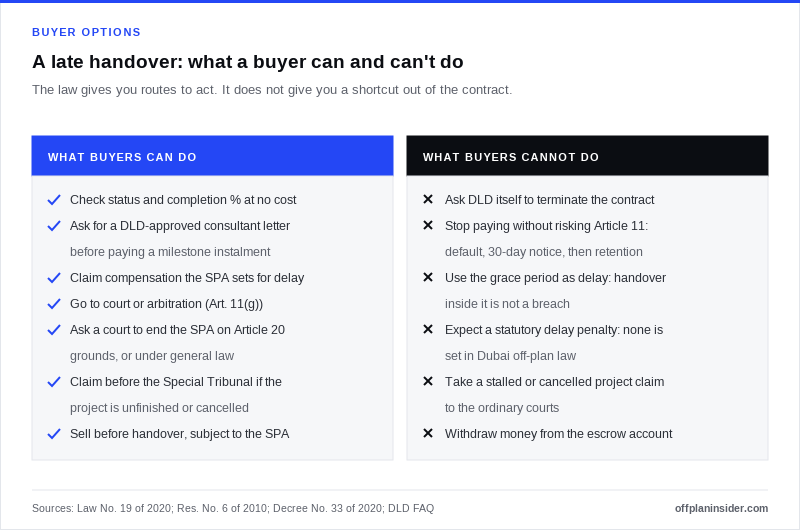
Stopping payment is the most common mistake. If you stop paying, the developer can start the Article 11 default procedure, whatever the reason. After DLD's 30-day notice, a developer may terminate and keep up to 40% of the unit value if the project is 60% complete or more, or up to 25% below that once work has started. Above 80% it may instead keep the contract and claim the balance.
On a unit priced at AED 1,500,000 in a project certified at 65% complete, that cap is AED 600,000. The safer route is the one DLD itself describes: if an instalment is tied to a milestone, ask for confirmation that the milestone has been reached before you pay.
Selling is an exit, not a remedy. You can usually sell before handover, with the developer's no objection certificate and on the terms in your SPA. Our guide to selling off-plan before handover explains how, including the effect of payment thresholds.
10Steps to take if your handover is late
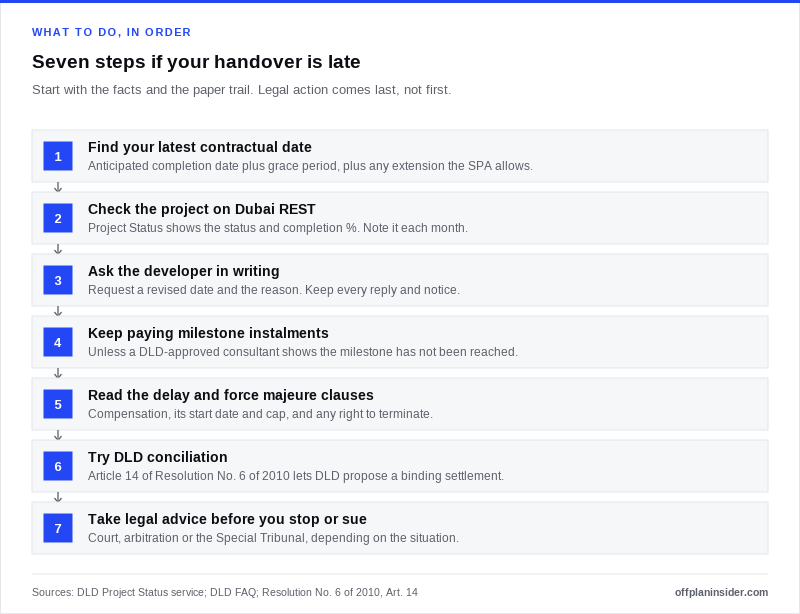
Work through these steps in order. They build the evidence you need for any later claim, and many delays are resolved before the later steps are reached.
- Work out your latest contractual date. Add the grace period and any valid extensions to the anticipated completion date. Note the SPA clause behind each figure.
- Check the project on Dubai REST. Record the status and completion percentage, with the date, and repeat each month.
- Write to the developer. Ask for a revised completion date and the reason for the delay. Keep every reply, notice and email in one place.
- Keep your contact details current. SPAs send notices to the address and email you gave. A missed notice can cost you a deadline.
- Keep paying, but check milestones. For a milestone-linked instalment, ask for a DLD-approved consultant's letter confirming the stage before you pay.
- Read the delay and force majeure clauses. Note the compensation rate, start date, cap, notice requirements and any right to terminate.
- Try DLD conciliation. Under Article 14 of the 2010 bylaw, DLD can propose a settlement. Once approved by DLD, a signed settlement binds both sides.
- Take legal advice before you act. A UAE-qualified lawyer can say whether your claim belongs in court, in arbitration under your SPA, or before the Special Tribunal.
- File in the right forum. Ordinary delay disputes go to the Dubai Courts or to arbitration if your SPA has a valid arbitration clause. Unfinished and cancelled projects go to the Special Tribunal.
General complaints about a government service can also be made through the Dubai Government's eComplain platform. It is not a substitute for a court or tribunal claim.
11What does the law not cover?
Knowing the gaps helps you read your SPA with the right expectations.
- No statutory delay penalty. Dubai's off-plan laws do not set a rate of compensation for late handover. It comes from the SPA or from a court or arbitrator.
- No statutory grace period. The length of the grace period, and the events that extend it, are contract terms.
- No automatic right to cancel for delay. A buyer needs a court, an arbitrator or the tribunal to end the contract, unless the SPA itself gives a termination right.
- No DLD power to terminate. DLD can mediate and certify, but it cannot end your contract.
- No fixed liquidation timescale. The bylaw sets deadlines for refunds after a RERA cancellation, but DLD gives no fixed time for distributing money in a liquidation.
12Key terms
| Term | Meaning |
|---|---|
| SPA | Sale and purchase agreement: the contract between you and the developer for an off-plan unit. |
| Anticipated completion date | The date in the SPA when the developer expects the building to be finished. A target, not the deadline. |
| Grace period | Extra time after the anticipated date, set by the SPA, within which late completion is not a breach. |
| Force majeure | An event outside a party's control that the SPA allows to extend the timetable, usually with notice. |
| Completion percentage | How far construction has progressed, confirmed by a RERA-approved consultant's technical report after a site inspection. |
| Oqood | DLD's Interim Real Property Register. An off-plan sale is void unless it is registered on it. |
| Escrow account | A bank account in the project's name into which buyer payments go under Law No. 8 of 2007, ring-fenced from the developer's creditors. |
| Unfinished project | A project where construction started and was then suspended, for any reason. Claims go to the Special Tribunal. |
| Cancelled project | A project cancelled by a final reasoned RERA decision. Buyers are entitled to a full refund. |
| Special Tribunal | The body set up under Decree No. 33 of 2020 to decide claims about unfinished and cancelled projects. Its decisions are final. |
| Conciliation | DLD's attempt to settle a dispute under Article 14 of the 2010 bylaw. A signed settlement binds both sides once DLD approves it. |
| Article 11 default procedure | The steps a developer must follow if a buyer stops paying: DLD notice, 30 days to pay, then limited retention. |
13Where to go next
If your project is close to completion, the steps from completion notice to keys are in our handover guide, and the inspection that follows is in our snagging guide. For the contract itself, read our guide to the off-plan SPA.
If you are still choosing, look at projects that are already well advanced on our near-handover page, or compare schedules for 2027 handovers. Browse every off-plan project in Dubai, and read the protections that apply to all of them in off-plan buyer protection.
FAQQuestions buyers ask.
Is a developer allowed to hand over later than the date in my SPA?
Yes, within limits. Most SPAs give an anticipated completion date and a grace period after it, and some list events that extend the date further. Handover within that combined window is not a breach. Once the window has passed without handover, the developer is late under the contract and the SPA's delay clause and your legal remedies come into play.
Am I entitled to compensation for a delayed handover in Dubai?
Only if your SPA provides it or a court or arbitrator awards it. Dubai's off-plan laws do not set a standard delay penalty. Read your SPA's delay clause for the rate, the date it starts, any cap and how it is paid, which is often as a credit against the final instalment. If there is no clause, compensation depends on proving loss.
Can I cancel my off-plan purchase because of a delay and get a full refund?
Not on your own, and not through DLD, which says it has no power to terminate a contract between a buyer and a developer. You can ask a court or an arbitrator to end the contract. A full refund is automatic only where RERA cancels the project, or where work never started for reasons beyond the developer's control, under Article 11(b).
Should I stop paying instalments if my project is delayed?
Take advice first. If you stop paying, the developer can start the Article 11 default procedure, and after DLD's 30-day notice it may terminate and keep up to 25% or 40% of the unit value depending on completion. If an instalment is tied to a construction milestone, you can ask for a letter from a DLD-approved consultant confirming the milestone has been reached.
How do I check whether my off-plan project is delayed?
Use DLD's Project Status service in the Dubai REST app or on the DLD website. Search by project number, land number or project name. It shows the project's status and completion percentage, and there is no fee. Compare the percentage over a few months, and compare it with the dates in your SPA.
What is the Special Tribunal for unfinished and cancelled projects?
It is a dedicated judicial body set up under Decree No. 33 of 2020, with its head office at DLD. It decides claims about projects that started and stopped, and about cancelled projects. It can assign completion to another developer, liquidate cancelled projects and order refunds. Its decisions are final, and claims before it are exempt from judicial fees.
What happens to my money in escrow if the project stalls?
It stays ring-fenced. Under Law No. 8 of 2007 the escrow account is dedicated to that project, and the developer's creditors cannot attach it. If a project is not completed, Article 15 requires the escrow agent to consult DLD and take steps either to complete the project or to refund depositors. If RERA cancels the project, refunds come from escrow first.
Can a developer use force majeure to extend the handover date?
Only as far as the SPA and the law allow. Read the force majeure clause for the events it lists, whether it needs written notice and whether it has a time limit. A developer relying on force majeure generally has to show the event and its effect on the work. If you disagree, the dispute goes to court, arbitration or, for a stalled project, the Special Tribunal.
Sources & methodWhere these figures come from.
Sources
- Dubai Legislation Portal: Law No. (13) of 2008
- Dubai Legislation Portal: Law No. (9) of 2009 Amending Law No. (13) of 2008
- Dubai Legislation Portal: Law No. (19) of 2020 Amending Law No. (13) of 2008 Regulating the Interim Real Property Register in the Emirate of Dubai
- Dubai Legislation Portal: Executive Council Resolution No. (6) of 2010 Approving the Implementing Bylaw of Law No. (13) of 2008
- Dubai Legislation Portal: Law No. (8) of 2007
- Dubai Legislation Portal: Decree No. (33) of 2020 Concerning the Special Tribunal
- Dubai Land Department: Real estate project status enquiry
- Dubai Land Department: Frequently asked questions
What we could not verify
- Grace periods, extension events, force majeure wording and delay compensation are set by each SPA, not by statute, and they vary between contracts.
- We found no standard statutory penalty for late handover in Dubai's off-plan laws, so the guide treats delay compensation as whatever the SPA states or a court or arbitrator awards.
- The AED 15,000 per unit fee for a RERA completion-percentage report comes from DLD's published answers, which are undated; confirm it with DLD before you apply.
20 Nov 2026 · Reviewed by OffPlan Insider Research. First published 20 Nov 2026.