A post-handover payment plan lets you take the keys to a new Dubai home while part of the price is still owed to the developer, and pay that balance in instalments over an agreed period after handover. Until the last instalment is paid, the sale normally stays on the Dubai Land Department's interim register (Oqood), because the department moves units to the main Property Register and issues a title deed once they are fully paid for. If you miss an instalment, the developer must follow the Dubai Land Department's 30-day notice procedure before it can act. Selling or mortgaging the home before the balance is cleared needs the developer's no objection certificate.
Key takeaways
- A post-handover plan is credit from the developer, written into your sale and purchase agreement. It is not a bank loan, so there is no bank valuation, and the terms are only what the contract says.
- The title deed usually waits for the final instalment. The Dubai Land Department transfers fully paid units from the interim register to the Property Register and issues the deed then.
- Service charges and utility bills start at handover, so the first years of ownership carry both the instalments and the running costs.
- If you fall behind, the developer must report the default to the Dubai Land Department, which gives you 30 days' written notice. A handed-over project is over 80% complete, so the developer may then claim the balance, ask for an auction or terminate and keep up to 40% of the unit's value.
- You can sell or refinance with a balance outstanding, but only with the developer's no objection certificate. A bank can pay off the developer, and the mortgage is registered at 0.25% of the loan.
- Read a plan for six things: the split, the length of the post-handover period, what counts as handover, the instalment dates, the late-payment and default clauses, and the conditions for resale and early settlement.
01What is a post-handover payment plan?
A post-handover payment plan lets you take the keys to a new home while part of the price is still owed to the developer. You pay that balance in instalments over an agreed period after handover, as set out in your sale and purchase agreement (SPA).
This guide explains how post-handover payment plans work: the mechanics, the paperwork and the risks. To compare live projects that offer one, see our post-handover payment plan projects, which lists them with prices and handover dates.
It is credit from the developer, not a mortgage. There is no bank valuation and no bank underwriting, and the developer is not lending you cash: it is letting you pay part of the price later. The only rules that apply beyond Dubai's property laws are the terms in your contract, so the contract is where the real plan lives.
Our guide to off-plan payment plans in the UAE compares the common structures in money terms. This guide goes deeper on the one that runs past the keys.
02How is the split set out?
A post-handover plan is written as the share paid before handover and the share paid after it, for example 50/50 or 60/40. The "after" share is then divided into the amount due at handover and a schedule of instalments over a set number of months or years.
The headline split hides three different pieces of money. Read them separately:
- Before the keys. The booking deposit and the construction instalments. Under Dubai's escrow law these payments go into the project's escrow account. Our escrow guide explains how that money is protected.
- At handover. Many post-handover plans still ask for a lump sum when the keys are released. It is often smaller than on a conventional plan, but it is rarely zero.
- After the keys. The balance, paid monthly, quarterly or in a few larger instalments over the period in the contract.
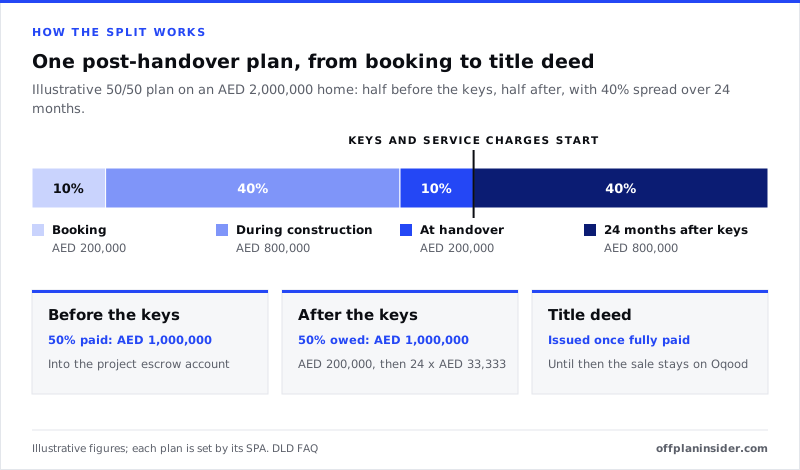
A worked example
Take a home priced at AED 2,000,000 on an illustrative 50/50 plan, split 10/40/10/40:
| Stage | Share | Amount | When |
|---|---|---|---|
| Booking | 10% | AED 200,000 | On signing |
| Construction | 40% | AED 800,000 | In instalments during the build |
| Handover | 10% | AED 200,000 | Before the keys are released |
| After handover | 40% | AED 800,000 | 24 monthly instalments of about AED 33,333 |
Stretch the same AED 800,000 over 36 months and each instalment falls to about AED 22,222. Over 60 months it is about AED 13,333. A longer schedule lowers the monthly figure, but it also keeps the title deed further away, as the next section explains.
The 4% Dubai Land Department fee is calculated on the full price and paid once, when the sale is registered on Oqood. On this example that is AED 80,000, due at the start, not spread over the plan. Our DLD fee guide explains it in full.
03When do I get the title deed, and what is the Oqood?
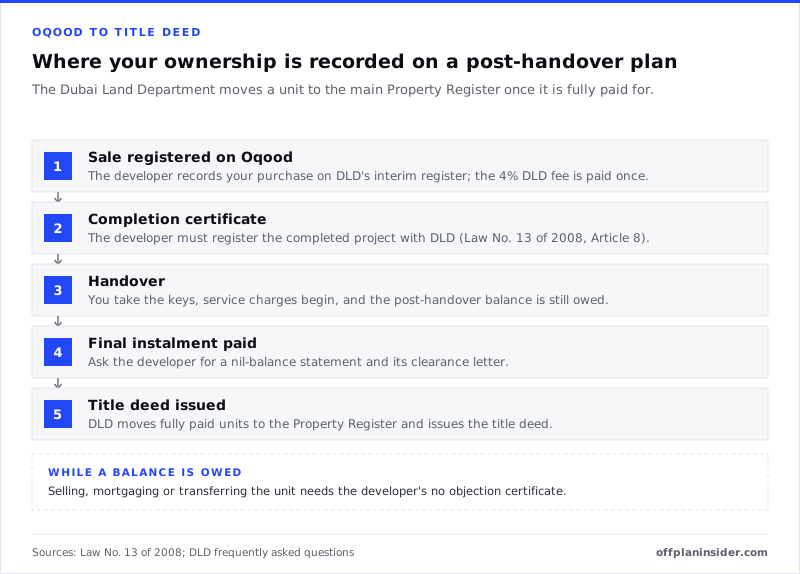
You normally get the title deed after the last instalment, not at handover. Until then your purchase stays registered in your name on the Dubai Land Department's interim register, known as Oqood.
What Oqood is. Law No. 13 of 2008 created an interim property register for off-plan sales. Under Article 3, any sale of an off-plan unit must be entered there, and a sale that is not entered is void. When you buy off-plan, the developer registers the sale on Oqood and you receive a registration certificate in your name.
What happens at completion. Article 8 of the same law says the developer must enter a completed project in the main Property Register once it receives the completion certificate. That includes registering sold units in buyers' names, "provided the purchasers have fulfilled their contractual obligations". The department may also register a unit at the buyer's request on the same condition.
Why the deed waits. The Dubai Land Department's published guidance says that units which have been fully paid for are transferred from the initial register to the real estate register, and a title deed is issued. On a post-handover plan you have not paid in full at handover, so the unit normally stays on Oqood until the final instalment clears.
Does staying on Oqood matter?
You are still the registered buyer, and Oqood is an official registration. You can live in the home, let it out and, with the developer's consent, sell it. Law No. 7 of 2006 gives the department's registers "absolute evidentiary value", and transactions are valid only once recorded.
What changes is what you can do alone. While the unit is on the interim register with a balance owed, the developer's consent is part of every major step: resale, mortgage, transfer to a company or a family member. Some contracts also limit what you can do while instalments are outstanding.
Some developers structure the paperwork differently. Ask before you sign how and when the title deed will be issued, whether anything will be registered against the unit in the developer's favour, and what document you receive when the last instalment is paid.
What to collect when you pay the last instalment
- A nil-balance statement from the developer, matching your receipts.
- A clearance or completion letter confirming the plan is settled.
- Confirmation that the title deed application has been made, and the expected timing.
- The title deed itself, normally issued electronically by the Dubai Land Department. You can check it with the department once issued.
04What changes at handover if I still owe money?
The keys come with the full costs of ownership, even though part of the price is still unpaid. From handover you pay the instalments and the running costs together.
Service charges start. Under Law No. 6 of 2019 an owner pays RERA-approved service charges for the building, invoiced through the Mollak system. You can look up a project's approved rate on the Dubai Land Department's Service Charge Index. Our handover guide explains what is payable at handover and after.
Utilities start. You open electricity and water accounts, and a cooling account where the building uses district cooling, and pay the deposits.
The instalments carry on regardless. An instalment falls due on its date whether or not the home is let, whether or not the building's facilities are fully open, and whether or not you have a snagging dispute with the developer. Raise defects in writing, but keep paying while you do.
Budget for both. A useful test before you sign: take the monthly post-handover instalment, add a monthly share of the expected service charge and utilities, and check whether your income or a realistic rent covers the total. Use rents for comparable finished homes nearby, not projections. Our guide to Dubai rents and the rental index shows where official rent figures come from.
Letting the home. If you rent the home out, the tenancy must be registered on Ejari. Check your SPA for any condition on leasing while a balance is owed. Short-term holiday letting needs a permit from the Department of Economy and Tourism; our holiday homes guide covers it.
05What happens if I miss an instalment after handover?
The developer will chase the payment and may apply the late-payment charge in your SPA. If the instalment stays unpaid, the developer must follow a legal procedure through the Dubai Land Department before it can cancel or claim, and you have 30 days to put things right.
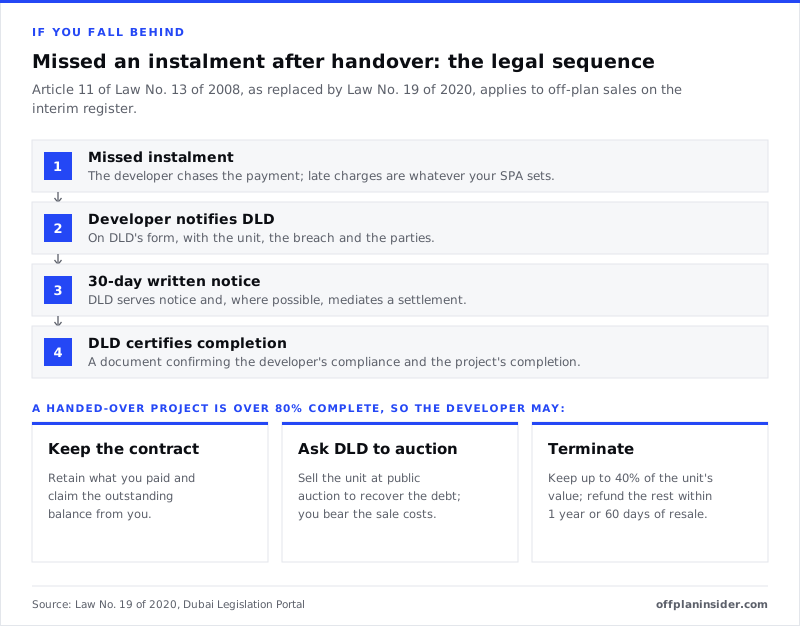
The procedure is in Article 11 of Law No. 13 of 2008, as replaced by Law No. 19 of 2020. It applies to off-plan sale agreements on the interim register, which is where a unit on a post-handover plan normally sits until it is paid off.
- The developer notifies the department on its form, with the parties, the unit and the breach.
- The department serves a 30-day written notice on you, in person, by registered mail, by email or by another method it sets. Where possible it mediates a settlement, which is then signed and attached to your contract.
- If nothing is resolved, the department issues a document confirming that the developer has met its own obligations and stating the project's completion percentage.
- The developer chooses its remedy, within limits set by the completion percentage.
By handover a project is complete, so the options for projects more than 80% complete apply. The developer may:
- keep the contract, retain what you have paid and claim the outstanding balance from you;
- ask the department to sell the unit at public auction to recover what is owed, with you liable for the costs of the sale; or
- terminate the contract, keep up to 40% of the unit's value and refund anything you paid above that.
If the developer terminates, the refund is due within one year of termination or within 60 days of the unit being resold, whichever is earlier. The law says these rules are part of public order, so a termination that skips the procedure is void, and you keep the right to go to court or arbitration.
Why this hurts more after the keys
Before handover a buyer in trouble can often sell the contract or agree an exit. After handover you may be living in the home or have a tenant in it, and the developer's options include an auction of a finished, occupied property. At that stage you may also have paid well over half the price, which is what is at stake.
What to do if you can see trouble coming
- Talk to the developer before the due date, in writing. Ask whether it will reschedule, defer or restructure the remaining instalments, and get any agreement signed as an addendum.
- Look at refinancing. A bank may pay off the balance with a mortgage on the finished home (see below).
- Consider selling with the developer's consent before arrears build up. Developers are less likely to approve a transfer while payments are overdue.
- Do not ignore a notice. The 30 days run from the date of the notice, and you can pay or settle within them.
The full default rules, with worked refund examples, are in our guide on what happens if you can't pay off-plan instalments in Dubai.
06Can I use a mortgage with a post-handover plan?
Yes, in two different ways: a bank can lend at handover to reduce what you owe the developer, or it can pay off the developer's balance later. Either way the bank lends against its own valuation and its own view of your income.
Lending on a completed home. Once the building has its completion certificate, a bank can lend on the finished home. The Central Bank's mortgage regulations cap lending against off-plan property at 50% of its value; lenders differ on whether a completed unit still registered on Oqood counts as off-plan or completed. Ask the bank in writing which cap it will apply.
Paying off the developer. If the bank agrees, it pays the outstanding post-handover balance to the developer, and its mortgage is registered with the Dubai Land Department. The department's mortgage registration service lists:
| Item | Amount |
|---|---|
| Mortgage registration fee | 0.25% of the mortgage value |
| Title deed issuance | AED 250 per deed |
| Knowledge and innovation fees | AED 10 each |
| Service partner fee | AED 4,000 plus VAT, or AED 5,000 plus VAT for a unit on Oqood |
| Developer consent | An electronic no objection certificate from the developer, through the Dubai REST app, for a unit on the interim register |
On an AED 800,000 loan, the 0.25% registration fee is AED 2,000. Banks also charge for the valuation and arrangement; ask for a full list.
Why refinance at all? A mortgage spreads the balance over a much longer term, so the monthly payment can be lower. It also usually means the title deed is issued and the mortgage is registered against it. Against that, a bank loan carries interest, and a developer plan may not, so compare the total cost and not only the monthly figure. Eligibility, non-resident lending and examples are in our off-plan mortgage guide.
07Can I sell with a post-handover balance outstanding?
Yes, with the developer's consent. The Dubai Land Department's guidance is that resale before the unit is transferred to the main register is possible after obtaining a no objection certificate from the developer.
There are two common ways to handle the balance:
| Route | How it works | What to check |
|---|---|---|
| Clear the balance on sale | The buyer's money, or the buyer's bank, pays off what you owe the developer, and you receive the rest | The developer's settlement figure, and how the payments are sequenced on transfer day |
| Buyer takes over the plan | The buyer pays you for what you have paid, plus any premium, and steps into the remaining instalments | The developer must agree; it may assess the new buyer and set its own conditions |
The fees. A resale is a new sale, so the 4% Dubai Land Department fee is due on the new price under Executive Council Resolution No. 30 of 2013; the law splits it equally between buyer and seller unless they agree otherwise. The developer sets its own charge and conditions for the no objection certificate; ask for them in writing at the time you buy.
Selling before handover. If you plan to sell during construction instead, the rules and costs are in our guide to selling off-plan before handover.
08How do I read a post-handover plan before I sign?
Read the payment schedule in the SPA, not the brochure, and check it line by line against the questions below. Two plans with the same headline split can behave very differently.
- The real split. How much is paid before handover, at handover and after it? Add the 4% DLD fee and other buying costs to the first number.
- The length. How many months or years does the post-handover period run, and how many instalments are there?
- What triggers the schedule. Does the first post-handover instalment run from the handover date, from the completion certificate or from a fixed calendar date? If the building finishes early or late, which dates move?
- What counts as handover. Many contracts treat the unit as handed over if you do not complete by the deadline in the notice. That can start the post-handover clock and service charges without you taking the keys.
- The amount due at handover. Is there a lump sum on the keys, and does it include fees and the first service charge payment?
- Interest and charges. Is any interest, administration fee or instalment charge added? What is the late-payment charge, and from when?
- How you pay. By bank transfer, direct debit or post-dated cheques? Where do the instalments go?
- Early settlement. Can you pay off the balance early, and is there a discount or a charge for doing so?
- Resale and mortgage. What does the developer require before it issues a no objection certificate while a balance is owed, and what does it charge?
- The title deed. When is it issued, and what is registered against the unit in the meantime?
- Leasing. Can you let the home, long term or short term, while the balance is outstanding?
- Default. Does the default clause match the procedure in Law No. 19 of 2020? It should not try to skip the Dubai Land Department notice.
If a point is unclear, ask the developer to answer it in writing before you sign. Our guide to off-plan buyer protection in Dubai covers the wider safeguards.
09Who is a post-handover plan suited to?
It suits a buyer who wants to keep cash free at handover and has a reliable way to pay the instalments afterwards. It suits a buyer who is stretching to reach handover at all much less well.
| Buyer | Why it can work | What to watch |
|---|---|---|
| Investor letting the home | Rent can contribute to the instalments from the first tenancy | Rent is not guaranteed; voids and service charges come first |
| End user with steady income | Moves in without a large final payment or a mortgage on day one | The instalment plus running costs must fit monthly income |
| Buyer expecting cash later | A bonus, sale or maturity can clear the balance early | Timing risk if the money arrives late |
| Buyer who cannot borrow easily | No bank approval is needed for the developer credit | The developer's default remedies apply if payments stop |
If your aim is the golden visa, read our guide to the golden visa through UAE property first. GDRFA Dubai's service card accepts mortgaged property, but how a developer balance is treated is assessed on your file.
10Key terms
- Post-handover payment plan. A schedule under which part of the price is paid after the keys are handed over.
- SPA. The sale and purchase agreement with the developer, which sets the plan.
- Oqood. The Dubai Land Department's interim register for off-plan sales, and the registration certificate you receive.
- Property Register. The main register; a title deed is issued from it.
- Completion certificate. The authority's confirmation that the building is complete.
- No objection certificate (NOC). The developer's written consent to a resale, mortgage or transfer.
- Mollak. The system through which service charges are invoiced and paid in Dubai.
11Where to go next
Compare live projects on our post-handover payment plans page, or browse every structure on payment plans. If you are weighing up cash flow, our guide to the true cost of buying off-plan in Dubai lists every fee from booking to resale. Tell us your budget and how long you want to pay after the keys, and we will send projects whose plans fit, with today's terms checked for each.
On live projectsSee these plans on live projects.
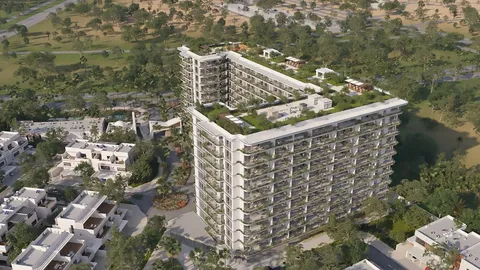 40 / 60California ResidencesInfracorp · Price on request
 60 / 40East Residence 2 at Serenia DistrictPalma Holding · Price on request
 50 / 50MirdadUnion Properties · from AED 999,000
Compare payment plans side by side for projects with a verified schedule.
FAQQuestions buyers ask.
What is a post-handover payment plan in Dubai?
It is a payment plan in which part of the price of an off-plan home is paid to the developer after you receive the keys, in instalments over an agreed period. The terms sit in your sale and purchase agreement. It is credit from the developer rather than a bank mortgage, and it ends when the last instalment is paid.
Do I get the title deed at handover on a post-handover plan?
Usually not. The Dubai Land Department transfers units that have been fully paid for from the interim register to the Property Register and issues the title deed at that point. While a post-handover balance is owed, your purchase normally stays registered on Oqood in your name. Ask the developer how its contract handles the deed before you sign.
Can I rent out my home before I finish the post-handover payments?
In most cases, yes, because you have possession from handover. The tenancy must be registered on Ejari, and some developers set conditions on leasing while a balance is owed, so check your sale and purchase agreement. Rent does not pause the instalments: each one is due on its date whether or not the home is let.
What happens if I miss a post-handover instalment?
The developer will first chase the payment and may apply any late charge in your contract. If it stays unpaid, the developer must notify the Dubai Land Department, which serves a 30-day written notice and tries to broker a settlement. After that, on a completed project, the developer may keep the contract and claim the balance, ask for the unit to be auctioned, or terminate and keep up to 40% of its value.
Can I sell a property that still has a post-handover balance?
Yes, with the developer's no objection certificate. Either you clear the balance from the sale proceeds, or the buyer takes over the remaining instalments with the developer's agreement. The Dubai Land Department fee of 4% is due on the new sale price, and the developer sets its own conditions and charges for the certificate.
Can I use a mortgage to pay off a post-handover plan?
Yes, if a bank will lend on the completed home. The bank pays the developer the outstanding balance and registers its mortgage with the Dubai Land Department, which charges 0.25% of the loan plus fixed fees. For a unit still on Oqood, the department asks for the developer's electronic no objection certificate, and the service partner fee is AED 5,000 plus VAT.
Is a post-handover plan more expensive than paying at handover?
Not necessarily, but compare the price. The plan changes when you pay, and some developers price a project differently depending on the plan you choose. Ask for the price with and without the post-handover option, and whether any interest, administration charge or early-settlement discount applies.
Does a property on a post-handover plan qualify for the golden visa?
The rules look at the value and ownership of the property, and GDRFA Dubai accepts mortgaged property. How a developer balance is treated is decided on your file, so confirm it with the Dubai Land Department before you rely on it. Our golden visa guide explains the eligibility rules.
Sources & methodWhere these figures come from.
Sources
- Dubai Legislation Portal: Law No. (13) of 2008
- Dubai Legislation Portal: Law No. (19) of 2020 Amending Law No. (13) of 2008 Regulating the Interim Real Property Register in the Emirate of Dubai
- Dubai Legislation Portal: Law No. (7) of 2006
- Dubai Legislation Portal: ECR 30 of 2013
- Dubai Land Department: Frequently asked questions
- Dubai Land Department: Request for mortgage registration
- Dubai Land Department: Request to register the initial sale
- Dubai Land Department: Service charge index overview
- gdrfad.gov.ae: Node
- Central Bank of the UAE Rulebook: Regulations regarding mortgage loans
What we could not verify
- Whether every developer keeps a post-handover unit on the interim register until the last instalment, or some transfer the title deed earlier and register a mortgage or other restriction in their own favour, could not be confirmed from an official source; the text relies on the Dubai Land Department's statement that fully paid units are transferred and tells readers to ask.
- Where post-handover instalments are paid (into the project escrow account or to the developer directly) is not stated on an official page we could open; the text tells readers to ask.
- Whether the default procedure in Law No. 19 of 2020 applies in the same way to a completed unit still on the interim register after handover was not confirmed by an official ruling or guidance; the text applies it because the sale remains an off-plan sale on the interim register.
5 Nov 2026 · Reviewed by OffPlan Insider Research. First published 5 Nov 2026.