An expression of interest (EOI) in Dubai property is a form and payment that put you on a developer's list before a launch, usually for priority at unit allocation. It does not buy a unit. The developer sets its amount and refund terms, so get them in writing. The sale exists in law once the SPA is registered on Oqood.
Key takeaways
- An EOI buys a place in the queue at a launch, not a unit. You choose a unit, if one suits you, at allocation, and the purchase begins with the reservation form and the sale and purchase agreement (SPA).
- The EOI amount and its refund terms are set by each developer for each launch. Before an SPA, those written terms decide whether and when you get the money back.
- Ask for three things in writing: a full refund if you are not allocated a suitable unit, the refund period and any deduction, and whether the EOI is credited to the booking payment.
- Law No. 8 of 2007 requires buyers' payments to go into the project escrow account, and the Dubai Land Department (DLD) says money received before an account was opened must be paid into it.
- A developer needs DLD's written authorisation to advertise off-plan units, and DLD says a project can be launched or announced only after registration and accreditation. Check the advert's Trakheesi permit and Madmoun QR code.
- Once you sign the SPA, the Article 11 default rules of Law No. 13 of 2008, as amended in 2020, cap what a developer may keep if you stop paying: 25% or 40% of the unit value, by completion.
- Under Article 3 of Law No. 13 of 2008, an off-plan sale is void unless it is registered on Oqood, so the EOI is only the first of five steps.
01What is an expression of interest in Dubai property?
An expression of interest, or EOI, is the first thing many buyers sign at a Dubai off-plan launch. It is a short form, usually with a payment, that puts your name on the developer's list before the project opens for sale.
What it secures is a place in the queue. When the developer releases the price list and opens unit selection, EOI holders are typically invited first, in an order the developer sets. You still have to choose a unit, sign a reservation form and then a sale and purchase agreement (SPA) before you have bought anything.
That is the whole point of this guide. An EOI is useful, and at popular launches it can be the only way to choose from the full range of units. But the money you pay at that stage is governed by a different set of rules from the money you pay once a sale exists, so it pays to know which rules apply when.
This guide explains what an EOI is, how it compares with a reservation, the SPA and Oqood, when it can be refunded, what the escrow law and RERA's advertising rules require, and the checks to run before you pay. It is general information, not legal advice. To see what is launching now, browse our new launches and the full list of off-plan projects.
02How an EOI fits into an off-plan purchase
An off-plan purchase in Dubai moves through five steps, and the EOI is the first. Each step secures something different, and only the last makes the sale exist in law.
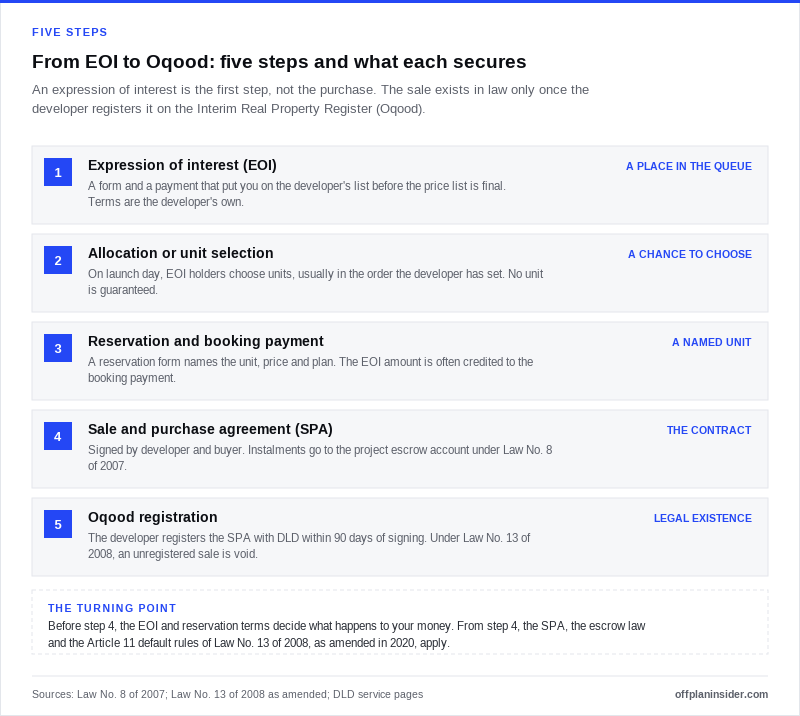
Step 1, the EOI. You fill in a form, provide identity documents and pay the amount the developer has set. Developers and brokers also run know-your-customer checks at this point, because they are covered by UAE anti-money laundering rules.
Step 2, allocation. On the launch or allocation day, the developer releases the price list, floor plans and payment plan, and EOI holders choose units. Nothing guarantees that the unit you wanted is still free when your turn comes.
Step 3, reservation. Once you choose a unit, you sign a reservation or booking form that names it, with the price and payment plan, and you pay the booking amount. The EOI is often credited to that payment.
Step 4, the SPA. The developer sends the sale and purchase agreement, often for electronic signature. From here, instalments are paid into the project's escrow account. Our guide to the sale and purchase agreement explains each clause.
Step 5, Oqood. The developer registers the SPA on the Dubai Land Department's (DLD's) Interim Real Property Register, known as Oqood. DLD's service page sets a deadline of 90 days from signing, and Article 3 of Law No. 13 of 2008 says an off-plan sale is void unless it is registered. Our Oqood guide covers the certificate.
03EOI, reservation, SPA and Oqood compared
People use these words loosely, and sales teams sometimes do too. The difference matters, because each document gives you different rights.
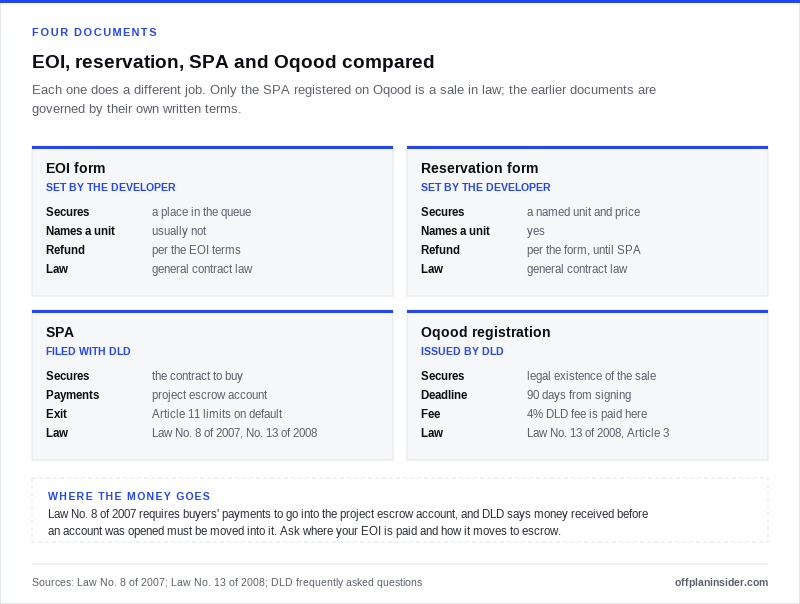
The table sets out the same comparison in more detail.
| EOI | Reservation or booking | SPA | Oqood | |
|---|---|---|---|---|
| When | Before the launch or allocation | When you choose a unit | Days to weeks after reserving | Within 90 days of the SPA |
| What it secures | Priority in the queue | A named unit, price and plan | The contract to buy | Legal existence of the sale |
| Who sets the terms | The developer | The developer | The developer, on the standard contract filed with DLD | DLD |
| Refund if you walk away | As the EOI terms say | As the reservation terms say | Article 11 limits if you default | Follows the SPA |
| Fees | The EOI amount | The booking payment | Instalments into escrow | 4% DLD fee |
Two points stand out. Until you sign the SPA, your rights come mainly from the EOI and reservation forms, so read them as carefully as the contract. And the SPA itself is not the end: it is the Oqood registration that makes the sale exist in law.
04Why developers use EOIs at launches
A busy launch can attract more buyers than there are units. An EOI lets the developer gauge demand, prepare the paperwork and run allocation in an orderly way.
For buyers, the benefit is access. EOI holders usually see the price list and choose before the public sale opens, which matters most for the units people compete over: higher floors, better views, corner layouts and the smallest number of large homes.
EOIs are not limited to new towers. They are also used for a new phase of an existing community, for villa plots in a masterplan, and for commercial blocks. On our project pages, a project with an EOI open is marked as coming soon or in presale, with the amount the developer has set where one applies. Projects that are announced but not yet open are on our upcoming projects page.
05How much is an EOI?
There is no official standard. Dubai law does not fix an EOI amount, and DLD does not publish a range, so each developer sets the figure for each launch.
In practice the EOI is usually a fixed dirham sum per unit, not a percentage of the price. It tends to be higher for villas, large homes and commercial space than for studios and one-bedroom flats. Some launches take a registration with no payment at all.
What matters more than the amount is what happens to it next. Ask whether it is credited to the booking payment, whether it is held for one unit or several, and how long it is held before a refund is due. Our payment plans pages explain what you will pay after the EOI, from the booking amount to handover.
06Is an EOI refundable?
It depends on the written terms. Before an SPA, there is no Dubai law that fixes a refund rule for an EOI, so the EOI form and the general law of contract decide.
That makes the refund clause the most important line on the form. The table below sets out the four situations buyers ask about most.
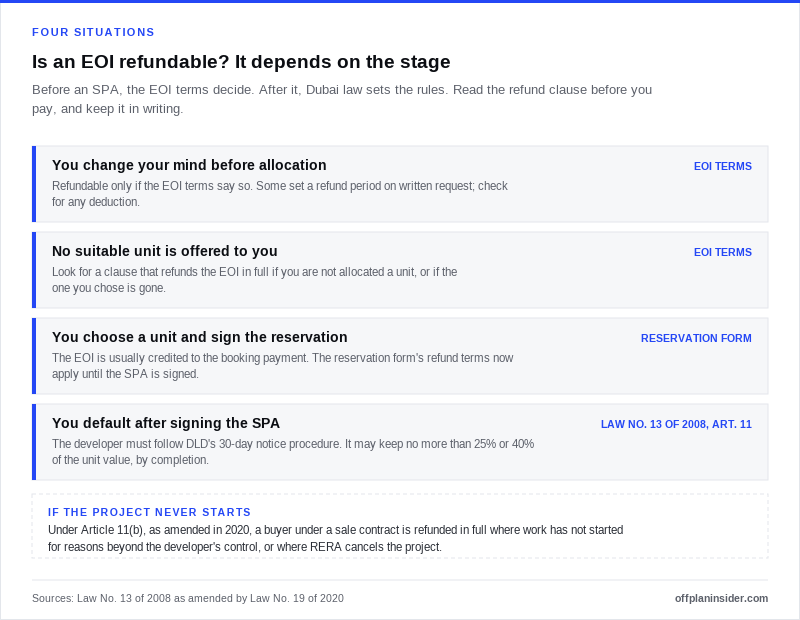
Before allocation. If you change your mind, you get the money back only if the EOI terms allow it. Look for the notice you must give, the period within which the refund is paid and any deduction.
If no suitable unit is offered. This is the situation a good EOI form deals with clearly. You want a sentence saying the EOI is refunded in full if you are not allocated a unit, or if none of the units left at your turn suits you.
Once you reserve. The EOI usually becomes part of the booking payment. From then on, the reservation form's terms govern a refund until you sign the SPA. A reservation form that does not mention a refund at all is a reason to ask before you sign.
After the SPA. The law takes over. If you stop paying, the developer must follow the procedure in Article 11 of Law No. 13 of 2008, as replaced by Law No. 19 of 2020, and the amount it may keep is capped. The section on the SPA below sets out the limits.
07What the EOI paperwork should say
A clear EOI form answers every question you would otherwise have to ask on launch day. If any of these points is missing, ask the developer to add it or to confirm it by email.
| Point | What to look for | Why it matters |
|---|---|---|
| The parties | The developer company named on the DLD project record, and your name as on your passport | The EOI should be with the company that will sign your SPA |
| The project | The project name and, where it is registered, its DLD project number | Lets you find it on DLD's Project Status service |
| The amount and payee | The amount, the account it is paid to and a receipt | Shows where your money is and how it reaches escrow |
| What it secures | Priority in allocation, and for how many units | Avoids assuming it reserves a specific unit |
| Refund if not allocated | A full refund if no suitable unit is offered | The most common reason buyers want their money back |
| Refund on request | The notice, the period and any deduction | Decides how quickly you can walk away |
| Credit to the booking | That the EOI is credited to the booking payment | Avoids paying twice |
| Expiry | What happens if the launch is delayed or does not take place | Your money should not be held indefinitely |
Keep the signed form, the receipt and every email about allocation. If you later reserve, check that the reservation form refers to the EOI and shows it as paid.
08Priority allocation: how launch day works
Allocation is how a developer matches buyers to units when a project opens. Each developer runs it differently, but the pattern at most Dubai launches is similar.
EOI holders are invited to an allocation event, in person or online, on a set date. The developer releases the final price list, floor plans and payment plan, and buyers choose in an order the developer has fixed, often the order in which EOIs were received, sometimes by priority tier.
Three points are worth knowing before the day:
- Priority is not a unit. An EOI gives you a turn, not a guaranteed home. Popular unit types can go before your turn comes.
- Prices are confirmed on the day. If the EOI was taken before the price list was final, the price you pay is the one on the price list and reservation form, not an earlier indication.
- Have a second choice. Shortlist two or three units in advance, with the price and payment plan you can manage. Our payment plan calculator lays out the cash needed for each.
Once you choose, you usually sign the reservation form and pay the balance of the booking amount within a short period the developer sets. Read that deadline on the EOI form, because missing it can mean losing the unit.
09Escrow: where your EOI money should go
This is where the EOI stage differs most from the rest of the purchase. Dubai's escrow law protects buyers' payments, and it is worth knowing exactly what it says.
What the law requires
Law No. 8 of 2007 applies to every developer that sells units off-plan and receives payments from buyers or financiers (Article 3). A developer that wants to sell off-plan must first ask DLD to open an escrow account for the project, filing documents that include the title deed for the land and a standard sale contract (Article 6).
Payments from off-plan buyers are deposited in that account, opened with an approved escrow agent in the project's name (Article 7). The account is used only for that project's construction and cannot be attached by the developer's creditors (Article 9). Our escrow law guide goes through every article.
DLD's answers add two rules. All amounts received from buyers of units sold off-plan are deposited in the project escrow account. And where a developer has received payments from buyers before opening an account, those payments must be paid into it.
What that means for an EOI
The law is written around payments from buyers of off-plan units. An EOI is often paid before you have bought a unit, and sometimes before the price list is final, so it is reasonable to ask how it is held until you reserve.
The answer should be simple and in writing: which account receives the EOI, and how it is moved into the project's escrow account once you reserve. Your booking payment and every instalment after it should then go to the escrow account shown on the project's DLD record.
Brokers are covered too. Article 12 of the 2010 implementing bylaw of Law No. 13 of 2008 says a broker selling a project must pay the price straight into the project escrow account, without taking its commission out first. Our guide to agent commission on off-plan explains who pays the agent.
How to check the account
Find the project on DLD's Project Status service, on the DLD website or in the Dubai REST app. Its record shows the project number, the developer, the completion status and the escrow bank. Match those details against the EOI form, the reservation form and every payment request.
A request to pay a personal account, or an account in a name different from the developer's, is a reason to stop and confirm with the developer through the contact details on its DLD record. Our guide to checking a project and developer walks through each step.
10RERA's advertising and pre-sale rules
The Real Estate Regulatory Agency (RERA), DLD's regulatory arm, controls who may sell off-plan and how it is advertised. These rules apply to the marketing that leads up to an EOI as much as to the sale itself.
Developer registration. Under Article 4 of Law No. 8 of 2007, no developer may sell off-plan unless it is entered in DLD's developer register and licensed. Article 17 strikes a developer off the register if it fails, without an acceptable reason, to start construction within six months of receiving permission to sell off-plan.
Advert approval. Article 5 says a developer may not advertise off-plan units in local or international media, or at exhibitions, without DLD's written authorisation. DLD's answers say a developer needs a RERA permit to advertise a project, and that a new project can be launched or announced after the registration procedures are complete and the accreditation certificate is issued.
Permits on the advert. Advert permits are issued through Trakheesi, DLD's licensing system. Since 24 April 2023, DLD has required real estate companies to show a QR code from its Madmoun service on their adverts. Scanning it shows that the advert is approved, who is advertising and the authorised property details.
Advertising in free zones. Under Article 5(11) of Law No. 4 of 2019, RERA approves real estate advertising content across the emirate, including in special development zones and free zones. Our RERA guide covers its other powers.
Licensed brokers. A broker should give you a broker registration number (BRN) and the office's registration number (ORN). Both can be checked on DLD's licensed brokers service.
| Rule | Source | What you can check |
|---|---|---|
| Developer must be registered and licensed to sell off-plan | Law No. 8 of 2007, Article 4 | The developer named on the project's DLD record |
| Escrow account requested before selling off-plan | Law No. 8 of 2007, Article 6 | The escrow bank on DLD Project Status |
| Buyers' payments go into the project escrow account | Law No. 8 of 2007, Article 7; DLD answers | The account on your forms and payment requests |
| No off-plan advert without written authorisation | Law No. 8 of 2007, Article 5 | The Trakheesi permit and Madmoun QR code |
| Launch or announce after registration and accreditation | DLD answers | A DLD project number for the project |
| Broker pays the price straight into escrow | Executive Council Resolution No. 6 of 2010, Article 12 | The payee on any payment the broker handles |
| Sale void unless registered on Oqood | Law No. 13 of 2008, Article 3 | Your Oqood certificate after the SPA |
11Once you sign the SPA: what the law adds
The SPA is where the statutory protections begin in full. Two sets of rules matter most if something goes wrong.
If you stop paying. Article 11 of Law No. 13 of 2008, as replaced by Law No. 19 of 2020, sets a fixed procedure. The developer notifies DLD, which serves a 30-day written notice on you and tries to settle the matter. Only then may the developer act, and the amount it may keep depends on how complete the project is.
| Project completion | What the developer may do |
|---|---|
| Over 80% | Keep the contract and claim the balance; ask DLD to sell the unit at public auction; or terminate and keep up to 40% of the unit value in the contract |
| 60% to 80% | Terminate and keep up to 40% of the unit value |
| Under 60%, work started | Terminate and keep up to 25% of the unit value |
| Not started for reasons beyond its control, or cancelled by RERA | Refund all payments through the escrow procedure |
Where the developer terminates and keeps a share, it must refund the rest within one year of termination or within 60 days of reselling the unit, whichever comes first. Article 11(f) makes these rules a matter of public order, so a contract term that goes further cannot be enforced as written.
If the project is cancelled. DLD's answers say that where RERA cancels a project, the developer is asked to return buyers' payments within 60 days of the cancellation decision, a period that can be extended. Our buyer protection guide covers delays, cancellation and defects.
These limits are written for a buyer under an off-plan sale contract. An EOI paid before any sale contract sits outside them, which is why its own terms matter so much.
12Worked examples
The figures below are invented to show the arithmetic. They are not typical EOI or booking amounts, which vary by developer and launch.
Example 1: an EOI credited to the booking
Say you pay an EOI of AED 50,000 for a launch, then choose an apartment priced at AED 1,500,000 with a 10% booking payment. The booking payment is AED 150,000.
If the EOI terms credit it to the booking, you pay a further AED 100,000 at reservation. The 4% DLD fee, AED 60,000, is a separate government fee paid when the developer registers the sale on Oqood.
So the cash needed around reservation is AED 210,000 in all: the EOI, the balance of the booking and the DLD fee, plus any administration fee the developer charges. Our guide to the true cost of buying off-plan lists every cost.
Example 2: no suitable unit at allocation
Now say that at allocation the unit types you wanted have gone, and nothing left fits your budget. You decide not to reserve.
If the EOI form says it is refunded in full where you are not allocated a unit, you get the AED 50,000 back within the period stated. If the form says nothing, the outcome rests on general contract law and on what the developer agrees. That difference is why the clause is worth asking for before you pay.
Example 3: default after the SPA
Finally, say you signed the SPA, paid 30% of the AED 1,500,000 price, AED 450,000, and then could not continue. DLD certifies the project as 50% complete.
Under Article 11, with work started and completion under 60%, the developer may terminate and keep no more than 25% of the unit value, AED 375,000. It must refund at least the remaining AED 75,000 within one year of termination, or within 60 days of reselling the unit if that comes first. Options short of default are in our guide to what to do if you cannot pay your instalments.
13The risks of paying an EOI
An EOI is a normal part of buying off-plan in Dubai. The risks are specific, and each one has a simple check.
- Assuming it reserves a unit. It gives you a turn. Have a second and third choice ready.
- Unclear refund terms. If the form does not say when and how you get the money back, you may wait or lose part of it. Ask before you pay.
- Paying the wrong account. Your money should go to the developer named on the DLD record, and on to the project's escrow account. Confirm any account details by contacting the developer directly.
- An unregistered project. An EOI offered with no DLD project number is a question to ask before paying.
- Pressure on the day. Allocation moves quickly. Decide your budget, unit types and payment plan in advance so you are not choosing under time pressure.
- Paying for more than you need. If one EOI covers several units, or several EOIs are needed for several units, know which before you pay.
- Cash. Pay by bank transfer and keep the receipt. Cash payments for real estate also trigger UAE anti-money laundering reporting.
14Checklist before you pay an EOI
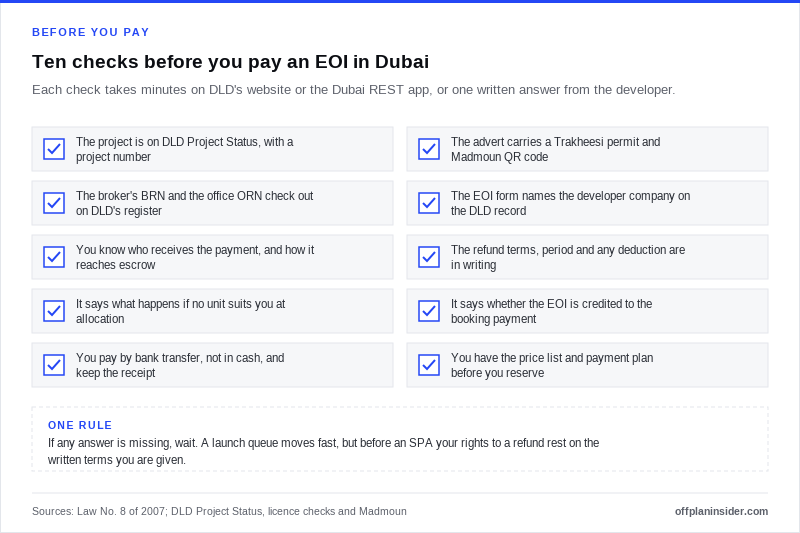
Run these checks in order. Most take a few minutes on DLD's website or the Dubai REST app; see our Dubai REST app guide for where each service sits.
- Find the project on DLD Project Status and note its project number, developer and escrow bank.
- Scan the advert's Madmoun QR code, or check its Trakheesi permit on DLD's licence and permit validation service.
- Check the broker's BRN and ORN on DLD's licensed brokers service, if you are buying through an agent.
- Match the developer on the EOI form to the company on the DLD record.
- Confirm the payee and how the EOI reaches the project's escrow account.
- Read the refund clause: the notice, the period, any deduction and the position if you are not allocated a unit.
- Check the credit of the EOI against the booking payment.
- Check the expiry: what happens if the launch is delayed or does not go ahead.
- Pay by bank transfer and keep the receipt and your bank's confirmation.
- Prepare for allocation: a shortlist of units, your budget and the payment plan you can manage.
15Abu Dhabi and the other emirates
Each emirate regulates off-plan sales under its own law, and these rules are Dubai's. In Abu Dhabi, ADREC says every off-plan project must be registered with it, backed by a licensed escrow account and listed on its Madhmoun platform before any unit is marketed or sold.
Our guide to ADREC explains Abu Dhabi's rules. In Sharjah, Ras Al Khaimah and the northern emirates, ask the developer for the project's registration and escrow details before paying an EOI.
16What the law covers, and what it does not
The law covers the money once a sale exists. Payments under an off-plan sale go into a ring-fenced escrow account, the sale must be registered on Oqood, and a developer that terminates for default must follow DLD's procedure and keep no more than the statutory cap.
The law also controls the launch itself. A developer must be registered, have asked for an escrow account and hold an advert permit before it markets units off-plan.
What the law does not do is set the terms of an EOI. The amount, the refund period, the order of allocation and whether the EOI is credited to the booking are for the developer to set and for you to read. That is why the paperwork at this stage deserves as much attention as the SPA.
17Key terms
- Expression of interest (EOI). A registration, usually with a payment, that places you on a developer's list before a launch.
- Allocation. The process by which buyers choose units at a launch, usually in an order the developer sets.
- Reservation or booking form. The form that names your unit, price and payment plan, signed with the booking payment.
- Booking payment. The first payment towards the price of a chosen unit.
- SPA. The sale and purchase agreement between the developer and the buyer.
- Oqood. DLD's Interim Real Property Register, on which off-plan sales are registered.
- Escrow account. The project's bank account for buyers' payments, under Law No. 8 of 2007.
- Trakheesi and Madmoun. DLD's licensing system for advert permits, and its QR code service that shows an advert is approved.
- BRN and ORN. The broker's and the brokerage office's registration numbers with DLD.
18Find a launch
When you are ready, compare what is opening now on our new launches page, or search every off-plan project by area, price and handover. Developers' current incentives are on our offers page, and each developer page lists its projects.
For the full journey after the EOI, read our step-by-step guide to buying off-plan property in Dubai. If you would like help comparing launches, ask us for a project shortlist.
FAQQuestions buyers ask.
What is an EOI in Dubai real estate?
An expression of interest is a registration, usually with a payment, that places you on a developer's list before a new project is launched. It typically gives you priority when units are allocated. It is not a sale: the purchase starts when you reserve a unit and sign the sale and purchase agreement, and it exists in law once the developer registers it on Oqood.
Is an EOI refundable in Dubai?
It depends on the written EOI terms, which each developer sets for each launch. No Dubai law fixes a refund rule for an EOI paid before a sale contract exists. Before paying, get in writing whether it is refundable if you change your mind or are not allocated a suitable unit, how long a refund takes, and whether anything is deducted.
How much is an EOI for an off-plan launch?
There is no official standard amount. The developer sets the EOI for each launch, usually as a fixed dirham sum per unit rather than a percentage of the price. Our project pages show the amount the developer has set where one applies; otherwise it is on request. Check whether it is credited to the booking payment when you reserve.
Is an EOI the same as a booking deposit?
No. An EOI holds a place in the queue before you have chosen a unit. A booking or reservation payment is made once you have chosen a specific unit at a known price and payment plan, and it is the first instalment of that price. Many developers credit the EOI to the booking payment, but check that it is written down.
Does an EOI go into the escrow account?
Law No. 8 of 2007 requires payments from off-plan buyers to be deposited in the project escrow account, and DLD's answers say payments received before an account was opened must be paid into it. Ask the developer, in writing, which account receives your EOI and how it is moved into the project's escrow account once you reserve.
Can a developer take an EOI before the project is registered?
Dubai law requires a developer to be registered and to ask DLD to open an escrow account before selling off-plan, and to have written authorisation before advertising. DLD says a project may be launched or announced after registration and accreditation. If an EOI is offered with no DLD project number, ask the developer for its registration status before you pay.
What happens to my EOI if I do not get the unit I want?
That is decided by the EOI terms. Look for a clause that refunds the EOI in full if you are not allocated a unit, or if the units left at your turn do not suit you, and for the refund period. If the form is silent, ask the developer to confirm the position in writing before you pay.
Sources & methodWhere these figures come from.
Sources
- Dubai Legislation Portal: Law No. (8) of 2007
- Dubai Legislation Portal: Law No. (13) of 2008
- Dubai Legislation Portal: Law No. (19) of 2020 Amending Law No. (13) of 2008 Regulating the Interim Real Property Register in the Emirate of Dubai
- Dubai Legislation Portal: Executive Council Resolution No. (6) of 2010 Approving the Implementing Bylaw of Law No. (13) of 2008
- Dubai Legislation Portal: Law No. (4) of 2019 Concerning the Real Estate Regulatory Agency
- Dubai Land Department: Frequently asked questions
- Dubai Land Department: Request to register the initial sale
- Dubai Land Department: Real estate project status
- Dubai Land Department: Validate real estate licenses and permits
- Dubai Land Department: Licensed real estate brokers list
- Dubai Land Department: Dubai land department provides madmoun service to verify validity of real estate ads via qr codes
- adrec.gov.ae: Project development
What we could not verify
- No Dubai law or DLD page sets a standard EOI amount or a refund rule for an EOI paid before a sale contract; amounts, refund periods and crediting to the booking payment are set by each developer's EOI terms.
- That the Article 11 default limits of Law No. 13 of 2008 apply only once a sale contract exists, not to an EOI on its own, is our reading of the law's wording, which refers to the purchaser under an off-plan sale contract.
- How EOI money is held before a buyer reserves, and when it reaches the project escrow account, varies between launches and is not described on a DLD page; buyers should ask the developer to confirm it in writing.
20 Nov 2026 · Reviewed by OffPlan Insider Research. First published 20 Nov 2026.