To buy property in Dubai you need a valid passport, an Emirates ID if you live in the UAE, and the signed sale and purchase agreement, which the developer registers with the Dubai Land Department. Developers and agents also check proof of address and source of funds under UAE anti-money laundering rules. Companies add a trade licence and memorandum.
Key takeaways
- For an individual, DLD's initial sale registration lists three documents: the signed sale and purchase agreement, a valid Emirates ID, and a valid passport if you are not resident.
- Companies add a valid trade licence, the licence holder's ID or passport, a memorandum of association legally translated into Arabic and a shareholder certificate. Foreign and GCC companies need the memorandum ratified by the Ministry of Foreign Affairs.
- The paperwork changes by stage: KYC at reservation, the SPA, Oqood registration within 90 days of signing, handover documents, the title deed and, on resale, the developer's e-NOC.
- Under Federal Decree-Law No. 10 of 2025, which replaced Decree-Law No. 20 of 2018, agents verify your identity, the beneficial owner and the source of funds. Bank statements, income records and earlier sale documents are typical evidence.
- Agents must report freehold purchases with AED 55,000 or more in cash, or any payment involving virtual assets. Paying by bank transfer from an account in your own name keeps the file simple.
- A power of attorney signed abroad needs a notary, that country's foreign ministry, the UAE embassy and the UAE Ministry of Foreign Affairs, then an Arabic translation. DLD treats one for a purchase as valid for five years.
- With a mortgage, add the bank's letter and three signed mortgage contracts, and a developer e-NOC for an off-plan unit. Off-plan lending is capped at 50% of value.
01The short answer
For an individual buyer, the documents are short and simple. You need a valid passport, an Emirates ID if you live in the UAE, and the signed sale and purchase agreement (SPA) that the developer registers with the Dubai Land Department (DLD).
Around those three sit two other layers. The first is the developer's and agent's anti-money laundering checks, which ask who you are and where your money comes from. The second is the extra paperwork for particular cases: buying through a company, borrowing, or letting someone sign for you.
This guide sets out each layer by type of buyer and by stage, from the first booking to a resale. Where this sits in the wider purchase, from choosing a project to getting the keys, is covered in our step-by-step guide to how to buy off-plan property in Dubai.
02What DLD itself requires
The legal minimum is set by the Dubai Land Department's registration services. For an off-plan purchase, that is the request to register the initial sale, which the developer files on Oqood, DLD's interim register for off-plan sales.
DLD lists three documents for an individual:
- A copy of the sale and purchase contract, signed by both you and the developer.
- A copy of a valid Emirates ID.
- A copy of a valid passport, for buyers who are not UAE residents.
The same page sets the conditions. The contract must be registered within 90 days of signing. If the buyer is a minor, the guardian signs and attaches their own passport or ID. If the buyer holds a citizenship decree, a valid letter from the Federal Authority for Identity and Citizenship is attached.
Registration is not a formality. Under Article 3 of Law No. 13 of 2008, an off-plan sale that is not entered on the interim register is void. Our Oqood guide explains the register and the provisional registration e-certificate you receive.
03Documents by buyer type
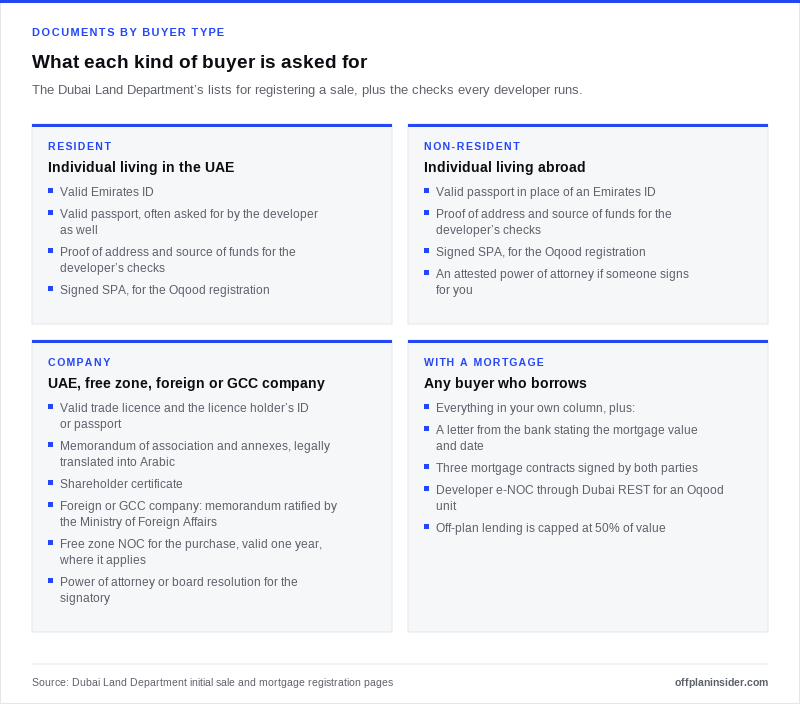
What you are asked for depends first on who is buying. The four common cases are a resident, a non-resident, a company, and anyone using a mortgage.
Resident buyers
If you live in the UAE, your Emirates ID is the key document. DLD registers sales against it, and at trustee centres it is used to verify your identity.
Developers usually ask for your passport as well, and for proof of address such as a recent utility bill or tenancy contract. Keep the name on every document identical, because names on the Oqood carry through to the title deed.
Non-resident buyers
You do not need a UAE visa or Emirates ID to buy in a freehold area. DLD's lists accept a valid passport for non-residents in place of the Emirates ID.
Expect the same anti-money laundering questions as a resident, answered with documents from your home country. Proof of address will be a utility bill or bank statement from where you live. Who can buy and where is in our guide on whether foreigners can buy property in the UAE, and the areas open to them are listed in our guide to freehold areas in Dubai.
If you are buying from a particular country, our guides for buyers from India, from the UK, from Pakistan and from the USA cover the home-country side, such as money transfer and tax.
Company buyers
Companies provide the most paperwork, and the most time-consuming. DLD lists separate sets for each kind of company on its initial sale page.
| Company type | Documents DLD lists |
|---|---|
| Sole establishment | Valid trade licence; licence holder's Emirates ID or passport; power of attorney, if any |
| Limited liability company | Valid trade licence; licence holder's ID or passport; power of attorney, if any; memorandum of association and annexes with a legal Arabic translation; shareholder certificate |
| Foreign company | As for an LLC, with the translated memorandum ratified by the Ministry of Foreign Affairs; a free zone no objection letter for the purchase, valid for one year, where it applies. Shareholder names must be listed |
| GCC company | Valid trade licence; ID or passport; power of attorney, if any; translated memorandum ratified by the Ministry of Foreign Affairs; shareholder certificate |
Two practical points matter. First, whoever signs for the company needs written authority: a power of attorney or a board resolution, notarised. DLD's mortgage registration page, for example, asks an LLC for "a power of attorney, or a duly notarized board of directors resolution".
Second, translation and ratification take weeks, and the registration clock is 90 days from signing. Prepare the company file before you book, not after. DLD's page for a sale with a mortgage adds that a foreign company must be registered in a free zone, such as DMCC or JAFZA.
Buying with a mortgage
A mortgage adds the bank's documents to your own. DLD's mortgage registration page lists a letter from the bank and three mortgage contracts certified by the bank and signed by both parties, with your Emirates ID or, for non-residents, a passport copy.
For a property still on Oqood, DLD also needs the developer's no objection e-certificate (e-NOC), obtained through the Dubai REST app. The service partner fee for an Oqood mortgage is AED 5,000 plus VAT, against AED 4,000 plus VAT on a title deed, and the mortgage registration fee is 0.25% of the loan.
Before any of that, the bank will want its own file to approve you. Lenders typically ask for a salary certificate or company accounts, payslips, several months of bank statements and a credit report, and each sets its own list. The Central Bank caps lending on off-plan property at 50% of value. Our guides to off-plan mortgages and the mortgage registration fee cover the rules and costs, and you can model repayments with the mortgage calculator.
04Documents by stage
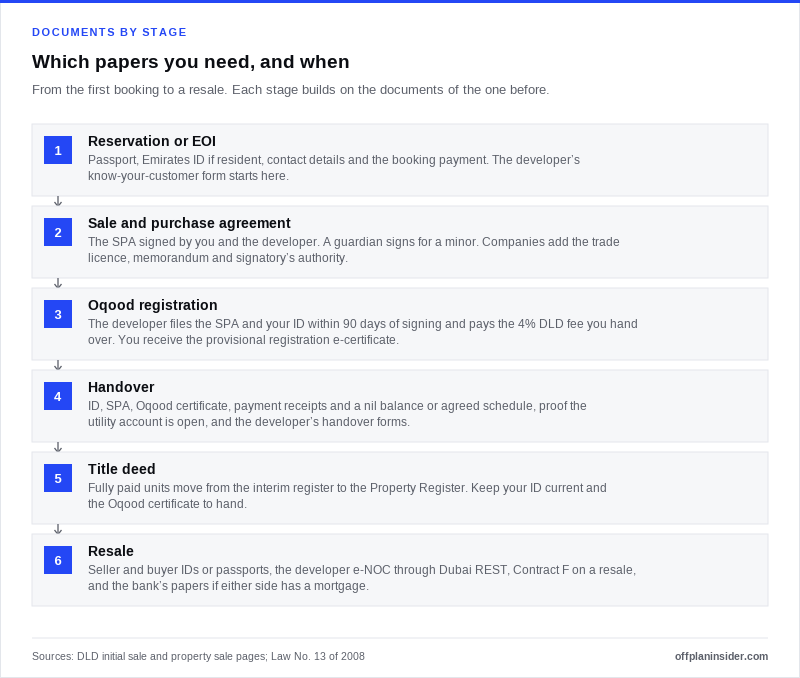
The paperwork is not all collected at once. Each stage of an off-plan purchase has its own documents, and each builds on the one before.
1. Reservation and expression of interest
Before a launch, a developer or its broker may take an expression of interest (EOI) to place you in the queue for units. Once a project is selling, you sign a reservation or booking form and pay a booking amount.
This is where the identity and anti-money laundering checks start. Expect to provide:
- A copy of your passport, and your Emirates ID if you are resident.
- Your contact details and address, often with proof of address.
- The developer's know-your-customer form, which may ask about your occupation, the purpose of the purchase and the source of the funds.
- For a company, the trade licence and the authority of the person signing.
Pay the booking amount by bank transfer or card, from an account in your own name, to the account the developer names in writing. Read the refund terms on the form, because they apply until the SPA is signed. Projects now taking bookings are listed on new launches.
2. The sale and purchase agreement
The SPA is the contract that will be registered. Both you and the developer must sign it, and it must name every buyer exactly as their passport shows, with the shares if there is more than one.
Most large developers now send the SPA for electronic signature, so you can sign from abroad. If someone signs for you, the power of attorney must be in place before this point. What to read in the contract itself is covered in our guide to the sale and purchase agreement in Dubai.
3. Oqood registration
You do not file anything with DLD yourself at this stage. The developer registers the SPA on the Oqood portal, attaching the contract and your Emirates ID or passport, within 90 days of signing.
The fee is 4% of the price, split 2% seller and 2% purchaser on DLD's page; on off-plan sales the developer usually collects the full 4% from the buyer. DLD also lists AED 10 knowledge and AED 10 innovation fees, and an AED 1,000 fee for a developer self-registering a provisional sale. What you receive is the provisional registration e-certificate, by email. Check every name and unit detail against your SPA the day it arrives. The fee is explained in our guide to the DLD fee in Dubai.
4. Handover
At completion, the developer sends a handover notice with its own list of documents. A typical set is:
- Your passport, and your Emirates ID if resident; for a company, its licence and the signatory's authority.
- The signed SPA and the Oqood certificate.
- Receipts for every instalment and the developer's statement showing a nil balance or the agreed post-handover schedule.
- For a mortgage buyer, the bank's final offer and the mortgage papers.
- Proof that the electricity and water account has been opened, where the developer asks for it.
- The developer's own forms: inspection, handover acceptance and key receipt.
Inspect the home before you sign the handover acceptance. Our guides to the handover process and to snagging walk through both. If you are buying a home that is almost finished, projects near handover lists them.
5. The title deed
Article 8 of Law No. 13 of 2008 requires the developer to register a completed project in the Property Register once it has the completion certificate. Units whose buyers have met their obligations are then registered in their names.
DLD's answers describe the same move: fully paid units pass from the interim register to the real estate register, and a title deed is issued. No second 4% is charged on the same sale. In practice, "met their obligations" means paid in full, so the documents that matter are your receipts and the developer's clearance. Our guide to the title deed in Dubai covers the steps and issuance fees.
6. Resale and the NOC
Selling needs a different set. DLD's property sale registration lists the Emirates IDs of seller and buyer, or valid passports for non-resident foreigners, and the developer's no objection e-certificate in freehold areas, obtained through the Dubai REST app.
For an off-plan unit sold before handover, DLD's answers say the resale is possible with a no objection certificate from the developer. The developer checks that your payments are up to date before it issues one, and sets its own fee and minimum payment, which are on request. On a resale of a ready home, the seller and buyer also sign Contract F, the DLD form our Form F guide explains.
The transfer itself takes place at a registration trustee centre, with documents checked and uploaded there. DLD gives the service time as 20 minutes once everything is ready. The costs of selling early are in our guide to selling off-plan before handover, and the trustee's charges in our guide to registration trustee fees.
05KYC and source of funds: the anti-money laundering checks
Most of the paperwork beyond your ID comes from the UAE's anti-money laundering rules. They apply to the businesses you deal with, not to you directly, but they decide what you are asked for.
The law behind the checks
The federal law is Federal Decree-Law No. 10 of 2025 on anti-money laundering and combating the financing of terrorism and proliferation financing. It replaced Federal Decree-Law No. 20 of 2018, the law most older guides still cite.
Its detailed rules are in Cabinet Resolution No. 134 of 2025, the law's executive regulation. Real estate agents and brokers are designated non-financial businesses and professions under these rules. The Ministry of Economy and Tourism supervises them and published supplementary guidance for the sector in March 2026.
DLD and RERA sit alongside this. DLD registers every sale and its trustee centres verify identity before a transaction is entered. Our guide to RERA explains how the regulator oversees brokers and developers.
What is checked
The ministry's 2026 guidance asks agents and brokers to identify the customer and the beneficial owner, the person who ultimately owns or controls the buyer. In parallel they must verify the source of funds used in the transaction and, where it applies, the source of wealth.
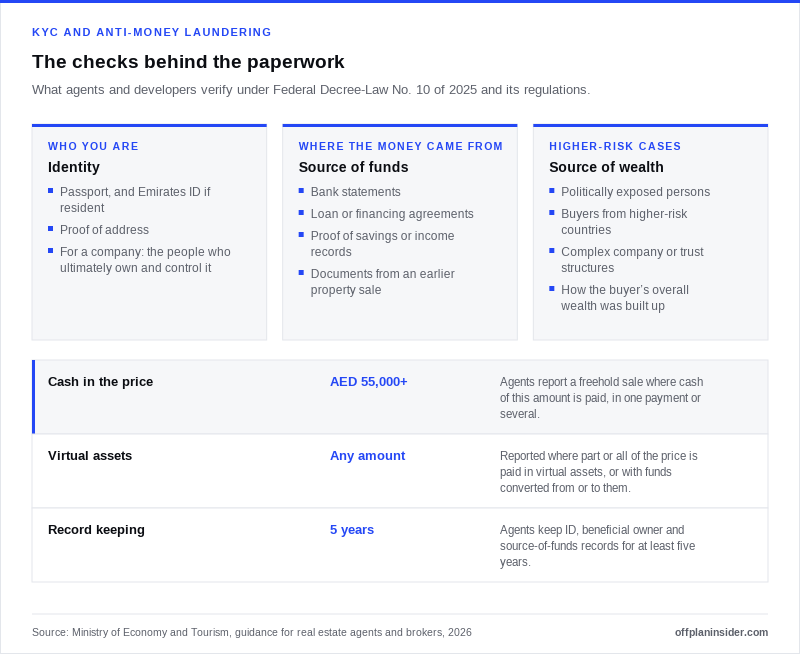
Source of funds is where the money for this purchase came from. The guidance gives examples of acceptable evidence: bank statements, loan or financing agreements, proof of savings, income records, and documents from earlier property sales. For company or foreign ownership structures, more may be needed to show the true source.
Source of wealth is how your overall wealth was built up. It is asked for in higher-risk cases, such as politically exposed persons, buyers from higher-risk jurisdictions or complex legal arrangements.
When a purchase must be reported
Some transactions are reported to the UAE Financial Intelligence Unit whatever the risk. The guidance requires agents and brokers to file a Real Estate Activity Report on the purchase or sale of freehold property where:
- Cash of AED 55,000 or more is paid, in one payment or several.
- Part or all of the price is paid in virtual assets.
- The funds used were converted from or to virtual assets.
A report is not an accusation, and the obligation applies even when the checks are satisfactory. But it is the clearest reason to pay by bank transfer from an account in your own name. Money from third parties, such as a relative or a company, should come with a written explanation of the relationship.
The ministry also requires agents and brokers to keep transaction records for at least five years. Expect a developer or agent you buy from again to ask you to refresh documents that have expired.
Preparing your source-of-funds file
A simple file prepared before you book saves time at every stage. For most individual buyers it holds:
- Bank statements for the account the money will come from, covering the last few months.
- Evidence of the money's origin: salary slips, a business's accounts, a sale contract for property or shares, or a loan agreement.
- For a gift from family, a signed gift letter and the giver's statement showing the transfer.
- For a company, the ownership chart down to the individuals who ultimately own or control it, with their IDs.
06Power of attorney
If you cannot sign in person, someone can sign for you under a power of attorney. DLD's answers say transactions can be registered by owners or their representatives holding a valid power of attorney.
A power of attorney signed abroad
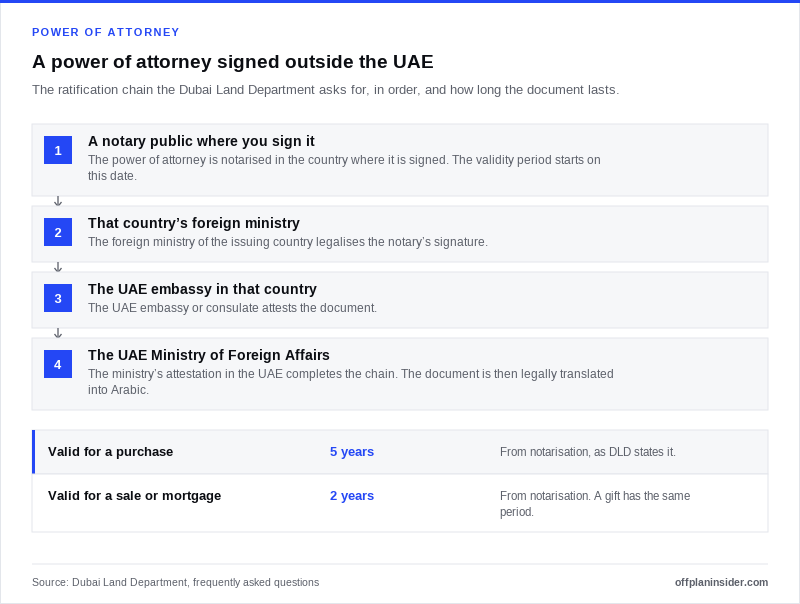
DLD says a power of attorney issued outside the UAE must be ratified in order:
- By a notary public in the country where it is signed.
- By that country's ministry of foreign affairs.
- By the UAE embassy in that country.
- By the UAE Ministry of Foreign Affairs.
The document is then legally translated into Arabic. Each step takes time, so allow several weeks and ask the developer whether it wants particular wording before you sign.
How long it lasts
DLD states that a power of attorney for a purchase is valid for five years from notarisation. One for a sale, mortgage or gift is valid for two years.
That difference matters for off-plan buyers. A purchase power of attorney signed at booking may not cover a sale or a mortgage at handover several years later, so check what it allows before relying on it.
What it should say
A general power of attorney often fails at the point of use. Name the property and list each act the attorney may do:
- Sign the reservation form, the SPA and any addenda.
- Make and receive payments, and deal with the escrow account.
- Inspect the unit, sign the handover documents and receive keys.
- Open utility accounts and register the tenancy.
- Sign mortgage documents, if you are borrowing.
- Apply for and receive the title deed.
A power of attorney signed inside the UAE is notarised by a notary public there and needs no foreign attestation. Keep a certified copy, because developers and trustee centres keep the one you hand in.
07The printable checklist
Use this table before you book, and again before each stage. "If any" means only where it applies to you.
| Document | Resident | Non-resident | Company | Mortgage | Stage |
|---|---|---|---|---|---|
| Valid passport | Yes | Yes | Signatory | Yes | Reservation onwards |
| Emirates ID | Yes | No | Signatory, if resident | If resident | Reservation onwards |
| Proof of address | Yes | Yes | Registered address | Yes | Reservation |
| Source-of-funds evidence | Yes | Yes | Yes | Yes | Reservation |
| Developer KYC form | Yes | Yes | Yes | Yes | Reservation |
| Signed reservation form and booking receipt | Yes | Yes | Yes | Yes | Reservation |
| Signed SPA | Yes | Yes | Yes | Yes | SPA |
| Trade licence | No | No | Yes | If a company | SPA |
| Memorandum of association, Arabic translation | No | No | LLC, foreign and GCC | If a company | SPA |
| Ministry of Foreign Affairs ratification | No | No | Foreign and GCC | If a company | SPA |
| Shareholder certificate | No | No | LLC, foreign and GCC | If a company | SPA |
| Free zone no objection letter | No | No | Where it applies | If a company | SPA |
| Power of attorney or board resolution | If any | If any | Yes | If any | Before signing |
| Oqood certificate | Yes | Yes | Yes | Yes | After registration |
| Instalment receipts and statement of account | Yes | Yes | Yes | Yes | Throughout |
| Bank letter and three mortgage contracts | No | No | No | Yes | Mortgage registration |
| Developer e-NOC for an Oqood mortgage | No | No | No | Yes | Mortgage registration |
| Utility account confirmation | Yes | Yes | Yes | Yes | Handover |
| Developer handover forms | Yes | Yes | Yes | Yes | Handover |
| Developer e-NOC for a resale | If selling | If selling | If selling | If selling | Resale |
08A worked example
Take a non-resident couple buying a two-bedroom off-plan apartment for AED 2,000,000 on a 60/40 plan, jointly, with a mortgage at handover. One of them will be abroad when the SPA is signed.
| When | What they provide |
|---|---|
| Before booking | Both passports; proof of address; six months of bank statements and salary slips showing the source of the booking money; a power of attorney from the absent buyer, notarised and attested through the four-step chain and translated |
| Reservation | The developer's KYC form for each buyer; the booking amount by transfer from a joint account |
| SPA | Both names exactly as in their passports, shares stated; the attorney signs for the absent buyer |
| Oqood | The developer registers the SPA with both passports; the couple pay the developer the 4% DLD fee, AED 80,000, and receive the e-certificate |
| Handover | Instalment receipts; the bank's final offer, letter and three signed mortgage contracts; the developer's e-NOC; the handover forms |
| Title deed | Issued in both names once the developer has been paid in full, part of it from the mortgage, with the bank's mortgage registered against the title |
The weak point here is the power of attorney. Signed for a purchase, it lasts five years, but it may not cover the mortgage at handover, which DLD gives a two-year period. The couple either both sign the mortgage themselves or arrange a second power of attorney nearer the time.
09What the rules cover, and what they do not
They cover the minimum for registration. DLD's lists are the documents it needs to register a sale or mortgage. Without them, the transaction cannot be entered, and an unregistered off-plan sale is void.
They cover the businesses' checks. The anti-money laundering law and its regulation require agents and other covered businesses to verify identity, beneficial ownership and source of funds, and to report certain transactions.
They do not fix each developer's list. Developers set their own reservation and handover forms, NOC procedures and KYC questions. Two developers may ask for different things for the same purchase.
They do not replace your own checks. Paperwork proves who you are; it does not prove the project is sound. Check the project and the developer's registration first, as our guide to checking an off-plan project shows, and pay instalments only into the project's escrow account under Law No. 8 of 2007, which our escrow guide explains.
10Common mistakes
- Names that do not match. A spelling difference between passport, SPA and Oqood carries through to the title deed and is slow to correct.
- Starting company papers late. Translation and ratification of a memorandum can outrun the 90-day registration window.
- The wrong power of attorney. One drafted for a purchase may not cover a mortgage or sale, and expires after five years.
- Paying in cash or from someone else's account. Cash of AED 55,000 or more is reported, and third-party money needs explaining.
- Expired documents. A passport or Emirates ID that has expired by handover holds up the keys and the title deed.
- Losing receipts. Every instalment receipt is evidence for handover, the title deed and a resale NOC.
11Key terms
- SPA. The sale and purchase agreement between you and the developer, registered on Oqood.
- Oqood. DLD's interim register for off-plan sales. See our Oqood guide.
- KYC. Know your customer: the identity and background checks developers and agents run.
- Source of funds. Evidence of where the money for this purchase came from.
- Source of wealth. How a buyer's overall wealth was built up, asked for in higher-risk cases.
- Beneficial owner. The person who ultimately owns or controls a buyer, such as a company's shareholders.
- e-NOC. The developer's no objection e-certificate, requested through the Dubai REST app. See our Dubai REST guide.
- Real Estate Activity Report. The report agents file with the Financial Intelligence Unit on cash or virtual-asset purchases above the thresholds.
12Where to go next
If your documents are in order, the next step is choosing a home. Browse all projects, see what is launching on new launches, or look at available units across developers. For the full buying process, start with our guide to how to buy off-plan property in Dubai.
FAQQuestions buyers ask.
What documents do I need to buy property in Dubai?
For an individual: a valid passport, an Emirates ID if you are a UAE resident, and the signed sale and purchase agreement, which the developer registers with the Dubai Land Department.
Expect the developer or agent to ask for proof of address and evidence of where your money comes from as part of anti-money laundering checks. A company buyer adds its trade licence, translated memorandum of association and shareholder certificate.
Can I buy property in Dubai with just a passport?
Yes, if you are not a UAE resident. DLD's registration lists accept a valid passport in place of an Emirates ID for non-resident buyers. You will still sign the SPA and answer the developer's know-your-customer questions, which usually include proof of address and source of funds. Residents use their Emirates ID.
Do I need a UAE residence visa or bank account to buy?
No residence visa is needed to buy in Dubai's freehold areas; non-residents register with a passport. DLD's lists for a purchase do not include a UAE bank account. In practice a UAE account makes paying instalments and later receiving sale proceeds easier, and a bank will need one for a mortgage.
What does source of funds mean when buying property in Dubai?
It is evidence of where the money for the purchase came from. Under the UAE's anti-money laundering law, agents must verify it, and the Ministry of Economy and Tourism's 2026 guidance lists bank statements, loan or financing agreements, proof of savings, income records and documents from an earlier property sale as examples. Higher-risk buyers may also be asked about source of wealth.
What documents does a company need to buy property in Dubai?
DLD lists a valid trade licence, the licence holder's Emirates ID or passport, a power of attorney if someone signs for the company, the memorandum of association and annexes legally translated into Arabic, and a shareholder certificate.
A foreign or GCC company's memorandum must be ratified by the Ministry of Foreign Affairs, and a free zone company may need a no objection letter from its free zone, valid for one year.
Can someone buy property in Dubai for me with a power of attorney?
Yes. DLD accepts a valid power of attorney. One signed outside the UAE must be notarised there, legalised by that country's foreign ministry, attested by the UAE embassy and then by the UAE Ministry of Foreign Affairs, and translated into Arabic. DLD treats a power of attorney for a purchase as valid for five years from notarisation, and one for a sale or mortgage for two years.
What documents do I need to sell my off-plan property?
DLD's sale registration lists the seller's and buyer's Emirates IDs, or passports for non-residents, and the developer's no objection e-certificate in freehold areas, obtained through the Dubai REST app. Before handover, DLD says a resale needs the developer's NOC. You will also need your SPA, Oqood certificate and payment receipts, and the bank's papers if the unit is mortgaged.
Do I need documents attested if I buy from abroad?
Your passport does not need attesting. Documents issued abroad that a Dubai authority must rely on usually do: a power of attorney, and a foreign company's memorandum of association, which DLD asks to be ratified by the Ministry of Foreign Affairs and translated into Arabic. Allow several weeks for this before you sign.
Sources & methodWhere these figures come from.
Sources
- Dubai Land Department: Request to register the initial sale
- Dubai Land Department: A sale registration application associated with an initial mortgage
- Dubai Land Department: Property sale registration
- Dubai Land Department: Request for mortgage registration
- Dubai Land Department: Frequently asked questions
- Dubai Legislation Portal: Law No. (13) of 2008
- Dubai Legislation Portal: Law No. (7) of 2006
- Dubai Legislation Portal: Law No. (8) of 2007
- uaelegislation.gov.ae: Download
- moj.gov.ae: Cabinet resolution no 134 of 2025 regarding the executive regulations of federal decree law no 639053857268671601
- moet.gov.ae: Supplemental+Guidance+for+Real+Estate+Agents+&+Brokers+ +2026.pdf
- moet.gov.ae: Ministry of economy obligates real estate brokers agents in the country to maintain records transactions data for at least five years
- Central Bank of the UAE Rulebook: Regulations regarding mortgage loans
What we could not verify
- Proof of address, source-of-funds evidence and the developer's own know-your-customer form are asked for by developers and agents in practice; DLD's registration lists do not include them, and each developer sets its own form.
- What a bank asks for to approve a mortgage, such as salary certificates, payslips, bank statements and credit reports, is set by each lender; the text gives a typical list rather than a rule.
- Developers' handover document lists, NOC fees and the minimum payment before a resale NOC are set by each developer and are given as on request.
20 Nov 2026 · Reviewed by OffPlan Insider Research. First published 20 Nov 2026.