Yes. Americans can buy freehold off-plan property in Dubai's designated areas without UAE residency, and a payment plan suits a US buyer well because the dirham is pegged to the dollar at AED 3.6725, so every instalment has a known dollar cost and there is no currency risk. Overseas investors pay the same price, fees and plan as UAE residents, including post-handover plans where part of the price is paid after the keys. The UAE does not tax individuals on rent or gains, but the US taxes citizens and residents on worldwide income: Dubai rent goes on Schedule E with the building depreciated over 30 years, a sale is subject to US capital gains tax, a UAE bank account can trigger an FBAR, and the property counts towards your US estate. There is no US–UAE income tax treaty.
Key takeaways
- Any US citizen can buy freehold in Dubai's designated areas, and you do not need a UAE visa or residency. The purchase works the same way as for every other foreign buyer.
- The dirham has been held at AED 3.6725 to the dollar since 1997, so a payment plan carries no exchange-rate risk for a dollar earner. An AED 2,000,000 unit costs $544,588, and each instalment's dollar figure is known the day you sign.
- Off-plan plans for overseas investors are the same plans residents get: 60/40, 50/50 or post-handover, where 30% to 50% of the price can fall due after the keys. The handover balance is either cash or a UAE mortgage capped at 50% of value on off-plan homes.
- US citizens and resident aliens are taxed on worldwide income wherever they live. Dubai rent goes on Schedule E, and residential rental property used outside the US is depreciated over 30 years under the Alternative Depreciation System.
- A sale is taxed in the US: long-term gains at 0%, 15% or 20%, up to 25% on the part that reflects depreciation, and possibly the 3.8% net investment income tax. The UAE levies no personal income tax, so there is nothing to credit, and there is no US–UAE income tax treaty.
- Property held directly is not reported on the FBAR or Form 8938, but a UAE bank account is, once thresholds are passed. The home is part of your US gross estate, and a US power of attorney needs authentication and UAE attestation because the UAE is not in the Apostille Convention.
01The short version
Americans buy in Dubai on exactly the same terms as every other foreign buyer. You reserve a unit, sign a sale and purchase agreement (SPA) with the developer, the developer registers the sale on the Dubai Land Department's Oqood register, and you pay instalments into the project's escrow account. Our step-by-step guide covers that process in full.
Two things make a US buyer's position unusual. The first is good news: the dirham is pegged to the dollar, so an off-plan payment plan carries no currency risk for anyone who earns in dollars. A British or Indian buyer has to budget for exchange-rate swings over three or four years; you do not.
The second is the US side. The United States taxes its citizens on worldwide income wherever they live, so the absence of UAE income tax does not mean a tax-free investment. Dubai rent goes on your federal return, a sale is a taxable event, a UAE bank account can bring reporting duties, and the property is part of your US estate.
This is general information, not tax, legal or financial advice. US tax depends on your status, your state and your circumstances. Before you commit, speak to a US tax adviser who deals with foreign property, and to an independent lawyer in Dubai.
02Who this applies to: US residents and Americans abroad
US federal tax follows citizenship as well as residence. The IRS says that US citizens and resident aliens are taxed on worldwide income from all sources, and that the rules for filing are generally the same whether you live in the US or abroad. A green card holder is a resident alien for this purpose.
That has two consequences for a Dubai buyer. An American who moves to Dubai keeps filing a US return, and a UAE residence visa, including a Golden Visa, changes nothing on the US side. Citizens and resident aliens living overseas do get an automatic two-month extension to file, to 15 June for calendar-year filers.
State tax is a separate question. Many states tax their residents on worldwide income too, and some keep treating you as resident after you move abroad. Check your own state's rules.
| US citizen or resident living in the US | US citizen living in the UAE | |
|---|---|---|
| Can buy freehold in Dubai | Yes, in designated areas | Yes, in designated areas |
| Currency risk on a payment plan | None while the AED 3.6725 peg holds | None while the peg holds |
| US tax on Dubai rent | Yes, Schedule E | Yes, Schedule E; the earned income exclusion generally does not cover rent |
| US tax on a Dubai sale | Capital gains tax, 0%, 15% or 20% long term | The same |
| UAE tax on rent or gains | None for individuals | None for individuals |
| Form 8938 threshold, single filer | Over $50,000 at year end or $75,000 at any time | Over $200,000 at year end or $300,000 at any time |
| FBAR threshold | Foreign accounts over $10,000 in total | The same |
| US estate tax on the Dubai home | Yes, part of the gross estate | Yes, part of the gross estate |
03Can Americans buy property in Dubai?
Yes. Non-UAE nationals can own freehold property in areas designated by the Ruler under Law No. 7 of 2006, and those areas include most of the communities where off-plan homes are sold. You need no UAE residency and no local partner. Our guide on whether foreigners can buy property in the UAE covers ownership across all seven emirates.
There is no US rule against buying property abroad either. You do not need permission from any US agency, and there is no limit on what you can wire for a purchase. Banks apply their usual anti-money-laundering checks to large international payments, which is a matter of paperwork rather than permission.
04Sending dollars, and why the peg matters
The UAE dirham has been held at AED 3.6725 to the US dollar since 1997 and formally pegged to it since 2002, as the UAE government's fact sheet confirms. The Central Bank of the UAE's published rates for August 2026 still show AED 3.6725 to the dollar.
For a US buyer that removes the largest hidden cost of a long payment plan. A price of AED 2,000,000 is $544,588 today and, while the peg holds, the same in three years when the handover payment falls due. You can budget every instalment in dollars at the outset, and you do not need forward contracts or a currency broker.
The peg is a policy, not a law of nature, and policies can change. It has held through several oil-price shocks and the 2008 crisis. A buyer should know it exists, not assume it is guaranteed forever.
How to pay
- From your own US account. Wire each instalment from an account in your name. A clear trail from salary, savings or a documented sale makes the developer's source-of-funds checks simple.
- Into escrow only. Off-plan instalments go to the project's escrow account, never to a sales agent or an ordinary company account. Match the account on each payment request to the project record on the Dubai Land Department's Dubai REST app. Our guide to whether off-plan in Dubai is safe explains the checks.
- Expect bank questions. A first large wire to a new overseas beneficiary may be held while your bank asks what it is for. Keep the reservation form and payment request to hand.
- Wire fees and spreads. The exchange rate is fixed, but banks still charge a wire fee and may apply a margin when they convert dollars to dirhams. Compare your bank with a transfer service on the first large payment.
05Which off-plan payment plan suits a US buyer?
Overseas investors are offered exactly the same plans as UAE residents. The developer does not price by passport, and a booking from New York or Texas goes through the same sales process as one from Dubai Marina. What changes is how you fund each stage. Our guide to off-plan payment plans in the UAE explains every structure in detail.
| Plan | What you pay before handover | At or after handover | Fits a US buyer who… |
|---|---|---|---|
| 60/40 | 60% of the price | 40%, coverable by a 50% off-plan mortgage | Has savings to cover construction and may borrow at the end |
| 50/50 | 50% | 50%, the most a mortgage could cover | Wants a little more deferred, with a cash reserve |
| 70/30 or 80/20 | 70% to 80% | 20% to 30% | Plans to pay cash and wants a small final bill |
| Post-handover | Often 50% to 70% | 30% to 50% in instalments after the keys | Wants rent to help pay the balance |
| 1% monthly | 1% a month during the build | Varies | Prefers payments that look like a monthly bill |
The construction instalments are nearly always paid in cash. The Central Bank's mortgage regulations cap loans on off-plan property at 50% of value for every buyer, and banks generally lend only at or near handover. So the question for any plan is how much cash you need before a bank will help, and whether the balance at the end fits under that cap.
06A worked example: a 60/40 plan on an AED 2,000,000 home
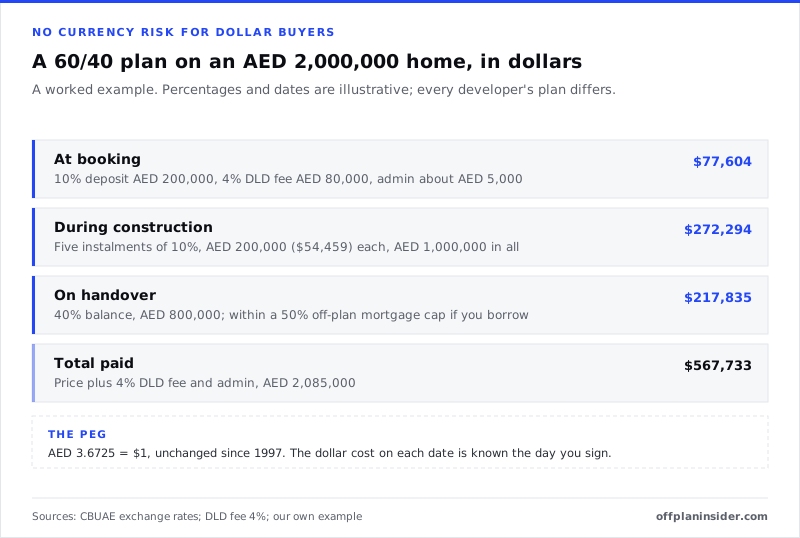
Take an apartment priced at AED 2,000,000, booked in late 2026 on a 60/40 plan, with handover expected in 2029. The DLD registration fee is 4% of the price, AED 80,000, paid when the sale is registered at the start. We assume a developer administration fee of about AED 5,000; our guide to the true cost of buying off-plan in Dubai gives the range.
| When | Payment | AED | USD at 3.6725 |
|---|---|---|---|
| Booking | 10% deposit, 4% DLD fee, developer admin | AED 285,000 | $77,604 |
| During construction | Five instalments of 10%, AED 200,000 ($54,459) each | AED 1,000,000 | $272,294 |
| Handover | 40% balance | AED 800,000 | $217,835 |
| Total | Price plus 4% DLD fee and admin | AED 2,085,000 | $567,733 |
The handover payment of $217,835 is where the decisions sit. You can pay it from savings, or apply to a UAE bank for a mortgage. The 40% balance, AED 800,000, is within the 50% cap of AED 1,000,000, so a loan could in principle cover all of it, subject to the bank's valuation and its terms for non-residents.
US mortgage lenders rarely lend against a home abroad, so most American buyers who borrow at handover use a UAE bank, or raise money against US assets. Our off-plan mortgage guide explains the UAE rules.
The same unit on a post-handover plan
Now suppose the same AED 2,000,000 home were sold on a plan where 40% is paid in 24 equal monthly instalments after handover instead of in one sum. Each instalment would be AED 33,333, or $9,076, a month for two years.
That only works comfortably if the rent and your own income cover it. Service charges and cooling start on the day you take the keys, and the first months may be spent furnishing and finding a tenant. A post-handover plan is credit from the developer, and its terms sit entirely in your SPA, so read the default clauses as carefully as the headline split.
Real plans vary widely. Eleve by Deyaar in Downtown Jebel Ali spreads 30% of the price at 1% a month for 30 months after handover. Sky Residences in Expo City puts 50% after handover, in ten instalments of 5% every six months up to 60 months after the keys. The post-handover payment plans page lists every project we track that offers one.
07US tax on Dubai rent: Schedule E
Before handover there is no rent and nothing to report as rental income. Keep every receipt from the start anyway: the purchase costs form part of your basis, and you will need them later.
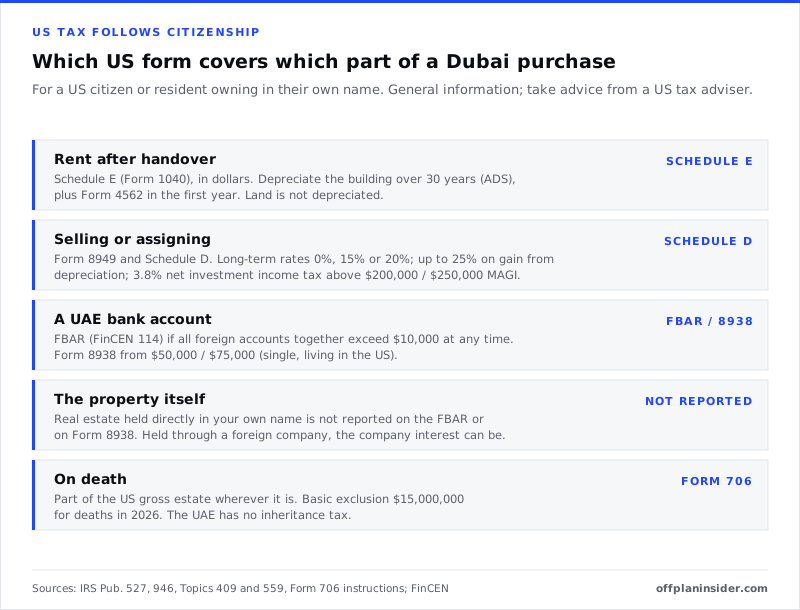
Once the home is let, rent from a Dubai property is reported on Schedule E of Form 1040, exactly as a US rental would be. The Schedule E instructions tell you to enter a foreign property's city, province or state, country and postal code on line 1a.
- Reported in dollars. Amounts in dirhams are translated into dollars. The IRS's guidance on foreign currency says to use the rate prevailing when you receive or pay each item. With the peg, that rate is AED 3.6725 every time, which makes the translation unusually simple.
- Deductible expenses. Ordinary costs of letting: service charges, district cooling and utilities you pay as landlord, property management fees, letting commission, repairs, insurance and the Ejari registration. The Publication 527 rules on residential rentals apply to a foreign rental as to a domestic one.
- Personal use. If you use the home yourself for more than 14 days, or more than 10% of the days it is let at a fair rent, the vacation-home limits on deductions apply. Holiday use by your family counts.
- Losses. A rental is usually a passive activity, and Publication 527 explains when a loss can be deducted against other income and when it is carried forward.
- No foreign tax credit to claim. The UAE does not levy income tax on individuals, and UAE corporate tax does not apply to an individual's real estate investment income earned outside a licensed business. With no UAE tax paid, there is nothing to credit.
- The foreign earned income exclusion. It covers earned income, which the IRS defines as pay for personal services performed. Rent from a home you simply own and let is generally not earned income, so even an American living in Dubai pays US tax on it.
Depreciation over 30 years
Depreciation is the largest deduction on most rentals, and the rules for a foreign one differ from a US one. Publication 946 and the Form 4562 instructions say tangible property used predominantly outside the United States must be depreciated under the Alternative Depreciation System (ADS).
For residential rental property placed in service after 2017, the ADS recovery period is 30 years, straight line, with a mid-month convention. A US rental would use 27.5 years under the general system. Depreciation starts when the home is placed in service, which for off-plan is when it is ready and available to rent after handover, not when you sign.
Only the building is depreciated. Land never is, so part of the basis has to be allocated to land. For a Dubai apartment, where you own a share of a tower's plot, that split is a judgement for your adviser. Form 4562 goes with the return for the first year the property is in service.
A Schedule E sketch for the first full year
Continue the AED 2,000,000 example. Assume the home is let from January for AED 130,000 a year, a gross yield of 6.5%, and that 80% of the basis is allocated to the building. These are assumptions for illustration, not a forecast; our guide to the best areas for rental yield in Dubai shows gross yields by community.
| Schedule E line | AED | USD at 3.6725 |
|---|---|---|
| Rents received | 130,000 | $35,398 |
| Service charge, 1,100 sq ft at AED 17 | 18,700 | $5,092 |
| District cooling and utilities paid by the landlord | 6,000 | $1,634 |
| Property management at 6% of rent | 7,800 | $2,124 |
| Insurance | 1,500 | $408 |
| Total cash expenses | 34,000 | $9,258 |
| Depreciation: basis $567,733, 80% building, over 30 years | $15,140 | |
| Net rental income on Schedule E | about $11,000 |
In this sketch, about $26,140 of cash profit becomes about $11,000 of taxable rental income, because depreciation shelters the rest. That $11,000 is added to your other income and taxed at your marginal federal rate, plus any state tax. If your modified adjusted gross income is high enough, the 3.8% net investment income tax can apply too.
The service charge figure uses the Dubai-wide median of about AED 17 per square foot a year, from our true-cost guide. A branded or waterfront tower can cost two or three times that; check the actual building.
08US capital gains tax when you sell
A sale of a Dubai property is taxed in the US like the sale of any other investment property. Under IRS Topic 409, a gain on property held for more than one year is long term and taxed at 0%, 15% or 20%, depending on your taxable income. Held for a year or less, it is short term and taxed as ordinary income.
- Depreciation comes back. The part of the gain that reflects depreciation, called unrecaptured section 1250 gain, is taxed at up to 25%. Basis is reduced by the depreciation you were entitled to claim, so skipping it does not avoid this.
- Net investment income tax. Under Topic 559, a further 3.8% applies to net investment income, including rents and gains on real estate, once modified adjusted gross income passes $200,000 for a single filer or $250,000 for a married couple filing jointly.
- Basis. The price plus acquisition costs: the 4% DLD fee, developer administration and other purchase costs, plus capital improvements, less depreciation. Selling costs reduce the amount realised.
- No currency gain to calculate. A British buyer must work out a gain in sterling and can show a gain or loss caused purely by exchange-rate moves. With the dirham pegged, a dollar gain is the dirham gain at a fixed rate.
- Where it goes. Form 8949 and Schedule D of your return for the year of sale.
A sale sketch
Suppose the example home is sold after five full years of letting for AED 2,400,000, $653,506, with selling costs of AED 48,000, $13,070, for a 2% broker commission. The amount realised is about $640,436.
Adjusted basis is $567,733 less five years of depreciation at $15,140, about $75,700, leaving about $492,033. The gain is about $148,400. Of that, about $75,700 is unrecaptured section 1250 gain taxed at up to 25%, and about $72,700 is long-term gain at your 0%, 15% or 20% rate, with the 3.8% net investment income tax on top if your income is above the thresholds.
Selling before handover
Many off-plan buyers sell their contract before completion, as our guide to selling off-plan before handover describes. For US tax that is still a disposal. Whether the holding period runs from the SPA or from handover, and how a part-paid contract is treated, are questions for your adviser before you sign an assignment.
09FBAR and Form 8938: what you report, and what you don't
US reporting of foreign assets catches many first-time buyers abroad, and the penalties for missing a form can be far larger than any tax. The good news for property owners is that the home itself is usually outside both regimes.
The IRS's comparison of Form 8938 and FBAR requirements says foreign real estate held directly is not reportable on either form. If the Dubai apartment is in your own name, you do not list it.
A UAE bank account is different. Many owners open one to receive rent and pay service charges and cooling bills in dirhams.
| FBAR (FinCEN Form 114) | Form 8938 (FATCA) | |
|---|---|---|
| Who files | A US person with a financial interest in, or signature authority over, foreign accounts | Specified individuals filing a US return |
| Threshold | All foreign accounts together over $10,000 at any time in the year | Single, in the US: over $50,000 at year end or $75,000 at any time. Married filing jointly: $100,000 or $150,000. Living abroad: $200,000 or $300,000, joint $400,000 or $600,000 |
| Dubai property in your name | Not reportable | Not reportable |
| UAE bank account | Reportable | Reportable |
| Where and when | Filed electronically with FinCEN through BSA E-Filing, not with your tax return; due 15 April with an automatic extension to 15 October | Attached to your federal income tax return |
Two points are easy to miss. The FBAR test adds up every foreign account, so a UAE current account plus a savings account plus a brokerage account abroad can cross $10,000 together. And the project escrow account you pay instalments into belongs to the project, not to you; it is the developer's account, held by an approved bank under Dubai's escrow law.
Owning through a foreign company changes the picture: the shares in a company can be a reportable foreign financial asset, and other information returns may apply. That is one reason most individual buyers own in their own name. FinCEN's FBAR page has the filing details.
10No US–UAE income tax treaty
The United States has income tax treaties with dozens of countries, but the UAE is not on the IRS's list of US income tax treaties. There is no comprehensive treaty between the two countries.
For a property owner this matters less than it sounds. A treaty mainly decides which country may tax an item and how double taxation is relieved. Because the UAE levies no personal income tax on rent or gains, there is no double taxation to relieve: you pay US tax, and nothing in the UAE.
| Tax point | UAE | US, for a US citizen or resident |
|---|---|---|
| Buying | 4% DLD registration fee | No US tax on buying |
| Rent | No personal income tax | Ordinary income on Schedule E, after expenses and 30-year depreciation |
| Sale or assignment | No personal capital gains tax | 0%, 15% or 20% long term; up to 25% on depreciation; possibly 3.8% NIIT |
| Foreign tax credit | No UAE tax to credit | Not relevant to Dubai property income |
| Reporting | Ejari for a tenancy; Oqood and title deed at DLD | Property held directly: none. UAE accounts: FBAR and Form 8938 above thresholds |
| Death | No inheritance tax | Estate tax on the worldwide estate above the basic exclusion |
11Estate tax and wills
The US estate tax reaches everything a citizen or resident owns. The Form 706 instructions say the gross estate includes all property in which the decedent had an interest, including property outside the United States. A Dubai apartment counts in full.
For deaths in 2026 the basic exclusion amount is $15,000,000, according to the IRS estate tax page and the Form 706 instructions. Most buyers will be well below it. Larger estates, and couples where one spouse is not a US citizen, face special rules that need planning with an adviser. The UAE does not levy inheritance tax.
A will that works in Dubai. US estate tax is one question; who inherits the Dubai property is another. Without a will recognised in the UAE, the estate of a non-Muslim can face delays while the courts deal with succession. Many foreign owners register a will with the DIFC Courts Wills Service, which is open to non-Muslims aged 21 or over with assets in Dubai or Ras Al Khaimah and does not require UAE residence. Make sure your US will or trust and the Dubai will are drafted to work together.
12Ownership structures: keep it general, take advice
Some American buyers ask whether to own through a US LLC, a trust or a UAE company. Each changes the tax reporting, the Dubai registration process and sometimes the price of borrowing. A US LLC is generally ignored for federal income tax if it has one owner, but it adds a layer that a Dubai developer, the Land Department and a UAE bank must accept.
Freehold ownership by companies is allowed in Dubai in some circumstances, but the rules are specific to the entity and the project. Holding through a foreign company can bring extra US information returns. For most individual buyers, owning in their own name is simplest. If you are considering anything else, speak to a US tax adviser and a Dubai lawyer together before you reserve.
13The purchase from the US, step by step
You can complete every stage of an off-plan purchase without travelling. In brief:
- Choose and check the project. Browse off-plan projects or new launches, then confirm the project and developer on the Dubai Land Department's systems. Our guide to checking an off-plan project and developer shows how.
- Reserve. Sign a reservation form and wire the booking deposit, usually 5% to 20%, to the escrow account.
- Sign the SPA. Usually electronically. Read the payment plan, the handover date and the default clauses.
- Oqood registration. The developer registers the sale with the Dubai Land Department, and the 4% DLD fee is paid. DLD's initial sale registration takes a copy of the buyer's passport for a non-resident.
- Pay instalments. Wire each one to escrow as it falls due, keeping records for your basis.
- Handover. Pay the balance or arrange a mortgage, inspect the home and receive the keys. Our guide to the off-plan handover process covers snagging and the title deed.
Documents for US buyers
- US passport, valid for the period of the transaction.
- Proof of address, such as a recent utility bill or bank statement, for the developer's know-your-customer checks.
- Source of funds, such as bank statements, payslips or a closing statement from a property sale.
Power of attorney signed in the US
Most off-plan purchases need no power of attorney. One becomes useful at handover, for a mortgage or an assignment at a trustee office, or for later resale and leasing.
The US joined the Hague Apostille Convention in 1981, but the UAE is not a party: the HCCH status table has no entry for it. An apostille alone is therefore not accepted in Dubai. The document goes through authentication and legalisation instead.
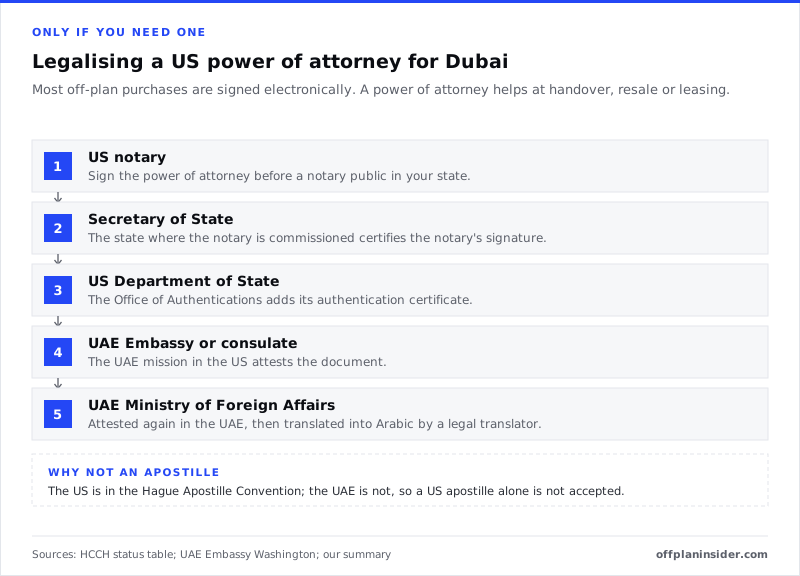
The UAE Embassy in Washington says documents must be authenticated by the US Department of State's Office of Authentications before the embassy attests them. Make the power of attorney specific to the property and to the acts you authorise; Dubai trustee offices and developers can refuse general wording. Signing before a notary in Dubai during a visit is often simpler.
Golden Visa
A property worth AED 2,000,000 or more, $544,588, can support a ten-year UAE Golden Visa, and an off-plan Oqood registration is accepted in place of a title deed. The test is applied to the Land Department's valuation, so buy with some headroom above the line. Our Golden Visa guide covers the detail, and the Golden Visa investment page and AED 2M to 3M budget page list projects at that level.
A Golden Visa gives you the right to live in the UAE. It does not change your US tax position: as a citizen, you remain taxable in the US on worldwide income.
14What the law covers, and what it doesn't
| Covered by Dubai regulation | Your own responsibility |
|---|---|
| Instalments held in the project's escrow account | Filing Schedule E, FBAR and Form 8938 correctly each year |
| Registration of your purchase on Oqood | Whether the rent will cover a post-handover instalment |
| A licensed developer and a registered project | Whether a UAE bank will lend to you at handover, and on what terms |
| A refund if the regulator cancels the project | US capital gains, depreciation recapture and estate planning |
| A set legal procedure if a buyer defaults | Whether the price is fair for the area |
15What it costs, all in
The Dubai costs are the same for every buyer: the 4% DLD fee, developer administration, and later service charges and utilities. A US buyer adds the US-side costs.
| Cost | Who charges it | Typical amount |
|---|---|---|
| DLD registration fee | Dubai Land Department, at Oqood | 4% of the price; AED 80,000 ($21,784) on AED 2,000,000 |
| Developer admin and Oqood fee | Developer | About AED 1,000 to 6,000 |
| Wire fees and conversion margin | Your bank or transfer service | Varies; the rate itself is fixed at 3.6725 |
| US tax preparation | Your adviser | Schedule E, Form 4562, FBAR and Form 8938 where needed |
| Power of attorney | Notary, Secretary of State, Department of State, UAE Embassy, UAE MOFA | Several separate fees, plus translation; only if needed |
| DIFC will | DIFC Courts Wills Service and your lawyer | Varies; recommended |
| US tax on rent and gains | IRS and your state | Your marginal rate on net rent; 0% to 20% on long-term gains, up to 25% on depreciation |
When you compare a Dubai yield with a US one, compare them after US tax. You keep the same share of Dubai rent as of US rent; the absence of UAE income tax helps you only if you are not a US taxpayer, and as a citizen you always are.
16Stress test before you book
Run these numbers on any unit before you reserve:
- The handover payment. Can you pay the balance from savings if a UAE bank lends less than you expect, or not at all?
- A late handover. If completion slips by a year, can you keep paying without rent, and does a post-handover plan start later too?
- Lower rent. If rent comes in 15% below your assumption, does the post-handover instalment still fit alongside service charges?
- The US tax bill. Have you set aside federal and state tax on net rent, and the recapture and capital gains on a future sale?
- Exit. Could you hold for five years or more if a quick resale is not possible at the price you want?
Our guide on what happens if you can't pay off-plan instalments explains the consequences if a stress test fails in real life.
17A checklist for US buyers
- Is the project registered and is every payment going to the escrow account shown on Dubai REST?
- Have I budgeted every instalment in dollars, including the 4% DLD fee at booking?
- How will I fund the handover payment: savings, US assets or a UAE mortgage capped at 50% of value?
- If I choose a post-handover plan, does the expected rent cover the instalment plus service charges?
- Am I keeping every receipt and payment record for my US basis?
- Do I know when the home will be placed in service, and has my adviser agreed the land and building split for 30-year depreciation?
- Will a UAE bank account take my foreign accounts over $10,000, and am I ready to file the FBAR and, if needed, Form 8938?
- Do I have a UAE-recognised will that works alongside my US estate plan?
18Key terms
- Oqood. The Dubai Land Department's interim register for off-plan sales. Registration is when the 4% fee is paid.
- Escrow account. The project's dedicated bank account into which buyers pay instalments.
- Post-handover plan. A plan that lets you pay part of the price in instalments after you receive the keys. It is developer credit, not a mortgage.
- ADS. The Alternative Depreciation System. A rental used outside the US is depreciated under it, over 30 years for residential property placed in service after 2017.
- Unrecaptured section 1250 gain. The part of a gain on real property that reflects depreciation, taxed at up to 25%.
- FBAR. FinCEN Form 114, the report of foreign financial accounts over $10,000 in total.
- Form 8938. The FATCA statement of specified foreign financial assets, attached to your tax return above its thresholds.
Browse current off-plan projects or homes near handover with these answers in hand, and use the payment plan calculator to map instalments in dirhams before converting at 3.6725. If you are comparing routes from more than one country, our UK guide covers the same ground for British buyers. Save homes to your shortlist, or contact us for help comparing projects. None of this is personal financial, tax or legal advice; for decisions specific to you, take advice from a US tax adviser and an independent lawyer in Dubai.
On live projectsSee these plans on live projects.
 70 / 30Eleve by DeyaarDeyaar · Price on request
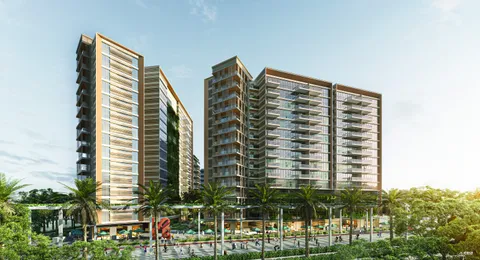 50 / 50Sky ResidencesExpo City Dubai · from AED 1,599,000
 20 / 40 / 40Avant Garde II ResidencesSkyline Builders · from AED 1,081,713
Compare payment plans side by side for projects with a verified schedule.
FAQQuestions buyers ask.
Can a US citizen buy off-plan property in Dubai?
Yes. Dubai's Law No. 7 of 2006 lets non-UAE nationals own freehold property in areas designated by the Ruler, which include most communities where off-plan projects are sold. You do not need to live in the UAE or hold a UAE visa, and there is no US rule stopping an American from buying property abroad. You reserve, sign the sale agreement and pay instalments into the project's escrow account from the US.
Which off-plan payment plan in Dubai suits US buyers?
The plans are the same for everyone; the right one depends on your cash flow. A 60/40 plan asks for 60% during construction and 40% at handover, which a UAE mortgage capped at 50% of value can cover. A 50/50 plan defers more. Because the dirham is pegged to the dollar, a US buyer can budget every instalment in dollars years ahead without currency risk.
Can Americans get a post-handover payment plan in Dubai?
Yes. Post-handover plans are offered by the developer, not a bank, so nationality and residence do not usually matter. Part of the price, often 30% to 50%, is paid in instalments after you receive the keys, sometimes over two to five years. The terms are in your sale agreement. Check that the expected rent covers the instalment plus service charges before you rely on it.
Do I pay US tax on rent from a Dubai property?
Yes. US citizens and resident aliens are taxed on worldwide income, wherever they live. Net rent, after expenses and depreciation, is reported in dollars on Schedule E of Form 1040. The UAE does not tax the rent, so there is no foreign tax to credit. The foreign earned income exclusion covers pay for work, so rent from a property you simply own and let is generally outside it.
How is a Dubai rental property depreciated for US tax?
Tangible property used predominantly outside the United States must be depreciated under the Alternative Depreciation System. For residential rental property placed in service after 2017 the ADS recovery period is 30 years, straight line, with a mid-month convention. Only the building is depreciated, not the land, and depreciation starts when the home is placed in service for rent, after handover.
Do I report a Dubai property on the FBAR or Form 8938?
Not if you own it directly in your own name: the IRS says directly held foreign real estate is not reportable on either. A UAE bank account is different. An FBAR is required once all your foreign accounts together exceed $10,000 at any time in the year, and Form 8938 applies above higher thresholds. Owning through a foreign company can bring the company interest into reporting.
Is there a tax treaty between the US and the UAE?
No comprehensive income tax treaty. The UAE does not appear on the IRS list of US income tax treaties. In practice this changes little for a property owner, because the UAE levies no personal income tax on rent or gains, so there would be no foreign tax to relieve. You pay US tax on Dubai income in full, as you would on US income.
Is Dubai off-plan property open to overseas investors who never visit?
Yes. Overseas investors buy on the same terms as residents, and most off-plan sales are signed electronically, with the developer registering the purchase with the Dubai Land Department. You can pay every instalment by international wire. A power of attorney becomes useful at handover or resale; a US one needs notarising, authenticating and attesting by the UAE before it is accepted.
Sources & methodWhere these figures come from.
Sources
- irs.gov: Us citizens and resident aliens abroad
- irs.gov: P527
- irs.gov: P946
- irs.gov: I4562
- irs.gov: I1040se
- irs.gov: Tc409
- irs.gov: Tc559
- irs.gov: I706
- irs.gov: Estate tax
- irs.gov: Comparison of form 8938 and fbar requirements
- irs.gov: Frequently asked questions about international individual tax matters
- irs.gov: Foreign currency and currency exchange rates
- irs.gov: Foreign earned income exclusion what is foreign earned income
- irs.gov: United states income tax treaties a to z
- fincen.gov: Report foreign bank and financial accounts
- hcch.net: Status table
- uae-embassy.org: General information
- centralbank.ae: Fx_aug26_en.pdf
- UAE Government portal: Fact sheet
- UAE Government portal: Taxation
- UAE Government portal: Golden visa
- Central Bank of the UAE Rulebook: Regulations regarding mortgage loans
- Dubai Legislation Portal: Law No. (7) of 2006
- Dubai Land Department: Request to register the initial sale
- difccourts.ae: Wills faq
What we could not verify
- The power of attorney chain (US notary, Secretary of State, US Department of State Office of Authentications, UAE Embassy or consulate, UAE Ministry of Foreign Affairs, Arabic translation) is described from the UAE Embassy's general guidance and practitioner sources; HCCH confirms the UAE is not in the Apostille Convention, but fees and processing times were not confirmed on an official page.
- How the 30-year ADS rule, the split between land and building, and the date an off-plan purchase counts as acquired apply to a particular Dubai home or to an assignment before handover depend on the facts; the 80% building share in the worked example is an assumption, and readers are told to confirm with a US tax adviser.
- That US mortgage lenders rarely lend against overseas homes, and the terms UAE banks offer non-resident Americans, are general market practice rather than official statements.
26 Oct 2026 · Reviewed by OffPlan Insider Research. First published 26 Oct 2026.