Rent-to-own in Dubai takes two forms. A Lease To Own contract with a financing party is registered by the Dubai Land Department, and the title deed passes to you when the financier releases it at the end. An ordinary Ejari lease with a promise to sell registers only the tenancy, so your right to buy stays contractual.
Key takeaways
- The Dubai Land Department registers Lease To Own contracts as their own service, between a seller, a purchaser and a financing party. Payments go to the financier and the purchaser becomes the owner at the end.
- Off-plan units can carry a provisional Lease To Own, which the developer registers on Oqood in favour of the financing entity and the lessee within 90 days of signing.
- An Ejari lease with a separate option to buy is not a Lease To Own registration. Ejari records the tenancy only, and under Law No. 7 of 2006 a transfer of property is valid only once recorded in the Property Register.
- DLD lists 2% of the sale value for each of seller and purchaser, 0.25% of the rental value, AED 250 for the title deed and a service partner fee of AED 4,000 plus VAT for a Lease To Own registration on a completed home.
- At the end, the bank's release letter goes to a Trustee centre and DLD lists AED 1,000 to remove the Lease To Own, with the updated title deed issued as an e-document.
- A post-handover plan keeps the sale on Oqood until the last instalment and follows DLD's 30-day default procedure. A mortgage makes you the registered owner from day one, with the bank's charge on the deed.
- Before you sign anything called rent-to-own, ask what DLD will register on the day you sign, who holds title meanwhile, and what happens to the money you have paid if you stop.
01What does rent-to-own mean in Dubai?
Rent-to-own is a marketing phrase, not a legal one. It describes any arrangement in which you live in a home and pay something like rent, with the aim of owning it at the end.
Dubai law gives that idea one formal shape. The Dubai Land Department registers Lease To Own contracts, between a seller, a purchaser and a financing party, in which payments are collected from the purchaser in favour of the financing party and the purchaser ultimately becomes the owner. The department used to call this a tenancy contract ending with acquisition of title.
Anything else sold under the same name is a private contract layered on top of an ordinary lease. That difference decides what you own, what is protected and what happens if things go wrong, so it is the first thing to establish. This guide sets out the law as of November 2026, for buyers planning a purchase in 2027.
02Which rent-to-own arrangements does the law recognise?
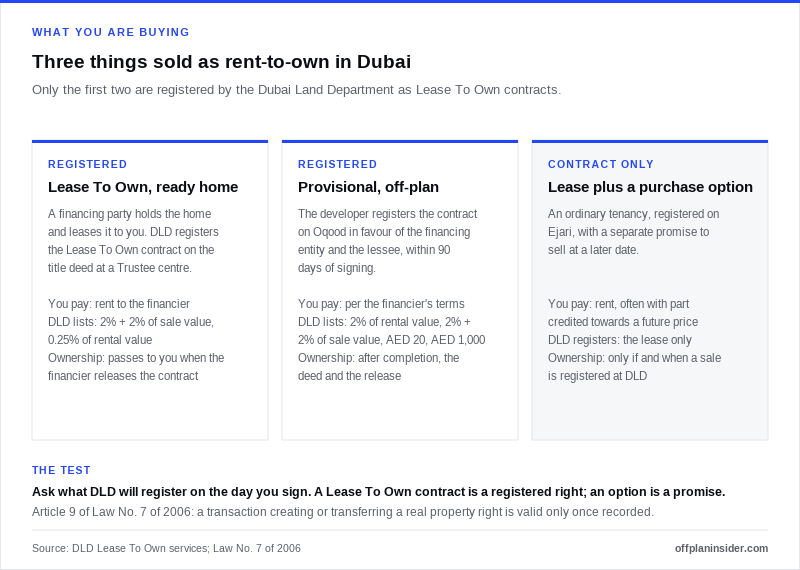
Three structures turn up under the rent-to-own label. Two are registered by DLD as Lease To Own; the third is not.
1. A registered Lease To Own on a completed home. A financing party, usually a bank or finance company, acquires the home and leases it to you for a fixed term. DLD registers the Lease To Own contract at a Real Estate Registration Trustee centre, and the output can be a title deed, a usufruct title deed or a provisional sale certificate, depending on the property.
2. A provisional Lease To Own on an off-plan unit. For a unit that is not yet built, DLD's provisional service lets the developer register a Lease To Own contract on the interim register in favour of the financing entity and the lessee. The developer files it through the Oqood portal, and the contract must be registered within 90 days of signing.
3. An ordinary lease with a promise to sell. A landlord lets the home on a normal tenancy, registered on Ejari, and signs a separate agreement promising to sell it later, often crediting part of the rent towards the price. Ejari records the tenancy. Nothing in that process records a right to buy.
The first two are forms of property finance; in Islamic finance this is the ijara structure, which DLD also handles as a finance lease. The third is a contract between two private parties, and its value depends entirely on what it says and who signed it.
03Who owns the home during a Lease To Own?
Not you, yet. In a registered Lease To Own the financing party holds the property and you hold a registered lease that ends in ownership. DLD's description is that the purchaser "ultimately becomes the owner", which is the end of the arrangement, not the start.
That matters because of how Dubai law defines ownership. Article 7 of Law No. 7 of 2006 gives the Property Register absolute evidentiary value against everyone, and DLD's own answer to the question of who is an owner is anyone registered in the real estate registry as one.
Your protection during the term is the registration itself. Because DLD has recorded the Lease To Own against the property, the arrangement is visible to anyone who checks the register, and it can only be amended, transferred or released through DLD's own services.
04What does DLD register, and when does ownership transfer?
DLD registers the Lease To Own contract at the start and removes it at the end. Ownership transfers to you when the financier releases the contract and DLD issues the updated deed.
At the start: registration
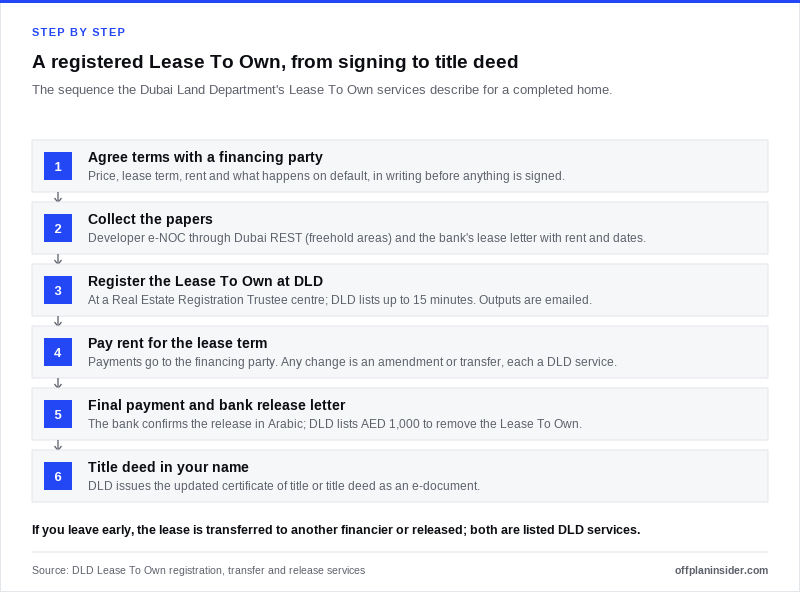
For a completed home, the application is made at a Trustee centre only. DLD lists the documents for an individual as:
- A no objection e-certificate from the developer, for freehold areas, obtained through the Dubai REST app.
- A lease letter from the bank stating the rental amount and the start and expiry dates.
- The Emirates ID of the seller and purchaser, or a valid passport for non-residents.
- A power of attorney, if someone signs for a party.
The centre checks the documents, enters and audits the transaction, takes the fees and emails the outputs. DLD lists the service time as up to 15 minutes. Companies must be registered with DLD first.
Off-plan: the provisional route
For an off-plan unit, the developer registers the provisional Lease To Own on Oqood. It enters the financing entity's details and the financing amount, attaches the signed sale and purchase agreement and your ID, and pays from its Noqodi wallet or the escrow account.
The output is a provisional Lease To Own e-contract, emailed to the lessee, with a listed service time of six business days. The conditions mirror an ordinary Oqood registration: the SPA must be signed by both sides, a guardian signs for a minor, and registration must happen within 90 days. Our guide to Oqood in Dubai explains the interim register in full.
During the term: amendments and transfers
If the financing changes, DLD has a service for it. A finance lease amendment covers a change to the amount or term, and DLD lists 0.25% of any increase or AED 1,000 for a term change.
A Lease To Own transfer moves the contract to a new financier. It needs a no objection letter from the old bank and a lease letter from the new one.
At the end: release and title deed
When you have paid everything due, the bank issues a letter in Arabic confirming the release. You take it to a Trustee centre with your ID, DLD removes the Lease To Own and issues the updated certificate of title or title deed as an e-document. From then on you are the registered owner, and our guide to the title deed in Dubai covers what that document proves.
05Ejari vs SPA vs Lease To Own: which document does what?
Three documents can be involved, and buyers often confuse them. Each is registered somewhere different and protects something different.
| Document | What it is | Where it is registered | What it protects |
|---|---|---|---|
| Ejari tenancy contract | A lease under the landlord and tenant law, Law No. 26 of 2007 | Ejari, run by RERA within DLD | Your right to occupy for the lease term; rent and eviction rules |
| Sale and purchase agreement (SPA) | The contract to buy, usually from a developer off-plan | Oqood (interim register) for off-plan sales | Your purchase; payments into the project's escrow account |
| Lease To Own contract | A lease ending in ownership, with a financing party | DLD, on the title deed or provisionally on Oqood | A registered route to ownership on release |
| Private option or promise to sell | A side agreement between landlord and tenant | Not registered by DLD as a property right | A contractual claim against the person who signed it |
Ejari. Article 4 of Law No. 26 of 2007, as replaced in 2008, requires every lease covered by the law to be registered, and courts will not hear a dispute on an unregistered lease. Ejari gives you tenant protection: the landlord can seek eviction for non-payment only after a 30-day notice to pay, and under Article 28 a sale of the property does not end a fixed-term lease. It does not make you a buyer. Our guide to Ejari in Dubai explains how the registration works and what it costs.
SPA. On an off-plan purchase, the SPA is what makes you a buyer, and it must be entered on Oqood. Article 3 of Law No. 13 of 2008 makes an off-plan sale void unless it is on the interim register. Our guide to the sale and purchase agreement in Dubai goes clause by clause.
Lease To Own. This is the only one of the three that is a registered lease ending in ownership. If an arrangement is called rent-to-own but nobody mentions DLD's Lease To Own registration, you are almost certainly looking at an Ejari lease and a side agreement.
06How much does a Lease To Own cost to register?
DLD lists the fees on each service page. As of 23 November 2026 they are as follows.
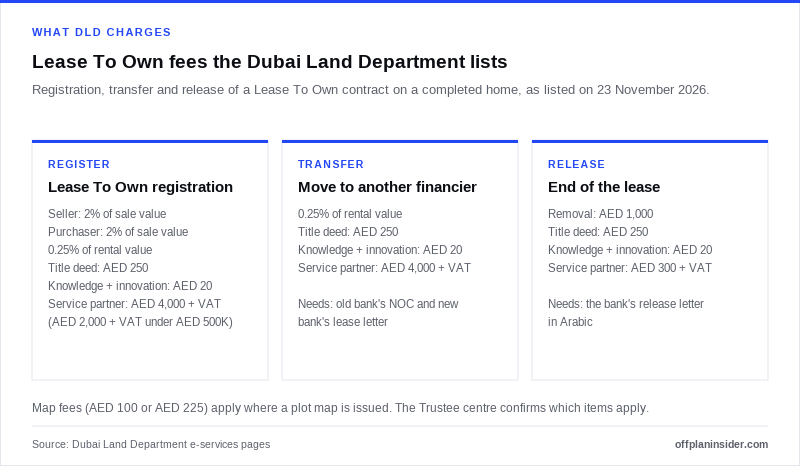
Registration. 2% of the sale value for the seller and 2% for the purchaser, 0.25% of the rental value, AED 250 for the title deed, AED 10 knowledge and AED 10 innovation fees, and a service partner fee of AED 4,000 plus VAT where the sale value is AED 500,000 or more, or AED 2,000 plus VAT below that. Map fees of AED 100 or AED 225 apply where a plot map is issued.
Provisional (off-plan). The provisional service page lists 2% of the rental value for the lessee, 2% of the sale value each for seller and purchaser, AED 10 knowledge and AED 10 innovation fees, and AED 1,000 where the developer self-registers on the Oqood portal. The page does not say which items apply in each case, so ask the developer and financier for the figures in writing.
Release. AED 1,000 to remove the Lease To Own, AED 250 for the new deed, AED 20 in knowledge and innovation fees and a service partner fee of AED 300 plus VAT.
The financier's own charges are on top: profit or rent margin, arrangement fees, valuation and insurance. These are set by each provider, so compare them across offers. The DLD fees above are the same whoever you finance with; the full list of buying costs is in our guide to the true cost of buying off-plan in Dubai.
07What does the law cover, and what does it not?
The protection you get depends on which structure you are in. This is where buyers lose money, so it is worth reading slowly.
What the law covers
- Registration of a Lease To Own. DLD records it against the property, and only DLD's amendment, transfer and release services can change it.
- The register as evidence. Article 7 of Law No. 7 of 2006 gives the Property Register absolute evidentiary value, challengeable only for fraud or forgery.
- Unregistered transfers. Article 9 of the same law says a transaction creating or transferring a real property right is not valid unless recorded. That cuts both ways: it protects a registered Lease To Own and leaves an unregistered promise without property effect.
- Tenancy protection. If you rent under Ejari, Law No. 26 of 2007 governs rent, the 30-day notice before eviction for non-payment and the survival of a fixed-term lease on sale.
- Off-plan sales. If a developer is the seller, the sale must be on Oqood under Law No. 13 of 2008, payments go to the project escrow account under Law No. 8 of 2007, and default follows DLD's procedure under Law No. 19 of 2020. Our guide to off-plan buyer protection in Dubai shows how these fit together.
- Bank finance. Lease To Own with a bank is home finance, and Article 6 of the Central Bank's mortgage regulation applies the same requirements to Islamic finance, including the loan-to-value caps.
What the law does not cover
- A rent credit in a side agreement. If part of your rent is credited towards a future price under a private option, that credit is a contractual promise. It is not a registered right in the property.
- The landlord's future. If a landlord under a private option sells to someone else, mortgages the home or dies, your claim is against them or their estate. The new owner is bound by your fixed-term lease, but not automatically by a promise to sell to you.
- Escrow for option money. Law No. 8 of 2007 governs payments for off-plan units into a project's escrow account. Money paid to a private landlord for an option on a completed home sits outside that regime.
- The price you will pay. Nothing in Dubai law fixes or caps the purchase price in a rent-to-own deal. Whatever the contract says is what you have agreed.
- Default terms. The financing agreement sets what happens if you stop paying a registered Lease To Own. Read it with the same care as an SPA.
08How does rent-to-own compare with post-handover plans and mortgages?
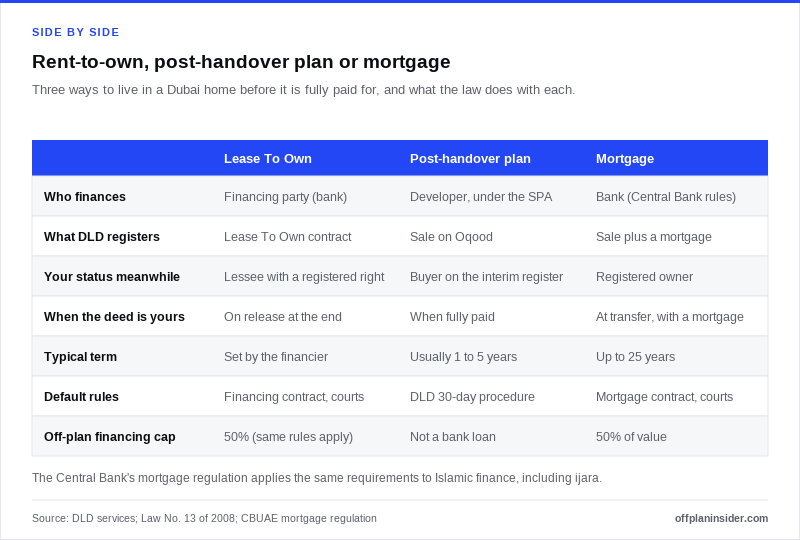
All three let you live in a home before it is fully paid for. They differ in who lends, what is registered and when the deed becomes yours.
Post-handover payment plans
A post-handover plan is credit from the developer. You sign an SPA, the sale goes on Oqood, and you keep paying instalments for an agreed period after you collect the keys.
You are the buyer from day one, but DLD normally issues the title deed only once the unit is fully paid. If you miss an instalment, the developer must follow DLD's procedure, with a 30-day notice, before it can claim, auction or terminate. Our guide to post-handover payment plans in Dubai covers the split, the deed and the risks, and live projects are on our post-handover payment plans page.
For most people who search for rent-to-own because they want to move in before paying in full, a post-handover plan on a new home is the structure the law treats most clearly. Your payments are towards a registered purchase, not rent.
Mortgages
With a mortgage you buy the home outright and the bank registers its charge on your title deed. You are the registered owner from transfer, and the loan can run up to 25 years.
The Central Bank caps lending. An expatriate buying a first home under AED 5 million can borrow up to 80% of value, a UAE national up to 85%, and any buyer of property bought off-plan up to 50%. Our guide to off-plan mortgages in the UAE explains the caps and the common strategy of using a mortgage for the handover payment.
A side-by-side summary
| Registered Lease To Own | Ejari lease plus option | Post-handover plan | Mortgage | |
|---|---|---|---|---|
| Who you pay | Financing party | Landlord | Developer | Bank |
| Registered right to own | Yes, Lease To Own | No, lease only | Yes, sale on Oqood | Yes, title deed |
| Deed in your name | On release | Only if a sale is registered | When fully paid | At transfer |
| Price fixed at the start | In the financing contract | Only if the option says so | Yes, in the SPA | Yes, in the sale contract |
| Main risk | Financier's default terms | The promise is not registered | Default procedure after handover | Approval and valuation |
09Worked example: one home, four routes
The figures below are illustrative only. They use a single AED 1,200,000 apartment to show how the fees and timing differ, not what any provider charges or what any home is worth.
| Route | What is paid at the start | How the rest is paid | When the deed is yours |
|---|---|---|---|
| Registered Lease To Own | DLD 2% + 2% of AED 1,200,000 = AED 48,000 (split as agreed); 0.25% of an assumed AED 1,000,000 rental value = AED 2,500; title deed AED 250; AED 20; service partner AED 4,000 + AED 200 VAT. About AED 54,970 in DLD-listed fees, plus the financier's charges | Rent to the financier for the agreed term | On release: AED 1,000 + AED 250 + AED 20 + AED 300 + AED 15 VAT = AED 1,585 |
| Ejari lease plus option | Ejari AED 177.75 online; any option fee set by the side agreement | Rent to the landlord; any credit only as the option says | Only when a sale is registered, with 4% DLD fee on the price paid then |
| Post-handover plan, 60/40 | 4% DLD fee, AED 48,000, at Oqood registration; instalments to AED 720,000 by handover | AED 480,000 after handover, e.g. 36 monthly payments of about AED 13,333 | When the last instalment is paid |
| Mortgage, expatriate first home, ready | At least 20%, AED 240,000, plus 4% DLD fee, AED 48,000, plus 0.25% mortgage registration on AED 960,000, AED 2,400 | Repayments to the bank over up to 25 years | At transfer, with the bank's charge |
Three things stand out. A registered Lease To Own and a purchase both carry the 4% DLD transfer fee; registering it does not avoid that cost. A private option defers it, but also defers your registered interest. And the post-handover plan is the only route where the instalments go towards a price already fixed and registered on day one.
10Risks to check before you sign
Most problems with rent-to-own come from not knowing which structure you are in. These are the points to settle in writing.
- What will DLD register? Ask for the name of the DLD service. If the answer is only Ejari, your purchase right is contractual.
- Who holds title now? Check the seller or financier is the registered owner, or for off-plan, that the project is registered and the developer is selling.
- Is the price fixed? A rent-to-own that leaves the final price to be agreed later is a lease with a hope attached.
- What happens to your money if you stop? Read the default clause. Find out whether rent credits, option fees or deposits are refunded, forfeited or set against arrears.
- What if the other side sells or borrows? With a private option, ask whether the landlord's mortgage lender has consented and what happens to your option on a sale.
- Who pays which fee? DLD lists fees for seller and purchaser; your contract allocates them.
- Service charges and maintenance. Ask who pays the service charge, insurance and repairs during the lease, and put it in the contract.
- Leaving early. Check whether the contract can be transferred to another financier or released, and on what terms.
- Is the person offering it licensed? Brokers in Dubai must be registered with RERA; check the broker and the agency card before paying anything.
11Rent-to-own checklist
- Identify the structure: registered Lease To Own, provisional Lease To Own, or Ejari lease plus option.
- Confirm the registered owner of the property and, for off-plan, the project's registration with DLD.
- Get the financier's or seller's terms in writing: price, term, rent, credit towards the price, fees and default.
- Check the DLD fees on the relevant service page and who pays each one.
- For a completed home, ask whether the developer's e-NOC is needed and who will obtain it through Dubai REST.
- For off-plan, confirm the provisional Lease To Own will be registered on Oqood within 90 days of signing.
- Make sure the lease is registered: Lease To Own at DLD, or Ejari for an ordinary tenancy.
- Read the default, early exit and transfer clauses before paying anything.
- Keep the registration outputs, receipts and the financier's letters together.
- At the end, collect the bank's release letter in Arabic and complete the release at a Trustee centre.
12Key terms
- Lease To Own. DLD's name for a lease ending in ownership between a seller, a purchaser and a financing party. Formerly a tenancy contract ending with acquisition of title.
- Provisional Lease To Own. The off-plan version, registered by the developer on the interim register.
- Ijara. An Islamic finance structure in which the financier owns the home and leases it to you, with ownership passing at the end.
- Financing party. The bank or finance company in a Lease To Own.
- Ejari. The system for registering tenancy contracts under Law No. 26 of 2007.
- Oqood. The interim register for off-plan sales under Law No. 13 of 2008.
- Property Register. DLD's main register; a title deed is issued from it.
- Release. The DLD service that removes a Lease To Own once the financier confirms it is paid.
- Option to purchase. A private promise to sell at a later date; not a registered property right on its own.
13Where to go next
If your aim is to move in before paying in full, start with the projects on our post-handover payment plans page, or browse every structure on payment plans. Homes close to completion are on near-handover projects, and finished homes on ready projects.
If you prefer bank finance, our off-plan mortgage guide explains what you can borrow and when. Tell us your budget and how you want to pay, and we will send projects whose plans fit, with today's terms checked for each.
FAQQuestions buyers ask.
Is rent-to-own legal in Dubai?
Yes. The Dubai Land Department has a Lease To Own registration service for contracts between a seller, a purchaser and a financing party, plus services to amend, transfer and release them. What matters is whether your arrangement is registered as one. An ordinary lease with a private promise to sell is a contract between the parties, not a registered property right.
When do I become the owner in a rent-to-own deal?
In a registered Lease To Own, when the financing party releases the contract at the end of the term and DLD issues the updated title deed in your name. Under Law No. 7 of 2006 the Property Register is the evidence of ownership, and DLD's own answer is that an owner is anyone registered as one. Until then, you are a lessee with a registered right.
Is an Ejari tenancy contract enough for rent-to-own?
No. Ejari registers a tenancy under the landlord and tenant law, which protects your right to live in the home for the lease term. It does not register a right to buy. If the purchase part sits only in a side agreement, it gives you a claim against the other party, not a registered interest in the property.
How much does Lease To Own registration cost in Dubai?
On a completed home DLD lists 2% of the sale value for the seller and 2% for the purchaser, 0.25% of the rental value, AED 250 for the title deed, AED 20 in knowledge and innovation fees, and a service partner fee of AED 4,000 plus VAT, or AED 2,000 plus VAT below AED 500,000. Your contract decides who bears each item.
Can I rent-to-own an off-plan property?
DLD has a provisional Lease To Own service for off-plan units. The developer registers it on the Oqood portal in favour of the financing entity and the lessee, within 90 days of signing, and DLD lists a service time of six business days. The Central Bank's 50% cap on financing property bought off-plan applies to Islamic finance as well.
What happens to my payments if I stop paying in a rent-to-own deal?
It depends on the contract, so read the default clause before you sign. In a registered Lease To Own with a bank, the financing agreement and the courts govern what happens. In an Ejari lease with an option, rent is rent: the landlord can seek eviction for unpaid rent after a 30-day notice, and any credit towards the price is only as safe as the side agreement.
Is a post-handover payment plan better than rent-to-own?
They solve different problems. A post-handover plan is credit from the developer: you are the buyer from the start, the sale sits on Oqood and the title deed is issued when you finish paying. A registered Lease To Own is finance from a third party, usually a bank, with the financier's terms and Central Bank rules. Compare the total cost, the term and the default rules.
Sources & methodWhere these figures come from.
Sources
- Dubai Land Department: Lease to own registration application
- Dubai Land Department: Request for registration of a rent to own property initial
- Dubai Land Department: Request for transfer of tenancy contract ending with acquisition of title
- Dubai Land Department: Request for termination of tenancy ending with acquisition of title
- Dubai Land Department: Request for amendment of finance lease contract
- Dubai Land Department: Name of services
- Dubai Land Department: Frequently asked questions
- Dubai Legislation Portal: Law No. (7) of 2006
- Dubai Legislation Portal: Law No. (26) of 2007
- Dubai Legislation Portal: Law No. (13) of 2008
- Dubai Legislation Portal: Law No. (19) of 2020 Amending Law No. (13) of 2008 Regulating the Interim Real Property Register in the Emirate of Dubai
- Dubai Legislation Portal: Law No. (8) of 2007
- Dubai Land Department: Register renew terminate tenancy contract
- Dubai Land Department: Request for mortgage registration
- Central Bank of the UAE Rulebook: Regulations regarding mortgage loans
- Central Bank of the UAE Rulebook: Article 3 important ratios
What we could not verify
- DLD's Lease To Own pages do not say which party bears each fee, and the 0.25% is charged on a rental value the pages do not define further; the worked example assumes a figure and is labelled illustrative.
- Whether a registered Lease To Own also needs a separate Ejari, for example to connect DEWA, is not stated on DLD's Lease To Own pages and is confirmed by the financier and the Trustee centre.
- That a rent credit or option fee paid to a private landlord under a lease with a purchase option falls outside the off-plan escrow regime is our reading of Law No. 8 of 2007, which covers payments for off-plan units.
23 Nov 2026 · Reviewed by OffPlan Insider Research. First published 23 Nov 2026.