EIBOR, the Emirates Interbank Offered Rate, is the daily benchmark for the cost of borrowing dirhams between banks, administered by the Central Bank of the UAE. Most UAE mortgages are fixed for an initial period and then charge EIBOR, usually the three-month rate, plus a fixed bank margin, so when EIBOR rises or falls your repayment follows at each reset. Because the dirham is pegged to the US dollar, the Central Bank's Base Rate follows the US Federal Reserve, and EIBOR tends to move with it. The Base Rate was raised to 3.90% on 17 September 2026 and held on 28 October 2026.
Key takeaways
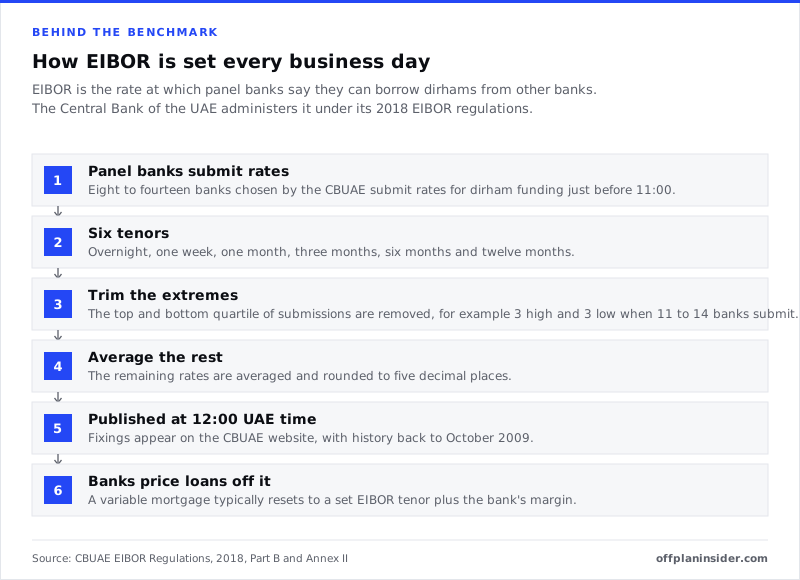
- EIBOR is set every business day from rates submitted by eight to fourteen panel banks chosen by the Central Bank of the UAE. The top and bottom quartile are removed, the rest averaged, and the result published at 12:00 UAE time.
- It is fixed for six tenors: overnight, one week, one month, three months, six months and twelve months. Variable home loans are usually priced off three-month EIBOR plus the bank's margin.
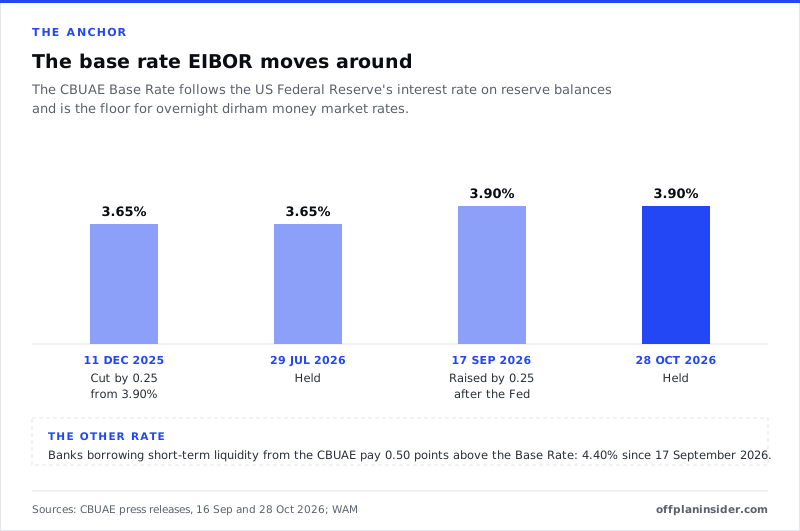
- The dirham is pegged at AED 3.6725 to the dollar, so the Central Bank's Base Rate follows the US Federal Reserve. It was cut to 3.65% in December 2025, raised to 3.90% from 17 September 2026 and held on 28 October 2026.
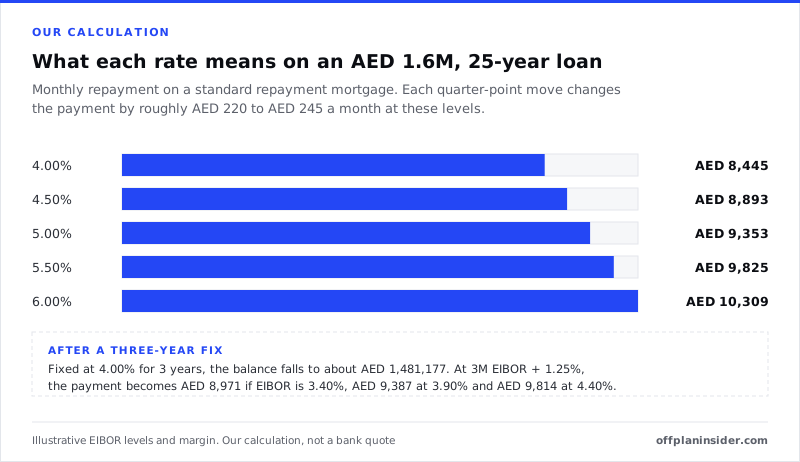
- On an AED 1.6 million, 25-year loan, each quarter-point change moves the monthly repayment by roughly AED 220 to AED 245. At 4.00% the payment is AED 8,445; at 5.00% it is AED 9,353.
- A fixed rate protects you only for its term. When it ends, the loan reverts to EIBOR plus margin on the remaining balance, so ask for the margin, the tenor and any minimum rate before you sign.
- For off-plan buyers the mortgage usually starts at handover, years after booking. Plan the handover payment at a rate one to two points above today's, and compare it with an interest-free post-handover plan.
01What is EIBOR?
EIBOR, the Emirates Interbank Offered Rate, is the benchmark for what it costs UAE banks to borrow dirhams from each other. It is published every business day by the Central Bank of the UAE, and it is the rate most UAE mortgages follow once their fixed period ends.
The Central Bank's EIBOR regulations define it as the daily reference rate at which panel banks are able and willing to access dirham funding, in reasonable market size, for a given period, from the UAE money market just before 11:00 local time. The Central Bank is the administrator: it chooses the panel, collects the data, oversees the calculation and publishes the result.
Why it matters to you: a bank's cost of money moves with EIBOR, so a loan priced as "EIBOR plus a margin" moves too. If you take a mortgage to pay the handover balance on an off-plan home, EIBOR will shape most of what you pay over the life of the loan.
This guide explains how EIBOR is set, what moves it and what a change does to a repayment. Eligibility, loan caps and fees for off-plan buyers are covered in our guide to off-plan mortgages in the UAE. This is general information, not financial advice.
02How is EIBOR calculated?
Every business day, a panel of banks submits the rate at which it could borrow dirhams for each period. The highest and lowest submissions are removed, the rest are averaged, and the result is published at noon.
The method is set out in the Central Bank's 2018 EIBOR regulations:
- The panel. Eight to fourteen banks operating in the UAE, nominated by the Central Bank, which reviews each bank's eligibility every year.
- The data. Banks base submissions first on real interbank transactions. Where there are none, they follow a set order of fallbacks, ending in documented expert judgement.
- The trim. The top and bottom quartile are excluded. With 11 to 14 submissions, the three highest and three lowest are dropped; with 8 to 10, two of each; with 5 to 7, one of each. With four or fewer, there is no fixing that day.
- The average. The remaining rates are averaged and published to five decimal places.
- Publication. Fixings are published at 12:00 UAE time each business day and appear on the Central Bank's website, with their history since the Central Bank took over the fixings in October 2009.
03What are the EIBOR tenors, and which one does a mortgage use?
EIBOR is fixed for six periods, called tenors. Variable mortgages are usually priced off three-month EIBOR, and reset every three months.
| Tenor | What it measures | Where you meet it |
|---|---|---|
| Overnight | Borrowing to the next business day | Bank liquidity; closest to the Base Rate |
| One week | Borrowing for a week | Money markets |
| One month | Borrowing for about a month | Some variable loans that reset monthly |
| Three months | Borrowing for about three months | The usual benchmark for variable home loans |
| Six months | Borrowing for about six months | Some home and business loans |
| Twelve months | Borrowing for about a year | Some business loans |
Longer tenors carry more uncertainty, so they usually price in what the market expects the Central Bank to do over that period. That is why three-month EIBOR can start moving before the Base Rate changes.
Your loan documents name the tenor, the margin and the reset dates. If they are not clear, ask the bank to state them in writing before you accept the offer.
04What is the UAE Base Rate, and how does it drive EIBOR?
The Base Rate is the Central Bank's policy rate. It is anchored to the US Federal Reserve because the dirham is pegged to the dollar, and it sets the floor that EIBOR moves around.
The peg. The dirham has been fixed at AED 3.6725 to the US dollar since 1997. To keep it stable, UAE interest rates have to follow US rates, otherwise money would flow towards whichever currency paid more.
The Base Rate. The Central Bank describes its Base Rate as anchored to the Federal Reserve's interest rate on reserve balances. It signals the stance of monetary policy and provides an effective floor for overnight money market rates. Banks that borrow short-term liquidity from the Central Bank pay 0.50 points above it, which has meant 4.40% since 17 September 2026.
The link to EIBOR. The Base Rate sets the cost of the shortest money. EIBOR, built from what banks pay each other for up to a year, sits around it and moves when expectations about the next Fed and Central Bank decisions change.
Recent Base Rate decisions
| Decision | Base Rate | What happened |
|---|---|---|
| 10 December 2025, effective 11 December | 3.65% | Cut by 0.25 points from 3.90%, after the Federal Reserve's cut |
| 29 July 2026 | 3.65% | Held |
| 16 September 2026, effective 17 September | 3.90% | Raised by 0.25 points after the Federal Reserve raised its rate on reserve balances |
| 28 October 2026 | 3.90% | Held, after the Federal Reserve left its rate unchanged |
A Base Rate change does not alter your mortgage on the day. It reaches you through EIBOR, at your loan's next reset, and only if you are past any fixed period.
05How does EIBOR set your mortgage rate?
A variable UAE mortgage rate is EIBOR plus a margin. The margin is fixed by the bank for the life of the loan; EIBOR is what changes.
Most home loans fall into one of three types:
| Type | How the rate works | What changes your payment |
|---|---|---|
| Fixed, then variable | A fixed rate for an initial period, then EIBOR plus margin for the rest of the term | Nothing during the fix; EIBOR at each reset afterwards |
| Variable from day one | EIBOR plus margin from the start | EIBOR at every reset |
| Variable with a minimum rate | EIBOR plus margin, but never below a stated floor | EIBOR when it is high; the floor when it is low |
The margin. It reflects the bank's view of the loan: your income and employer, the loan-to-value, whether you are resident, and the property. A lower margin matters more than a low introductory rate if you keep the loan for many years.
The minimum rate. Some loans set a floor, so you do not benefit if EIBOR falls below a certain level. Ask whether your loan has one, and at what level.
Islamic home finance. Ijara and murabaha products charge a profit rate rather than interest, but the rental or profit element is commonly benchmarked to EIBOR in the same way. The Central Bank's mortgage regulations apply the same loan caps and debt limits to Islamic finance.
06Worked example: what a rate change does to a repayment
On a large loan, small rate changes add up. These figures use a standard repayment mortgage of AED 1,600,000 over 25 years, the loan on an AED 2,000,000 home bought with 20% down.
| Mortgage rate | Monthly repayment | Change from 4.00% | Total repaid over 25 years |
|---|---|---|---|
| 4.00% | AED 8,445 | - | AED 2,533,617 |
| 4.50% | AED 8,893 | +AED 448 | AED 2,667,996 |
| 5.00% | AED 9,353 | +AED 908 | AED 2,806,032 |
| 5.50% | AED 9,825 | +AED 1,380 | AED 2,947,620 |
| 6.00% | AED 10,309 | +AED 1,864 | AED 3,092,647 |
At these levels each quarter-point moves the payment by roughly AED 220 to AED 245 a month. A one-point rise, from 4.00% to 5.00%, adds about AED 908 a month, or roughly AED 10,900 a year.
When a fixed rate ends
Say the same loan is fixed at 4.00% for three years, and then reverts to three-month EIBOR plus a margin of 1.25%. After three years of payments of AED 8,445, the balance is about AED 1,481,177, with 22 years to run.
| Three-month EIBOR at reversion | New rate | New monthly repayment | Change |
|---|---|---|---|
| 3.40% | 4.65% | AED 8,971 | +AED 526 |
| 3.90% | 5.15% | AED 9,387 | +AED 942 |
| 4.40% | 5.65% | AED 9,814 | +AED 1,369 |
| 4.90% | 6.15% | AED 10,249 | +AED 1,804 |
The point of the example is the jump at reversion. A low fixed rate can make a loan look cheaper than it is, so ask the bank to show you the payment at the end of the fix, using today's EIBOR and its margin.
07What EIBOR means for an off-plan buyer
Off-plan buyers usually borrow at handover, often two to four years after booking. The rate you see today is not the rate you will get, so plan for a range.
The loan starts late. The Central Bank caps mortgages on property bought off-plan at 50% of value, and banks generally lend late in construction or at handover. That leaves years between the day you commit and the day your rate is set. Our off-plan mortgage guide explains why.
Pre-approval does not lock the rate. An approval in principle is typically valid for 60 to 90 days. At handover the bank re-assesses your income, the valuation and the rate on that day.
Affordability moves with the rate. The Central Bank limits total debt repayments to 50% of income. A higher rate raises the repayment, which lowers how much you can borrow on the same salary. On the AED 1,600,000 example, the repayment at 5.15% is AED 9,387 a month, which on its own would need a monthly income of at least AED 18,774 to stay within that limit.
Stress-test it yourself. Banks commonly test applicants at two to four points above the loan rate. Do the same before you choose a plan: work out the handover payment you would owe at today's rate plus one and plus two points.
Compare it with a post-handover plan. A developer post-handover plan is usually interest-free credit, so it is not touched by EIBOR at all. Its instalments are shorter and larger than mortgage repayments, but if your income can carry them, the plan can cost less than borrowing. Projects that offer one are listed under post-handover payment plans, and our payment plan guide compares structures.
Watch the cash, not just the rate. Since 1 February 2025 banks have not financed the 4% DLD fee, and mortgage registration adds 0.25% of the loan. Our guide to the DLD fee has worked examples of both.
08Fixed or variable: how to compare
Neither is right for everyone. A fixed rate buys certainty for a period; a variable rate gives you any fall in EIBOR, and every rise.
| Fixed for a period | Variable (EIBOR plus margin) | |
|---|---|---|
| Payment during the first years | Known in advance | Changes at each reset |
| If EIBOR rises | Protected until the fix ends | Payment rises at the next reset |
| If EIBOR falls | No benefit until the fix ends | Payment falls, down to any minimum rate |
| After the initial period | Usually reverts to EIBOR plus margin | Continues as before |
| Leaving early | An early settlement fee may apply | An early settlement fee may apply |
| Best suited to | Buyers who need a fixed budget | Buyers with room in their budget for rises |
Questions that settle the choice:
- How long do you expect to keep the loan or the property?
- Could you meet the payment if the rate rose two points at the end of the fix?
- What is the margin after the fix, and is there a minimum rate?
- What would it cost to repay early or move to another bank?
09Can I switch banks or repay early if rates change?
Yes, but count the cost. Repaying early can carry a fee, and moving the loan to another bank means registering the change with the Dubai Land Department.
Early settlement. The Central Bank set a limit in 2019 on the fee banks may charge to settle a mortgage early: 1% of the outstanding balance or AED 10,000, whichever is lower. Check the figure in your own key facts statement.
Moving banks. A buyout by another bank usually means discharging the old mortgage and registering the new one. In Dubai, discharging a mortgage is AED 1,000 and transferring a mortgage is 0.25% of its value under the Land Department's fee schedule, and new mortgage registration is 0.25% of the loan plus fixed and service partner fees. Add the new bank's valuation and arrangement fees.
Switching makes sense when the saving over the years you expect to hold the loan is clearly larger than those costs. Run the numbers with the new bank's margin, not just its introductory rate.
10How to check EIBOR yourself
The Central Bank of the UAE publishes the day's EIBOR fixings on its website after noon on each business day, for all six tenors, with history back to October 2009. Many UAE banks also publish them.
To estimate your own next payment:
- Find your loan's tenor and margin in your offer letter or key facts statement.
- Note the reset date; your rate will use EIBOR on or near that date.
- Add the margin to the current EIBOR for that tenor.
- Check the result against any minimum rate in your loan.
- Recalculate the payment on your remaining balance and term, or ask the bank to.
EIBOR is published to five decimal places, but your loan uses the rate the bank applies on its reset date, so small differences are normal.
11Questions to ask your bank
- Is the rate fixed, variable or fixed then variable? For how long is it fixed?
- Which EIBOR tenor is used, and how often does the rate reset?
- What is the margin, and does it ever change?
- Is there a minimum rate, and at what level?
- What will my payment be when the fixed period ends, at today's EIBOR?
- What is the early settlement fee, and are part-payments allowed without a fee?
- For an off-plan home, how long is the approval valid, and what happens if rates change before handover?
12Key terms
- EIBOR. Emirates Interbank Offered Rate, the daily benchmark for dirham borrowing between banks.
- Tenor. The period an EIBOR rate covers, from overnight to twelve months.
- Base Rate. The Central Bank of the UAE's policy rate on its overnight deposit facility, anchored to the US Federal Reserve.
- IORB. The Federal Reserve's interest rate on reserve balances, the US rate the Base Rate follows.
- Margin. The fixed amount a bank adds to EIBOR to set a variable rate.
- Reversion rate. The rate a loan moves to when its fixed period ends.
- Minimum rate. A floor below which a variable rate does not fall.
- Debt burden ratio. Total monthly debt repayments as a share of income, capped at 50% by the Central Bank.
13Where to go next
If you are buying off-plan and plan to borrow at handover, start with our off-plan mortgage guide for the loan caps and timing, then the true cost guide for the full cash plan. To compare homes whose handover suits your finances, see projects near handover or browse by year, such as handover in 2027.
FAQQuestions buyers ask.
What is EIBOR?
EIBOR stands for Emirates Interbank Offered Rate. It is the daily reference rate at which a panel of UAE banks say they can borrow dirhams from other banks for a given period. The Central Bank of the UAE administers it, and banks use it as the benchmark for variable-rate loans, including most mortgages after their fixed period ends.
How is EIBOR calculated?
Each business day, panel banks chosen by the Central Bank submit the rate at which they could borrow dirhams just before 11:00. For each tenor, the highest and lowest quarter of submissions are removed, the remaining rates are averaged, and the result is published to five decimal places at 12:00 UAE time. If fewer than five banks submit, there is no fixing that day.
Which EIBOR rate is used for mortgages in the UAE?
Most variable-rate home loans use three-month EIBOR, reset every three months, plus a fixed margin set by the bank. Some products use one-month or six-month EIBOR. The tenor, the margin, the reset dates and any minimum rate are written in your loan offer and key facts statement, so check them before you sign.
What is the difference between EIBOR and the UAE Base Rate?
The Base Rate is the Central Bank's policy rate, paid on banks' overnight deposits with it and anchored to the US Federal Reserve's rate on reserve balances. It sets a floor for overnight money market rates. EIBOR is a market rate built from banks' own funding costs for periods up to a year, so it moves around the Base Rate and reflects expectations as well as policy.
Why does UAE EIBOR follow US interest rates?
Because the dirham is pegged to the US dollar at AED 3.6725. To hold the peg, the Central Bank keeps its Base Rate anchored to the Federal Reserve's interest rate on reserve balances, and changes it when the Fed does. On 16 September 2026 it raised the Base Rate by 0.25 points to 3.90% after the Fed's increase the same day.
How much does a 1% rise in EIBOR add to a mortgage?
On an AED 1.6 million loan over 25 years, moving from 4.00% to 5.00% raises the monthly repayment from AED 8,445 to AED 9,353, about AED 908 a month or roughly AED 10,900 a year. The effect is smaller on a smaller or shorter loan and is felt only when your rate resets, not on a fixed rate until it ends.
Is a fixed or variable mortgage better in the UAE?
Neither is better in every case. A fixed rate gives certainty for one to five years but usually reverts to EIBOR plus margin afterwards, and leaving early can cost a fee. A variable rate follows EIBOR from the start, so payments can rise or fall. Compare the total cost over the years you expect to keep the loan, not just the first rate.
Where can I check today's EIBOR?
On the Central Bank of the UAE's website, which publishes the daily EIBOR fixings for every tenor along with their history since October 2009. Many UAE banks also publish the rates. Use the three-month figure to estimate what a variable mortgage tied to it would cost at its next reset.
Sources & methodWhere these figures come from.
Sources
- centralbank.ae: Cbuaeeiborregulations25032018.pdf
- centralbank.ae: Cbuae raises the base rate by 25 basis points en.pdf
- centralbank.ae: Cbuae maintains the base rate at 39 en.pdf
- wam.ae: Bn56ctj UAE cuts benchmark interest rate 365
- wam.ae: C1grqlq cbuae maintains base rate 365
- centralbank.ae: Eibor rates
- Central Bank of the UAE Rulebook: Regulations regarding mortgage loans
- UAE Government portal: Fact sheet
- Dubai Legislation Portal: ECR 30 of 2013
- Dubai Land Department: Request for mortgage registration
- Khaleej Times: UAE central bank sets early settlement fee limit for mortgages
What we could not verify
- Today's EIBOR fixings could not be read on 4 November 2026 because the Central Bank's EIBOR page would not open, so no current EIBOR level is quoted; the worked examples use illustrative EIBOR levels and a 1.25-point margin, labelled as such.
- That most variable home loans use three-month EIBOR reset quarterly, that fixed periods run one to five years, and that many loans carry a minimum rate are market practice that varies by bank, not Central Bank rules.
- The early settlement fee limit of 1% of the outstanding balance or AED 10,000, whichever is lower, is taken from press reporting of a 2019 Central Bank instruction; the regulator's own text could not be opened.
4 Nov 2026 · Reviewed by OffPlan Insider Research. First published 4 Nov 2026.