Owners apply for DEWA Move-in online with the title deed or SPA; a tenant's account opens automatically when the lease is registered on Ejari. Both pay a refundable deposit of AED 2,000 for a flat or AED 4,000 for a villa, plus AED 155 activation charges. DEWA connects supply within 15 working hours of payment.
Key takeaways
- DEWA's refundable security deposit is AED 2,000 for a flat and AED 4,000 for a villa. Activation charges are AED 155 for a home on a small meter: AED 125 connection plus AED 10 each for registration, knowledge and innovation.
- Tenants do not apply separately. Registering the lease on Ejari sends DEWA the details, and DEWA emails the account number and a payment link.
- Owners apply for Move-in on the DEWA website or app, uploading the title deed or SPA. An owner's deposit is refunded only when the home is sold.
- Electricity and water are connected within 15 working hours of paying the deposit and fees. DEWA's working hours run Monday to Saturday, 7 am to 8 pm.
- The Dubai Municipality housing fee appears on the DEWA bill. For a tenant it is 5% of the yearly rent, split into 12 monthly instalments.
- District cooling is a separate account with its own provider, deposit and connection fee. With Empower, an annual demand charge of AED 750 per refrigeration ton applies on top of what you use.
- Gas, internet and TV are separate contracts again. Ask the developer which gas supplier and which telecoms operator serve your building before handover week.
01What does connecting DEWA mean for a new home?
Connecting DEWA means opening an account with the Dubai Electricity and Water Authority for your home, paying a security deposit and activation charges, and having electricity and water switched on in your name. Every home in Dubai has a 9-digit DEWA premise number, usually shown on the front door, and the account is opened against it.
For a buyer collecting the keys to an off-plan home, DEWA is one of the first things to arrange. Until an account is open in the occupant's name, the home has no domestic supply of its own, so it belongs on the handover-week list next to the keys and the final payment.
This guide covers the utility side of moving in: DEWA for owners and for tenants, the deposits and fees, the housing fee, smart meters, district cooling, gas, internet and Ejari. The rest of the handover, from the completion notice and the final payment to the keys and the title deed, is in our off-plan handover guide.
02How much is the DEWA deposit for an apartment or villa?
DEWA's refundable security deposit is AED 2,000 for a flat and AED 4,000 for a villa. The same amounts apply to owners and tenants. For non-residential premises, such as an office or shop, DEWA works the deposit out from the premise's expected consumption.
The deposit is held against your account. It is not a fee and it is not used to pay your monthly bills while you live there; you pay those as they arrive. It is set against the final bill when the account is closed.
DEWA lists two residential categories, flat and villa. If you are not sure which applies to a townhouse, the deposit amount is shown in the welcome email or on screen during the Move-in application before you pay.
03What are DEWA's activation charges?
On top of the deposit, DEWA charges activation fees to connect the supply. For a home on a small meter, which covers almost all apartments and most villas, the charges come to AED 155.
| Charge | Small meter | Large meter |
|---|---|---|
| Connecting electricity and water | AED 125 | AED 300 |
| Registration | AED 10 | AED 10 |
| Knowledge fee | AED 10 | AED 10 |
| Innovation fee | AED 10 | AED 10 |
| Total activation charges | AED 155 | AED 330 |
DEWA defines small meters as directly connected single-phase and three-phase meters. Large meters are connected through current transformers, or through current and voltage transformers at medium and high voltage, and are found in larger commercial premises rather than homes.
UAE nationals holding the Thukher card for senior citizens aged 60 and over, or the Sanad card for people of determination, both issued by Dubai's Community Development Authority, are entitled to a 50% discount on activation charges.
Worked example. A buyer moving into a new one-bedroom apartment on a small meter pays AED 2,000 deposit plus AED 155 activation, a total of AED 2,155 to DEWA. A family moving into a new villa pays AED 4,000 plus AED 155, a total of AED 4,155.
04How does DEWA Move-in work for an owner?
An owner applies for the Activation of Electricity/Water (Move-in) service on the DEWA website or the DEWA Smart App. There is no Ejari for an owner who lives in the home, so the application is made directly.
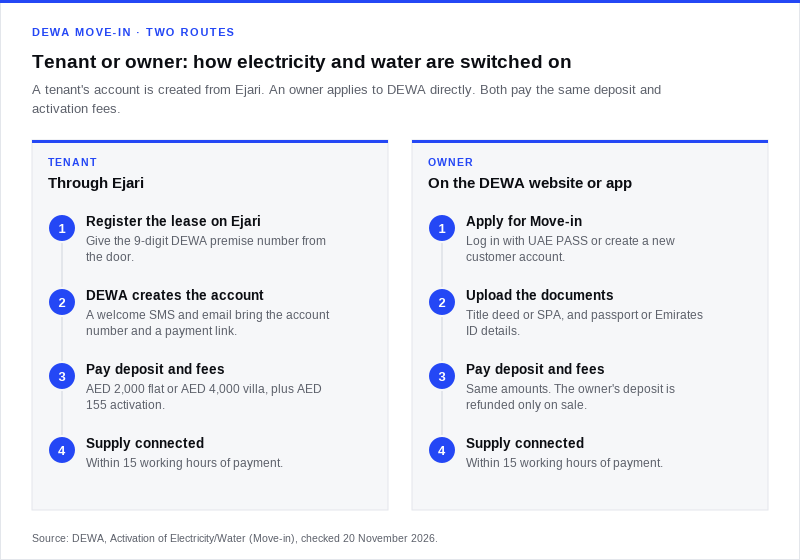
The steps are:
- Log in or register. Existing DEWA customers log in with UAE PASS or a DEWA ID. New customers choose "New Customer in Dubai" to create a business partner number and online credentials.
- Fill in the application. Select the premise by its 9-digit DEWA premise number and enter your details.
- Upload the ownership document. DEWA asks owners for the title deed or the sale and purchase agreement, together with passport or Emirates ID details.
- Pay the deposit and activation fees. You can pay on screen, or choose to pay later through another DEWA payment channel. You get an on-screen confirmation and a reference number.
- Wait for connection. DEWA connects electricity and water within 15 working hours of payment.
Title deed or SPA? DEWA accepts either for owners. That matters for off-plan buyers, because the SPA lets you open the account at handover even if the title deed is still being issued. Our title deed guide explains how the deed itself is issued.
Owners who will not live in the home. DEWA states that all landlords must pay the security deposit for premises under maintenance. In practice, if you are fitting out, furnishing or preparing the home for a tenant, you open the account in your own name first so that power and water are on while the work is done.
05How does DEWA Move-in work for a tenant?
For a tenant, DEWA Move-in is part of the Ejari registration. When the tenancy contract is registered, the Dubai Land Department system passes the tenant and property details to DEWA, which opens the account without a separate application.
The tenant then receives a welcome SMS and email from DEWA with:
- the new DEWA contract account number;
- the security deposit amount, AED 2,000 for a flat or AED 4,000 for a villa;
- a link to pay the deposit and the AED 155 activation charges online.
Once payment is made, the supply is connected within 15 working hours. DEWA's own guidance says the tenant does not need to submit documents or a DEWA receipt to get Ejari; the only DEWA detail needed is the 9-digit premise number.
If the welcome email does not arrive, usually because an email address was entered wrongly when the contract was registered, the tenant can apply on the DEWA website or app instead. Entering a valid Ejari number there means no further documents are needed. Tenants in free zones where Ejari does not apply apply on the DEWA website or app with their tenancy contract.
06Ejari and DEWA: what tenants need to know
Ejari is the Dubai Land Department's system for registering tenancy contracts, and for tenants it is the key to the DEWA account. Our Ejari guide covers the registration in full; this section covers only the link with DEWA.
| Ejari channel | Fee breakdown | Total |
|---|---|---|
| Dubai REST app or DLD website | AED 100 registration, AED 10 knowledge fee, AED 10 innovation fee, AED 55 service partner fee and AED 2.75 VAT on it | AED 177.75 |
| Real Estate Services Trustee Centre | AED 100 registration, AED 10 knowledge fee, AED 10 innovation fee, AED 95 service partner fee plus VAT | AED 220 |
Three points matter for a tenant moving into a newly handed-over home:
- The owner's details must be up to date. Registration through the apps requires the owner's data to be current. On a brand-new unit, that means the sale has been registered in the buyer's name, so a tenant may need to wait until the owner's registration is complete.
- The rent on Ejari drives the housing fee. The 5% housing fee is worked out from the yearly rent registered on Ejari, so the figure must match the signed contract.
- Who pays the deposit is for the lease. The DEWA account is opened in the tenant's name, but who funds the deposit is a matter for landlord and tenant. Agree it in writing in the contract.
If the owner already has a DEWA account open on the unit, for example from fit-out, the tenant's Ejari creates the tenant's own account. Ask DEWA how and when to close the owner's account so that the two do not overlap and you are not billed twice.
07What is the housing fee on the DEWA bill?
The housing fee is a Dubai Municipality charge that DEWA collects on the monthly bill as its own line. It is not part of DEWA's tariff and does not change with how much electricity or water you use.
For a tenant, the fee is 5% of the yearly rent in the registered tenancy contract, divided into 12 monthly instalments. On a lease of AED 120,000 a year, that is AED 6,000 a year, or AED 500 a month on the DEWA bill.
An owner who lives in the home also sees a housing fee on the DEWA bill. For an owned unit, Dubai Municipality bases the fee on the unit's rental value as it assesses it, rather than on a contract rent. Our guide to the Dubai housing fee explains both cases, gives more worked examples and covers how to correct a wrong amount.
| Yearly rent on Ejari | Housing fee a year (5%) | Monthly line on the DEWA bill |
|---|---|---|
| AED 60,000 | AED 3,000 | AED 250 |
| AED 90,000 | AED 4,500 | AED 375 |
| AED 120,000 | AED 6,000 | AED 500 |
| AED 200,000 | AED 10,000 | AED 833.33 |
| AED 350,000 | AED 17,500 | AED 1,458.33 |
For landlords. Once a tenant's account is opened through Ejari, the housing fee moves to the tenant's bill. While the home is empty or you live in it, the fee is billed on whichever account is open, usually yours.
08Smart meters: is there anything to activate?
No separate activation step is needed. DEWA has installed over 2 million smart electricity and water meters to cover all of Dubai, so a newly completed building is connected on smart meters that DEWA reads automatically.
Smart meters send readings to DEWA remotely and keep a history of your consumption. Once your account is active, you can see current and past usage in the DEWA app and website, which helps you spot a leak or an air-conditioning unit left running in an empty home.
What you should still do on handover day is photograph the meter displays with the date showing. A dated photograph helps settle any question about which consumption belongs to the period before your account started.
09How DEWA bills are worked out
Your monthly DEWA bill has four parts: electricity used, water used, fixed meter service charges and, as a separate line, the housing fee. DEWA's slab tariff charges more per unit as monthly consumption rises, and a fuel surcharge is added per unit.
| Electricity, residential (per month) | Rate per kWh |
|---|---|
| 0 to 2,000 kWh | AED 0.23 |
| 2,001 to 4,000 kWh | AED 0.28 |
| 4,001 to 6,000 kWh | AED 0.32 |
| 6,001 kWh and above | AED 0.38 |
| Fuel surcharge, November 2026 | AED 0.06 per kWh |
| Water, residential (per month) | Rate per cubic metre |
|---|---|
| 0 to 27 m³ | AED 7.70 |
| 27 to 54 m³ | AED 8.80 |
| Above 54 m³ | AED 10.12 |
| Fuel surcharge, November 2026 | AED 1.10 per m³ |
Meter service charges are a small fixed monthly amount set by meter type: AED 5, 6 or 35 for electricity and AED 5 or 7 for water. VAT at 5% is added to the tariffs.
Worked example: an apartment. Say a one-bedroom apartment uses 1,200 kWh of electricity and 15 m³ of water in a month. Electricity is 1,200 × AED 0.23 = AED 276, plus a fuel surcharge of 1,200 × AED 0.06 = AED 72. Water is 15 × AED 7.70 = AED 115.50, plus 15 × AED 1.10 = AED 16.50. That is AED 480 before meter charges and VAT, and before the housing fee.
Worked example: a villa. Say a villa uses 4,500 kWh and 40 m³ in a summer month. Electricity is 2,000 × 0.23 + 2,000 × 0.28 + 500 × 0.32 = AED 1,180, plus a fuel surcharge of AED 270. Water is 27 × 7.70 + 13 × 8.80 = AED 322.30, plus AED 44 fuel surcharge. That is AED 1,816.30 before meter charges, VAT and the housing fee.
These consumption figures are illustrations, not estimates for any particular home. Usage depends on size, insulation, occupancy and above all on cooling: in a building on district cooling, the air conditioning is billed by the cooling provider, not DEWA, so the DEWA bill is lower and a separate cooling bill arrives.
10District cooling: Empower and other providers
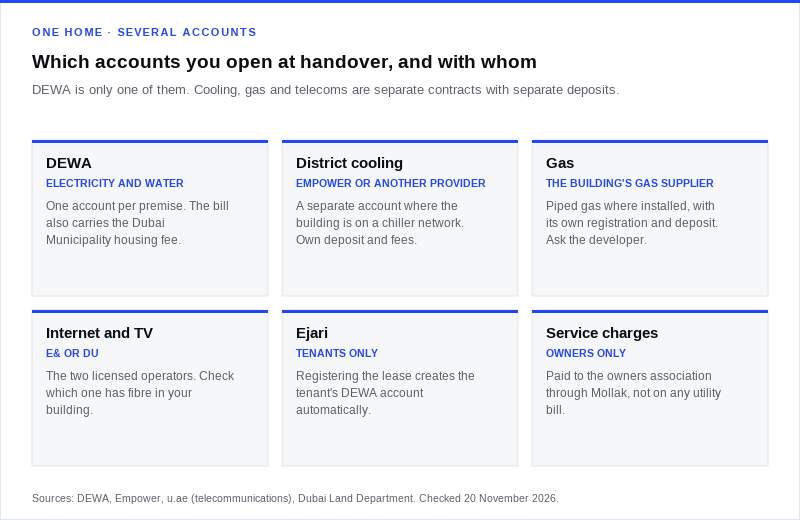
Many Dubai apartment towers, and some villa communities, are cooled by a district cooling network rather than by air-conditioning units in each home. Chilled water is piped in from a central plant, and you pay a separate cooling provider for it.
District cooling is never on the DEWA bill. You open a separate account with the provider that serves your building. Empower serves many Dubai buildings; other licensed providers serve some master communities. Your developer or building manager will tell you which one serves your building.
How district cooling is regulated
District cooling in Dubai is regulated under Executive Council Resolution No. 6 of 2021. The Regulatory and Supervisory Bureau for electricity and water (RSB) licenses providers and billing agents, and no one may supply district cooling or bill for it without an RSB permit.
Under the resolution, a provider may collect only charges and tariffs approved by the Supreme Council of Energy. That covers connection, disconnection and reconnection charges, and billing service charges. Bills must show the contracted capacity, the rates and the consumption, and customers have a route to complain to the provider and then to the RSB.
How to register with Empower
Empower's registration is online, through its e-Services portal:
- Create an account. New customers register with a mobile number and email; existing customers log in, including with UAE PASS.
- Select the premise. Enter the same 9-digit DEWA premise number used for DEWA.
- Choose customer type and view the charges. The deposit and connection fee for your building are shown here.
- Upload documents. Owners provide the title deed or SPA and a passport copy with the signature page. Tenants provide the tenancy contract or Ejari, Emirates ID (both sides) and the visa page. Companies add a trade licence and the authorised person's passport.
- Pay and wait. Empower states that e-registration takes 1 to 3 working days, and it completes only once any balance on other accounts in the same name is cleared.
What Empower charges
Empower's published charges show why district cooling deserves attention before you buy. Its bill has a fixed part you pay whether or not you use the cooling, and a variable part for what you use.
| Empower charge | Rate | When |
|---|---|---|
| Security deposit | Varies by project and building | Once, at registration |
| Connection charge | Varies by project and building | Once, at registration, for a new owner or tenant |
| Demand charge | AED 750 per refrigeration ton (RT) a year | Billed monthly in advance |
| Consumption charge | AED 0.568 per RT-hour metered | Billed monthly in arrears |
| Meter maintenance | AED 50 a quarter or AED 30 a month, by location | Recurring |
| Voluntary disconnection | AED 150 each time | On request |
| Disconnection for non-payment | AED 500 | If bills go unpaid |
| Meter test | AED 160 if the meter is found accurate | On request |
Worked example. Suppose a two-bedroom apartment has a contracted cooling load of 3 RT. The demand charge is 3 × AED 750 = AED 2,250 a year, or about AED 191 in a 31-day month. If the meter records 600 RT-hours that month, consumption adds 600 × AED 0.568 = AED 340.80. With AED 30 meter maintenance, the month's cooling bill is about AED 562 before 5% VAT.
The fixed charge continues when the home is empty. Empower states that demand charges and meter maintenance continue to be charged even if the unit is disconnected. An owner holding a vacant home between tenants should budget for them.
What to ask before you buy. Ask which provider serves the building, the contracted RT load for your unit, the provider's deposit and connection fee, and whether the developer's service charge includes any cooling. These answers belong in your sums alongside service charges and the other running costs in our true cost of buying off-plan guide.
11Gas, internet and telecoms
Gas
Where a building has piped gas for cooking, it is supplied by a gas company appointed for that building or community, not by DEWA. You register with that company, pay its own deposit and connection fee, and provide the documents it asks for, typically proof of ownership or tenancy and ID.
Not every new building has piped gas; many new homes have electric hobs. Check the specification in your SPA, and ask the developer or building manager which supplier serves the building and what it charges. Book the connection for a time when someone can be at the home.
Internet, TV and landline
Two licensed operators provide fixed-line, internet and TV services in the UAE: e& (formerly Etisalat) and du. A new building is usually wired for one of them, so your choice may be limited to the operator with fibre in your building.
Both operators publish coverage maps on their websites. Check your building before handover, and book the installation early, because the engineer needs access to the home.
You usually need your Emirates ID, and for some packages the title deed, SPA or Ejari. If you will not have residency yet, ask the operator what it accepts.
12A handover-week checklist
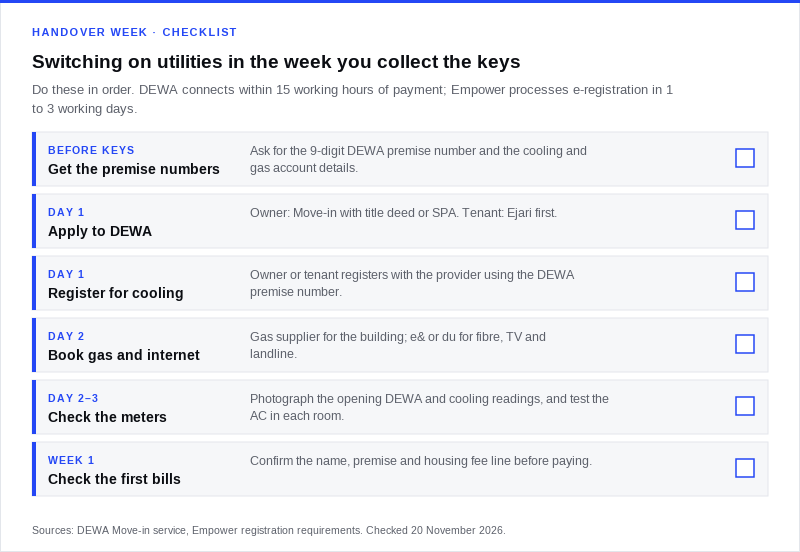
Utilities take a few days to line up. Getting the order right means the home has power, water and cooling on the day you want to move in, rather than a week later.
Before the keys
- Ask the developer for the DEWA premise number, the district cooling provider and account details, and the gas supplier for the building.
- Check your snagging inspection is booked, and ask the developer whether power, water and cooling will be on for it. Testing the air conditioning, water pressure and every socket needs them.
- Have digital copies of your title deed or SPA, passport, Emirates ID and visa ready to upload.
- Check which telecoms operator serves the building and book an installation date.
Handover day
- Apply for DEWA Move-in (owner) or confirm the Ejari is registered (tenant), and pay the deposit and activation charges.
- Register with the district cooling provider and pay its deposit and connection fee.
- Photograph every meter with the date showing: electricity, water, cooling and gas.
The days after
- Confirm supply is on within DEWA's 15 working hours, and chase if not.
- Book the gas connection and safety check, and the internet installation.
- Run every air-conditioning unit or fan coil and note any that do not cool for the defects list.
First bills
- Check each bill is in the right name and for the right premise.
- On the DEWA bill, check the housing fee line matches your rent or your status as an owner-occupier.
- Set up payment for each account. The cooling provider and DEWA bill separately.
13The full cost table
This table brings together every official charge you meet when connecting a new home. District cooling and gas amounts are set by the provider for each building, so ask for them before handover.
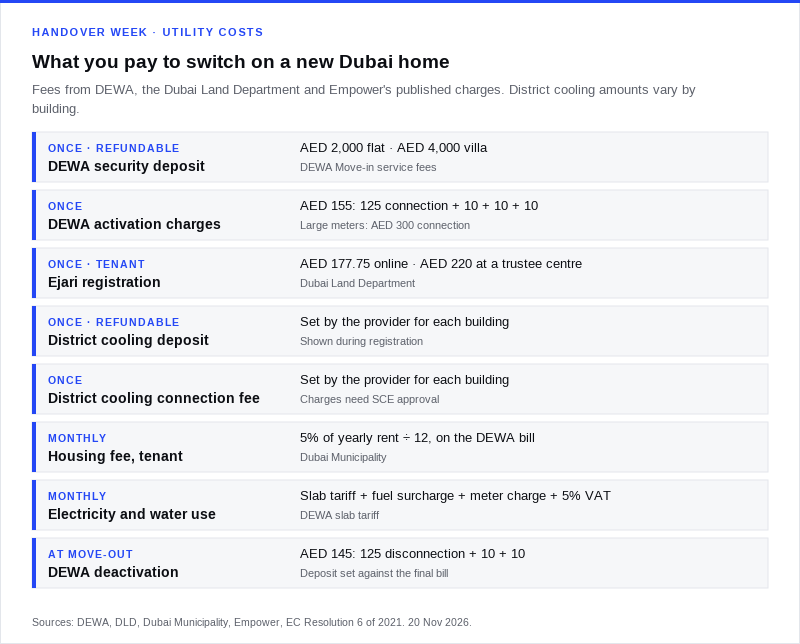
| Item | Apartment, owner | Apartment, tenant | Villa, owner |
|---|---|---|---|
| DEWA deposit (refundable) | AED 2,000 | AED 2,000 | AED 4,000 |
| DEWA activation | AED 155 | AED 155 | AED 155 |
| Ejari, online | Not needed | AED 177.75 | Not needed |
| District cooling deposit and connection | Per building, if on district cooling | Per building, if on district cooling | Per community, if on district cooling |
| Gas deposit and connection | Per supplier, if piped gas | Per supplier, if piped gas | Per supplier, if piped gas |
| Total of the fixed official items | AED 2,155 | AED 2,332.75 | AED 4,155 |
The deposits come back to you in the end, but they are cash you need on handover day alongside the final payment, title deed fees and the first service charge. Our handover guide lists all of those.
14Moving out and getting the deposit back
For a tenant, the DEWA deposit comes back at move-out. You apply for Deactivation of Electricity/Water (Move-out) on the DEWA website or app, or through DubaiNow, after paying any earlier bills in full.
You choose the move-out date and time, and the supply is switched off and final readings taken within 24 working hours of it. DEWA emails the final bill and sets the deposit against it: if the bill is larger, you pay the difference; if the deposit is larger, the balance is refunded.
| Item | Amount or time |
|---|---|
| Move-out charges, small meter | AED 125 disconnection, AED 10 knowledge fee, AED 10 innovation fee: AED 145 |
| Move-out charges, large meter | AED 300 disconnection plus the same AED 20 of fees |
| Refund by IBAN | No fee. 8 minutes for deposits up to AED 4,000 with nothing outstanding; otherwise 3 working days |
| Transfer to another DEWA account | 3 working days |
| Refund by cheque | AED 20 plus VAT; 6 working days |
For an IBAN refund, the bank account must be in the same name as the DEWA account, and you attach proof of the IBAN. Thukher and Sanad cardholders receive 50% off the move-out charges as well.
Owners are different. DEWA states that an owner's security deposit is refunded only when the premise is sold. If you move out of a home you own and let it, the tenant opens a new account through Ejari; your own deposit stays with DEWA until you sell.
If you are moving from one Dubai home to another, DEWA also has a Transfer of Electricity/Water (Move-to) service that carries your account across, rather than closing one and opening another.
15What the rules cover, and what they do not
What is set officially. DEWA's deposits, activation charges, move-out charges, tariffs and service times are published by DEWA. The Ejari fee is set by the Dubai Land Department. The housing fee rate for tenants is set by Dubai Municipality. District cooling charges must be approved by the Supreme Council of Energy, and providers must hold an RSB permit.
What varies by building. District cooling deposits and connection fees, the contracted cooling load of your unit, piped gas suppliers and their charges, and which telecoms operator has fibre in the building all depend on the project.
What is for the contract. Who pays the DEWA deposit and the housing fee between landlord and tenant is for the lease to say. Whether the service charge includes any cooling or common-area utilities is set out in the building's approved budget.
16Key terms
- DEWA premise number. The 9-digit number that identifies your home to DEWA, usually on the front door. District cooling providers use it too.
- Contract account number. Your DEWA account number, issued when Move-in is approved.
- Move-in. DEWA's service to activate electricity and water at a new premise.
- Move-out. DEWA's service to deactivate supply and issue the final bill.
- Security deposit. The refundable amount DEWA holds against an account: AED 2,000 for a flat, AED 4,000 for a villa.
- Housing fee. The Dubai Municipality charge collected on the DEWA bill; for tenants, 5% of yearly rent.
- Slab tariff. DEWA's tiered pricing, in which the rate per unit rises with monthly consumption.
- Fuel surcharge. An amount per kWh or cubic metre added to the tariff, set by DEWA from month to month.
- District cooling. Air conditioning supplied as chilled water from a central plant and billed by a separate provider.
- Refrigeration ton (RT). The unit of cooling capacity. Empower's demand charge is based on the RT load contracted for your unit.
- RSB. The Regulatory and Supervisory Bureau for electricity and water in Dubai, which licenses district cooling providers.
- Ejari. The Dubai Land Department's tenancy registration system, which also opens the tenant's DEWA account.
17Where to go next
If you are still choosing a home and want one you can move into soon, see projects near handover, ready projects and available units. When you compare buildings, ask whether each is on district cooling and what the contracted load is for the unit you like.
If your handover notice has arrived, work through our off-plan handover guide and snagging guide, and line up the utilities in this guide for the same week.
FAQQuestions buyers ask.
How much is the DEWA deposit for a new apartment or villa?
DEWA's refundable security deposit is AED 2,000 for a flat and AED 4,000 for a villa. On top of it you pay AED 155 in activation charges for a home on a small meter. Non-residential premises have a deposit worked out from expected consumption.
How long does DEWA take to connect electricity and water?
DEWA connects the supply within 15 working hours of payment of the security deposit and activation fees. Working hours are Monday to Saturday, 7 am to 8 pm, excluding public holidays, so a payment on Saturday evening may not be connected until Monday.
What documents does an owner need for DEWA Move-in?
The title deed, or the sale and purchase agreement if the title deed has not yet been issued, plus your passport or Emirates ID details. You apply on the DEWA website or the DEWA Smart App, using UAE PASS or a new customer account, and pay online.
Do tenants need to apply to DEWA separately?
Not usually. When the lease is registered on Ejari, DEWA receives the details and sends a welcome SMS and email with the account number, the deposit amount and a payment link. If that email does not arrive, the tenant can apply on the DEWA website or app using the Ejari number.
When do I get my DEWA deposit back?
A tenant gets the deposit back at move-out: it is set against the final bill and the balance is refunded by IBAN, cheque or transfer to another DEWA account. IBAN refunds are free; a cheque costs AED 20 plus VAT. An owner's deposit is refunded only when the home is sold.
Is district cooling included in my DEWA bill?
No. District cooling is supplied by a separate provider such as Empower and billed on its own account. You register with the provider using the DEWA premise number and pay its own security deposit and connection fee, which vary by building.
Who pays the housing fee on the DEWA bill?
Whoever holds the DEWA account. For a tenant it is 5% of the yearly rent registered on Ejari, split into 12 monthly instalments. An owner who lives in the home pays a fee based on the unit's rental value as Dubai Municipality assesses it.
Do I need a smart meter installed when I move in?
No separate step is needed. DEWA has installed over 2 million smart electricity and water meters across Dubai, so a new home is connected on a smart meter that is read automatically. You can follow your consumption on the DEWA app once the account is active.
Sources & methodWhere these figures come from.
Sources
- dewa.gov.ae: Move-in (checked 20 November 2026)
- dewa.gov.ae: Move-out (checked 20 November 2026)
- dewa.gov.ae: Request-for-refund (checked 20 November 2026)
- dewa.gov.ae: Slab-tariff (checked 20 November 2026)
- dewa.gov.ae: Smart-grid-and-meters-smart-applications (checked 20 November 2026)
- Dubai Land Department: Register-renew-ejari-contract (checked 20 November 2026)
- UAE Government portal: Leasing-a-property-in-the-UAE (checked 20 November 2026)
- UAE Government portal: Telecommunications (checked 20 November 2026)
- Empower: (checked 20 November 2026)
- Empower: (checked 20 November 2026)
- Dubai Legislation Portal: Executive Council Resolution No. (6) of 2021 Regulating the Provision of District.html (checked 20 November 2026)
What we could not verify
- District cooling security deposits and connection fees are set by the provider for each building and shown during registration, so this guide gives no figure for them; ask the developer or the provider before handover.
- Piped gas suppliers, their deposits and their connection fees differ by building and are on request from the developer or the building's management.
- The handover-week order of steps is practical advice, not a legal requirement; DEWA's 15 working hours and Empower's 1 to 3 working days are the only official timings.
20 Nov 2026 · Reviewed by OffPlan Insider Research. First published 20 Nov 2026.