Dubai's resident population reached 4.580 million at the end of 2025, according to Digital Dubai, an increase of about 332,000 people, or 7.5%, on the end of 2024. The figure comes from a new register-based count that also revised the estimates for 2022 to 2024 upwards, to 3.718 million, 3.974 million and 4.248 million. The Dubai 2040 Urban Master Plan provides for 5.8 million residents by 2040. On the supply side, the Dubai Land Department reported 124 completed projects in 2025 and 937 under construction at the end of the year, and 24,537 new units completed in the first half of 2026.
Key takeaways
- Dubai had 4.580 million residents at the end of 2025, up about 332,000, or 7.5%, on a year earlier, according to Digital Dubai's July 2026 release.
- In 2025 Dubai moved to a register-based population count. The Dubai Statistics Center revised end-of-year estimates for 2022 to 2024 to 3,718,000, 3,974,300 and 4,248,200.
- Under the earlier method, the Dubai Statistics Center had estimated 3,549,900 for 2022, 3,655,000 for 2023 and 3,863,600 for 2024. The two series should not be mixed.
- Dubai's average daytime population at peak hours in 2025 was 6.392 million, including more than 1.812 million temporary visitors.
- The Dubai 2040 Urban Master Plan provides for 5.8 million residents by 2040, from 3.3 million in 2020. That is a planning target, not a forecast.
- The Dubai Land Department reported 124 projects completed in 2025 and 937 under construction. In the first half of 2026, 104 completed projects added 24,537 new units, against 18,043 a year earlier.
- Private consultancies count completions their own way: Cavendish Maxwell counted 40,400 units completed in 2025 and ValuStrat about 36,000. Neither is an official statistic.
01What is Dubai's population?
Dubai had 4.580 million residents at the end of 2025, according to Digital Dubai's release of 30 July 2026. That was about 332,000 more than a year earlier, growth of 7.5%.
The figure comes from "Dubai Population Now", a register-based count run through the Dubai Data and Statistics Establishment. Instead of a traditional census, it builds the population from administrative records held by government bodies and updates continuously, feeding Dubai's population clock.
Residents are only part of the picture. Digital Dubai put the average daytime population at peak hours in 2025 at 6.392 million, including more than 1.812 million temporary visitors: people who work in Dubai but live elsewhere, tourists and others present on an average day.
This guide sets out the published population figures by year, the plan for 2040, and the official and consultancy figures for new homes. It reports what each source states for a stated period. It does not forecast prices, rents or the balance between people and homes.
02How has Dubai's population grown, year by year?
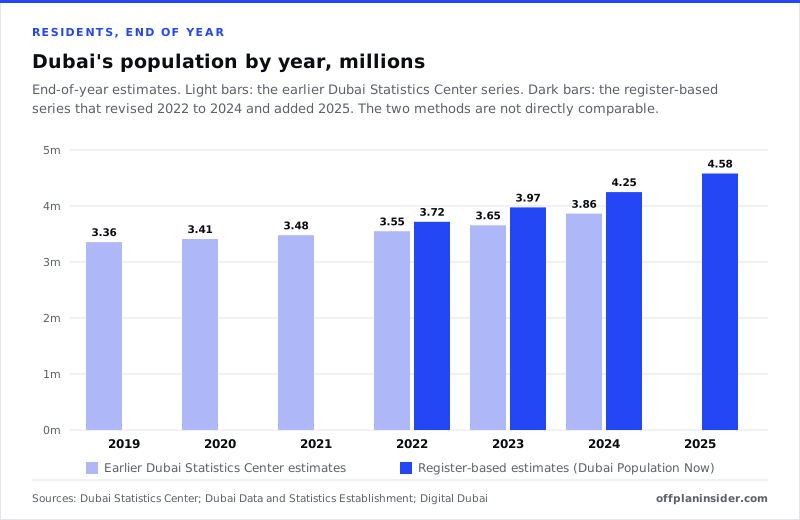
On the current register-based series, Dubai's population rose from 3,718,000 at the end of 2022 to 4.580 million at the end of 2025. Earlier years are available only on the previous method, which gave lower figures.
| End of year | Earlier Dubai Statistics Center estimate | Register-based estimate |
|---|---|---|
| 2019 | 3,355,900 | – |
| 2020 | 3,411,200 | – |
| 2021 | 3,478,300 | – |
| 2022 | 3,549,900 | 3,718,000 |
| 2023 | 3,655,000 | 3,974,300 |
| 2024 | 3,863,600 | 4,248,200 |
| 2025 | – | 4,580,000 |
Within the register-based series, the population grew by 256,300 in 2023, by 273,900 in 2024 and by about 332,000 in 2025, by our subtraction of the published figures. Digital Dubai gives the 2025 growth rate as 7.5%.
Within the earlier series, growth between 2019 and 2021 was slower: 55,300 in 2020 and 67,100 in 2021. Those were the years of the pandemic.
03Why do Dubai's population figures differ between sources?
Because Dubai changed how it counts. The Dubai Statistics Center's 2024 bulletin says the estimates for 2022 to 2024 were revised and adjusted using the results of the Dubai Population Now project, calculated on a register-based approach. The revised figures are higher.
For the end of 2024, for example, the earlier method gave 3,863,600 and the register-based method 4,248,200. The difference, about 385,000 people, comes from the method, not from a year of growth.
This matters when you read older articles and listings. Figures such as 3.66 million for 2023 or 3.8 million for 2024 belong to the earlier series. Some official pages still show older numbers: the federal portal's page on Dubai, for instance, gives 3,759,864 without a date.
Who lives in Dubai. The 2024 bulletin gives 2,911,500 males (68.5%) and 1,336,700 females (31.5%) at the end of 2024, on the revised estimate.
04What population does the Dubai 2040 plan provide for?
The Dubai 2040 Urban Master Plan provides for 5.8 million residents by 2040, from 3.3 million in 2020. It also plans for a daytime population of 7.8 million, from 4.5 million in 2020.
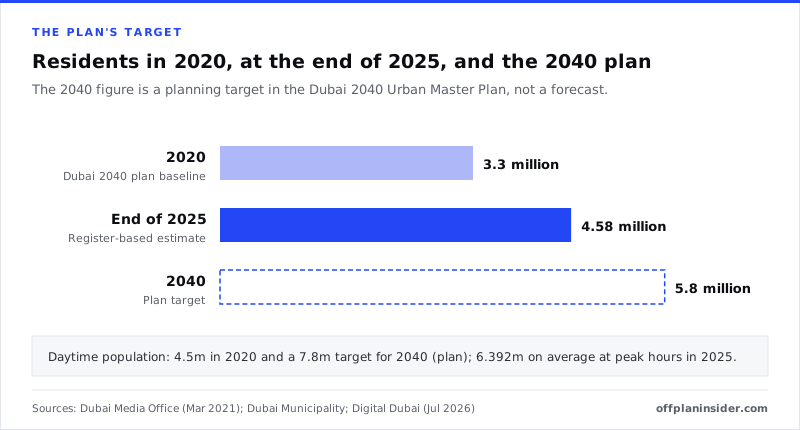
These are planning numbers. The plan uses them to size land for homes, schools, transport, parks and beaches, and Dubai Municipality's summary says the land needed for that growth is within the unbuilt land already allocated for development. They are not a forecast of how many people will live in Dubai in any given year.
The plan's 2020 baseline of 3.3 million was set on the earlier counting method, so it is not directly comparable with the 4.58 million register-based figure for 2025. Our guide to the Dubai 2040 Urban Master Plan covers the urban centres, the land targets and the housing chapter in full.
05How many new homes is Dubai completing?
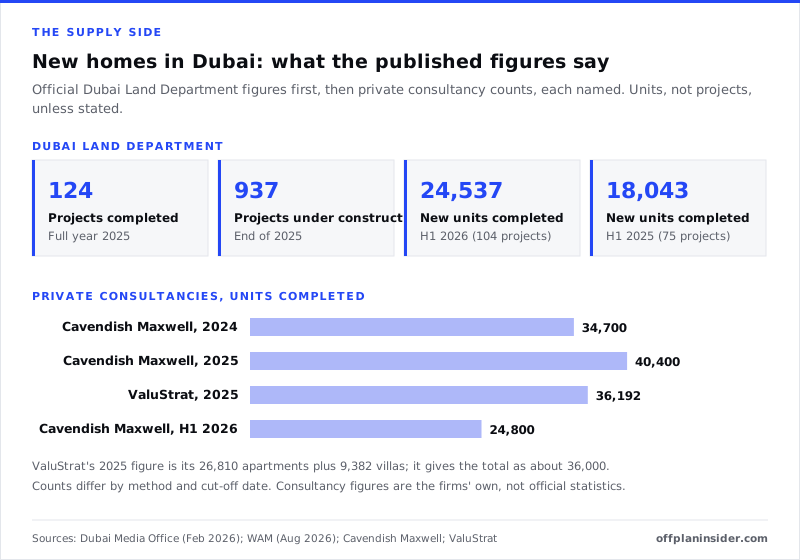
The Dubai Land Department reported 124 completed real estate projects in 2025, worth AED 27.5 billion, up 7% in number and 23% in value on 2024. For the first half of 2026 it reported 104 completed projects adding 24,537 new units, against 75 projects and 18,043 units in the first half of 2025.
| Period | Measure | Figure | Source |
|---|---|---|---|
| 2025 | Projects completed | 124, worth AED 27.5bn | Dubai Land Department |
| End of 2025 | Projects under construction | 937, up 25% | Dubai Land Department |
| H1 2025 | New units completed | 18,043 in 75 projects | Dubai Land Department |
| H1 2026 | New units completed | 24,537 in 104 projects, worth over AED 111bn | Dubai Land Department |
| H1 2026 | Built-up area ready for handover | 1.95 million sq m, from 1.58 million | Dubai Land Department |
| 2024 | Units completed | 34,700 | Cavendish Maxwell |
| 2025 | Units completed | 40,400 | Cavendish Maxwell |
| 2025 | Units completed | About 36,000: 26,810 apartments and 9,382 villas | ValuStrat |
| H1 2026 | Units completed | 24,800 | Cavendish Maxwell |
| February 2026 | Units under construction | More than 220,000: 187,676 apartments, 39,291 villas and townhouses | ValuStrat |
The official figures count projects first. The Dubai Land Department's full-year release counts projects and their value, not units. Its first-half release does count units, which is the closest official measure of new homes delivered.
The consultancies count units. Cavendish Maxwell counted 34,700 units completed in 2024 and 40,400 in 2025. ValuStrat counted about 36,000 in 2025, which it split into 26,810 apartments and 9,382 villas, and put Dubai's existing stock at about 855,927 residential units at the start of 2024. The firms use their own definitions and cut-off dates, which is why their totals differ.
Under construction. The Dubai Land Department reported 937 projects under construction at the end of 2025, 25% more than a year earlier. ValuStrat counted more than 220,000 units under construction in February 2026.
06What do the official demand figures show?
The Dubai Land Department's 2025 figures describe how many people bought and rented, which is a different thing from how many people live in Dubai. They are the closest official measures of housing activity.
| 2025 | Figure | Change on 2024 |
|---|---|---|
| Units sold | 147,500, worth AED 280bn | Up 25% in number, 30% in value |
| Registered tenancy contracts | 1.38 million, worth AED 126.4bn | Up 6% in number, 17% in value |
| New tenancy contracts | Over 513,000 | Up 10% |
| Renewed tenancy contracts | Over 514,000 | Up 3% |
| Real estate investors | About 193,100, of whom 129,600 new | Up 24% and 23% |
| All real estate transactions | Over 270,000, worth over AED 917bn | Up 20% in value |
Read these with care. A tenancy contract is a lease, not a household, and one person can sign more than one in a year. Sales include investors who do not live in Dubai. Neither figure can be divided into the population to give a meaningful number of people per home.
For the latest quarterly sales, see our analysis of Dubai Land Department registered sales. For how rents are set and when they can rise, see the Dubai rental index.
07Can you compare population growth with new homes?
Only roughly, and the published figures do not support a precise answer. No official source we found publishes Dubai's total number of homes, its average household size or how many residents live in employer-provided housing. Without those, residents and units cannot be set against each other reliably.
What the figures do show, each for its own period:
- Residents: about 332,000 more at the end of 2025 than at the end of 2024 (Digital Dubai).
- New units completed: 24,537 in the first half of 2026 (Dubai Land Department), and about 36,000 to 40,400 in 2025 by the two consultancies' counts.
- Pipeline: 937 projects under construction at the end of 2025 (Dubai Land Department).
Many of Dubai's residents share homes, live in staff accommodation or live in other emirates and commute. A new unit can be a studio or a six-bedroom villa. For those reasons we report the figures side by side and draw no conclusion about shortage or surplus.
08What do these figures mean for an off-plan buyer?
They describe the city; your purchase depends on the building and the area. Use the citywide numbers as background, then check the local ones.
- Look at supply where you are buying. A citywide completion total says little about one community. See which projects hand over in the same year, using our handover 2027 and handover 2028 pages and the area pages.
- Check rents on the Dubai Land Department's rental index for completed buildings near your project, rather than citywide averages.
- Check the project's progress on the Dubai Land Department's Project Status service. Our guide to checking an off-plan project and developer shows how.
- Read the plan for the area. The Dubai 2040 Urban Master Plan shows where Dubai intends to grow, and new areas in Dubai covers the districts being built now.
- Use the latest series. When a seller or article quotes a population figure, check whether it is the register-based figure or the earlier one.
09Where can you find the latest figures?
Each figure in this guide has an official home, and most are updated during the year. These are the places to check before you rely on a number.
| Figure | Where it is published | How often |
|---|---|---|
| Resident population | Dubai's population clock and the Dubai Statistics Center's annual population bulletin | Clock continuously; bulletin yearly |
| Annual population release | Digital Dubai and the Dubai Data and Statistics Establishment | Yearly; the 2025 figure was released on 30 July 2026 |
| 2040 targets | Dubai Municipality's Dubai 2040 Urban Master Plan pages and executive summary | Updated when the plan is revised |
| Completed and under-construction projects | Dubai Land Department releases, carried by the Dubai Media Office and WAM | Half-yearly and yearly |
| Sales and tenancy contracts | Dubai Land Department open data and the Dubai REST app | Daily data, with quarterly and yearly releases |
| Project progress | Dubai Land Department Project Status service | As each project is inspected |
Consultancies publish their own counts, often quarterly. When you use one, note the firm, the period and whether it counts units or projects, and do not add one firm's figure to another's.
When a figure changes, we update this guide and its date. The population series in particular may be revised again as the register-based count matures.
10Key terms
| Term | What it means here |
|---|---|
| Resident population | People who live in Dubai, Emirati and non-Emirati, as estimated at the end of each year |
| Daytime population | Everyone present in Dubai at peak daytime hours, including commuters and visitors |
| Register-based count | A population estimate built from linked government records instead of a census; Dubai's method since 2025 |
| Dubai Population Now | The initiative that introduced the register-based count and the real-time population clock |
| Completed project | A project the Dubai Land Department records as finished; one project can hold many units |
| Unit | One home or other property in a project, from a studio to a villa |
| Planning target | A figure a master plan is designed to accommodate, such as 5.8 million residents by 2040 |
11Where to go next
- The city plan: the Dubai 2040 Urban Master Plan.
- Where new homes are going: new areas in Dubai and Dubai's areas and districts.
- Homes on sale now: all projects and new launches.
FAQQuestions buyers ask.
What is the population of Dubai in 2026?
The latest published annual figure is 4.580 million residents at the end of 2025, from Digital Dubai's release of 30 July 2026. It was produced by Dubai's register-based population count, which updates continuously from government records. A live estimate is shown on Dubai's population clock.
How fast is Dubai's population growing?
By about 332,000 people, or 7.5%, in 2025, according to Digital Dubai. On the revised register-based series the population rose from 3,718,000 at the end of 2022 to 3,974,300 at the end of 2023, 4,248,200 at the end of 2024 and 4.580 million at the end of 2025.
Why do Dubai population figures differ between sources?
Because the method changed. In 2025 Dubai moved to a register-based count built from administrative records, and the Dubai Statistics Center revised its 2022 to 2024 estimates upwards. Many websites still quote the earlier series, such as 3,655,000 for 2023 or 3,863,600 for 2024, which is lower than the revised figures for the same years.
What is Dubai's population target for 2040?
The Dubai 2040 Urban Master Plan provides for 5.8 million residents by 2040, up from 3.3 million in 2020, and a daytime population of 7.8 million, up from 4.5 million. These are planning targets for land, transport and services, not population forecasts.
How many new homes were completed in Dubai in 2025?
The Dubai Land Department reported 124 completed real estate projects in 2025, worth AED 27.5 billion, but did not publish a full-year unit count in that release. Consultancies counted about 40,400 units (Cavendish Maxwell) and about 36,000 units (ValuStrat). For the first half of 2026, the Dubai Land Department reported 24,537 new units in 104 completed projects.
How many homes are under construction in Dubai?
The Dubai Land Department reported 937 projects under construction at the end of 2025, up 25% on a year earlier. It did not give a unit count. The consultancy ValuStrat counted more than 220,000 residential units under construction in February 2026: 187,676 apartments and 39,291 villas and townhouses.
What is Dubai's daytime population?
Digital Dubai put the average daytime population at peak hours in 2025 at 6.392 million, including more than 1.812 million temporary visitors such as workers commuting in from other emirates and tourists. The Dubai 2040 plan targets a daytime population of 7.8 million by 2040.
Is Dubai's population mostly male?
Yes. The Dubai Statistics Center's 2024 population bulletin gives 2,911,500 males, 68.5% of the population, and 1,336,700 females, 31.5%, at the end of 2024, on the revised register-based estimate of 4,248,200.
Sources & methodWhere these figures come from.
Sources
- digitaldubai.ae: Dubai digital dubai's population tops 4.580 million by the end of 2025 recording 7.5 growth
- dsc.gov.ae: Population Bulletin Emirate of Dubai - 2024.pdf
- dsc.gov.ae: Population Bulletin For Emirate of Dubai - 2023.pdf
- dsc.gov.ae: Population Bulletin Emirate of Dubai-2022.pdf
- dsc.gov.ae: Population clock
- dubai.ae: Population and vital statistics
- UAE Government portal: Dubai
- Khaleej Times: Dubais population crosses 3 55 million
- Gulf News: Dubai population grew to 34 million even amid covid 19 report reveals
- zawya.com: Dubai unemployment rate at just 05 as population crosses 35mln mark ioropw9t
- mediaoffice.ae: Mohammed bin rashid
- dm.gov.ae: Dubai 2040 urban master plan
- dmpmedia.dm.gov.ae: Dubai 2040 Urban Master Plan 2040 Executive Summary v1.pdf
- mediaoffice.ae: Dubai rental sector records strong growth in 2025
- Dubai Land Department: Dubai s rental sector records strong growth in 2025 underscoring market stability and the strength of the emirate s real estate ecosystem
- prod.mediaoffice.ae: Dubais real estate market records new historic milestone
- wam.ae: C1tv9lh dubai’s real estate sector completes 104 projects
- Khaleej Times: Dubai completes 104 property projects worth over dh111 billion in H1 2026
- cavendishmaxwell.com: Dubai residential market performance fy 2025
- cavendishmaxwell.com: Dubai Residential Market Performance_FY2025.pdf
- Gulf News: Dubai homebuyers get more choice as 24800 new units enter the market
- valustrat.com: Dubai real estate 220000 units under construction 2029
What we could not verify
- The Dubai Statistics Center's own pages and bulletins could not be opened on 7 November 2026 (requests were rejected). The revised 2022 to 2024 figures (3,718,000, 3,974,300, 4,248,200), the 2024 gender split and the earlier-method figures for 2022 (3,549,900) and 2023 (3,655,000) are taken from search extracts of the bulletins; the 2024 earlier-method figure of 3,863,600 is from the Government of Dubai portal dubai.ae, and the 2025 figure is from Digital Dubai's own release.
- The earlier-method figures for 2019 (3,355,900), 2020 (3,411,200) and 2021 (3,478,300) are Dubai Statistics Center estimates as reported by Khaleej Times, Gulf News and Zawya; the Center's own tables were not opened.
- Cavendish Maxwell's full-year completion counts (34,700 units in 2024, 40,400 in 2025) are from the firm's FY2025 report as shown in search extracts; its report pages returned an error when opened. Its first-half 2026 count of 24,800 is as reported by Gulf News on 30 July 2026. ValuStrat's figures were read on its own page, dated 18 February 2026.
7 Nov 2026 · Reviewed by OffPlan Insider Research. First published 7 Nov 2026. Data: population to the end of 2025 (Digital Dubai, 30 July 2026) and Dubai Statistics Center bulletins; Dubai Land Department completions for 2025 and the first half of 2026; consultancy counts as dated in the text.