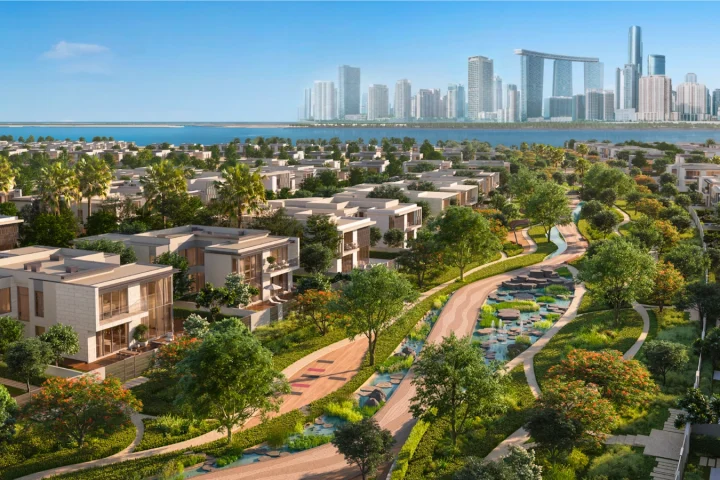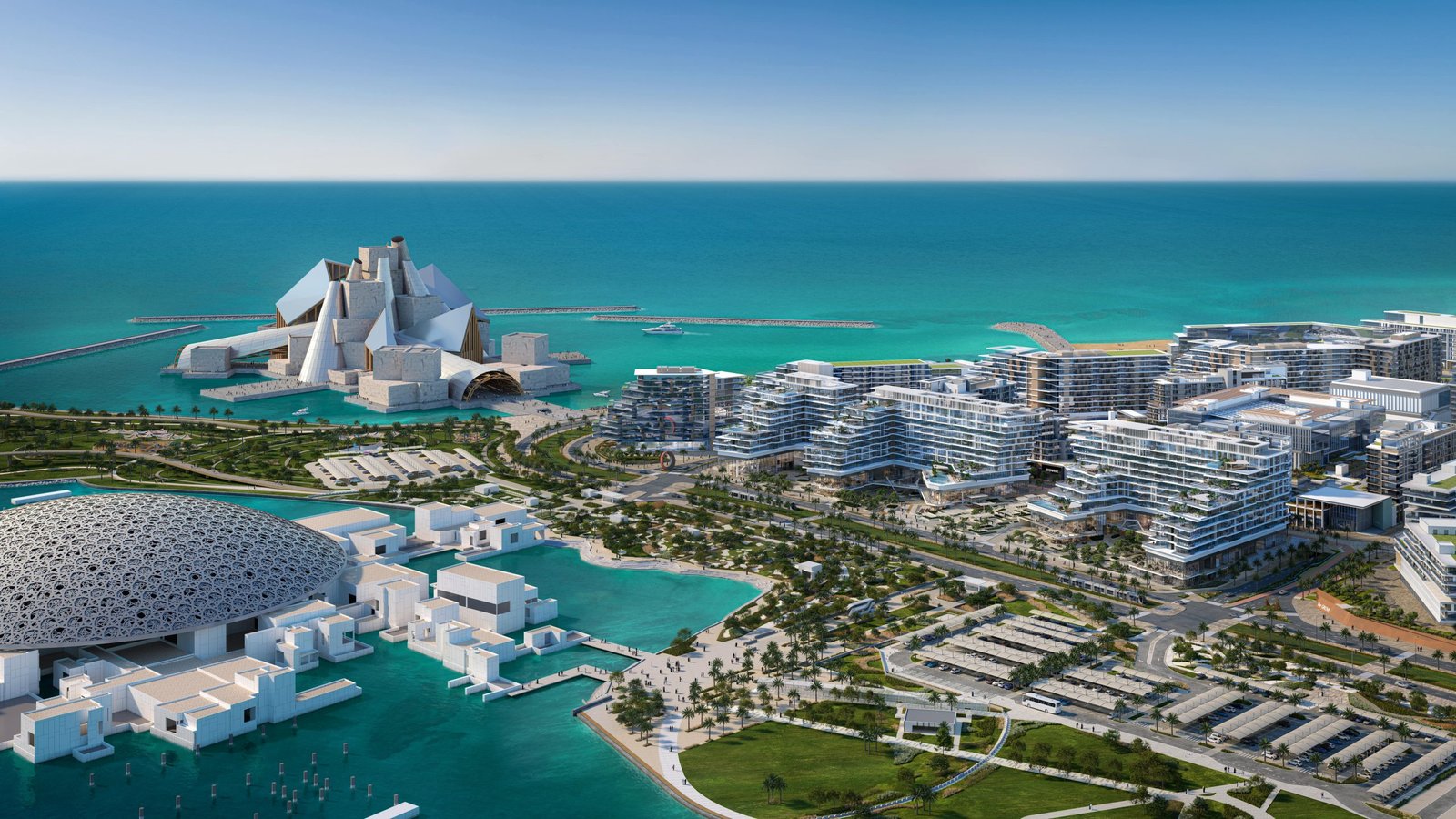
Marsa Al Saadiyat is Aldar's AED 100 billion waterfront district on Saadiyat Island, Abu Dhabi, inaugurated on 22 July 2026 by His Highness Sheikh Khaled bin Mohamed bin Zayed Al Nahyan and described by Aldar chairman Mohamed Khalifa Al Mubarak as the activation of the final phase of the Saadiyat Island masterplan. Gulf News records 6.4 million square metres, 8 km of waterfront, 5.6 km of beaches and more than 58,000 residents expected, around what Aldar calls Abu Dhabi's largest marina at some 350 berths. Zawya reported enabling work beginning in Q3 2026 and Gulf News put home sales in the second half of 2026.
Marsa Al Saadiyat is the last piece of Saadiyat Island. Aldar’s own chairman put it plainly when the masterplan was inaugurated on 22 July 2026: it “marks the activation of the final phase of the Saadiyat Island masterplan”. That makes the scarcity argument here unusually literal, and it also means almost everything a buyer is being asked to pay for is still ahead of the ground works.
What was announced, and by whom
His Highness Sheikh Khaled bin Mohamed bin Zayed Al Nahyan, Crown Prince of Abu Dhabi, inaugurated the district on 22 July 2026. Aldar states a gross development value of AED 100 billion, which Zawya reported as USD 27.2 billion. Gulf News records the scale at 6.4 million square metres, with 8 kilometres of waterfront of which 5.6 kilometres are beach, and more than 58,000 residents expected. The district was previously known as Saadiyat Marina District.
The programme reported by Gulf News, Zawya and Gulf Business includes what Aldar calls Abu Dhabi’s largest marina, at around 350 sailing boats and yachts, plus a yacht club, two luxury hotels, the Dar al Funoon theatre at more than 6,000 capacity, three schools, healthcare, sports courts and clubhouses, a central landscaped park, 140 kilometres of interconnected walking paths, a 46-kilometre cycling track and a one-kilometre retail and dining promenade. Housing is described as private mansions, luxury villas, waterfront apartments, branded residences and a hillside villa community rising to 22.5 metres.
Aldar chief executive Talal Al Dhiyebi called it “a landmark development for Abu Dhabi, reinforcing the emirate’s emergence as a powerful force in the global luxury landscape”.
Fifty-eight thousand residents is a city, not a marina
Run the arithmetic on Aldar’s own two headline numbers. More than 58,000 residents across 6.4 square kilometres is roughly 9,100 people per square kilometre. That is urban density. It is lower than Dubai Islands, which works out at about 12,400 on the same basis using Nakheel’s published figures, but it is a long way from the resort-density picture the marina imagery suggests.
Density is not a criticism. It is what pays for three schools, a theatre, a promenade and a rail station, none of which a low-density enclave can support. But it should change what you expect to be living in, and it should change which part of the masterplan you want to be in. A mansion plot and a waterfront apartment in a district of 58,000 people are two entirely different products sharing one brochure.
The build sequence, in the order it is happening
Zawya reported that enabling work on the district was set to begin in the third quarter of 2026, and Gulf News put home sales in the second half of the same year. The earliest buyers here are therefore committing while the site works are under way, on a masterplan inaugurated weeks earlier. That is a normal Gulf launch sequence and it is worth pricing in rather than glossing over.
The underground Etihad Rail station, reported by Gulf News alongside new roads, tunnels and bridge connections to adjacent islands, is the item to watch most carefully. It is a genuine differentiator on an island with no rail, and the national picture moved in 2026. Etihad Rail began passenger services on 30 June 2026, running Mohammed Bin Zayed City to Fujairah in 1 hour 45 minutes at up to 200 km/h across a network of roughly 900 kilometres and 11 cities. Gulf News lists the stations that follow: Jumeirah Golf Estates and Al Dhaid on 30 September 2026, Madinat Zayed and Liwa on 30 November, Al Sila, Al Dhannah and Al Mirfa on 30 December, and Sharjah University City on 30 March 2027. No station on Saadiyat Island or in central Abu Dhabi appears in that published network, so the masterplan station is an Aldar design element rather than a scheduled stop, and the nearest operating station is Mohammed Bin Zayed City on the mainland. Price the district on the bridges and the E12.
Abu Dhabi gives you different tools from Dubai
Off-plan property in Abu Dhabi is registered with ADREC, the Abu Dhabi Real Estate Centre, under Law No. 3 of 2015, and buyer funds belong in a project escrow account. Dubai additionally runs a public lookup, the Dubai Land Department’s project status service and the Dubai REST app, which return a project number, an escrow bank and a verified construction percentage on demand. Abu Dhabi has no equivalent, so the checks a buyer can run alone are narrower, and the escrow arrangement is something to get named in the sale agreement.
What that leaves you is the developer covenant. Aldar is Abu Dhabi’s largest listed developer and the master developer of Saadiyat Island itself, which is a stronger covenant than most, and its delivery pace on the island is visible: The National reported on 7 September 2026 that Sei Saadiyat, in the neighbouring Cultural District, runs to 778 homes across six buildings with a first phase of 265 homes and sales opening on 16 September 2026.
Five product tiers in one district
Aldar sets the housing out in five tiers: private mansions, luxury villas, waterfront apartments, branded residences and a hillside villa community rising to 22.5 metres. That range inside a single district is unusual, and it is the most practical thing to hold on to when comparing anything sold here.
A mansion on the marina frontage, a townhouse-scale villa a few streets back and an apartment above the promenade are three different assets with three different buyers and three different resale markets, and they share one brochure, one set of renders and one headline value. Establish which tier a release belongs to before you compare its price to anything, and compare it against the equivalent tier elsewhere on Saadiyat, where Aldar’s own portfolio already runs from Saadiyat Lagoons and Saadiyat Reserve to Mamsha Palm and the Louvre Abu Dhabi Residences.
The hillside villa community is the tier worth most attention, because a height limit stated in metres implies terracing and level changes across the site. Where a plot sits on that slope will decide its outlook, and on a district built around water views that is not a detail.
The market this district is selling into
ADREC published its Abu Dhabi Real Estate Market Report for the first half of 2026 on 18 August. Residential sales reached AED 70.4 billion against AED 25.3 billion in the same period of 2025, and Saadiyat Island took AED 13.3 billion of that, second only to Hudayriyat Island at AED 19 billion and ahead of Al Reem and Al Maryah combined at AED 10.5 billion. Off-plan accounted for 89 per cent of sales value and 82 per cent of deals, and foreign and expatriate buyers for 70 per cent of value.
On pricing, Knight Frank’s half-year research reported by The National on 22 July 2026 makes Saadiyat the most expensive villa location in the emirate at AED 26,500 per square metre, roughly AED 2,460 per square foot, while island apartments rose 21 per cent over the year to AED 43,100 per square metre, roughly AED 4,000 per square foot. The ratio between those two is the most useful number on this page: a villa here costs about 61 per cent of the apartment rate per square metre, with land and a garden attached.
Direction of travel differs by product. ADREC recorded repeat-sale increases of 20 per cent for apartments against 12 per cent for villas, and Knight Frank put Al Jubail Island villas up around 40 per cent, well ahead of Saadiyat. So Saadiyat is the address rather than the momentum trade. Supply supports the villa side: of roughly 36,900 units under construction across the emirate to 2030, about two thirds are apartments and a third villas, with ADREC expecting deliveries to peak in 2028 at around 21,800 units.
What foreign buyers actually own on Saadiyat
Foreign ownership in Abu Dhabi runs under Law No. 19 of 2005 regulating the real estate sector, as amended in April 2019, and applies only inside nine designated investment zones. Saadiyat is one, alongside Yas, Reem, Al Maryah, Lulu, Al Raha Beach, Sayh Al Sedairah, Al Reef and Masdar City.
The UAE Government portal sets out four instruments open to non-UAE nationals inside those zones: a 99-year ownership deed with full disposal rights over an apartment or villa but excluding the land beneath it; a 50-year musataha contract, renewable for another 50, allowing use, construction and alteration; a 99-year usufruct allowing use without alteration; and a long-term lease from 25 years. Usufruct and musataha holders gain wider disposal and mortgage rights after ten years.
The distinction bites hardest on the villa tiers, where the land is most of what you are buying and the standard foreign instrument specifically excludes it. Anyone arriving with Dubai freehold assumptions should establish which of the four applies before discussing price, and should check eligibility as a separate question: Aldar released the first phase of Saadiyat Lagoons to UAE nationals only.
Questions buyers ask
What is Marsa Al Saadiyat?
A waterfront district on Saadiyat Island in Abu Dhabi, master-developed by Aldar and inaugurated on 22 July 2026 at a stated AED 100 billion of gross development value. It covers 6.4 million square metres with 8 km of waterfront and 5.6 km of beaches, and is planned for more than 58,000 residents around what is described as Abu Dhabi’s largest marina at roughly 350 berths. It was previously known as Saadiyat Marina District.
When do sales open at Marsa Al Saadiyat?
Home sales were reported for the second half of 2026, with enabling work on the district beginning in the third quarter of the same year. That sequence matters more than the date: the earliest buyers here are committing while the site works are still under way, which is normal for a launch of this size and worth pricing in rather than glossing over.
Is Marsa Al Saadiyat the last part of Saadiyat Island?
That is Aldar’s own framing. At the inauguration the chairman, Mohamed Khalifa Al Mubarak, said it marks the activation of the final phase of the Saadiyat Island masterplan. It makes the scarcity argument unusually literal, and it also means the district is competing against the finished parts of the island rather than adding to them.
Will there be a train station at Marsa Al Saadiyat?
Not in the published network. Etihad Rail began passenger services on 30 June 2026, running Mohammed Bin Zayed City to Fujairah in 1 hour 45 minutes across a roughly 900-kilometre network serving 11 cities, and Gulf News lists the stations opening through to Sharjah University City in March 2027. None of them is on Saadiyat Island or in central Abu Dhabi. The underground station described in the Marsa Al Saadiyat masterplan is an Aldar design element rather than a scheduled Etihad Rail stop, and Abu Dhabi has no metro, so the district is reached by road across the Saadiyat bridges.
Can I check a Marsa Al Saadiyat project on a public register?
Not the way you can in Dubai. Abu Dhabi off-plan sales are registered with ADREC under Law No. 3 of 2015, but the emirate publishes no public project register equivalent to the Dubai Land Department project status service or the Dubai REST app. You cannot look up a project number, an escrow bank or a verified construction percentage. Get the escrow arrangements written into the sale agreement rather than assuming them.
What types of home will Marsa Al Saadiyat have?
Aldar describes five tiers: private mansions, luxury villas, waterfront apartments, branded residences and a hillside villa community rising to 22.5 metres. That spread inside one district means a headline price, yield or growth figure for Marsa Al Saadiyat describes none of them accurately. Work out which tier a release belongs to, then compare it against the equivalent tier elsewhere on Saadiyat Island.
How much does property on Saadiyat Island cost?
Knight Frank research reported by The National on 22 July 2026 makes Saadiyat the most expensive villa location in Abu Dhabi at AED 26,500 per square metre, about AED 2,460 per square foot, with island apartments up 21 per cent over the year to AED 43,100 per square metre, about AED 4,000 per square foot. A villa on Saadiyat therefore costs roughly 61 per cent of the apartment rate per square metre. At the top of the market, Sotheby’s International Realty sold a five-bedroom penthouse at the Four Seasons Private Residences on Saadiyat Beach for AED 200 million, AED 14,000 per square foot.
Can foreigners buy property at Marsa Al Saadiyat?
Saadiyat is one of nine designated investment zones under Law No. 19 of 2005 as amended in April 2019, so non-UAE nationals can own there. The UAE Government portal lists four instruments: a 99-year ownership deed giving full disposal rights over the apartment or villa but excluding the land beneath it, a 50-year musataha renewable for another 50, a 99-year usufruct, and a long-term lease from 25 years. The land exclusion matters most on villa tiers. Eligibility is a separate question from ownership type: Aldar released the first phase of Saadiyat Lagoons to UAE nationals only, so confirm it release by release.
Last reviewed 12 September 2026 · How we verify