Jumeirah Village Circle is a Nakheel master development of about 860 hectares laid out as a circle of ten districts. It is the most liquid community in Dubai, with 18,782 transactions in 2025, and it carries the largest handover pipeline of any Dubai community. It is roughly 70% complete, with full build-out expected around 2030, and it has no metro station in the current plan.
What JVC actually is: 860 hectares, ten districts, still being built
Jumeirah Village Circle is a Nakheel master development of roughly 860 hectares, laid out as a circle and divided into ten districts numbered 10 to 19. It sits between Al Khail Road (E44) and Hessa Street (D61), which is the whole of its connectivity story and we will come back to that.
The number most buyers are not told: JVC is around 70% complete, and full build-out is not expected until 2030. You are not buying into a finished community. You are buying into one with four more years of cranes, hoarding and lorry traffic, and that is the single most common complaint from people who already live there.
JVC prices and transaction volume: the most liquid market in Dubai
JVC recorded 18,782 transactions in 2025, more than 1,500 a month, which makes it comfortably the most liquid community in Dubai. Nowhere else comes close. Apartments were reported at about AED 1,508 per square foot in June 2026, up 1.69% over twelve months, and villa stock at roughly AED 837 per square foot with a median gross yield near 7%.
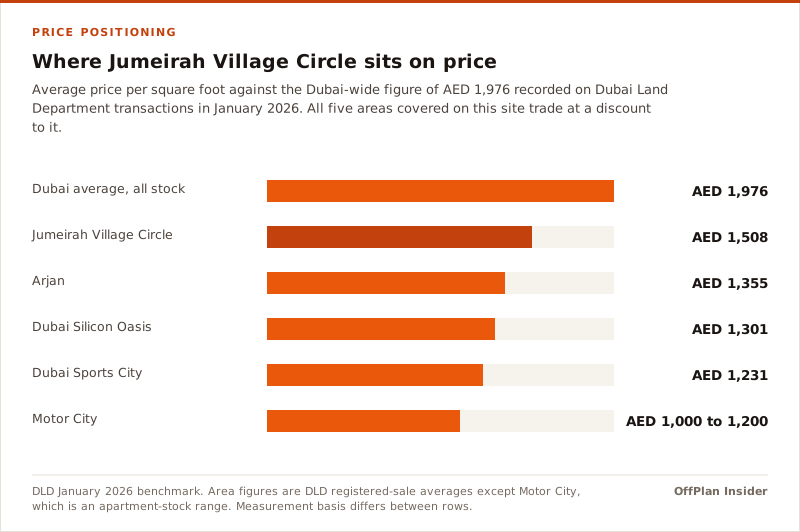
Over a longer horizon the growth is real: from roughly AED 660 per square foot in 2020 to comfortably above AED 1,150 by 2026, a gain of more than 75% in five years. Note that sources disagree on the current figure by a wide margin, and the two numbers above come from different measurements. Treat the trend as sound and any single headline figure as indicative.
Entry is low, which is the draw. Studios run 330 to 510 square feet, averaging about 420, and transact between roughly AED 470,000 and AED 800,000. One-bedroom apartments run 600 to 1,000 square feet at about AED 1,049,000 to AED 1,189,000.
JVC service charges: the newer building is the cheaper one to hold
This is the most useful thing on this page, and almost nobody says it. Service charges in JVC run from about AED 11 per square foot in buildings completed between 2024 and 2026, up to about AED 22 per square foot in stock from 2014 to 2017. The community average sits near AED 14 to 16.
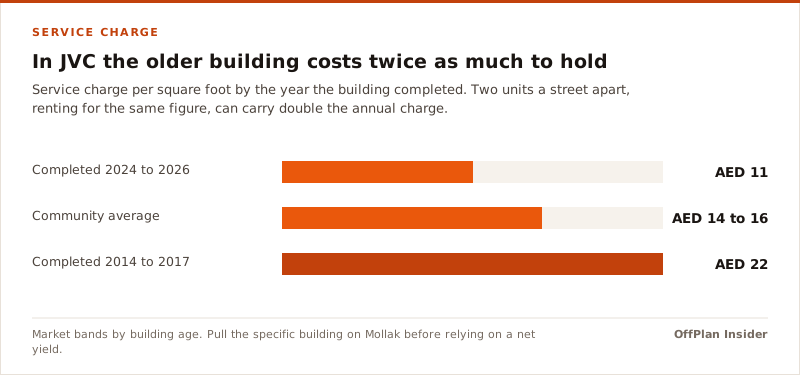
On a 1,000 square foot apartment that is a difference of AED 11,000 a year, every year, between two units that may sit a street apart and rent for the same figure. Against a rent of AED 90,000 it is over 12 percentage points of gross income. In JVC the age of the building is a bigger variable in your net return than the price you negotiate, and it is the first thing to check on Mollak rather than the last. The mechanics of that drag are set out in our guide to the true cost of buying off-plan.
JVC supply and oversupply risk: 16,852 units and counting
JVC carries around 16,852 units across 2025 to 2027, the largest pipeline of any community in Dubai. It is named alongside Arjan in market commentary as the clearest case of localised oversupply in the mid-market apartment segment. Active handovers run through Q4 2026 and out to 2028.
The mechanism to understand is concentration rather than volume. Where several towers complete inside the same six-month window, rental yields in that pocket can fall 50 to 100 basis points until the units are absorbed. Spreading across two or three projects with staggered handover dates is a more effective hedge than picking one tower and hoping. Before you commit, read what an exit actually costs in our guide to selling off-plan before handover.
JVC connectivity: no metro, and none in the current plan
JVC has no metro station and is not on the Blue Line route, which runs east through International City, Dubai Silicon Oasis, Academic City and Mirdif. Public transport within the community is the J01 bus route. Access is by Al Khail Road and Hessa Street, and internal roads are well laid out, but congestion concentrates at the exits onto those two roads at peak.
Parking is one of the genuine advantages. Most buildings have dedicated bays, street parking is generally available, and villas and townhouses have garages or covered spaces. That is not true of every dense Dubai district.
Living in JVC: what is finished and what is not
Circle Mall opened in April 2021 and is the retail anchor. JSS International School, opened 2017, teaches the ICSE curriculum to Year 12 inside the community, with Sunmarke School and Nord Anglia International School nearby on the UK curriculum. Nurseries are plentiful. Day-to-day healthcare runs through Karama Medical Centre on Kaheel Boulevard; the nearest larger hospitals, Emirates Hospital Day Surgery in Motor City and Mediclinic Parkview in Arjan, are about a fifteen-minute drive.
So the essentials exist. What does not yet exist is the finished streetscape, and in districts still under construction the gap between the render and the walk to the shops is wide.
Who JVC suits, and who it does not
It suits a yield-focused investor who wants a low entry price and, above all, an exit. Liquidity is the real product here: with more than 1,500 transactions a month you can sell, which is not true of most Dubai communities. That matters more than most buyers realise until they try to leave.
It suits a buyer chasing capital growth considerably less well. The same depth of supply that makes JVC liquid is what caps appreciation, and there is no rail catalyst coming. If you want space and are content to drive, the villa communities in Dubailand are cheaper per square foot. If you want an apartment with an employment base and a metro station arriving in 2029, Dubai Silicon Oasis has the stronger structural case.
Frequently asked questions
Is JVC a good investment in 2026?
It depends on whether you want yield and liquidity or capital growth. JVC recorded 18,782 transactions in 2025, making it comfortably the most liquid community in Dubai, so you can exit. But it also carries around 16,852 units completing between 2025 and 2027, the largest pipeline of any Dubai community, and is named alongside Arjan as a clear case of localised mid-market oversupply. That supply is what caps appreciation.
What are service charges in JVC?
They vary far more than most buyers expect. Buildings completed between 2024 and 2026 run around AED 11 per square foot, while stock from 2014 to 2017 runs up to about AED 22. The community average is roughly AED 14 to 16. On a 1,000 square foot apartment that is an AED 11,000 annual difference between two units a street apart, so check the specific building on Mollak before you buy.
Does JVC have a metro station?
No, and none is planned. JVC is not on the Dubai Metro Blue Line route, which runs east through International City, Dubai Silicon Oasis, Academic City and Mirdif. Public transport within the community is the J01 bus route. Access is by Al Khail Road and Hessa Street.
Is JVC finished?
No. JVC is around 70% complete and full build-out is not expected until 2030. Several districts remain active construction sites, and ongoing building noise is the most common complaint from current residents.
What rental yield does JVC offer?
Published figures disagree substantially, ranging from about 5% to 7% gross in portal-tracked listings up to 8% to 8.5% in some investor guides, with villa stock near 7% median gross. All of those are gross. Net typically lands 1.5 to 2.5 percentage points lower once service charges, management and voids are deducted, and in JVC the service charge on your specific building is the largest single variable.
How big is JVC and how is it laid out?
JVC covers roughly 860 hectares and is laid out as a circle divided into ten districts, numbered 10 to 19. It was developed by Nakheel and sits between Al Khail Road (E44) and Hessa Street (D61).
Last reviewed 28 August 2026 · How we verify